



Build Your Custom Market Intelligence Report
Customize Your ReportIndia Building Insulation Materials Market Insights & Analysis
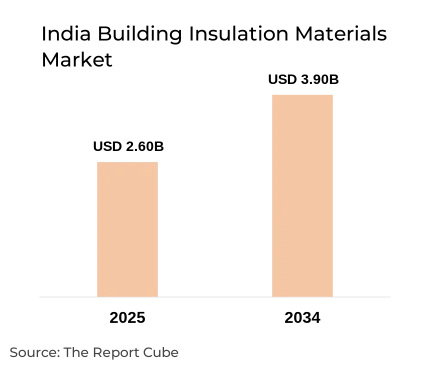
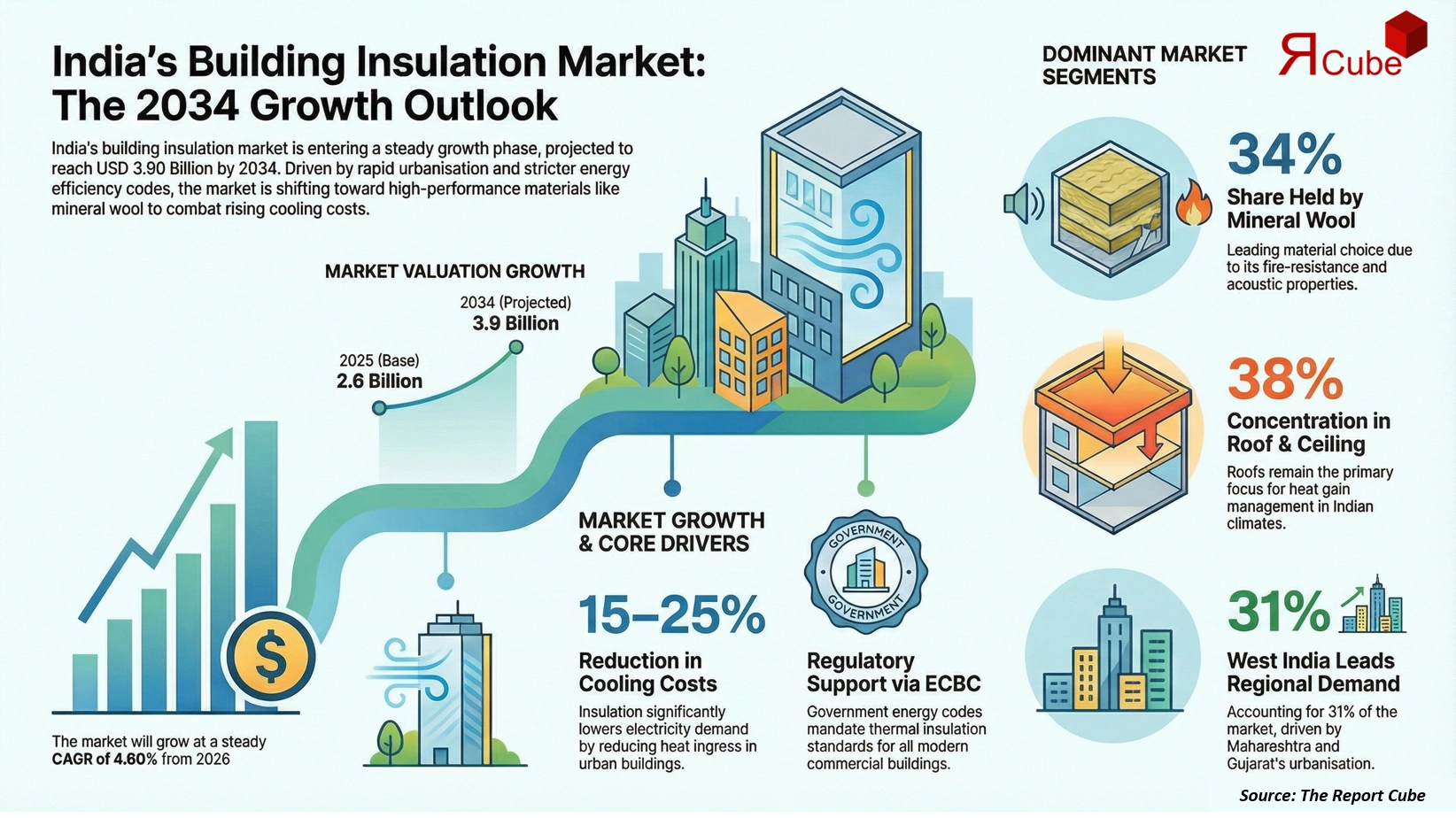
The India Building Insulation Materials Market is anticipated to register a 4.60% CAGR during 2026-2034. The market size was valued at USD 2.6 Billion in 2025 and is projected to reach USD 3.90 Billion by 2034. Market expansion is supported by India’s accelerating construction activity across residential, commercial, and industrial sectors, coupled with rising awareness of energy efficiency and thermal comfort. Government-backed green building initiatives, stricter building energy codes, and increasing electricity costs are encouraging developers to adopt insulation solutions that reduce heat gain and cooling loads. Urban housing demand, smart city projects, and growth in logistics warehouses and industrial parks further strengthen insulation demand.
Additionally, climate variability and extended summer periods have increased the need for thermal insulation to maintain indoor comfort and reduce HVAC energy consumption. Manufacturers are responding with cost-effective, durable, and fire-resistant insulation materials suited to India’s diverse climatic zones. The market benefits from both new construction and renovation activity, as retrofitting older buildings with insulation becomes a practical solution for reducing long-term operational costs. These structural drivers collectively position the building insulation materials market as a steady-growth segment within India’s broader construction ecosystem.
India Building Insulation Materials Market Recent Developments
- 2025: Saint-Gobain India expanded local manufacturing capacity for mineral wool insulation to meet rising green building demand.
- 2025: Owens Corning introduced advanced fiberglass insulation solutions tailored for Indian commercial construction projects.
Government Initiatives & Policies
- Energy Conservation Building Code (ECBC): Promotes energy-efficient building design and mandates thermal insulation standards for commercial buildings.
- National Mission on Sustainable Habitat: Encourages adoption of sustainable construction materials to reduce environmental impact.
India Building Insulation Materials Market Dynamics
Key Driver: Growing emphasis on energy efficiency in buildings
Energy efficiency has emerged as the primary driver of the India building insulation materials market, as buildings account for an estimated 30-35% of total electricity consumption nationwide. Rising cooling demand, particularly in urban residential and commercial spaces, has increased the focus on reducing heat ingress through roofs, walls, and facades. Developers and building owners are increasingly adopting insulation to lower air-conditioning energy use by 15-25% annually, improving lifecycle cost savings. Regulatory support through ECBC compliance and green building certifications further accelerates insulation adoption. Additionally, large commercial projects such as IT parks, malls, and hospitals prioritize insulation to meet sustainability benchmarks and attract institutional investors. As energy prices continue to rise, insulation is increasingly viewed as a long-term cost-control solution rather than an optional construction add-on, reinforcing steady market demand.
Industry Trends: Shift toward sustainable and fire-resistant materials
The market is witnessing a strong trend toward sustainable, recyclable, and fire-resistant insulation materials. Mineral wool and fiberglass are gaining preference due to their non-combustible properties, sound absorption benefits, and durability in extreme temperatures. Developers are also seeking materials with low embodied carbon and longer service life to align with ESG goals. Prefabricated construction and modular building techniques are influencing insulation design, driving demand for lightweight and easy-to-install products. Additionally, manufacturers are focusing on moisture-resistant and termite-proof insulation suitable for India’s humid and tropical regions. Digital building simulations and energy modeling tools are further supporting informed insulation selection during the design phase, improving performance outcomes.
Major Challenge: Limited awareness and cost sensitivity
Despite clear benefits, limited awareness among small builders and homeowners remains a key challenge. Many residential projects prioritize upfront construction cost over long-term energy savings, delaying insulation adoption. High-quality insulation materials can add 3-6% to initial construction costs, which deters price-sensitive buyers. In unorganized construction segments, inconsistent workmanship and lack of standardized installation practices further reduce effectiveness. Additionally, regional disparities in enforcement of building codes slow market penetration outside major urban centers. Addressing these challenges requires stronger education efforts, simplified product offerings, and demonstration of tangible energy savings.
Opportunity: Retrofitting and commercial infrastructure growth
Retrofitting existing buildings presents a significant growth opportunity for insulation material suppliers. India’s large stock of aging residential and commercial buildings offers substantial potential for energy upgrades, particularly roof and wall insulation. Retrofitting can reduce indoor temperatures by 4-6°C and lower cooling costs by up to 20%. Rapid expansion of data centers, warehouses, and manufacturing facilities also creates demand for high-performance insulation to manage heat loads and meet safety standards. As institutional investors increasingly favor energy-efficient assets, insulation adoption in retrofits and commercial infrastructure is expected to rise steadily.
India Building Insulation Materials Market Segment-wise Analysis
By Material Type:
- Fiberglass
- Mineral Wool
- Cellulose
- Polyurethane Foam
- Polystyrene
- Other Materials
Mineral wool is the leading material type in the India building insulation materials market, accounting for an estimated 34% share. Its strong thermal resistance, fire safety, and acoustic insulation properties make it ideal for commercial and industrial buildings. Fiberglass follows closely, driven by affordability and ease of installation in residential projects. Polyurethane foam is gaining traction in premium and industrial applications due to its high insulation efficiency and space-saving properties. The material mix reflects a balance between performance, safety, and cost considerations across diverse construction segments.
By Application:
- Roof Ceiling
- Wall Insulation
- Floor Basement
- Window Insulation
Roof and ceiling insulation dominate application demand, contributing approximately 38% of total market revenue. Roofs are the primary source of heat gain in Indian buildings, especially in warmer regions, making insulation critical for thermal control. Wall insulation is expanding steadily in commercial buildings and high-rise residential projects. Floor and basement insulation remains limited but is growing in premium housing and institutional facilities. Application trends indicate increasing awareness of holistic building envelope insulation rather than isolated installations.
Regional Projection of India Building Insulation Materials Industry
- North India
- South India
- East India
- West India
West India leads the building insulation materials market with an estimated 31% share, driven by high construction activity in Maharashtra and Gujarat. Rapid urban development, industrial expansion, and adoption of green building practices support strong demand. South India follows closely due to IT infrastructure growth and climatic conditions that favor thermal insulation. North India shows seasonal demand linked to extreme temperatures, while East India remains an emerging market supported by infrastructure investments. Regional performance highlights the importance of climate, urbanization, and regulatory enforcement in shaping insulation demand.
Why Choose This Report?
- Provides a comprehensive overview of market trends, risks, and construction-sector dynamics.
- Delivers accurate insights into market size, segmentation, and future opportunities.
- Enhances understanding of material preferences and application patterns.
- Offers competitive benchmarking of key insulation material suppliers.
- Reduces research time through consolidated market intelligence.
- Supports strategic planning and investment decisions.
- Identifies challenges and untapped growth avenues.
- Leverages real construction and energy-efficiency trends.
Table of Contents
- Introduction
- Objective of the Study
- Product and Category Definition
- Market Segmentation
- Study Variables
- Research Methodology
- Secondary Data Points
- Breakdown of Secondary Sources
- Primary Data Points
- Breakdown of Primary Interviews
- Secondary Data Points
- Executive Summary
- Market Dynamics
- Drivers
- Challenges
- Opportunity Assessment
- Recent Trends and Developments
- Regulatory and Policy Landscape
- India Building Insulation Materials Market Overview (2021-2034)
- Market Size, By Value (USD Billion)
- Market Share, By Material Type
- Fiberglass
- Mineral Wool
- Cellulose
- Polyurethane Foam
- Polystyrene
- Other Materials
- Market Share, By Application
- Roof Ceiling
- Wall Insulation
- Floor Basement
- Window Insulation
- Market Share, By End User
- Residential Buildings
- Commercial Buildings
- Industrial Facilities
- Institutional Buildings
- Market Share, By Function
- Thermal Insulation
- Acoustic Insulation
- Fire Protection
- Market Share, By Region
- North India
- South India
- East India
- West India
- Market Share, By Company
- Revenue Shares & Analysis
- Competition Characteristics
- North India Building Insulation Materials Market
- Market Size, By Value (USD Billion)
- Market Share, By Material Type
- Market Share, By Application
- Market Share, By End User
- Market Share, By Function
- South India Building Insulation Materials Market
- Market Size, By Value (USD Billion)
- Market Share, By Material Type
- Market Share, By Application
- Market Share, By End User
- Market Share, By Function
- East India Building Insulation Materials Market
- Market Size, By Value (USD Billion)
- Market Share, By Material Type
- Market Share, By Application
- Market Share, By End User
- Market Share, By Function
- West India Building Insulation Materials Market
- Market Size, By Value (USD Billion)
- Market Share, By Material Type
- Market Share, By Application
- Market Share, By End User
- Market Share, By Function
- Competitive Outlook and Company Profiles
- Owens Corning
- Company Overview
- Product Portfolio
- Strategic Alliances/Partnerships
- Recent Developments
- Saint-Gobain India
- Company Overview
- Product Portfolio
- Strategic Alliances/Partnerships
- Recent Developments
- Rockwool India
- Company Overview
- Product Portfolio
- Strategic Alliances/Partnerships
- Recent Developments
- Knauf Insulation
- Company Overview
- Product Portfolio
- Strategic Alliances/Partnerships
- Recent Developments
- Johns Manville
- Company Overview
- Product Portfolio
- Strategic Alliances/Partnerships
- Recent Developments
- BASF India
- Company Overview
- Product Portfolio
- Strategic Alliances/Partnerships
- Recent Developments
- Kingspan Group
- Company Overview
- Product Portfolio
- Strategic Alliances/Partnerships
- Recent Developments
- Thermocare Rock Wool India
- Company Overview
- Product Portfolio
- Strategic Alliances/Partnerships
- Recent Developments
- Polybond Insulation India
- Company Overview
- Product Portfolio
- Strategic Alliances/Partnerships
- Recent Developments
- Goenka Rockwool (India)
- Company Overview
- Product Portfolio
- Strategic Alliances/Partnerships
- Recent Developments
- Others
- Owens Corning
- Contact Us and Disclaimer
Top Key Players & Market Share Outlook
- Owens Corning
- Saint-Gobain India
- Rockwool India
- Knauf Insulation
- Johns Manville
- BASF India
- Kingspan Group
- Thermocare Rock Wool India
- Polybond Insulation India
- Goenka Rockwool (India)
- Others
Frequently Asked Questions






