



Build Your Custom Market Intelligence Report
Customize Your ReportGCC Camel Dairy Market Insights & Analysis
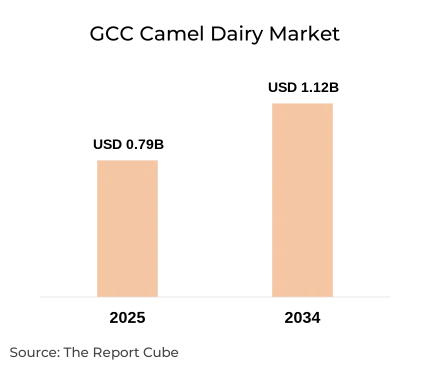
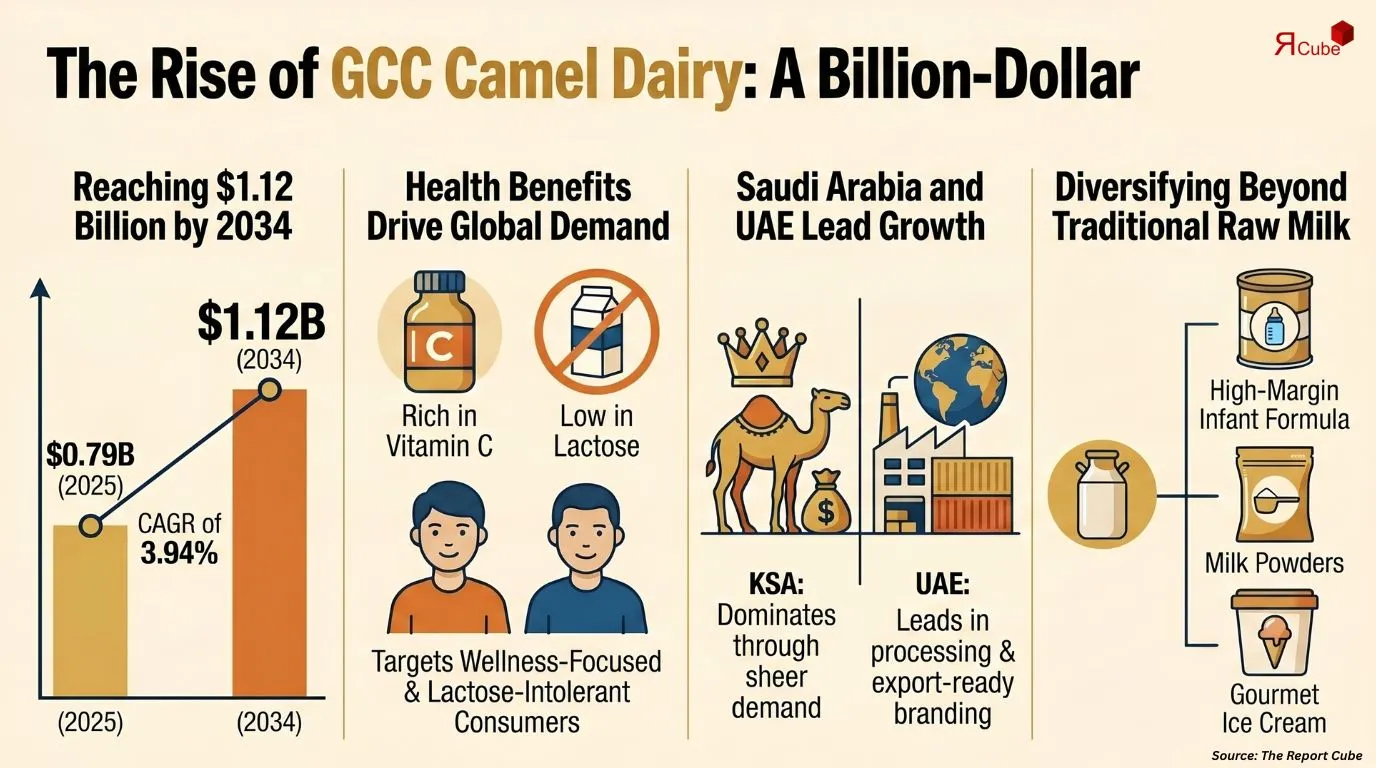
The GCC camel dairy market represents a unique and culturally significant segment of the regional dairy industry, supported by traditional consumption patterns, rising health awareness, and increasing commercialization of camel milk products. In 2025, the market was valued at USD 0.79 billion and is projected to reach USD 1.12 billion by 2034, expanding at a CAGR of 3.94% during the 2026–2034 forecast period. The market’s steady growth reflects growing consumer preference for functional and nutrient-rich dairy products, along with expanding product availability across modern retail channels.
Camel milk has long been consumed across GCC countries due to its nutritional profile, digestibility, and suitability for arid climates. It is rich in vitamins, minerals, and bioactive compounds and is often associated with health benefits such as improved immunity, lactose tolerance, and metabolic support. These attributes are driving renewed interest among health-conscious consumers, particularly in urban markets.
Commercialization and branding of camel dairy products have transformed the market from largely traditional consumption to organized retail offerings. Producers are expanding beyond raw and pasteurized milk to value-added products such as flavored milk, powders, infant formula, and fermented dairy. Improved cold chain infrastructure, packaging innovations, and food safety standards further support market expansion. As regional food security initiatives and local dairy production gain momentum, the GCC camel dairy market is expected to maintain stable, long-term growth.
GCC Camel Dairy Market Key Highlight
- Strong cultural acceptance supports baseline camel milk consumption
- Rising health awareness drives demand for functional dairy products
- Pasteurized camel milk remains the dominant product category
- Value-added camel dairy products gain increasing shelf space
- Modern retail channels support wider product availability
- Government support strengthens local dairy production
- Camel milk powder and infant formula gain niche demand
- Regional brands dominate market supply
GCC Camel Dairy Market Dynamics
Key Market Driver – Nutritional Benefits and Health Positioning
The primary driver of the GCC camel dairy market is the growing awareness of camel milk’s nutritional and functional benefits. Camel milk contains lower lactose levels compared to cow milk and is rich in vitamin C, iron, and immune-supporting proteins. These attributes make it attractive to lactose-intolerant consumers, diabetics, and individuals seeking natural health-focused foods. Increasing emphasis on preventive healthcare and wellness further strengthens demand.
Key Market Trends – Product Diversification and Modern Retail Expansion
A major trend shaping the market is the diversification of camel dairy products. Producers are expanding portfolios to include flavored camel milk, drinking yoghurt, laban, ice cream, cheese, ghee, and infant formula. These innovations improve consumer appeal and expand usage occasions beyond traditional consumption.
Simultaneously, modern retail channels such as supermarkets, hypermarkets, and specialty health stores are gaining importance. Improved packaging, branding, and refrigeration allow camel dairy products to reach a broader consumer base, particularly in urban centers.
Major Market Challenge – High Production Costs and Limited Supply
Despite growing demand, the market faces challenges related to high production costs and limited camel milk supply. Camel farming requires specialized husbandry, longer lactation cycles, and higher operational expenses compared to conventional dairy farming. Limited scalability and supply chain constraints impact pricing and restrict mass-market penetration.
Key Market Opportunity – Export Potential and Premium Product Positioning
The growing global interest in camel milk as a functional and exotic dairy product presents export opportunities for GCC producers. Premium positioning of camel milk powder, infant formula, and nutraceutical-based products can unlock higher margins. Expansion into international health food markets and online retail channels further enhances growth potential.
Need Specific Data, Let’s Customize the Report for You
Contact UsGCC Camel Dairy Market Segment-wise Analysis
This section evaluates market segmentation by product type and distribution channel, highlighting consumption patterns and revenue contribution.
By Product Type:
- Pasteurized Camel Milk
- Flavoured Camel Milk
- Camel Milk Powder
- Camel Milk Ice Cream
- Camel Milk Cheese
- Camel Milk Laban
- Camel Milk Ghee
- Camel Milk Drinking Yoghurt
- Camel Milk Infant Formula
- Others
Pasteurized camel milk holds the largest share of the GCC camel dairy market, driven by daily consumption and traditional preference. Flavoured camel milk and drinking yoghurt are gaining popularity among younger consumers. Camel milk powder and infant formula represent premium, high-growth segments supported by longer shelf life and export potential.
By Distribution Channel:
- Traditional
- Modern
Traditional distribution channels, including local farms and direct sales, continue to account for a significant share, particularly in rural areas. However, modern retail channels are expanding rapidly, supported by improved cold chain infrastructure and rising consumer trust in packaged camel dairy products.
Country Projection of GCC Camel Dairy Market
- Saudi Arabia
- UAE
- Qatar
- Oman
- Kuwait
- Bahrain
Saudi Arabia leads the GCC camel dairy market due to a large camel population, strong domestic demand, and established production facilities. The UAE follows with advanced processing infrastructure, strong branding, and export-oriented production. Qatar and Oman demonstrate steady growth supported by food security initiatives, while Kuwait and Bahrain show increasing adoption through niche and premium dairy offerings.
GCC Camel Dairy Market Recent Development 2025
- Camelicious expanded value-added camel milk and flavoured product lines
- Al Ain Farms strengthened camel milk processing and retail distribution
- Baladna increased camel dairy product availability in domestic markets
- Mazoon Dairy enhanced camel milk supply chain and packaging capabilities
GCC Camel Dairy Market Future Outlook (2034)
By 2034, the GCC camel dairy market is expected to reach USD 1.12 billion, supported by stable consumer demand, rising health awareness, and continued product innovation. Growth will be driven by value-added dairy formats, premium positioning, and expansion into modern retail and export markets. Government support for local dairy production and food security will further strengthen supply resilience. Overall, the market outlook remains positive, characterized by gradual expansion and increasing commercialization of camel dairy products.
Major Queries Answered in the Report
- What is the current and forecast size of the GCC camel dairy market?
- Which camel dairy products generate the highest demand?
- How do health benefits influence consumer adoption?
- Which distribution channels drive market growth?
- Which GCC countries lead camel dairy production and consumption?
- What are the key drivers, trends, challenges, and opportunities?
- Who are the leading companies operating in the GCC camel dairy market?
Table of Contents
- Introduction
- Objective of the study
- Product Definition
- Market Segmentation
- Study Variables
- Research Methodology
- Secondary Data Points
- Companies Interviewed
- Primary Data Points
- BreakDown of Primary Interviews
- Secondary Data Points
- Executive Summary
- Market Dynamics
- Drivers
- Challenges
- Opportunity Assessment
- Recent Trends and Developments
- Policy and Regulatory Landscape
- GCC Camel Dairy Market Overview (2020-2034)
- Market Size, By Value (in USD Billions)
- Market Share, By Product Type
- Pasteurized Camel Milk
- Flavoured Camel Milk
- Camel Milk Powder
- Camel Milk Ice Cream
- Camel Milk Cheese
- Camel Milk Laban
- Camel Milk Ghee
- Camel Milk Drinking Yoghurt
- Camel Milk Infant Formula
- Others
- Market Share, By Distribution Channel
- Traditional
- Modern
- Market Share, By Packaging Type
- Bottles
- Cartons
- Cans
- Jars
- Others
- Market Share, By Region
- Saudi Arabia
- UAE
- Kuwait
- Oman
- Qatar
- Bahrain
- Market Share, By Competitors
- Competition Characteristics
- Revenue Shares
- GCC Pasteurized Camel Milk Camel Dairy Market Overview, 2020-2034F
- By Value (USD Million)
- By Distribution Channel- Market Size & Forecast 2020-2034, USD Million
- By Packaging Type- Market Size & Forecast 2020-2034, USD Million
- GCC Flavoured Camel Milk Camel Dairy Market Overview, 2020-2034F
- By Value (USD Million)
- By Distribution Channel- Market Size & Forecast 2020-2034, USD Million
- By Packaging Type- Market Size & Forecast 2020-2034, USD Million
- GCC Camel Milk Powder Camel Dairy Market Overview, 2020-2034F
- By Value (USD Million)
- By Distribution Channel- Market Size & Forecast 2020-2034, USD Million
- By Packaging Type- Market Size & Forecast 2020-2034, USD Million
- GCC Camel Milk Ice Cream Camel Dairy Market Overview, 2020-2034F
- By Value (USD Million)
- By Distribution Channel- Market Size & Forecast 2020-2034, USD Million
- By Packaging Type- Market Size & Forecast 2020-2034, USD Million
- GCC Camel Milk Cheese Camel Dairy Market Overview, 2020-2034F
- By Value (USD Million)
- By Distribution Channel- Market Size & Forecast 2020-2034, USD Million
- By Packaging Type- Market Size & Forecast 2020-2034, USD Million
- GCC Camel Milk Laban Camel Dairy Market Overview, 2020-2034F
- By Value (USD Million)
- By Distribution Channel- Market Size & Forecast 2020-2034, USD Million
- By Packaging Type- Market Size & Forecast 2020-2034, USD Million
- GCC Camel Milk Ghee Camel Dairy Market Overview, 2020-2034F
- By Value (USD Million)
- By Distribution Channel- Market Size & Forecast 2020-2034, USD Million
- By Packaging Type- Market Size & Forecast 2020-2034, USD Million
- GCC Camel Milk Drinking Yoghurt Camel Dairy Market Overview, 2020-2034F
- By Value (USD Million)
- By Distribution Channel- Market Size & Forecast 2020-2034, USD Million
- By Packaging Type- Market Size & Forecast 2020-2034, USD Million
- GCC Camel Milk Infant Formula Camel Dairy Market Overview, 2020-2034F
- By Value (USD Million)
- By Distribution Channel- Market Size & Forecast 2020-2034, USD Million
- By Packaging Type- Market Size & Forecast 2020-2034, USD Million
- GCC Others Camel Dairy Market Overview, 2020-2034F
- By Value (USD Million)
- By Distribution Channel- Market Size & Forecast 2020-2034, USD Million
- By Packaging Type- Market Size & Forecast 2020-2034, USD Million
- Competitive Outlook (Company Profile – Partial List)
- Camelicious
- Company Overview
- Business Segments
- Strategic Alliances/Partnerships
- Recent Developments
- Al Ain Farms
- Company Overview
- Business Segments
- Strategic Alliances/Partnerships
- Recent Developments
- Baladna
- Company Overview
- Business Segments
- Strategic Alliances/Partnerships
- Recent Developments
- Desert Farms
- Company Overview
- Business Segments
- Strategic Alliances/Partnerships
- Recent Developments
- Al Marmoom Dairy
- Company Overview
- Business Segments
- Strategic Alliances/Partnerships
- Recent Developments
- Saudi Camel Dairy Company
- Company Overview
- Business Segments
- Strategic Alliances/Partnerships
- Recent Developments
- Al Watania Agriculture
- Company Overview
- Business Segments
- Strategic Alliances/Partnerships
- Recent Developments
- Mazoon Dairy
- Company Overview
- Business Segments
- Strategic Alliances/Partnerships
- Recent Developments
- A’Saffa Foods
- Company Overview
- Business Segments
- Strategic Alliances/Partnerships
- Recent Developments
- Others
- Camelicious
- Contact Us & Disclaimer
Top Key Players & Market Share Outlook
- Camelicious
- Al Ain Farms
- Baladna
- Desert Farms
- Al Marmoom Dairy
- Saudi Camel Dairy Company
- Al Watania Agriculture
- Mazoon Dairy
- A’Saffa Foods
- Others
Frequently Asked Questions






