



Build Your Custom Market Intelligence Report
Customize Your ReportGCC Cement Market Insights & Analysis
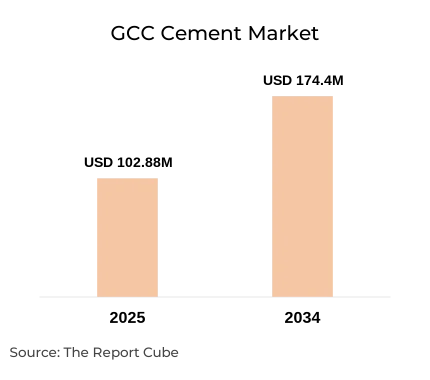
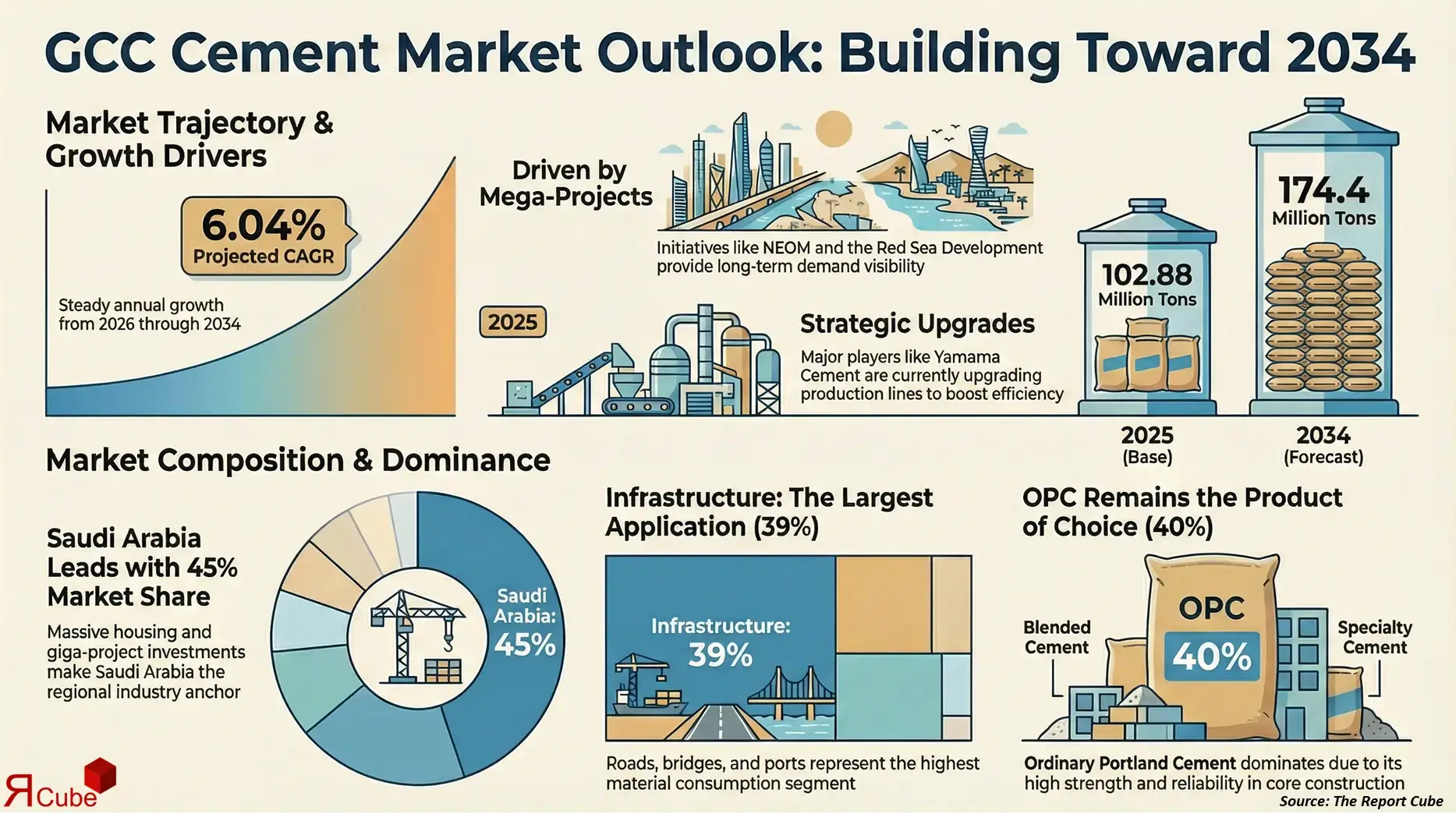
The GCC Cement Market is anticipated to register a CAGR of 6.04% during 2026-2034. The market volume stood at 102.88 million Tons and is projected to reach 174.4 million Tons by 2034. This strong growth outlook is driven by sustained infrastructure investments, rapid urban development, and large-scale industrial expansion across GCC economies. Cement remains a strategic material supporting economic diversification agendas, population-driven housing demand, and the execution of mega construction projects across Saudi Arabia, the UAE, and neighboring countries.
Across the GCC, governments continue to prioritize long-term infrastructure planning, including transportation corridors, smart cities, ports, airports, industrial zones, and energy facilities. These initiatives, combined with rising residential and commercial construction, underpin steady cement demand. Additionally, increasing adoption of blended and specialty cement products to meet durability and environmental requirements is reshaping consumption patterns. Capacity expansions, export-oriented strategies, and modernization of production facilities further strengthen the GCC cement market outlook through the forecast period.
GCC Cement Market Recent Developments
- 2025: Yamama Cement Company commissioned upgraded production lines to improve clinker efficiency and output capacity.
- 2025: Raysut Cement Company expanded cross-border export operations targeting East Africa and GCC markets.
Government Initiatives & Policies
- Saudi Vision 2030 - Housing & Infrastructure Programs: Supports large-scale urban, transport, and industrial development.
- UAE National Infrastructure Strategy: Focuses on sustainable construction, logistics, and urban expansion.
GCC Cement Market Dynamics
Key Driver: Large-scale Infrastructure and Mega Construction Projects
The primary driver of the GCC cement market is the scale and continuity of infrastructure and mega construction projects across the region. Governments are investing heavily in highways, rail networks, ports, airports, industrial cities, and smart urban developments to support economic growth and diversification. Projects such as NEOM, Red Sea Development, and extensive metro expansions require high volumes of cement over long timelines. These initiatives ensure stable and predictable cement consumption, providing long-term demand visibility for manufacturers.
Major Challenge: Overcapacity and Competitive Pricing Pressure
A major challenge facing the GCC cement market is persistent overcapacity in several countries, leading to intense competition and pricing pressure. Rapid capacity expansions over the past decade have resulted in supply-demand imbalances, particularly during periods of slower construction activity. This has compressed margins and increased reliance on exports. Additionally, fluctuating fuel costs, environmental compliance requirements, and carbon emission regulations add operational complexity and cost pressure for producers.
Industry Trends: Rising Adoption of Blended and Specialty Cement
An important trend shaping the market is the growing use of blended and specialty cement products. Portland slag cement, pozzolana cement, sulphate-resistant cement, and oil well cement are increasingly adopted to enhance durability, reduce environmental impact, and meet project-specific requirements. The use of alternative fuels, clinker substitution, and energy-efficient kilns is also gaining traction as manufacturers align with sustainability goals and green building standards across the GCC.
Opportunity Ahead: Industrial Expansion and Precast Construction
Significant opportunities exist in industrial construction, oil & gas projects, and precast infrastructure development. Expansion of refineries, petrochemical complexes, and industrial zones requires specialized cement types with high strength and chemical resistance. Additionally, the growing adoption of precast and prefabricated construction methods is increasing demand for consistent-quality cement and ready-mix concrete, offering attractive growth avenues through 2034.
GCC Cement Market Segment-wise Analysis
By Product Type:
- Ordinary Portland Cement (OPC)
- Portland Pozzolana Cement (PPC)
- Portland Slag Cement (PSC)
- White Cement
- Clinker
Ordinary Portland Cement (OPC) remains the dominant product type, accounting for approximately 40% of total GCC cement consumption in 2025. OPC is widely preferred for residential, commercial, and infrastructure projects due to its high early strength, reliability, and broad applicability. While blended cement products are gaining traction, OPC continues to lead due to entrenched construction practices and widespread availability across GCC markets.
By Application:
- Residential Construction
- Commercial Construction
- Industrial Construction
- Infrastructure
- Oil & Gas and Petrochemical Projects
Infrastructure applications represent the largest consumption segment, contributing nearly 39% of total cement demand in 2025. Extensive investments in roads, bridges, ports, metro systems, and airports across Saudi Arabia, the UAE, and Qatar underpin this dominance. Long project durations and high material intensity ensure sustained cement usage within this segment.
Regional Projection of GCC Cement Industry
- Saudi Arabia
- United Arab Emirates
- Qatar
- Kuwait
- Bahrain
- Oman
Saudi Arabia leads the GCC cement market, accounting for approximately 45% of total regional consumption in 2025. Massive investments in housing, infrastructure, industrial cities, and giga-projects under Vision 2030 continue to drive cement demand. The UAE follows, supported by real estate development, logistics infrastructure expansion, and tourism-led construction activity.
Why Choose This Report?
- Provides a comprehensive overview of the overall market analysis, encompassing key trends, consumer behavior analysis, and risk assessment to support strategic decision-making.
- Provides accurate, up-to-date insights into market size, segmentation, and emerging opportunities, helping to minimize risk & capitalizing on growth.
- Gives deep understanding of target audience preferences, investment habits, and communication channels for enhanced product development & marketing effectiveness.
- Delivers competitive analysis & benchmarking, uncovering the strengths & weaknesses of market competitors to guide strategies.
- Consolidate comprehensive market intelligence, reducing reasoning & streamlining research efforts.
- Facilitates customized market segmentation & risk mitigation strategies, fine-tuned to the business objectives.
- Aids in identifying both market challenges & untapped opportunities within the industry to drive long-term business growth.
- Provides valuable information based on actual customer data & search trends.
Table of Contents
- Introduction
- Objective of the Study
- Product/Category Definition
- Market Segmentation
- Study Variables
- Research Methodology
- Secondary Data Points
- Breakdown of Secondary Sources
- Primary Data Points
- Breakdown of Primary Interviews
- Secondary Data Points
- Executive Summary
- Market Dynamics
- Drivers
- Challenges
- Opportunity Assessment
- Recent Trends and Developments
- Policy and Regulatory Landscape
- GCC Cement Market Overview (2020-2034)
- Market Size, By Volume & Value (Million Tons / USD Million)
- Market Share, By Product Type
- Ordinary Portland Cement (OPC)
- Portland Pozzolana Cement (PPC)
- Portland Slag Cement (PSC)
- White Cement
- Sulphate-Resistant Cement
- Oil Well Cement
- Blended/Composite Cement
- Ready-mix Concrete
- Clinker
- Market Share, By Application
- Residential Construction
- Commercial Construction
- Industrial Construction
- Infrastructure (Roads, Bridges, Ports)
- Oil & Gas and Petrochemical Projects
- Precast & Prefabricated Structures
- Market Share, By End User
- Construction Companies
- Infrastructure & Civil Contractors
- Real Estate Developers
- Ready-Mix Concrete Producers
- Precast Manufacturers
- Others
- Market Share, By Distribution Channel
- Direct Sales (Bulk)
- Distributors & Dealers
- Retail/Yard Sales
- Market Share, By Country
- United Arab Emirates
- Saudi Arabia
- Qatar
- Kuwait
- Bahrain
- Oman
- Market Share, By Company
- Revenue Shares
- Competitive Landscape
- United Arab Emirates Cement Market
- Market Size, By Volume & Value (USD Million)
- Market Share, By Product Type
- Market Share, By Application
- Market Share, By End User
- Market Share, By Distribution Channel
- Saudi Arabia Cement Market
- Market Size, By Volume & Value (USD Million)
- Market Share, By Product Type
- Market Share, By Application
- Market Share, By End User
- Market Share, By Distribution Channel
- Qatar Cement Market
- Market Size, By Volume & Value (USD Million)
- Market Share, By Product Type
- Market Share, By Application
- Market Share, By End User
- Market Share, By Distribution Channel
- Kuwait Cement Market
- Market Size, By Volume & Value (USD Million)
- Market Share, By Product Type
- Market Share, By Application
- Market Share, By End User
- Market Share, By Distribution Channel
- Bahrain Cement Market
- Market Size, By Volume & Value (USD Million)
- Market Share, By Product Type
- Market Share, By Application
- Market Share, By End User
- Market Share, By Distribution Channel
- Oman Cement Market
- Market Size, By Volume & Value (USD Million)
- Market Share, By Product Type
- Market Share, By Application
- Market Share, By End User
- Market Share, By Distribution Channel
- Competitive Outlook & Company Profiles
- Saudi Cement Company
- Company Overview
- Product Portfolio
- Capacity and Production Facilities
- Key Projects and Clients
- Recent Developments
- Yamama Cement Company
- Company Overview
- Product Portfolio
- Capacity and Production Facilities
- Key Projects and Clients
- Recent Developments
- Arabian Cement Company
- Company Overview
- Product Portfolio
- Capacity and Production Facilities
- Key Projects and Clients
- Recent Developments
- Qatar National Cement Company (QNCC)
- Company Overview
- Product Portfolio
- Capacity and Production Facilities
- Key Projects and Clients
- Recent Developments
- Raysut Cement Company
- Company Overview
- Product Portfolio
- Capacity and Production Facilities
- Key Projects and Clients
- Recent Developments
- Oman Cement Company
- Company Overview
- Product Portfolio
- Capacity and Production Facilities
- Key Projects and Clients
- Recent Developments
- Union Cement Company (UAE)
- Company Overview
- Product Portfolio
- Capacity and Production Facilities
- Key Projects and Clients
- Recent Developments
- Gulf Cement Company (UAE)
- Company Overview
- Product Portfolio
- Capacity and Production Facilities
- Key Projects and Clients
- Recent Developments
- CEMEX UAE
- Company Overview
- Product Portfolio
- Capacity and Production Facilities
- Key Projects and Clients
- Recent Developments
- Al Safwa Cement Company
- Company Overview
- Product Portfolio
- Capacity and Production Facilities
- Key Projects and Clients
- Recent Developments
- Others
- Saudi Cement Company
- Contact Us / Disclaimer
Top Key Players & Market Share Outlook
- Saudi Cement Company
- Yamama Cement Company
- Arabian Cement Company
- Qatar National Cement Company (QNCC)
- Raysut Cement Company
- Oman Cement Company
- Union Cement Company (UAE)
- Gulf Cement Company (UAE)
- CEMEX UAE
- Al Safwa Cement Company
- Others
Frequently Asked Questions






