




Build Your Custom Market Intelligence Report
Customize Your ReportMiddle East Cement Market Insights & Analysis
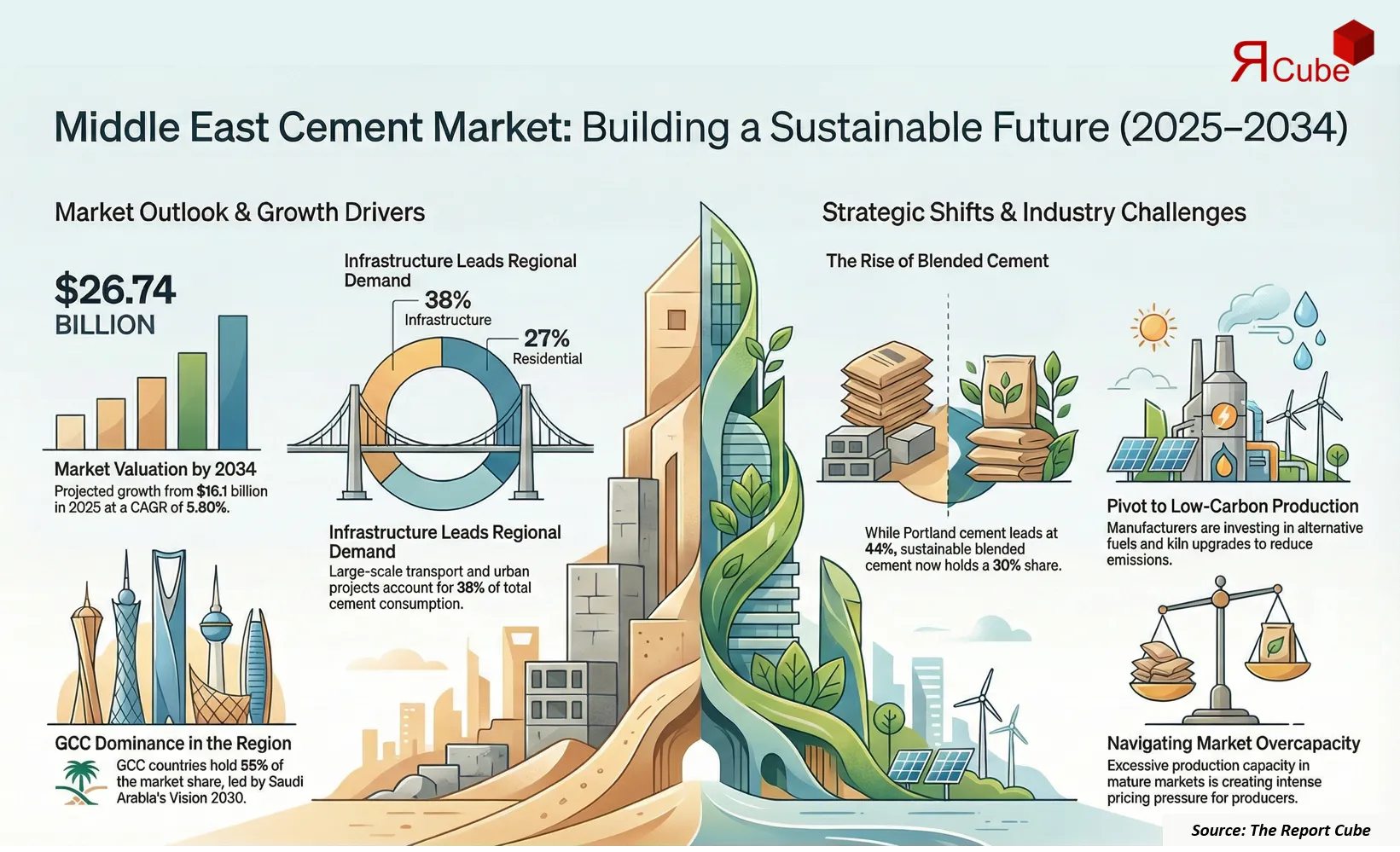
The Middle East Cement Market is anticipated to register a CAGR of 5.80% during the forecast period 2026-2034. The market size was valued at USD 16.1 billion in 2025 and is projected to reach USD 26.74 billion by 2034. This growth trajectory reflects accelerating construction activity across residential, commercial, and large-scale infrastructure projects driven by urban expansion and economic diversification initiatives across the region.
Rapid population growth, rising urbanization rates, and ambitious government-led development programs are reinforcing cement demand across the Middle East. Mega infrastructure projects such as smart cities, transport corridors, airports, and industrial zones are significantly increasing cement consumption, particularly in GCC countries. At the same time, reconstruction activities in parts of North Africa and other Middle Eastern nations are supporting stable long-term demand. Cement manufacturers are responding by expanding production capacity, improving distribution efficiency, and optimizing product portfolios to meet evolving construction standards.
Furthermore, sustainability considerations are reshaping market dynamics, with producers increasingly focusing on blended and low-carbon cement products to meet environmental regulations and reduce emissions. Investments in modern kilns, alternative fuels, and energy-efficient technologies are strengthening regional competitiveness. As infrastructure pipelines remain robust and private sector construction activity gains momentum, the Middle East Cement Market is positioned for steady expansion throughout the forecast period.
Middle East Cement Market Recent Developments
- 2025: Holcim Group expanded low-carbon cement production capacity to support sustainable construction projects in GCC countries.
- 2025: Saudi Cement upgraded kiln operations to improve efficiency and meet rising domestic infrastructure demand.
Government Initiatives & Policies
- Saudi Vision 2030 Infrastructure Program: National development plan driving large-scale housing and infrastructure construction.
- UAE National Infrastructure Strategy: Long-term investment framework supporting transport, housing, and urban development.
Middle East Cement Market Dynamics
Key Driver: Large-Scale Infrastructure and Urban Development Projects
The primary driver of the Middle East Cement Market is the sustained rollout of large-scale infrastructure and urban development projects. Governments across the GCC are investing heavily in transportation networks, residential housing, commercial complexes, and industrial facilities to diversify economies beyond hydrocarbons. Cement remains a core construction material for these projects due to its structural strength, durability, and cost-effectiveness. For instance, infrastructure spending in the GCC accounts for over 35% of total construction investment, directly supporting cement demand. Additionally, population growth and increasing housing needs are accelerating residential construction, particularly in Saudi Arabia and the UAE. These interconnected factors ensure consistent cement consumption, positioning infrastructure-led growth as the backbone of market expansion through 2034.
Book your FREE 30-minute expert consultation today
Contact UsIndustry Trends: Rising Adoption of Blended and Sustainable Cement
A key trend shaping the Middle East Cement Market is the growing adoption of blended and environmentally sustainable cement products. Stricter environmental regulations and rising awareness of carbon emissions are pushing manufacturers to reduce clinker content and incorporate supplementary materials such as fly ash and slag. Blended cement is gaining preference due to its lower carbon footprint and improved durability in harsh climatic conditions. Currently, blended cement accounts for nearly 28% of regional cement consumption, with steady year-on-year growth. Manufacturers are also investing in alternative fuels and waste heat recovery systems to enhance energy efficiency. This shift toward sustainability not only aligns with regulatory requirements but also strengthens long-term competitiveness and market resilience.
Major Challenge: Overcapacity and Pricing Pressure
Despite strong demand fundamentals, overcapacity remains a major challenge for the Middle East Cement Market. Several countries have expanded production capacity faster than demand growth, leading to intense price competition among manufacturers. Excess supply, particularly in mature GCC markets, has compressed profit margins and increased reliance on exports. Additionally, fluctuating energy costs and logistics expenses further strain operational efficiency. Smaller producers face difficulties maintaining profitability amid aggressive pricing strategies by large players. These challenges highlight the need for capacity rationalization, export diversification, and operational optimization to sustain long-term growth.
Opportunity: Reconstruction and Industrial Expansion in Emerging Markets
Reconstruction and industrial expansion in parts of North Africa and other Middle Eastern countries present significant growth opportunities for the cement market. Countries undergoing infrastructure rehabilitation and housing redevelopment are expected to drive incremental cement demand over the forecast period. Industrial zones, manufacturing hubs, and energy projects are also increasing cement consumption for foundations and structural works. As regional trade connectivity improves, cement producers can leverage export opportunities to balance domestic overcapacity. Strategic investments in logistics and regional distribution networks are enabling manufacturers to tap into these emerging demand centers, supporting market expansion beyond traditional GCC strongholds.
Middle East Cement Market Segment-wise Analysis
By Product Category:
- Ordinary Portland Cement
- Blended Cement
- White Cement
- Oilwell Cement
- Other Types
Ordinary Portland Cement dominates the market, accounting for approximately 44% of total consumption due to its widespread use in residential and commercial construction. Its versatility and availability make it the preferred choice for general construction applications. However, Blended Cement is rapidly gaining traction, holding nearly 30% market share, driven by sustainability initiatives and infrastructure durability requirements. White and Oilwell cement cater to niche applications, including architectural finishes and energy sector projects. The gradual shift toward blended products reflects evolving construction standards and environmental priorities across the region.
By Application:
- Residential
- Commercial
- Infrastructure
- Industrial
- Institutional
The Infrastructure segment leads the application landscape, contributing close to 38% of total cement demand. Large-scale transport, energy, and urban development projects are the primary growth engines for this segment. Residential construction follows, supported by housing initiatives and population growth, accounting for around 27% market share. Commercial and industrial applications continue to expand steadily, driven by retail, hospitality, and manufacturing investments. The balanced demand across applications ensures market stability while supporting long-term growth.
Regional Projection of Middle East Cement Industry
- GCC Countries
- North Africa
- Other Middle East
The GCC Countries segment leads the Middle East Cement Market, holding approximately 55% of total market share. Saudi Arabia remains the largest contributor, supported by Vision 2030 projects and extensive housing programs. The UAE and Qatar follow, driven by commercial and infrastructure investments. North Africa represents a growing market, supported by urbanization and reconstruction activities, while Other Middle East regions are gradually expanding through industrial development. The GCC’s strong infrastructure pipeline and financial capacity ensure its continued dominance throughout the forecast period.
Need insights for a specific region within this market?
Request Regional DataWhy Choose This Report?
- Provides a comprehensive overview of the overall market analysis, encompassing key trends, consumer behavior analysis, and risk assessment to support strategic decision-making.
- Provides accurate, up-to-date insights into market size, segmentation, and emerging opportunities, helping to minimize risk & capitalizing on growth.
- Gives deep understanding of target audience preferences, investment habits, and communication channels for enhanced product development & marketing effectiveness.
- Delivers competitive analysis & benchmarking, uncovering the strengths & weaknesses of market competitors to guide strategies.
- Consolidate comprehensive market intelligence, reducing reasoning & streamlining research efforts.
- Facilitates customized market segmentation & risk mitigation strategies, fine-tuned to the business objectives.
- Aids in identifying both market challenges & untapped opportunities within the industry to drive long-term business growth.
- Provides valuable information based on actual customer data & search trends.
Table of Contents
- Introduction
- Objective of the Study
- Product and Category Definition
- Market Segmentation
- Study Variables
- Research Methodology
- Secondary Data Points
- Breakdown of Secondary Sources
- Primary Data Points
- Breakdown of Primary Interviews
- Secondary Data Points
- Executive Summary
- Market Dynamics
- Drivers
- Challenges
- Opportunity Assessment
- Recent Trends and Developments
- Regulatory and Policy Landscape
- Middle East Cement Market Overview (2021-2034)
- Market Size, By Value (USD Billion)
- Market Share, By Product Category
- Ordinary Portland
- Blended Cement
- White Cement
- Oilwell Cement
- Other Types
- Market Share, By Application
- Residential
- Commercial
- Infrastructure
- Industrial
- Institutional
- Market Share, By End User
- Ready-Mix Plants
- Contractors
- Developers
- Market Share, By Region
- GCC Countries
- Saudi Arabia
- United Arab Emirates
- Qatar
- Oman
- Kuwait
- Bahrain
- North Africa
- Egypt
- Algeria
- Morocco
- Tunisia
- Rest of North Africa
- Other Middle East
- Iran
- Iraq
- Jordan
- Lebanon
- Rest of Middle East
- GCC Countries
- Market Share, By Company
- Revenue Shares
- Competitive Landscape
- GCC Cement Market
- Market Size, By Value (USD Billion)
- Market Share, By Product Category
- Market Share, By Application
- Market Share, By End User
- Market Share, By Country Group
- Market Share, By Country
- Saudi Arabia Cement Market
- UAE Cement Market
- Qatar Cement Market
- Oman Cement Market
- Kuwait Cement Market
- Bahrain Cement Market
- North Africa Cement Market
- Market Size, By Value (USD Billion)
- Market Share, By Product Category
- Market Share, By Application
- Market Share, By End User
- Market Share, By Country Group
- Market Share, By Country
- Egypt Cement Market
- Algeria Cement Market
- Morocco Cement Market
- Tunisia Cement Market
- Rest of North Africa
- Other Middle East Cement Market
- Market Size, By Value (USD Billion)
- Market Share, By Product Category
- Market Share, By Application
- Market Share, By End User
- Market Share, By Country Group
- Market Share, By Country
- Iran Cement Market
- Iraq Cement Market
- Jordan Cement Market
- Lebanon Cement Market
- Rest of Middle East
- Competitive Outlook and Company Profiles
- Holcim Group
- Company Overview
- Product Portfolio
- Strategic Alliances/Partnerships
- Recent Developments
- Cemex S.A.B.
- Company Overview
- Product Portfolio
- Strategic Alliances/Partnerships
- Recent Developments
- Saudi Cement
- Company Overview
- Product Portfolio
- Strategic Alliances/Partnerships
- Recent Developments
- Qatar National Cement
- Company Overview
- Product Portfolio
- Strategic Alliances/Partnerships
- Recent Developments
- Kuwait Cement
- Company Overview
- Product Portfolio
- Strategic Alliances/Partnerships
- Recent Developments
- Yamama Cement
- Company Overview
- Product Portfolio
- Strategic Alliances/Partnerships
- Recent Developments
- Gulf Cement
- Company Overview
- Product Portfolio
- Strategic Alliances/Partnerships
- Recent Developments
- Arabian Cement
- Company Overview
- Product Portfolio
- Strategic Alliances/Partnerships
- Recent Developments
- Fujairah Cement
- Company Overview
- Product Portfolio
- Strategic Alliances/Partnerships
- Recent Developments
- Najran Cement
- Company Overview
- Product Portfolio
- Strategic Alliances/Partnerships
- Recent Developments
- Others
- Holcim Group
- Contact Us and Disclaimer
Top Key Players & Market Share Outlook
- Holcim Group
- Cemex S.A.B.
- Saudi Cement
- Qatar National Cement
- Kuwait Cement
- Yamama Cement
- Gulf Cement
- Arabian Cement
- Fujairah Cement
- Najran Cement
- Others
Frequently Asked Questions






