



Build Your Custom Market Intelligence Report
Customize Your ReportGCC Chocolate Market Insights & Analysis
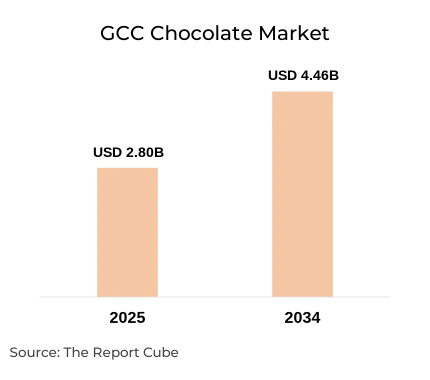
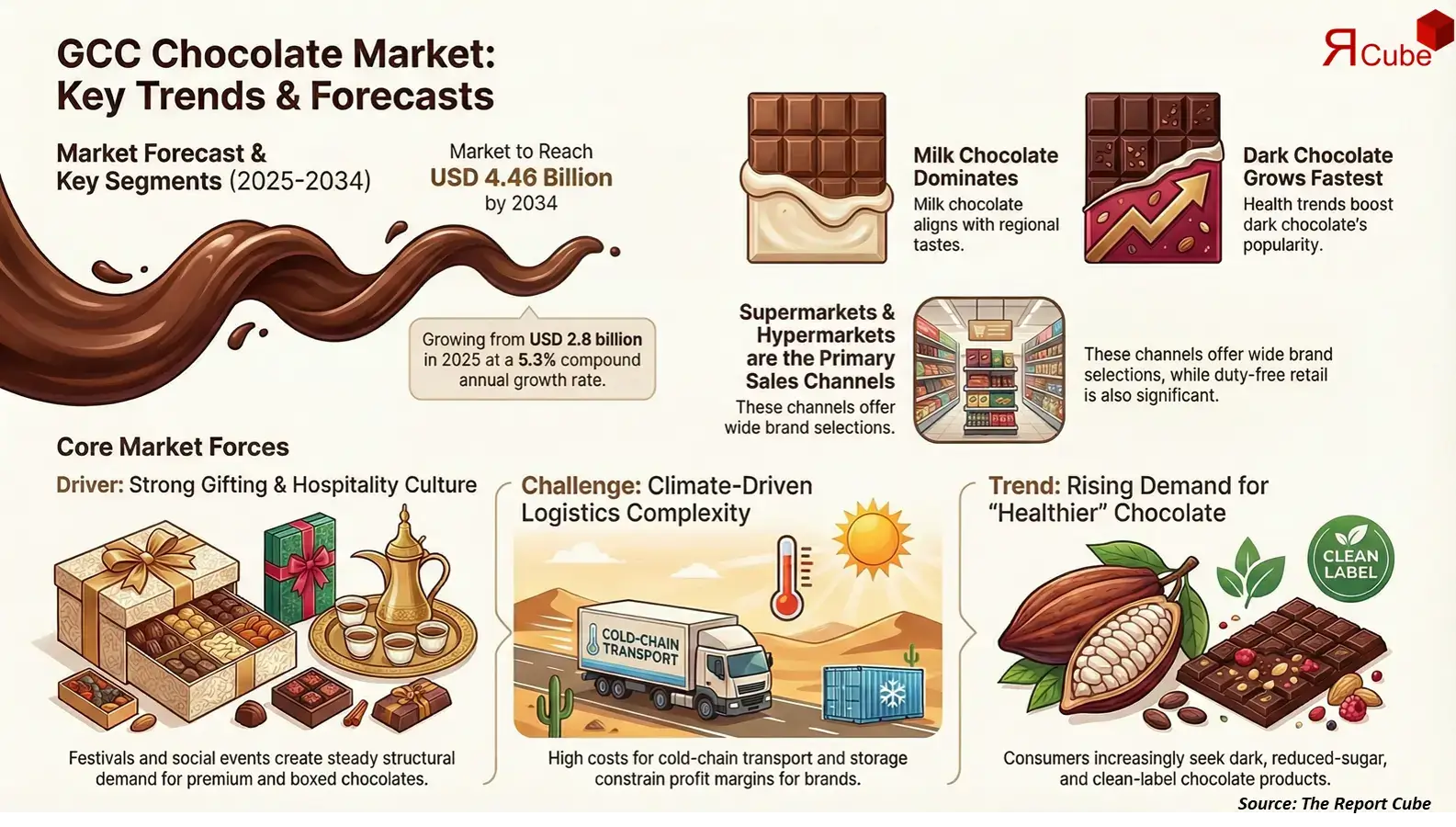
The GCC Chocolate Market is anticipated to register a CAGR of 5.30% during 2026-2034. The market size was valued at USD 2.8 billion in 2025 and is projected to reach USD 4.46 billion by 2034. The market continues to expand steadily, supported by rising disposable incomes, strong gifting culture, and increasing demand for premium and specialty chocolates across Gulf countries. Chocolate consumption in the region has evolved from occasional indulgence to a regular lifestyle product, especially among younger consumers and expatriate populations.
This upward momentum is further reinforced by rapid urbanization, growing tourism flows, and the expansion of modern retail formats such as supermarkets, specialty confectionery stores, and duty-free outlets. GCC consumers increasingly favor premium, artisanal, and imported chocolate brands, driven by aspirational lifestyles and exposure to global food trends. Seasonal demand spikes during Ramadan, Eid, and wedding seasons significantly contribute to annual sales volumes, making chocolate a culturally embedded product category.
Additionally, manufacturers are responding to shifting preferences by introducing innovative flavors, premium packaging, and health-oriented formulations such as dark and sugar-free chocolates. These developments, combined with strong brand presence and expanding distribution networks, position the GCC Chocolate Market for sustained growth throughout the forecast period.
GCC Chocolate Market Recent Developments
- 2025: Ferrero Group expanded premium gifting assortments across GCC duty-free and luxury retail channels.
- 2025: Mondelez International introduced reduced-sugar chocolate variants targeting health-conscious consumers in the UAE.
Government Initiatives & Policies
- Saudi Vision 2030 - Food Manufacturing Localization: Supports confectionery manufacturing and food processing investments.
- UAE National Food Security Strategy: Encourages local food production and value-added food industries.
GCC Chocolate Market Dynamics
Key Driver: Strong Gifting Culture and Premiumization Across GCC Countries
The deeply rooted gifting culture across GCC countries remains a primary driver of chocolate market growth. Chocolates are widely exchanged during religious festivals, social gatherings, weddings, and corporate events, making them a preferred gifting option year-round. Premium and luxury chocolate brands, particularly those offering elegant packaging and exotic flavors, experience heightened demand during festive seasons. In markets such as Saudi Arabia and the UAE, premium chocolates account for over 35% of gifting-related confectionery sales. Rising disposable incomes and a preference for high-quality imported brands further amplify this trend, supporting consistent market expansion.
Book your FREE 30-minute expert consultation today
Contact UsIndustry Trends: Rising Demand for Premium, Dark, and Functional Chocolates
A notable trend shaping the GCC Chocolate Market is the shift toward premium, dark, and functional chocolate products. Consumers are increasingly aware of ingredient quality, cocoa content, and perceived health benefits, driving demand for dark chocolates with higher cocoa percentages. At the same time, sugar-free and fortified chocolates are gaining traction among health-conscious consumers and diabetics, particularly in the UAE and Qatar. Premiumization is also evident in limited-edition launches, artisanal offerings, and collaborations with luxury brands, enhancing brand differentiation and value perception across the region.
Major Challenge: High Import Dependence and Price Sensitivity
Despite strong demand, the market faces challenges related to heavy reliance on imported cocoa and finished chocolate products. Fluctuations in global cocoa prices, logistics costs, and currency movements directly impact pricing in GCC markets. While premium consumers show lower price sensitivity, mass-market buyers remain cost-conscious, limiting manufacturers’ ability to pass on rising costs. Additionally, increasing competition from private-label and regional brands intensifies price pressure, particularly in supermarkets and hypermarkets.
Opportunity: Growth of Health-Oriented and Sugar-Free Chocolate Segments
The expanding demand for healthier indulgence presents a significant growth opportunity for chocolate manufacturers in the GCC. Sugar-free, low-calorie, vegan, and organic chocolate products are witnessing double-digit growth, especially among urban consumers. Rising awareness of diabetes and lifestyle-related health concerns has accelerated interest in alternative sweeteners and functional ingredients. Brands that invest in clean-label formulations, transparent sourcing, and targeted marketing are well-positioned to capture emerging demand and strengthen long-term market presence.
GCC Chocolate Market Segment-wise Analysis
By Product Category:
- Milk Chocolate
- Dark Chocolate
- White Chocolate
- Filled Chocolate
- Premium Chocolate
Milk chocolate remains the leading product category, accounting for approximately 42% of the GCC Chocolate Market in 2025. Its widespread appeal across age groups and affordability make it a staple product. However, premium chocolate is the fastest-growing segment, driven by gifting demand and luxury consumption trends. Dark chocolate continues to gain share, supported by health perceptions and higher cocoa content, particularly in urban markets.
By Category:
- Mass Market
- Premium Segment
- Seasonal Gifts
- Healthy Options
- Sugar-Free
The premium segment leads category-wise, holding nearly 38% market share in 2025. Premium chocolates benefit from strong gifting demand, high brand loyalty, and attractive packaging. Seasonal gifts also represent a substantial share, especially during Ramadan and Eid. Meanwhile, healthy and sugar-free categories are emerging rapidly, supported by changing dietary preferences and increasing health awareness across GCC countries.
Regional Projection of GCC Chocolate Industry
- Saudi Arabia
- United Arab Emirates
- Qatar
- Kuwait
- Oman
- Bahrain
Saudi Arabia leads the GCC Chocolate Market, contributing approximately 34% of total regional revenue in 2025. The country’s large population, strong gifting traditions, and expanding modern retail infrastructure drive high chocolate consumption. The UAE follows closely, supported by tourism, expatriate demand, and premium retail outlets. Smaller markets such as Qatar and Kuwait show strong per-capita consumption, while Oman and Bahrain present steady growth opportunities driven by rising urbanization and retail expansion.
Need insights for a specific region within this market?
Request Regional DataWhy Choose This Report?
- Provides a comprehensive overview of the overall market analysis, encompassing key trends, consumer behavior analysis, and risk assessment to support strategic decision-making.
- Provides accurate, up-to-date insights into market size, segmentation, and emerging opportunities, helping to minimize risk & capitalizing on growth.
- Gives deep understanding of target audience preferences, investment habits, and communication channels for enhanced product development & marketing effectiveness.
- Delivers competitive analysis & benchmarking, uncovering the strengths & weaknesses of market competitors to guide strategies.
- Consolidate comprehensive market intelligence, reducing reasoning & streamlining research efforts.
- Facilitates customized market segmentation & risk mitigation strategies, fine-tuned to the business objectives.
- Aids in identifying both market challenges & untapped opportunities within the industry to drive long-term business growth.
- Provides valuable information based on actual customer data & search trends.
Table of Contents
- Introduction
- Objective of the Study
- Product and Category Definition
- Market Segmentation
- Study Variables
- Research Methodology
- Secondary Data Points
- Breakdown of Secondary Sources
- Primary Data Points
- Breakdown of Primary Interviews
- Secondary Data Points
- Executive Summary
- Market Dynamics
- Drivers
- Challenges
- Opportunity Assessment
- Recent Trends and Developments
- Regulatory and Policy Landscape
- GCC Chocolate Market Overview (2020-2034)
- Market Size, By Value (USD Billion)
- Market Share, By Product Category
- Milk Chocolate
- Dark Chocolate
- White Chocolate
- Filled Chocolate
- Premium Chocolate
- Market Share, By Category
- Mass Market
- Premium Segment
- Seasonal Gifts
- Healthy Options
- Sugar-Free
- Market Share, By Distribution Channel
- Supermarkets/Hypermarkets
- Specialty Stores
- Convenience Stores
- Online Retail
- Other Channels
- Market Share, By End User
- Retail Consumers
- Foodservice Sector
- Travel Retail
- Corporate Gifting
- Market Share, By Country
- Saudi Arabia
- United Arab Emirates
- Qatar
- Kuwait
- Oman
- Bahrain
- Market Share, By Company
- Competition Characteristics
- Revenue Shares & Analysis
- Saudi Arabia Chocolate Market
- Market Size, By Value (USD Billion)
- Market Share, By Product Category
- Market Share, By Category
- Market Share, By Distribution Channel
- Market Share, By End User
- United Arab Emirates Chocolate Market
- Market Size, By Value (USD Billion)
- Market Share, By Product Category
- Market Share, By Category
- Market Share, By Distribution Channel
- Market Share, By End User
- Qatar Chocolate Market
- Market Size, By Value (USD Billion)
- Market Share, By Product Category
- Market Share, By Category
- Market Share, By Distribution Channel
- Market Share, By End User
- Kuwait Chocolate Market
- Market Size, By Value (USD Billion)
- Market Share, By Product Category
- Market Share, By Category
- Market Share, By Distribution Channel
- Market Share, By End User
- Oman Chocolate Market
- Market Size, By Value (USD Billion)
- Market Share, By Product Category
- Market Share, By Category
- Market Share, By Distribution Channel
- Market Share, By End User
- Bahrain Chocolate Market
- Market Size, By Value (USD Billion)
- Market Share, By Product Category
- Market Share, By Category
- Market Share, By Distribution Channel
- Market Share, By End User
- Competitive Outlook and Company Profiles
- Mars Incorporated
- Company Overview
- Product Portfolio
- Strategic Alliances/Partnerships
- Recent Developments
- Mondelez International
- Company Overview
- Product Portfolio
- Strategic Alliances/Partnerships
- Recent Developments
- Nestlé SA
- Company Overview
- Product Portfolio
- Strategic Alliances/Partnerships
- Recent Developments
- Ferrero Group
- Company Overview
- Product Portfolio
- Strategic Alliances/Partnerships
- Recent Developments
- The Hershey Company
- Company Overview
- Product Portfolio
- Strategic Alliances/Partnerships
- Recent Developments
- Patchi SAL
- Company Overview
- Product Portfolio
- Strategic Alliances/Partnerships
- Recent Developments
- Bateel International
- Company Overview
- Product Portfolio
- Strategic Alliances/Partnerships
- Recent Developments
- Lindt & Sprüngli
- Company Overview
- Product Portfolio
- Strategic Alliances/Partnerships
- Recent Developments
- Barry Callebaut
- Company Overview
- Product Portfolio
- Strategic Alliances/Partnerships
- Recent Developments
- Al Seedawi Sweets
- Company Overview
- Product Portfolio
- Strategic Alliances/Partnerships
- Recent Developments
- Others
- Mars Incorporated
- Contact Us and Disclaimer
Top Key Players & Market Share Outlook
- Mars Incorporated
- Mondelez International
- Nestlé SA
- Ferrero Group
- The Hershey Company
- Patchi SAL
- Bateel International
- Lindt & Sprüngli
- Barry Callebaut
- Al Seedawi Sweets
- Others
Frequently Asked Questions






