




Build Your Custom Market Intelligence Report
Customize Your ReportUnited States Clinical Laboratory Services Market Key Highlights
By Test Type:
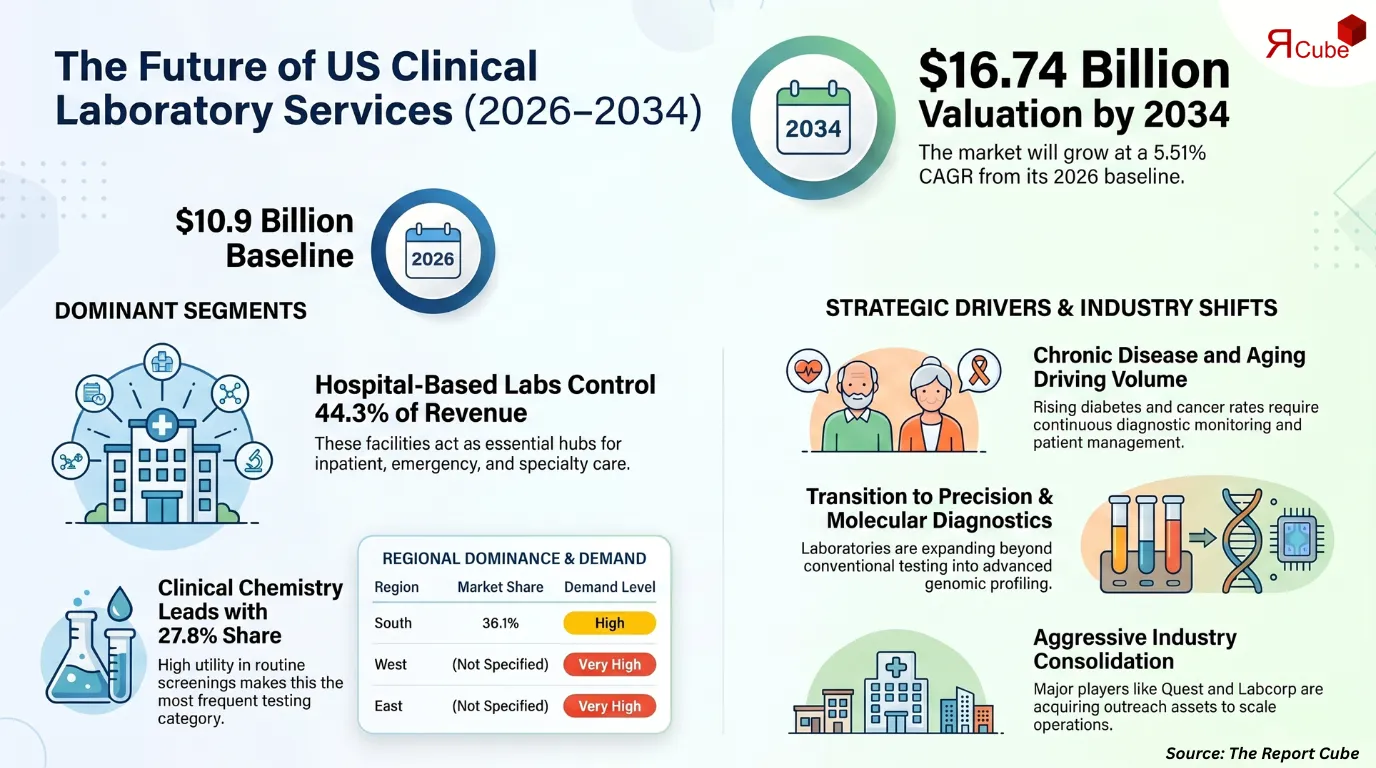
Clinical Chemistry segment leads the market with approximately 27.8% share.
By Service Provider:
Hospital-Based Laboratories segment dominates the market with nearly 44.3% of revenue.
Regional Outlook:
South region dominates the United States Clinical Laboratory Services market with around 36.1% share.
United States Clinical Laboratory Services Market Insights & Analysis
The United States Clinical Laboratory Services Market is anticipated to register a CAGR of around 5.51% during the forecast period 2026-2034. The market size is valued at USD 10.90 billion in 2026 and is projected to reach USD 16.74 billion by 2034. Clinical laboratories serve as the backbone of the U.S. healthcare system, supporting disease diagnosis, treatment selection, patient monitoring, and preventive care across nearly every medical specialty. Growing rates of cancer, cardiovascular disease, diabetes, autoimmune conditions, and infectious diseases continue to increase demand for both routine and advanced laboratory testing. Healthcare providers are placing greater emphasis on evidence-based clinical decision-making, making laboratory services an indispensable component of patient management. The market is also benefiting from broader insurance coverage for diagnostic services and growing awareness of early disease detection among patients and healthcare professionals.
The industry is undergoing a significant transformation as laboratory operators expand beyond conventional testing into molecular diagnostics, genomic profiling, and precision medicine applications. Large laboratory networks are strengthening their competitive position through strategic acquisitions, regional expansion, and investments in specialized testing capabilities. Recent transactions involving Quest Diagnostics, Labcorp, and Abbott Laboratories illustrate the industry's movement toward consolidation and service diversification. At the same time, healthcare systems are increasingly partnering with laboratory providers to improve operational efficiency, accelerate turnaround times, and expand access to specialized diagnostics. These developments are creating a more integrated testing ecosystem capable of supporting the evolving needs of physicians, hospitals, and patients across the United States.
US Clinical Laboratory Services Market Impact Analysis
| Factor | Type | Specific Impact on Market | Magnitude | Business Implication |
|---|---|---|---|---|
| Aging Population & Chronic Disease Burden | Market | More elderly patients drive higher test volumes for chronic care | High | Supports long term growth in routine and specialty diagnostics demand |
| Shift Toward Early Disease Detection | Consumer | Preventive screening increases need for high frequency lab testing | High | Encourages investment in panels targeting screening and risk stratification |
| Advances in Molecular & Genetic Testing | Technological | New assays raise complexity and value per test across segments | High | Creates premium revenue streams but requires capital for platforms |
| Ambiguous Regulations & Reimbursement Pressure | Regulatory | Unclear rules and cuts challenge pricing and test menu decisions | Medium | Necessitates active payer negotiation and rigorous cost management |
| Post COVID-19 Testing Normalization | Market | Pandemic surge recedes but leaves higher baseline diagnostic usage | Medium | Labs must rebalance capacity toward core and chronic disease testing |
| Laboratory Automation & Digital Health Adoption | Technological | Automation boosts throughput while digital tools streamline reporting | Medium | Improves unit economics but demands upfront technology investment |
| Economic Role and Consolidation Trends | Competitive | Sector adds jobs and GDP while large players expand market share | Medium | Favors scalable networks and partnerships to stay regionally relevant |
United States Clinical Laboratory Services Market Dynamics
Key Driver: Growing Demand for Early Disease Detection and Chronic Disease Management
The rising burden of chronic illnesses remains one of the strongest growth drivers for the US clinical laboratory services market. Diseases such as diabetes, cancer, chronic kidney disease, cardiovascular disorders, and autoimmune conditions require continuous diagnostic evaluation throughout the patient care journey. Laboratory testing plays a central role in identifying disease progression, measuring treatment effectiveness, and supporting long-term clinical management. As the U.S. population ages and chronic disease prevalence continues to increase, healthcare providers are ordering a higher volume of laboratory tests to support proactive and personalized treatment strategies.
Preventive healthcare initiatives are further strengthening testing demand across the country. Health systems and insurers are encouraging routine screenings to identify medical conditions at earlier stages when treatment outcomes are often more favorable and healthcare costs can be reduced. This shift toward preventive medicine has increased utilization of clinical chemistry, hematology, immunology, and cancer screening tests. The growing recognition that timely laboratory diagnostics contribute directly to improved patient outcomes continues to reinforce the importance of laboratory services throughout the healthcare continuum.
Industry Trends: Expansion of Precision Diagnostics and Laboratory Consolidation
One of the most influential trends shaping the clinical laboratory services industry in usa is the rapid adoption of precision diagnostics. Healthcare providers are increasingly utilizing molecular testing, genetic sequencing, and biomarker analysis to develop personalized treatment plans for patients. This trend is particularly visible in oncology, reproductive health, rare disease diagnostics, and transplant medicine, where highly specialized laboratory testing is becoming a standard component of clinical care. As scientific understanding of disease biology advances, laboratories are expanding their capabilities to support increasingly sophisticated diagnostic requirements.
Another notable trend is the continued consolidation of laboratory services across the healthcare sector. National laboratory providers are acquiring specialty laboratories, outreach testing networks, and hospital-affiliated diagnostic operations to broaden their geographic reach and service portfolios. These transactions create operational efficiencies, strengthen negotiating power with payers, and improve access to advanced testing services. The result is a market environment where large-scale providers are increasingly positioned to deliver comprehensive diagnostic solutions across physician offices, hospitals, and outpatient care settings.
Book your FREE 30-minute expert consultation today
Contact UsMajor Challenge: Reimbursement Complexity and Skilled Workforce Constraints
Although demand for laboratory testing continues to grow, reimbursement pressures remain a significant challenge for service providers. Clinical laboratories operate within a highly regulated payment environment where reimbursement rates are frequently reviewed by government programs and private insurers. Changes in payment policies can directly affect profitability, particularly for routine testing categories where pricing competition is intense. Laboratories must continuously balance cost management, technology investments, and service quality while adapting to evolving reimbursement frameworks.
The industry also faces an ongoing shortage of qualified laboratory professionals. Many healthcare organizations report difficulty recruiting and retaining experienced medical laboratory scientists, technicians, and pathology specialists. Workforce shortages can limit testing capacity and create operational strain during periods of elevated demand. At the same time, laboratories must comply with stringent quality standards, accreditation requirements, and regulatory oversight, increasing the need for specialized expertise. Addressing workforce development and talent retention remains a critical priority for sustaining long-term market growth.
Opportunity: Rising Adoption of Specialty and High-Value Diagnostic Testing
Specialty diagnostics represent one of the most attractive growth opportunities within the United States clinical laboratory services market. Healthcare providers are increasingly relying on advanced testing methods to guide treatment decisions in complex disease areas, including oncology, transplant medicine, infectious diseases, and inherited disorders. These specialized tests often provide clinically actionable insights that support personalized care and improve patient outcomes. As a result, laboratories with strong expertise in molecular diagnostics and genomic testing are well positioned to capture future market growth.
Expanding access to advanced diagnostics in community healthcare settings presents an additional opportunity. Patients and physicians increasingly expect convenient access to high-quality laboratory services regardless of location. Laboratory operators are responding by expanding patient service centers, strengthening hospital partnerships, and enhancing specimen collection networks. These initiatives improve accessibility while enabling providers to deliver specialized testing capabilities to a broader patient population. Continued investment in outreach services and regional laboratory infrastructure is expected to support sustained growth across both urban and non-urban markets.
United States Clinical Laboratory Services Market Segment-wise Analysis
By Test Type:
- Medical Microbiology Testing
- Immunology Testing
- Clinical Chemistry
- Cytology Testing
- Genetic Testing
- Drug of Abuse Testing
- Hematology Testing
- Other Esoteric Tests
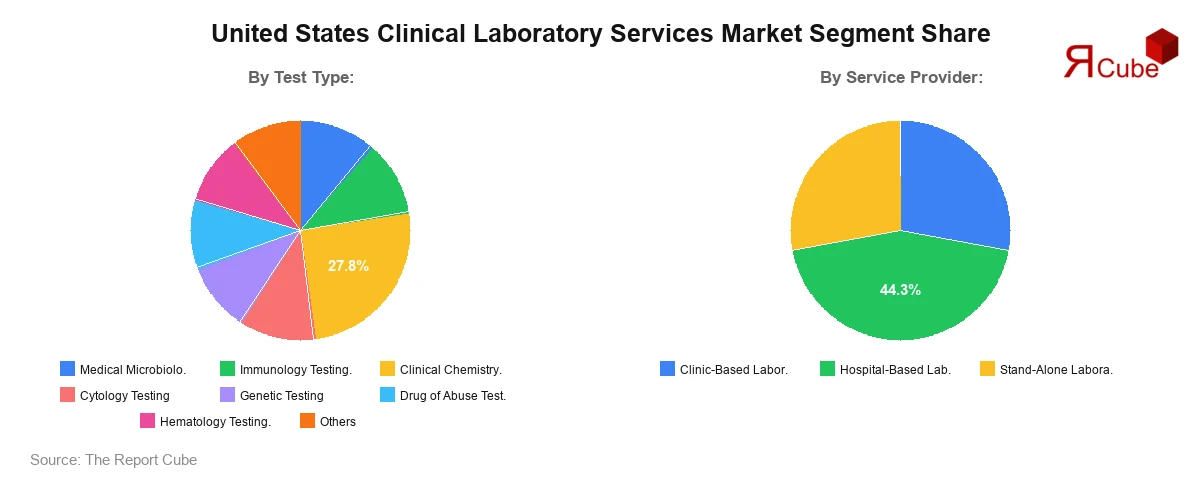
Clinical Chemistry remains the largest test category within the United States clinical laboratory services market, accounting for an estimated 27.8% share of total industry revenue. The segment's leadership is rooted in its broad clinical utility across preventive care, chronic disease management, emergency medicine, and inpatient treatment. Clinical chemistry testing provides essential information related to kidney function, liver health, electrolyte balance, endocrine disorders, metabolic conditions, and cardiovascular risk assessment. Because these tests are frequently ordered during routine medical evaluations, they generate substantial and recurring testing volumes across healthcare settings.
The segment also benefits from ongoing technological advancements that improve efficiency and diagnostic accuracy. Modern chemistry analyzers are capable of processing thousands of samples daily while maintaining high levels of consistency and reliability. Increasing prevalence of diabetes, obesity, hypertension, and metabolic disorders continues to support long-term demand for chemistry-based diagnostics. As healthcare providers focus more heavily on preventive care and chronic disease monitoring, clinical chemistry testing is expected to maintain its dominant position throughout the forecast period.
By Service Provider:
- Clinic-Based Laboratories
- Hospital-Based Laboratories
- Stand-Alone Laboratories
Hospital-Based Laboratories account for the largest share of the us clinical laboratory services market, representing approximately 44.3% of total revenue. These laboratories serve as critical diagnostic hubs for inpatient care, emergency services, surgical procedures, and specialty treatment programs. Their ability to provide rapid testing results and direct clinical integration makes them indispensable to hospital operations. Complex diagnostic services such as pathology, transplant testing, oncology diagnostics, and critical care laboratory testing are commonly performed within hospital laboratory environments.
Many healthcare systems continue to modernize laboratory infrastructure through automation, digital pathology platforms, and integrated laboratory information systems. These investments improve workflow efficiency while supporting rising testing volumes associated with aging populations and increasing disease burden. Hospital-based laboratories also benefit from strong physician relationships and direct access to patient records, allowing more coordinated clinical decision-making. Their central role in healthcare delivery continues to support market leadership despite increasing competition from stand-alone and reference laboratory providers.
Regional Projection of United States Clinical Laboratory Services Industry
- West
- East
- South
- Midwest
- Others
The South region holds the leading position in the United States clinical laboratory services market, accounting for approximately 36.1% of total revenue. Several factors contribute to this leadership, including a large and growing population, extensive healthcare infrastructure, and elevated prevalence of chronic health conditions. States such as Texas, Florida, Georgia, and North Carolina have experienced substantial healthcare expansion over the past decade, driving increased demand for diagnostic testing services across hospitals, physician offices, and independent laboratories.
The region also records higher incidences of diabetes, cardiovascular disease, obesity, and chronic kidney disease compared with several other parts of the country, creating sustained demand for laboratory diagnostics and disease monitoring services. In addition, ongoing investments in healthcare facilities, specialty clinics, and diagnostic laboratories are improving access to testing across metropolitan and community healthcare markets. The presence of major laboratory providers and large healthcare networks further strengthens the South's position as the largest regional contributor to the United States clinical laboratory services market growth.
Need insights for a specific region within this market?
Request Regional DataUS Clinical Laboratory Services Market Regional Analysis
The U.S. clinical laboratory services market shows varied regional patterns driven by demographics, payer mix, chronic disease burden, and health system consolidation.
| Cluster | Demand Level | Key Areas | System Dominance | Core Demand Logic | Growth Nature |
|---|---|---|---|---|---|
| West | Very High | CA, WA, OR metros | Reference & esoteric labs | Tech hubs and high insured base | Innovation and oncology-led growth |
| East | Very High | NY–NJ–MA corridor | Hospital outreach networks | Dense hospitals and specialists | Complex testing and aging demand |
| South | High | TX, FL, GA belts | Independent and chain labs | Fast population and chronic load | Volume-led and consolidation |
| Midwest | Medium | IL, OH, MI clusters | Health system core labs | Integrated IDNs and elderly base | Steady, efficiency-focused |
| Others (Rural & Remote) | Low to Medium | Frontier and rural states | POC and satellite collection | Access gaps and hub‑and‑spoke | Telehealth and outreach driven |
Government Initiatives & Policies
- Cancer Moonshot Initiative (2025 Expansion): The federal government continued expanding cancer screening accessibility and precision oncology programs through Cancer Moonshot initiatives, encouraging broader adoption of laboratory-based molecular and genomic testing across healthcare systems.
- CDC Laboratory Response Network Modernization Program (2026): The Centers for Disease Control and Prevention strengthened laboratory infrastructure investments to enhance infectious disease surveillance, diagnostic preparedness, and public health laboratory capabilities nationwide.
United States Clinical Laboratory Services Industry Recent Developments
- 2025: Abbott Laboratories announced the acquisition of Exact Sciences in a transaction valued at approximately USD 21 billion. The deal expands Abbott's oncology diagnostics portfolio by incorporating Cologuard, Oncotype DX, and other genomic testing capabilities, significantly strengthening its position within precision medicine and molecular diagnostics.
- 2025: Quest Diagnostics completed the acquisition of Spectra Laboratories' clinical testing assets from Fresenius Medical Care. The transaction enables Quest to enter the renal dialysis testing segment while supporting approximately 200,000 dialysis patients through expanded laboratory service offerings.
- 2025: Labcorp finalized the acquisition of Community Health Systems' outreach laboratory assets for approximately USD 194 million. The acquisition expands Labcorp's patient service network across 13 states and strengthens access to advanced specialty testing services in community healthcare markets.
Why Choose This Report?
- Provides a comprehensive overview of the overall market analysis, encompassing key trends, consumer behavior analysis, and risk assessment to support strategic decision-making.
- Provides accurate, up-to-date insights into market size, segmentation, and emerging opportunities, helping to minimize risk & capitalizing on growth.
- Gives deep understanding of target audience preferences, investment habits, and communication channels for enhanced product development & marketing effectiveness.
- Delivers competitive analysis & benchmarking, uncovering the strengths & weaknesses of market competitors to guide strategies.
- Consolidate comprehensive market intelligence, reducing reasoning & streamlining research efforts.
- Facilitates customized market segmentation & risk mitigation strategies, fine-tuned to the business objectives.
- Aids in identifying both market challenges & untapped opportunities within the industry to drive long-term business growth.
- Provides valuable information based on actual customer data & search trends.
Table of Contents
- Introduction
- Objective of the Study
- Product and Category Definition
- Market Segmentation
- Study Variables
- Research Methodology
- Secondary Data Points
- Breakdown of Secondary Sources
- Primary Data Points
- Breakdown of Primary Interviews
- Secondary Data Points
- Executive Summary
- Market Dynamics
- Emerging Opportunities
- Adoption Trends
- Demand Drivers
- Disruption Analysis (Challenges)
- Industry Analysis and Strategic Insights
- Supply and Value Chain Analysis
- Pricing Analysis
- Go-to-Market (GTM) Strategy
- BCG Matrix
- Recent Trends and Developments
- Regulatory and Policy Landscape
- Region-wise Policies
- Government Initiatives
- United States Clinical Laboratory Services Market Overview and Forecast Analysis (2021-2034)
- Market Size, By Value, By Growth Rate (CAGR/USD Billion)
- Market Share, By Test Type
- Medical Microbiology Testing
- Transplant Diagnostic Testing
- Infectious Disease Testing
- Others
- Immunology Testing
- Clinical Chemistry
- Endocrinology Chemistry Testing
- Routine Chemistry Testing
- Specialized Chemistry Testing
- Therapeutic Drug Monitoring Testing
- Others
- Cytology Testing
- Genetic Testing
- Drug of Abuse Testing
- Hematology Testing
- Other Esoteric Tests
- Medical Microbiology Testing
- Market Share, By Service Provider
- Clinic-Based Laboratories
- Hospital-Based Laboratories
- Stand-Alone Laboratories
- Market Share, By Application
- Neurological Disorders
- Infectious Diseases
- Cancer and Oncology Disorders
- Cardiovascular Diseases
- Autoimmune Diseases
- Kidney and Urinary Tract Disorders
- Women’s Health and Reproductive Health Disorders
- Gastrointestinal and Liver Disorders
- Diabetes and Metabolic Disorders
- Others
- Market Share, By Region
- West
- East
- South
- Midwest
- Others
- Market Share, By Company
- Revenue Shares and Analysis
- Competitive Landscape
- West United States Clinical Laboratory Services Market Overview and Forecast Analysis (2021-2034)
- Market Size, By Value, By Growth Rate (CAGR/USD Billion/Million)
- Market Share, By Test Type
- Market Share, By Service Provider
- Market Share, By Application
- East United States Clinical Laboratory Services Market Overview and Forecast Analysis (2021-2034)
- Market Size, By Value, By Growth Rate (CAGR/USD Billion/Million)
- Market Share, By Test Type
- Market Share, By Service Provider
- Market Share, By Application
- South United States Clinical Laboratory Services Market Overview and Forecast Analysis (2021-2034)
- Market Size, By Value, By Growth Rate (CAGR/USD Billion/Million)
- Market Share, By Test Type
- Market Share, By Service Provider
- Market Share, By Application
- Midwest United States Clinical Laboratory Services Market Overview and Forecast Analysis (2021-2034)
- Market Size, By Value, By Growth Rate (CAGR/USD Billion/Million)
- Market Share, By Test Type
- Market Share, By Service Provider
- Market Share, By Application
- Competitive Analysis, 2026
- Market Share of Key Players
- Competitive Mapping for Each Segment and Companies Operating Regionally
- West United States Clinical Laboratory Services Companies Share and Competitive Analysis, 2026
- East United States Clinical Laboratory Services Companies Share and Competitive Analysis, 2026
- South United States Clinical Laboratory Services Companies Share and Competitive Analysis, 2026
- Midwest United States Clinical Laboratory Services Companies Share and Competitive Analysis, 2026
- Company Profile (Partial List)
- NeoGenomics Laboratories
- Company Overview
- Product Portfolio
- Strategic Alliances and Partnerships
- Recent Developments
- Labcorp (Laboratory Corporation of America)
- Company Overview
- Product Portfolio
- Strategic Alliances and Partnerships
- Recent Developments
- IDEXX Laboratories
- Company Overview
- Product Portfolio
- Strategic Alliances and Partnerships
- Recent Developments
- Siemens Medical Solutions USA, Inc.
- Company Overview
- Product Portfolio
- Strategic Alliances and Partnerships
- Recent Developments
- Quest Diagnostics
- Company Overview
- Product Portfolio
- Strategic Alliances and Partnerships
- Recent Developments
- Natera
- Company Overview
- Product Portfolio
- Strategic Alliances and Partnerships
- Recent Developments
- ARUP Laboratories
- Company Overview
- Product Portfolio
- Strategic Alliances and Partnerships
- Recent Developments
- OPKO Health, Inc.
- Company Overview
- Product Portfolio
- Strategic Alliances and Partnerships
- Recent Developments
- Mayo Clinic Laboratories
- Company Overview
- Product Portfolio
- Strategic Alliances and Partnerships
- Recent Developments
- BioReference Laboratories
- Company Overview
- Product Portfolio
- Strategic Alliances and Partnerships
- Recent Developments
- Others (Partial List)
- NeoGenomics Laboratories
- Contact Us and Disclaimer
Top Key Players & Market Share Outlook
- NeoGenomics Laboratories
- Labcorp (Laboratory Corporation of America)
- IDEXX Laboratories
- Siemens Medical Solutions USA, Inc.
- Quest Diagnostics
- Natera
- ARUP Laboratories
- OPKO Health, Inc.
- Mayo Clinic Laboratories
- BioReference Laboratories
Frequently Asked Questions






