



Build Your Custom Market Intelligence Report
Customize Your ReportSouth Korea Laboratory Automation Market Key Highlights
By Application:
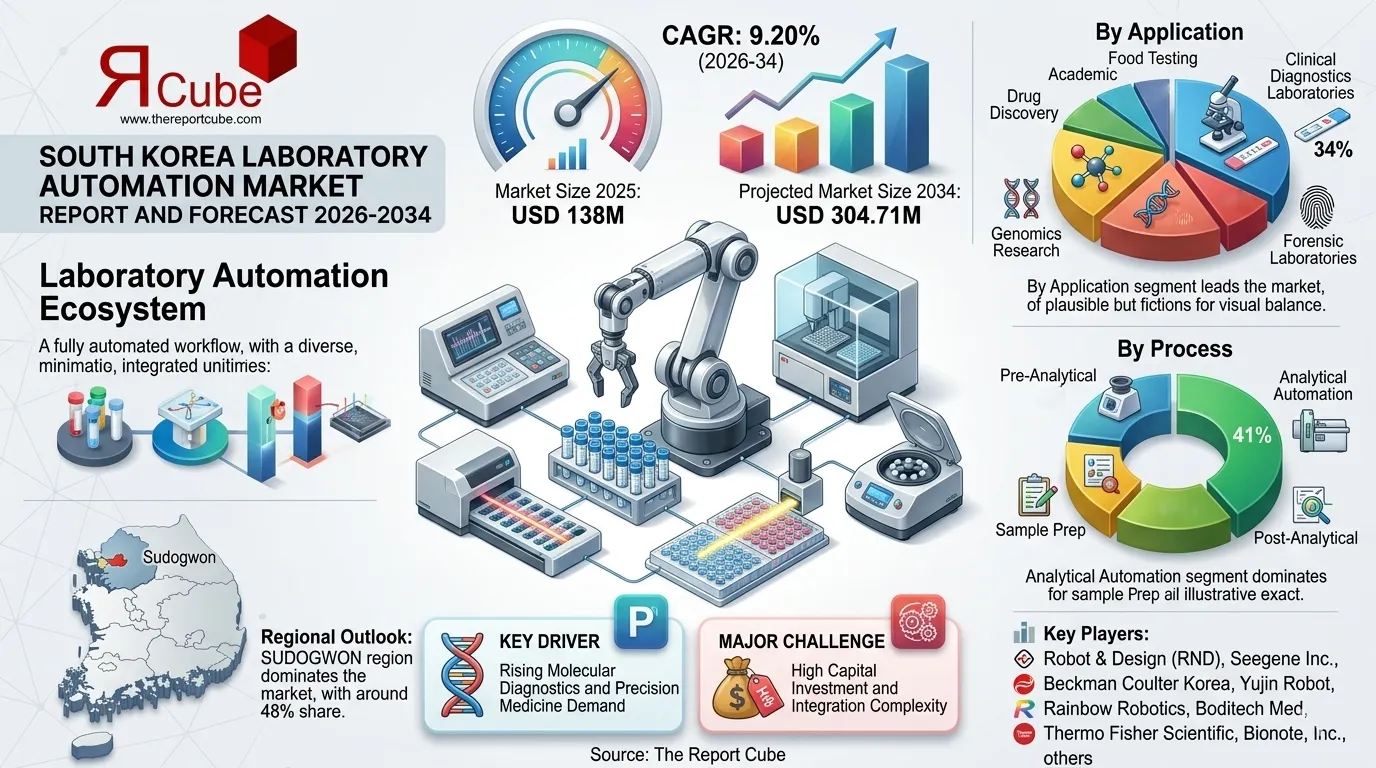
Clinical Diagnostics Laboratories segment leads the market, with around 34% share.
By Process:
Analytical Automation segment dominates the market, accounting for nearly 41% of total revenue.
Regional Outlook:
Sudogwon region dominates the south korea laboratory automation market, with around 48% share.
Government Initiatives & Policies
- Korean New Deal - Digital Healthcare Innovation Strategy (Updated 2026 Roadmap): Supports AI-based diagnostics, smart hospitals, and laboratory automation infrastructure modernization.
- Bio-Health Industry Innovation Strategy 2025+ (Ministry of Trade, Industry and Energy): Promotes automation in pharmaceutical R&D and smart manufacturing facilities.
South Korea Laboratory Automation Market Insights & Analysis
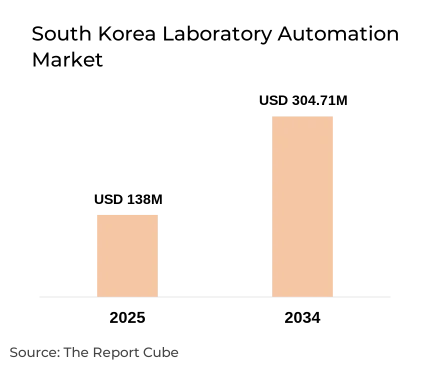
The South Korea Laboratory Automation Market is anticipated to register a CAGR: 9.20% during 2026-34. The market size was valued at USD 138 million in 2025 and is projected to reach USD 304.71 million by 2034. Rising molecular diagnostics demand, expansion of biopharmaceutical research, and hospital digital transformation programs are reshaping laboratory infrastructure across the country.
South Korea’s healthcare system processes over 600 million outpatient visits annually, generating substantial diagnostic workloads. Clinical laboratories are under pressure to reduce turnaround times while maintaining precision and compliance. Automation platforms are addressing workforce shortages, minimizing human error, and enabling 24/7 operational continuity. By 2025, more than 55% of tertiary hospitals in Sudogwon had integrated some form of automated sample handling or analytical system, reflecting strong capital investment in smart laboratory ecosystems.
The pharmaceutical and biotechnology sector further strengthens automation adoption. South Korea’s biopharma exports surpassed USD 13 billion recently, increasing demand for high-throughput screening, quality control, and data-integrated laboratory systems. Pharmaceutical R&D labs are increasingly deploying automated liquid handling systems and robotic workcells to accelerate drug discovery timelines. Automation reduces manual pipetting errors by nearly 40% and improves reproducibility, which is critical for regulatory compliance and global clinical trials.
Artificial intelligence integration within laboratory information systems (LIS) is another structural driver. AI-assisted analytics streamline diagnostic interpretation, detect anomalies in real time, and enhance predictive maintenance of instruments. This convergence of robotics, analytics, and cloud-enabled data exchange positions South Korea as a technology-forward laboratory automation market in Asia-Pacific, supported by strong domestic robotics manufacturing and semiconductor expertise.
South Korea Laboratory Automation Market Dynamics
Key Driver: Rising Molecular Diagnostics and Precision Medicine Demand
South Korea has experienced sustained growth in molecular diagnostics, particularly PCR and genetic testing. The volume of molecular tests expanded by more than 18% year-over-year across major metropolitan laboratories, increasing reliance on automated workflows. Automation reduces sample contamination risk and standardizes complex PCR procedures. Precision medicine initiatives in oncology and infectious disease management are also driving automation adoption, as laboratories must process high sample volumes with consistent quality. Additionally, reimbursement frameworks increasingly favor efficiency and accuracy, encouraging hospitals to invest in total laboratory automation systems that reduce operational costs over time.
Book your FREE 30-minute expert consultation today
Contact UsIndustry Trends: Integration of Robotics and AI-Enabled Data Platforms
Collaborations between robotics firms and diagnostics companies are redefining laboratory workflows. Korean robotics manufacturers are developing compact robotic arms optimized for laboratory bench environments. AI-driven analytics platforms are enabling predictive diagnostics and workflow optimization. Laboratories are moving toward modular systems that allow phased upgrades rather than full infrastructure replacement. Cloud-based LIS platforms enhance interoperability across hospital networks, facilitating centralized data monitoring. The convergence of automation hardware with intelligent software ecosystems is becoming a defining trend, strengthening scalability and operational resilience.
Major Challenge: High Capital Investment and Integration Complexity
Initial capital expenditure for total laboratory automation systems can exceed USD 1 million for large hospitals, limiting adoption among smaller institutions. Integration of legacy equipment with modern automation platforms presents technical challenges, often requiring customized interfaces and specialized engineering support. Training laboratory personnel to manage automated workflows also demands time and financial resources. Data security concerns related to cloud-based systems add compliance complexities. These factors may slow deployment in regional facilities outside major urban centers, where budget constraints remain significant.
Opportunity: Expansion of Smart Hospitals and Biopharmaceutical Manufacturing
South Korea’s smart hospital initiatives are creating structured demand for fully automated diagnostic environments. Government-backed investments in digital hospitals aim to reduce patient waiting times by 30% and improve operational efficiency. Biopharmaceutical manufacturing clusters in Yeongnam and Hoseo are integrating automated quality control laboratories to meet export standards. Contract research organizations are also scaling automation to attract international clinical trial partnerships. These structural investments create long-term opportunities for modular automation suppliers and software providers.
South Korea Laboratory Automation Market Segment-wise Analysis
By Application:
- Clinical Diagnostics Laboratories
- Hospital Laboratories
- Pharmaceutical and Biotechnology R&D
- Academic and Research Institutes
- Contract Research Organizations
- Industrial and Manufacturing Laboratories
Clinical Diagnostics Laboratories lead with approximately 34% revenue share in 2025. Increasing test volumes, particularly in infectious diseases and oncology diagnostics, require automated pre-analytical and analytical workflows. Automated analyzers reduce turnaround times by up to 35%, enhancing patient throughput. Large diagnostic chains are implementing centralized automation hubs that process thousands of samples daily. Growing health screening programs and preventive medicine initiatives further expand diagnostic workloads, reinforcing segment leadership.
By Process:
- Pre-analytical Automation
- Analytical Automation
- Post-analytical Automation
Analytical Automation accounts for nearly 41% of total revenue, reflecting heavy investment in high-precision analyzers and PCR platforms. Automated analyzers ensure consistent reagent handling, minimize human variability, and enhance throughput efficiency. Molecular diagnostic labs increasingly adopt fully automated PCR systems to streamline complex workflows. Integration with LIS platforms enables real-time quality control monitoring and automated reporting. This segment benefits from continuous innovation in high-sensitivity testing technologies.
Regional Projection of South Korea Laboratory Automation Industry
- Sudogwon
- Yeongnam
- Honam
- Hoseo
- Gwandong
Sudogwon dominates with around 48% market share, supported by Seoul’s dense hospital network and research institutes. Major tertiary hospitals and biotechnology firms are concentrated in this region, driving automation demand. Yeongnam follows due to pharmaceutical manufacturing clusters in Busan and Daegu. Hoseo is witnessing rising automation adoption linked to semiconductor and industrial research laboratories. Regional growth patterns align closely with healthcare infrastructure density and industrial R&D investments.
South Korea Laboratory Automation Market Recent Developments
- 2025: Seegene Inc. unveiled CURECA™, the world’s first fully unattended PCR automation system, along with STAgora™, a real-time analytics platform at ADLM 2025, enabling end-to-end automated PCR workflows and data-driven diagnostics optimization.
Need insights for a specific region within this market?
Request Regional DataWhy Choose This Report?
- Provides a comprehensive overview of the overall market analysis, encompassing key trends, consumer behavior analysis, and risk assessment to support strategic decision-making.
- Provides accurate, up-to-date insights into market size, segmentation, and emerging opportunities, helping to minimize risk & capitalizing on growth.
- Gives deep understanding of target audience preferences, investment habits, and communication channels for enhanced product development & marketing effectiveness.
- Delivers competitive analysis & benchmarking, uncovering the strengths & weaknesses of market competitors to guide strategies.
- Consolidate comprehensive market intelligence, reducing reasoning & streamlining research efforts.
- Facilitates customized market segmentation & risk mitigation strategies, fine-tuned to the business objectives.
- Aids in identifying both market challenges & untapped opportunities within the industry to drive long-term business growth.
- Provides valuable information based on actual customer data & search trends.
Table of Contents
- Introduction
- Objective of the Study
- Product and Category Definition
- Market Segmentation
- Study Variables
- Research Methodology
- Secondary Data Points
- Breakdown of Secondary Sources
- Primary Data Points
- Breakdown of Primary Interviews
- Secondary Data Points
- Executive Summary
- Market Dynamics
- Drivers
- Challenges
- Opportunity Assessment
- Recent Trends and Developments
- Regulatory and Policy Landscape
- South Korea Laboratory Automation Market Overview (2021-2034)
- Market Size, By Value (USD Million)
- Market Share, By Application
- Clinical Diagnostics Laboratories
- Hospital Laboratories
- Pharmaceutical and Biotechnology R&D
- Academic and Research Institutes
- Contract Research Organizations
- Industrial and Manufacturing Laboratories
- Market Share, By Process
- Pre-analytical Automation
- Analytical Automation
- Post-analytical Automation
- Market Share, By System Type
- Total Laboratory Automation Systems
- Modular Laboratory Automation Systems
- Workcell Automation
- Market Share, By Equipment
- Automated Robotic Systems
- Automated Liquid Handling Systems
- Automated Sample Storage and Retrieval
- Automated Incubation and Imaging Systems
- Automated Analyzers
- Automated Transport and Conveyors
- Laboratory Information Systems and Software
- Market Share, By End User
- Hospitals and Diagnostic Centers
- Pharmaceutical and Biotechnology Companies
- Academic and Research Institutes
- Others
- Market Share, By Region
- Sudogwon
- Yeongnam
- Honam
- Hoseo
- Gwandong
- Market Share, By Company
- Revenue Shares and Analysis
- Competitive Landscape
- Sudogwon South Korea Laboratory Automation Market
- Market Size, By Value (USD Million)
- Market Share, By Application
- Market Share, By Process
- Market Share, By System Type
- Market Share, By Equipment
- Market Share, By End User
- Yeongnam South Korea Laboratory Automation Market
- Market Size, By Value (USD Million)
- Market Share, By Application
- Market Share, By Process
- Market Share, By System Type
- Market Share, By Equipment
- Market Share, By End User
- Honam South Korea Laboratory Automation Market
- Market Size, By Value (USD Million)
- Market Share, By Application
- Market Share, By Process
- Market Share, By System Type
- Market Share, By Equipment
- Market Share, By End User
- Hoseo South Korea Laboratory Automation Market
- Market Size, By Value (USD Million)
- Market Share, By Application
- Market Share, By Process
- Market Share, By System Type
- Market Share, By Equipment
- Market Share, By End User
- Gwandong South Korea Laboratory Automation Market
- Market Size, By Value (USD Million)
- Market Share, By Application
- Market Share, By Process
- Market Share, By System Type
- Market Share, By Equipment
- Market Share, By End User
- Competitive Outlook and Company Profiles
- Robot & Design (RND)
- Company Overview
- Product Portfolio
- Strategic Alliances/Partnerships
- Recent Developments
- Seegene Inc.
- Company Overview
- Product Portfolio
- Strategic Alliances/Partnerships
- Recent Developments
- Beckman Coulter Korea
- Company Overview
- Product Portfolio
- Strategic Alliances/Partnerships
- Recent Developments
- Yujin Robot
- Company Overview
- Product Portfolio
- Strategic Alliances/Partnerships
- Recent Developments
- Rainbow Robotics
- Company Overview
- Product Portfolio
- Strategic Alliances/Partnerships
- Recent Developments
- Boditech Med
- Company Overview
- Product Portfolio
- Strategic Alliances/Partnerships
- Recent Developments
- Thermo Fisher Scientific
- Company Overview
- Product Portfolio
- Strategic Alliances/Partnerships
- Recent Developments
- Bionote, Inc.
- Company Overview
- Product Portfolio
- Strategic Alliances/Partnerships
- Recent Developments
- Jeio Tech
- Company Overview
- Product Portfolio
- Strategic Alliances/Partnerships
- Recent Developments
- K-MAC (Korea Materials)
- Company Overview
- Product Portfolio
- Strategic Alliances/Partnerships
- Recent Developments
- DKSH Korea
- Company Overview
- Product Portfolio
- Strategic Alliances/Partnerships
- Recent Developments
- LG Electronics (CLOi)
- Company Overview
- Product Portfolio
- Strategic Alliances/Partnerships
- Recent Developments
- Roche Diagnostics Korea
- Company Overview
- Product Portfolio
- Strategic Alliances/Partnerships
- Recent Developments
- Abbott Korea
- Company Overview
- Product Portfolio
- Strategic Alliances/Partnerships
- Recent Developments
- Sysmex Korea
- Company Overview
- Product Portfolio
- Strategic Alliances/Partnerships
- Recent Developments
- Takara Korea Biomedical
- Company Overview
- Product Portfolio
- Strategic Alliances/Partnerships
- Recent Developments
- Bioneer Corporation
- Company Overview
- Product Portfolio
- Strategic Alliances/Partnerships
- Recent Developments
- Robot & Design (RND)
- Contact Us and Disclaimer
Top Key Players & Market Share Outlook
- Robot & Design (RND)
- Seegene Inc.
- Beckman Coulter Korea
- Yujin Robot
- Rainbow Robotics
- Boditech Med
- Thermo Fisher Scientific
- Bionote, Inc.
- Jeio Tech
- K-MAC (Korea Materials)
- DKSH Korea
- LG Electronics (CLOi)
- Roche Diagnostics Korea
- Abbott Korea
- Sysmex Korea
- Takara Korea Biomedical
- Bioneer Corporation
Frequently Asked Questions






