



Build Your Custom Market Intelligence Report
Customize Your ReportUAE Robotics and Automation In Manufacturing Market Insights & Analysis
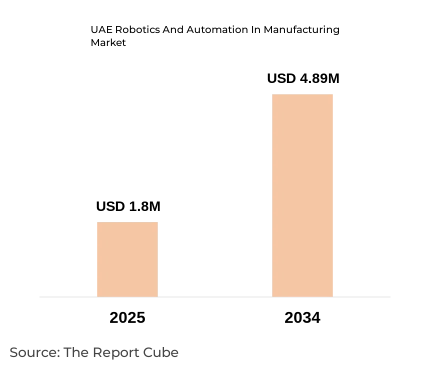
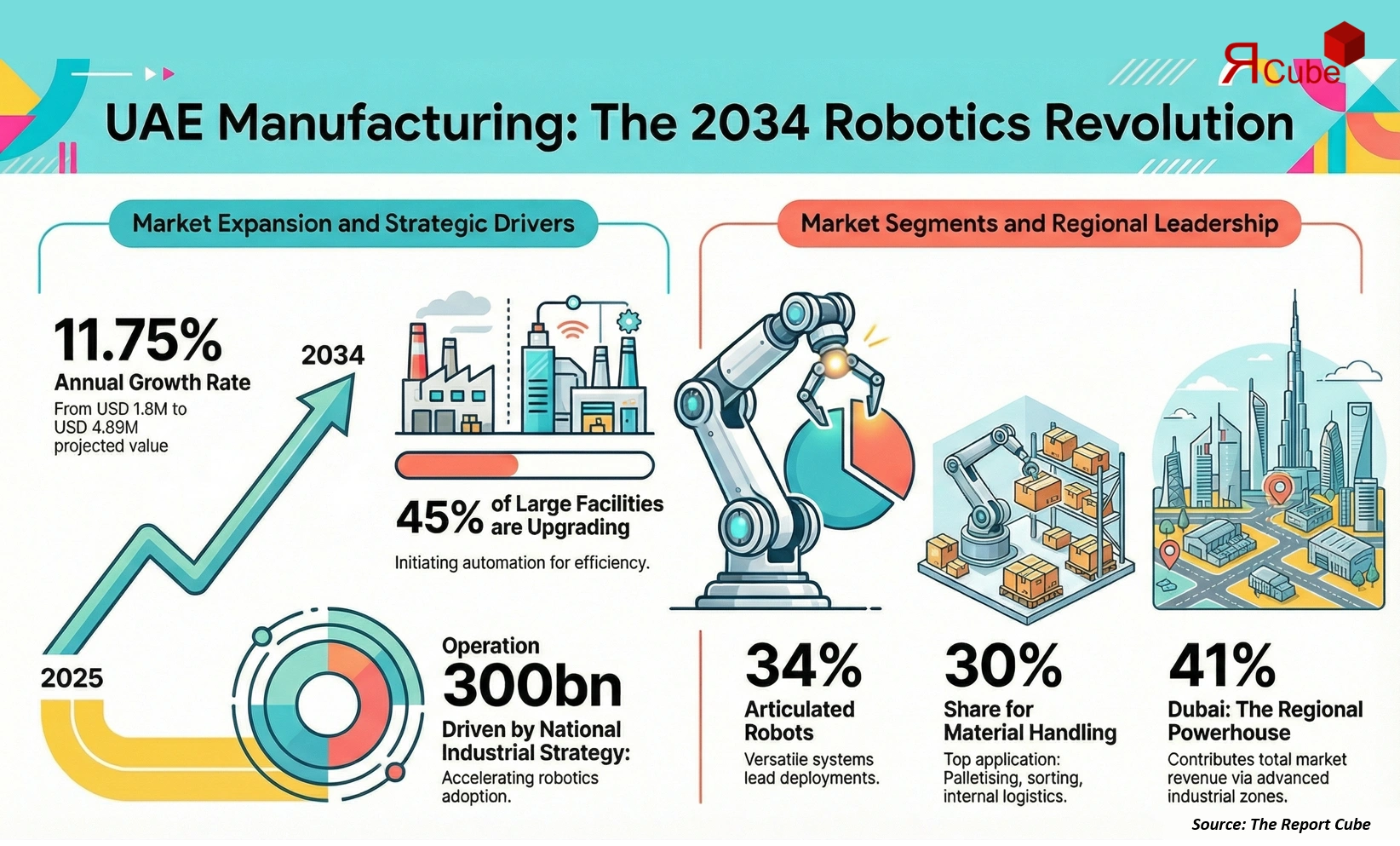
The UAE Robotics and Automation In Manufacturing Market is anticipated to register a CAGR of 11.75% during 2026-2034. The market size was valued at USD 1.8 million in 2025 and is projected to reach USD 4.89 million by 2034. The market is gaining strong momentum as manufacturers across the UAE accelerate investments in smart factories, precision manufacturing, and labor-efficient production systems. Robotics and automation technologies are increasingly viewed as strategic enablers for improving productivity, consistency, and global competitiveness within the country’s manufacturing sector.
Growth is closely aligned with the UAE’s broader industrial diversification agenda, which aims to reduce dependence on oil revenues by strengthening advanced manufacturing capabilities. Automation adoption is rising across automotive components, electronics assembly, food processing, and metal fabrication, driven by the need for higher throughput and reduced error rates. Manufacturers are increasingly integrating robotics with industrial IoT platforms, enabling real-time monitoring, predictive maintenance, and enhanced operational transparency.
Furthermore, rising labor costs, skill shortages in repetitive tasks, and stringent quality requirements are reinforcing the shift toward robotics-driven manufacturing. As local manufacturers transition from semi-automated to fully automated production lines, demand for advanced robotic systems, software platforms, and integration services is expected to grow steadily through 2034.
UAE Robotics and Automation In Manufacturing Market Recent Developments
- 2025: ABB expanded its robotics service hub in the UAE to support advanced manufacturing automation projects.
- 2025: Siemens introduced digital twin-enabled automation solutions for UAE-based smart factories.
Government Initiatives & Policies
- Operation 300bn: UAE industrial strategy supporting advanced manufacturing and automation adoption.
- UAE Industry 4.0 Program: National initiative promoting robotics, AI, and smart manufacturing systems.
UAE Robotics and Automation In Manufacturing Market Dynamics
Key Driver: Strong Push Toward Smart Manufacturing and Industrial Diversification
The UAE’s strategic push toward smart manufacturing is the primary driver accelerating robotics and automation adoption. Government-backed industrial programs encourage manufacturers to modernize production lines using advanced robotics, AI-driven controls, and data-centric systems. Nearly 45% of large manufacturing facilities in the UAE have initiated automation upgrades to improve efficiency and reduce dependency on manual labor. Robotics enables consistent product quality, reduced downtime, and enhanced safety, making it a preferred investment for high-value manufacturing operations. This alignment between national industrial goals and private-sector modernization is sustaining robust market demand.
Book your FREE 30-minute expert consultation today
Contact UsIndustry Trends: Rising Adoption of Collaborative Robots and Integrated Automation
Collaborative robots and integrated automation platforms are emerging as key industry trends. Manufacturers increasingly favor cobot systems due to their flexibility, lower installation costs, and ability to operate alongside human workers. These systems are particularly popular among small and mid-sized manufacturers transitioning toward automation. Additionally, the integration of robotics with software platforms for analytics, machine vision, and predictive maintenance is becoming standard practice. This convergence enhances production agility and supports mass customization, reinforcing automation as a long-term operational strategy.
Major Challenge: High Initial Investment and Integration Complexity
Despite strong growth prospects, high upfront costs remain a significant challenge for market expansion. Advanced robotic systems require substantial capital investment, along with skilled integration and maintenance support. Many small manufacturers face difficulties justifying return on investment, especially when production volumes are inconsistent. Integration complexity with legacy systems further increases project timelines and costs. These factors can delay automation adoption, particularly among price-sensitive industrial segments.
Opportunity: Expansion of Automation in Non-Automotive Manufacturing Sectors
The expansion of robotics into non-automotive sectors presents a major growth opportunity. Industries such as food and beverage, logistics, and electronics assembly are increasingly deploying robots for packaging, palletizing, and quality inspection. These sectors value automation for hygiene compliance, speed, and traceability. As awareness of automation benefits grows and modular solutions become more affordable, adoption across diverse manufacturing verticals is expected to accelerate, driving sustained market expansion.
UAE Robotics and Automation In Manufacturing Market Segment-wise Analysis
By Robot Type:
- Articulated Robots
- SCARA Robots
- Cartesian Robots
- Cobot Systems
Articulated robots dominate the UAE market, accounting for approximately 34% of total deployments in 2025. Their versatility, multi-axis movement, and suitability for welding, assembly, and material handling make them ideal for complex manufacturing processes. Automotive and metal fabrication facilities are key adopters, leveraging articulated robots to improve precision and cycle times. SCARA and Cartesian robots are widely used for high-speed, repetitive tasks, while cobot systems are gaining momentum among smaller manufacturers.
By Application:
- Material Handling
- Welding Automation
- Assembly Automation
- Quality Inspection
Material handling represents the leading application segment, holding nearly 30% market share in 2025. Robots are increasingly deployed for palletizing, sorting, and internal logistics to improve throughput and workplace safety. Welding and assembly automation follow closely, driven by demand for consistent quality and reduced rework. Quality inspection applications are also expanding as manufacturers adopt machine vision and AI-enabled inspection systems.
Regional Projection of UAE Robotics And Automation In Manufacturing Industry
- Dubai
- Abu Dhabi
- Sharjah
- Northern Emirates
Dubai leads the UAE Robotics and Automation In Manufacturing Market, contributing approximately 41% of total market revenue in 2025. The emirate benefits from advanced industrial zones, strong foreign investment, and early adoption of smart factory initiatives. Abu Dhabi follows with growing investments in heavy manufacturing and energy-related industries. Sharjah and the Northern Emirates are gradually increasing automation adoption, supported by industrial cluster development and SME-focused manufacturing growth.
Need insights for a specific region within this market?
Request Regional DataWhy Choose This Report?
- Provides a comprehensive overview of the overall market analysis, encompassing key trends, consumer behavior analysis, and risk assessment to support strategic decision-making.
- Provides accurate, up-to-date insights into market size, segmentation, and emerging opportunities, helping to minimize risk & capitalizing on growth.
- Gives deep understanding of target audience preferences, investment habits, and communication channels for enhanced product development & marketing effectiveness.
- Delivers competitive analysis & benchmarking, uncovering the strengths & weaknesses of market competitors to guide strategies.
- Consolidate comprehensive market intelligence, reducing reasoning & streamlining research efforts.
- Facilitates customized market segmentation & risk mitigation strategies, fine-tuned to the business objectives.
- Aids in identifying both market challenges & untapped opportunities within the industry to drive long-term business growth.
- Provides valuable information based on actual customer data & search trends.
Table of Contents
- Introduction
- Objective of the Study
- Product and Category Definition
- Market Segmentation
- Study Variables
- Research Methodology
- Secondary Data Points
- Breakdown of Secondary Sources
- Primary Data Points
- Breakdown of Primary Interviews
- Secondary Data Points
- Executive Summary
- Market Dynamics
- Drivers
- Challenges
- Opportunity Assessment
- Recent Trends and Developments
- Regulatory and Policy Landscape
- UAE Robotics and Automation in Manufacturing Market Overview (2020-2034)
- Market Size, By Value (USD Million)
- Market Share, By Robot Type
- Articulated Robots
- SCARA Robots
- Cartesian Robots
- Cobot Systems
- AGV/AMR Systems
- Market Share, By Application
- Material Handling
- Welding Automation
- Assembly Automation
- Painting/Coating
- Quality Inspection
- Market Share, By Component
- Hardware Systems
- Software Platforms
- Services & Integration
- Market Share, By Industry
- Automotive Manufacturing
- Food & Beverage
- Metals & Machinery
- Electronics Assembly
- Logistics & Warehousing
- Market Share, By Region
- Dubai
- Abu Dhabi
- Sharjah
- Northerns
- Market Share, By Company
- Revenue Shares
- Competitive Landscape
- Dubai Manufacturing Robotics Market
- Market Size, By Value (USD Million)
- Market Share, By Robot Type
- Market Share, By Application
- Market Share, By Component
- Market Share, By Industry
- Abu Dhabi Manufacturing Robotics Market
- Market Size, By Value (USD Million)
- Market Share, By Robot Type
- Market Share, By Application
- Market Share, By Component
- Market Share, By Industry
- Sharjah Manufacturing Robotics Market
- Market Size, By Value (USD Million)
- Market Share, By Robot Type
- Market Share, By Application
- Market Share, By Component
- Market Share, By Industry
- Northerns Saudi Manufacturing Robotics Market
- Market Size, By Value (USD Million)
- Market Share, By Robot Type
- Market Share, By Application
- Market Share, By Component
- Market Share, By Industry
- Competitive Outlook and Company Profiles
- ABB Ltd.
- Company Overview
- Product Portfolio
- Strategic Alliances/Partnerships
- Recent Developments
- FANUC Corporation
- Company Overview
- Product Portfolio
- Strategic Alliances/Partnerships
- Recent Developments
- Yaskawa Electric
- Company Overview
- Product Portfolio
- Strategic Alliances/Partnerships
- Recent Developments
- KUKA AG
- Company Overview
- Product Portfolio
- Strategic Alliances/Partnerships
- Recent Developments
- Kawasaki Robotics
- Company Overview
- Product Portfolio
- Strategic Alliances/Partnerships
- Recent Developments
- Mitsubishi Electric
- Company Overview
- Product Portfolio
- Strategic Alliances/Partnerships
- Recent Developments
- Siemens AG
- Company Overview
- Product Portfolio
- Strategic Alliances/Partnerships
- Recent Developments
- Omron Corporation
- Company Overview
- Product Portfolio
- Strategic Alliances/Partnerships
- Recent Developments
- Rockwell Automation
- Company Overview
- Product Portfolio
- Strategic Alliances/Partnerships
- Recent Developments
- Schneider Electric
- Company Overview
- Product Portfolio
- Strategic Alliances/Partnerships
- Recent Developments
- Others
- ABB Ltd.
- Contact Us and Disclaimer
Top Key Players & Market Share Outlook
- ABB Ltd.
- FANUC Corporation
- Yaskawa Electric
- KUKA AG
- Kawasaki Robotics
- Mitsubishi Electric
- Siemens AG
- Omron Corporation
- Rockwell Automation
- Schneider Electric
- Others
Frequently Asked Questions






