



Build Your Custom Market Intelligence Report
Customize Your ReportSouth Korea Cloud API Market Key Highlights
By API Type:
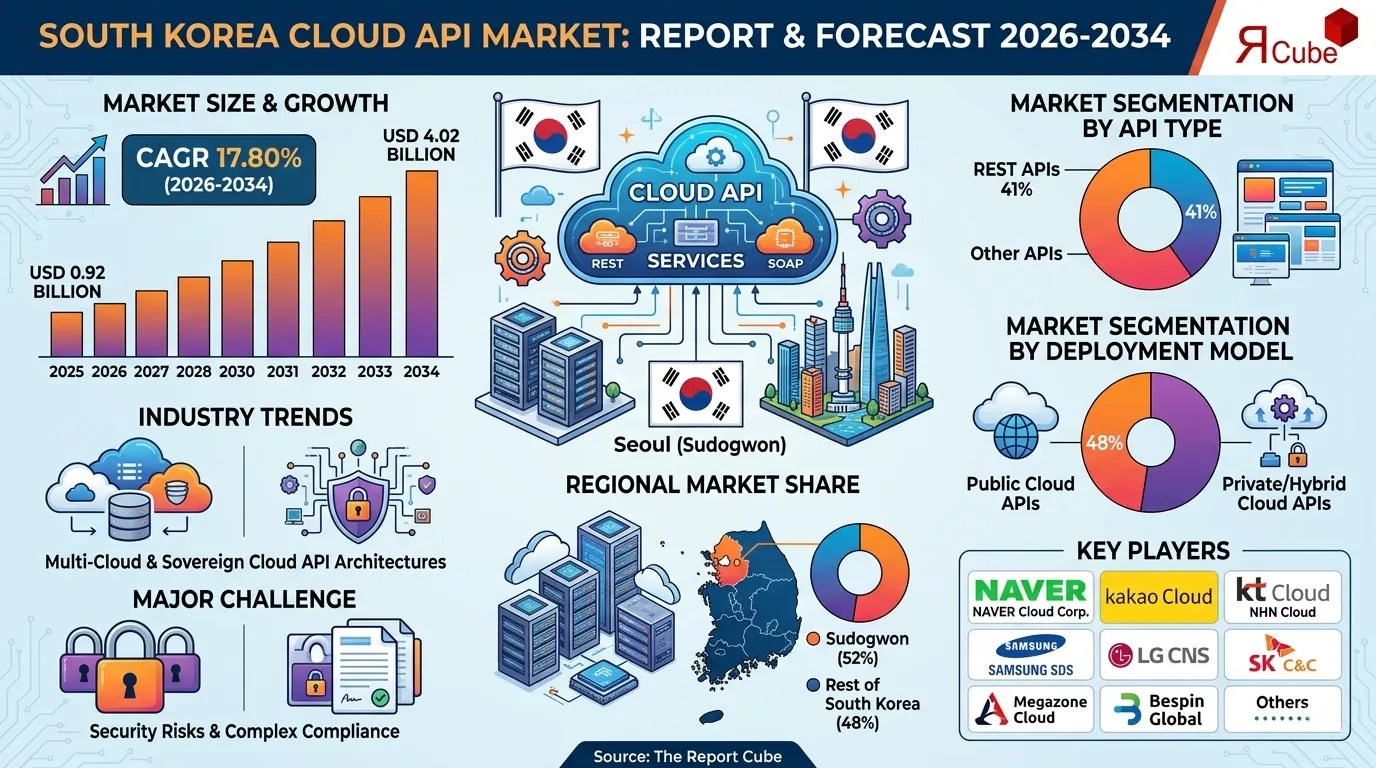
REST APIs segment leads the market, with around 41% share.
By Deployment Model:
Public Cloud APIs segment dominates the market, accounting for nearly 48% of total revenue.
Regional Outlook:
Sudogwon region dominates the south korea cloud api market, with around 52% share.
Government Initiatives & Policies
- K-Digital Platform Government Cloud Expansion Program (2025 Update): The Ministry of Science and ICT expanded national API integration standards and cloud-native adoption across public institutions to accelerate AI and API-based digital services.
- Digital Platform Government (DPG) Roadmap 2.0 (2025-2027): Strengthens open API interoperability across ministries and mandates cloud-first procurement policies for new public IT systems.
South Korea Cloud API Market Insights & Analysis
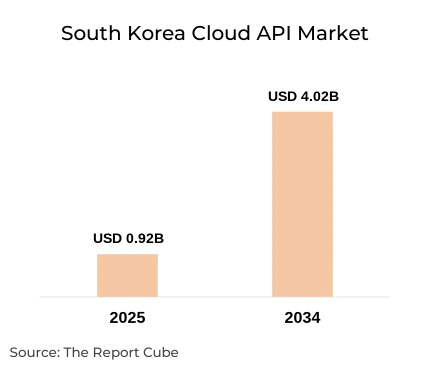
The South Korea Cloud API Market is anticipated to register a CAGR 17.80% during 2026-34. The market size was valued at USD 0.92 billion in 2025 and is projected to reach USD 4.02 billion by 2034. South Korea’s advanced digital infrastructure, high internet penetration exceeding 97%, and strong enterprise digitization momentum are fueling rapid adoption of API-driven cloud ecosystems.
Cloud APIs are becoming the backbone of Korea’s AI-powered service economy. Enterprises across finance, telecom, manufacturing, and e-commerce are embedding API gateways, microservices architecture, and AI-enabled integration frameworks to streamline application development. By 2025, more than 78% of large Korean enterprises had adopted hybrid or multi-cloud strategies, creating strong demand for API orchestration and interoperability layers. This shift supports seamless integration between on-premise legacy systems and hyperscale public cloud environments.
South Korea’s thriving startup ecosystem and digital-native conglomerates are also reshaping API consumption. Financial institutions are expanding open banking APIs, while telecom providers are launching 5G-enabled edge APIs to power IoT services. Manufacturing firms are integrating industrial IoT platforms through cloud APIs to optimize predictive maintenance and real-time production analytics. The rise of generative AI applications further intensifies API traffic volumes, as enterprises rely on scalable API management systems to handle millions of concurrent requests with low latency.
Investment in hyperscale data centers across Sudogwon and Yeongnam is strengthening backend cloud infrastructure. Domestic cloud providers are competing aggressively with global hyperscalers by offering sovereign cloud capabilities, regulatory compliance advantages, and localized AI API services. As South Korea continues positioning itself as a regional AI innovation hub, the cloud API layer is emerging as a strategic digital infrastructure component underpinning enterprise transformation and public digital services.
South Korea Cloud API Market Dynamics
Key Driver: AI-Driven Digital Transformation Across Enterprises
Artificial intelligence integration across enterprises is significantly increasing API consumption volumes. Korean conglomerates and financial institutions are embedding generative AI services into customer support, fraud detection, and data analytics systems, all dependent on scalable API frameworks. By 2025, API call volumes across major Korean enterprises grew by an estimated 35% year-over-year due to AI service deployment. Cloud-native development environments are enabling faster software releases, reducing deployment cycles by nearly 40%. The BFSI sector is leveraging secure API gateways to comply with open banking regulations while maintaining strict cybersecurity controls. Additionally, 5G rollout has accelerated edge computing applications that require low-latency APIs. These structural factors collectively strengthen the demand for high-performance, secure, and scalable cloud API ecosystems.
Book your FREE 30-minute expert consultation today
Contact UsIndustry Trends: Rise of Multi-Cloud and Sovereign Cloud API Architectures
South Korean enterprises increasingly adopt multi-cloud architectures to reduce vendor dependency and improve operational resilience. Nearly 62% of mid-to-large enterprises now operate workloads across at least two cloud environments. This transition amplifies demand for API abstraction layers that ensure seamless interoperability between domestic providers and global hyperscalers. Sovereign cloud initiatives are also gaining traction, especially in regulated industries such as finance and public sector, where data residency requirements are strict. API management platforms offering real-time monitoring, automated throttling, and zero-trust security integration are becoming core infrastructure components. Furthermore, GraphQL and gRPC APIs are witnessing rising adoption in microservices-heavy applications due to efficiency in handling high-throughput workloads.
Major Challenge: Security Risks and Complex Compliance Requirements
Expanding API ecosystems introduce cybersecurity vulnerabilities. API breaches globally have increased, and Korean enterprises are strengthening API authentication, encryption, and threat detection frameworks. Managing thousands of APIs across hybrid environments creates governance complexity. Financial and healthcare institutions must comply with Personal Information Protection Act (PIPA) regulations, requiring advanced API logging and audit mechanisms. Smaller enterprises often lack mature API security infrastructure, making them vulnerable to attacks such as credential stuffing or distributed denial-of-service incidents. While API management platforms mitigate risks, integration and maintenance costs can be substantial, especially for SMEs transitioning from legacy systems.
Opportunity: API Monetization and Industry-Specific Vertical Platforms
API monetization models are emerging as a high-growth opportunity. Telecom providers, fintech firms, and e-commerce platforms are launching developer portals to commercialize proprietary APIs. Industrial sectors such as manufacturing are adopting vertical AI APIs tailored to robotics automation and predictive analytics. With South Korea’s export-oriented economy, cloud API providers are exploring cross-border digital service expansion into Southeast Asia and the Middle East. The integration of AI model APIs with enterprise SaaS platforms opens new revenue streams in subscription-based API consumption models. As digital ecosystems mature, API marketplaces are expected to expand significantly by 2034.
South Korea Cloud API Market Segment-wise Analysis
By API Type:
- REST APIs
- SOAP APIs
- GraphQL APIs
- gRPC APIs
- WebSocket APIs
- Others
REST APIs dominate with approximately 41% market share in 2025 due to their scalability, flexibility, and compatibility with cloud-native microservices architectures. Korean enterprises favor REST frameworks for web and mobile applications because of lightweight communication protocols and simplified integration. API traffic in retail and fintech applications relies heavily on REST endpoints for payment gateways, user authentication, and data synchronization. GraphQL adoption is growing rapidly in media and entertainment platforms requiring dynamic data fetching, yet REST remains the backbone for enterprise-level integrations.
By Deployment Model:
- Public Cloud APIs
- Private Cloud APIs
- Hybrid Cloud APIs
- Multi-cloud APIs
Public Cloud APIs account for nearly 48% of total revenue, supported by hyperscale infrastructure investments in Sudogwon. Enterprises benefit from elastic scalability and rapid deployment cycles. Hybrid models are expanding among financial institutions balancing regulatory requirements with performance optimization. Multi-cloud API frameworks are gaining popularity as enterprises diversify workloads across domestic and global providers. The deployment shift reflects strong enterprise confidence in cloud-native transformation strategies.
Regional Projection of South Korea Cloud API Industry
- Sudogwon
- Yeongnam
- Honam
- Hoseo
- Gwandong
Sudogwon leads the market with approximately 52% share due to concentration of technology enterprises, financial institutions, and hyperscale data centers in Seoul and surrounding metropolitan areas. The region hosts headquarters of major cloud providers and digital conglomerates, driving strong API traffic volumes. Yeongnam follows with expanding industrial IoT adoption in manufacturing clusters. Honam and Hoseo regions are witnessing gradual cloud adoption supported by smart city initiatives and regional innovation centers. Infrastructure density and enterprise digital maturity remain key regional growth differentiators.
South Korea Cloud API Market Recent Developments
- 2025: Kakao Cloud announced a strategic collaboration with OpenAI to integrate advanced AI models including ChatGPT Enterprise into Kakao services, strengthening AI-driven API orchestration and enterprise cloud offerings across South Korea.
- 2025: NAVER Cloud Corp. unveiled its Sovereign AI 2.0 strategy, focusing on industry-specific vertical AI models for manufacturing, energy, and bio sectors, expanding sovereign cloud API services domestically and globally.
- 2025: LG CNS partnered with Google Cloud to accelerate enterprise generative AI deployments using Gemini and Vertex AI, enhancing API-driven AI transformation services across manufacturing, finance, and public sector clients.
- 2025: KT Cloud announced the establishment of an AI Data Center demonstration center in Seoul to validate high-performance cloud and AI workloads, reinforcing Korea’s AI-focused cloud infrastructure capabilities.
- 2025: Megazone Cloud signed an MOU with PTC Korea to advance manufacturing digital transformation by integrating cloud APIs and physical AI technologies for end-to-end industrial process optimization.
Need insights for a specific region within this market?
Request Regional DataWhy Choose This Report?
- Provides a comprehensive overview of the overall market analysis, encompassing key trends, consumer behavior analysis, and risk assessment to support strategic decision-making.
- Provides accurate, up-to-date insights into market size, segmentation, and emerging opportunities, helping to minimize risk & capitalizing on growth.
- Gives deep understanding of target audience preferences, investment habits, and communication channels for enhanced product development & marketing effectiveness.
- Delivers competitive analysis & benchmarking, uncovering the strengths & weaknesses of market competitors to guide strategies.
- Consolidate comprehensive market intelligence, reducing reasoning & streamlining research efforts.
- Facilitates customized market segmentation & risk mitigation strategies, fine-tuned to the business objectives.
- Aids in identifying both market challenges & untapped opportunities within the industry to drive long-term business growth.
- Provides valuable information based on actual customer data & search trends.
Table of Contents
- Introduction
- Objective of the Study
- Product and Category Definition
- Market Segmentation
- Study Variables
- Research Methodology
- Secondary Data Points
- Breakdown of Secondary Sources
- Primary Data Points
- Breakdown of Primary Interviews
- Secondary Data Points
- Executive Summary
- Market Dynamics
- Drivers
- Challenges
- Opportunity Assessment
- Recent Trends and Developments
- Regulatory and Policy Landscape
- South Korea Cloud API Market Overview (2021-2034)
- Market Size, By Value (USD Billion)
- Market Share, By API Type
- REST APIs
- SOAP APIs
- GraphQL APIs
- gRPC APIs
- WebSocket APIs
- Others
- Market Share, By Deployment Model
- Public Cloud APIs
- Private Cloud APIs
- Hybrid Cloud APIs
- Multi-cloud APIs
- Market Share, By Service Model
- Infrastructure as a Service (IaaS) APIs
- Platform as a Service (PaaS) APIs
- Software as a Service (SaaS) APIs
- API Management and Gateway Services
- Market Share, By Organization Size
- Large Enterprises
- Small Enterprises
- Medium Enterprises
- Market Share, By End User
- Banking, Financial Services and Insurance (BFSI)
- Information Technology and Telecom
- Retail and E-commerce
- Manufacturing and Industrial
- Media and Entertainment
- Healthcare and Life Sciences
- Public Sector
- Others
- Market Share, By Region
- Sudogwon
- Yeongnam
- Honam
- Hoseo
- Gwandong
- Market Share, By Company
- Revenue Shares and Analysis
- Competitive Landscape
- Sudogwon Cloud API Market
- Market Size, By Value (USD Billion/Million)
- Market Share, By API Type
- Market Share, By Deployment Model
- Market Share, By Service Model
- Market Share, By Organization Size
- Market Share, By End User
- Yeongnam Cloud API Market
- Market Size, By Value (USD Billion/Million)
- Market Share, By API Type
- Market Share, By Deployment Model
- Market Share, By Service Model
- Market Share, By Organization Size
- Market Share, By End User
- Honam Cloud API Market
- Market Size, By Value (USD Billion/Million)
- Market Share, By API Type
- Market Share, By Deployment Model
- Market Share, By Service Model
- Market Share, By Organization Size
- Market Share, By End User
- Hoseo Cloud API Market
- Market Size, By Value (USD Billion/Million)
- Market Share, By API Type
- Market Share, By Deployment Model
- Market Share, By Service Model
- Market Share, By Organization Size
- Market Share, By End User
- Gwandong Cloud API Market
- Market Size, By Value (USD Billion/Million)
- Market Share, By API Type
- Market Share, By Deployment Model
- Market Share, By Service Model
- Market Share, By Organization Size
- Market Share, By End User
- Competitive Outlook and Company Profiles
- NAVER Cloud Corp.
- Company Overview
- Product Portfolio
- Strategic Alliances/Partnerships
- Recent Developments
- Kakao Cloud
- Company Overview
- Product Portfolio
- Strategic Alliances/Partnerships
- Recent Developments
- KT Cloud
- Company Overview
- Product Portfolio
- Strategic Alliances/Partnerships
- Recent Developments
- NHN Cloud
- Company Overview
- Product Portfolio
- Strategic Alliances/Partnerships
- Recent Developments
- Samsung SDS
- Company Overview
- Product Portfolio
- Strategic Alliances/Partnerships
- Recent Developments
- LG CNS
- Company Overview
- Product Portfolio
- Strategic Alliances/Partnerships
- Recent Developments
- SK C&C
- Company Overview
- Product Portfolio
- Strategic Alliances/Partnerships
- Recent Developments
- Megazone Cloud
- Company Overview
- Product Portfolio
- Strategic Alliances/Partnerships
- Recent Developments
- Bespin Global
- Company Overview
- Product Portfolio
- Strategic Alliances/Partnerships
- Recent Developments
- Gabia
- Company Overview
- Product Portfolio
- Strategic Alliances/Partnerships
- Recent Developments
- Metanet Tplatform
- Company Overview
- Product Portfolio
- Strategic Alliances/Partnerships
- Recent Developments
- AWS Korea
- Company Overview
- Product Portfolio
- Strategic Alliances/Partnerships
- Recent Developments
- Google Cloud Korea
- Company Overview
- Product Portfolio
- Strategic Alliances/Partnerships
- Recent Developments
- Microsoft Korea
- Company Overview
- Product Portfolio
- Strategic Alliances/Partnerships
- Recent Developments
- Oracle Korea
- Company Overview
- Product Portfolio
- Strategic Alliances/Partnerships
- Recent Developments
- Equinix Korea
- Company Overview
- Product Portfolio
- Strategic Alliances/Partnerships
- Recent Developments
- Cloudflare Korea
- Company Overview
- Product Portfolio
- Strategic Alliances/Partnerships
- Recent Developments
- Others
- NAVER Cloud Corp.
- Contact Us and Disclaimer
Top Key Players & Market Share Outlook
- NAVER Cloud Corp.
- Kakao Cloud
- KT Cloud
- NHN Cloud
- Samsung SDS
- LG CNS
- SK C&C
- Megazone Cloud
- Bespin Global
- Gabia
- Metanet Tplatform
- AWS Korea
- Google Cloud Korea
- Microsoft Korea
- Oracle Korea
- Equinix Korea
- Cloudflare Korea
Frequently Asked Questions






