



Build Your Custom Market Intelligence Report
Customize Your ReportVietnam Combine Harvester Market Key Takeaways
- Vietnam combine harvester market valued at USD 167.82 million in 2026, reflecting accelerating agricultural mechanization.
- Industry projected to reach USD 399.47 million by 2034 at a robust 11.45% CAGR.
- Market expanding at a consistent 11.45% CAGR through the 2034 forecast period.
- Self-propelled combine harvesters lead the type segment driven by large-scale rice farm adoption.
- Wheel type dominates the movement segment across Vietnam's delta and flatland farming regions.
- Mekong River Delta remains the fastest-growing and highest-volume regional demand center.
- Kubota Corporation, Yanmar Holdings, and CNH Industrial lead combine harvester supply across Vietnam.
- Agricultural mechanization policy targets and rice export growth are reshaping harvester procurement demand.
Vietnam Combine Harvester Market Overview
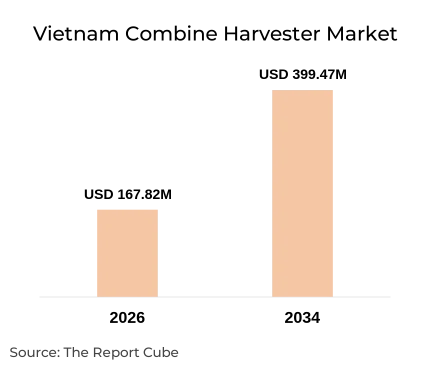
The Vietnam Combine Harvester Market is anticipated to register an 11.45% CAGR during 2026–2034. The market size was valued at USD 167.82 million in 2026 and is projected to reach USD 399.47 million by 2034. A comprehensive Vietnam Combine Harvester Market Analysis reveals three structural shifts sustaining this expansion: accelerating government-led mechanization programs, rising rice export volumes creating harvesting throughput pressure, and declining rural labor availability pushing farmers toward mechanized solutions. Vietnam's Ministry of Agriculture and Environment - reconstituted in March 2025 from the merger of MARD and the Ministry of Natural Resources and Environment - has maintained subsidy disbursement programs supporting small and mid-scale farmers in acquiring advanced combine harvesting equipment across all crop-producing provinces.
Vietnam ranks as the world's fifth-largest rice producer, with paddy output exceeding 43.5 million tonnes in 2024. Agricultural exports reached USD 46.28 billion in the first nine months of 2024, a 21% increase year-on-year, intensifying commercial demand for high-efficiency harvesting machinery. Combine harvesters now execute approximately 98% of rice harvesting operations in the Mekong Delta. Kubota Corporation, leveraging its Vietnamese assembly plant infrastructure, and Yanmar Holdings Co. Ltd., through established dealer networks, continue to capture the majority of institutional procurement volumes. Government investment in logistics infrastructure under the agricultural competitiveness strategy through 2030 is further reinforcing equipment procurement budgets across cooperative and commercial farming enterprises.
Vietnam Combine Harvester Market Size & Forecast
|
Metric |
Details |
|---|---|
|
Market Size (2026) |
USD 167.82 Million |
|
Market Size (2034) |
USD 399.47 Million |
|
CAGR (2026–2034) |
11.45% |
|
Base Year |
2026 |
|
Historical Years |
2021–2025 |
|
Forecast Years |
2026–2034 |
This Vietnam Combine Harvester Market Size study values the industry at USD 167.82 million in 2026, projecting growth to USD 399.47 million by 2034 at an 11.45% CAGR - substantially exceeding the broader Southeast Asian agricultural machinery average - driven by Vietnam's dual-crop intensification cycles, tightening rural labor availability, and government-backed mechanization financing programs active through 2034.
Vietnam Combine Harvester Market Dynamics
Vietnam's combine harvester sector is experiencing sustained structural expansion as mechanization policy matures, export-oriented agriculture scales, and commercial farming enterprises shift from contractor-based to fleet-owned harvesting operations. Government subsidy programs, shrinking rural labor pools, and increasing precision agriculture adoption are collectively reinforcing replacement and new-unit procurement across rice, maize, and multi-crop harvesting applications. The Vietnam Combine Harvester Market Growth trajectory is underpinned by intensifying rice cultivation pressure and accelerating mechanization requirements across the delta farming system.
|
Factor |
Type |
Specific Impact on Market |
Magnitude |
|---|---|---|---|
|
Agricultural mechanization government programs |
Driver |
Increases subsidy-backed equipment procurement volumes across smallholder and cooperative segments |
High |
|
Declining rural farm labor availability |
Driver |
Accelerates substitution of manual harvesting with combine units in delta provinces |
High |
|
High equipment import dependency |
Challenge |
Creates supply chain vulnerability and price pressure as 60–70% of demand is import-reliant |
Medium |
|
Rice export volume growth |
Opportunity |
Drives throughput demand for high-capacity combine harvesters across commercial farming enterprises |
High |
|
Precision agriculture technology integration |
Trend |
Encourages adoption of GPS-guided, sensor-equipped combine platforms among progressive operators |
Medium |
Growth Drivers - Agricultural Mechanization Policy and Labor Scarcity:
Vietnam's government allocated over VND 10 trillion in subsidies and financial support programs for agricultural machinery purchases in 2024, reducing capital barriers for farmers transitioning from manual to mechanized harvesting. Agricultural employment declined to 32.98% of total employment in 2023, tightening seasonal labor availability across rice-producing provinces. The national mechanization target of 70% crop cultivation coverage by 2030 is directly driving fleet expansion and replacement procurement. Combine harvester sales volumes rose 15% in 2024, reflecting accelerating smallholder adoption facilitated by government-backed financing schemes.
Market Restraints - Import Dependency and Domestic Manufacturing Gaps:
As of 2023, domestic manufacturers meet only approximately 32% of Vietnam's agricultural machinery demand, with imported equipment accounting for 60–70% of the combine harvester market. This structural import reliance creates exposure to currency volatility, logistics cost fluctuations, and supply chain disruptions impacting equipment availability and pricing across the forecast period. Efforts to establish deeper local assembly capabilities remain constrained by limited technical workforce capacity and insufficient domestic component supplier development for complex harvesting systems.
Market Opportunities - Rice Export Growth and Precision Harvesting Adoption:
Vietnam exported more than 9 million tonnes of rice in 2024, generating throughput pressure that favors reliable, high-capacity combine harvesters with measurable uptime performance. Rice export value rose 24% year-on-year in 2024, strengthening cooperative cash flows and enabling fleet renewal and upgrade cycles. The government's one-million-hectare high-quality rice program targeting sustainable cultivation practices by 2030 creates additional demand for low-loss, precision harvesting equipment aligned with export-grade quality standards.
Industry Challenges - Smallholder Credit Access and Regional Infrastructure Gaps:
Limited access to formal credit facilities for smallholder farmers in mountainous northern provinces continues restricting equipment adoption beyond the major delta production regions. Uneven rural road infrastructure creates operational constraints for wheeled combine platforms in upland farming areas, limiting market penetration to terrain-accessible zones. Evolving emissions and safety certification requirements under Vietnam's national standards framework are raising compliance costs for equipment importers and compelling powertrain configuration adaptation ahead of 2026 regulatory tightening cycles.
Vietnam Combine Harvester Market Trends
- Emerging Trends: Among the most significant Vietnam Combine Harvester Market Trends is the shift toward dual-crop system-compatible harvesting platforms capable of rapid field clearing between rice and winter-spring rotation cycles. Compressed harvest windows across southern paddy systems are accelerating adoption of high-throughput self-propelled models. Contractor-operated fleet models are expanding, with custom-hiring and rental channels accounting for an estimated 58.7% of equipment access in 2025, allowing fragmented smallholder farms to access high-value machinery without full ownership commitment.
- Technology Trends: Smart harvesting systems integrating GPS guidance, real-time yield monitoring, and automated threshing adjustment are becoming standard specifications in mid-to-high-tier combine platforms entering Vietnam. These technologies reduce post-harvest losses by up to 12% and enhance grain quality consistency critical for export-grade crop standards. Kubota's auto-leveling controls and Yanmar's advanced engine management systems are representative of the precision mechanization capabilities being introduced into the Vietnamese commercial farming segment through 2034.
- Consumer / Buyer Trends: Professional agricultural buyers and cooperative procurement managers increasingly prioritize combine harvester suppliers offering comprehensive after-sales service networks, spare parts availability, and technical training programs. Over 65% of Mekong Delta rice cooperatives now operate through private retail dealer networks rather than state distribution channels, shifting procurement dynamics toward supplier relationship quality and service bundling capabilities. Financing arrangements including hire-purchase and leasing are expanding equipment access among mid-scale farm operators previously excluded from full-unit ownership.
- Regulatory Trends: Vietnam's Ministry of Agriculture and Environment continues to develop mechanization targets that directly influence subsidy eligibility and import tariff structures for harvesting equipment. National standards body certification requirements aligned with safety and engine emission benchmarks filter overseas supplier qualification for state-supported procurement programs. The February 2024 Prime Minister decree enhancing agricultural logistics connectivity signals regulatory intent to reduce post-harvest losses - increasing operational urgency for low-loss combine harvesting platforms meeting official certification standards across rice, maize, and multi-crop applications.
Need Specific Data, Let’s Customize the Report for You
Request CustomizationVietnam Combine Harvester Market Segment Analysis
Vietnam's combine harvester market serves distinct operational categories across equipment type and movement mechanism configurations, each shaped by farm scale, crop profile, terrain requirements, and procurement budget thresholds.
By Type
|
Type |
Estimated Share (2026) |
Key Characteristics |
|---|---|---|
|
Self-propelled |
62% |
Engine-integrated; suited for large farms; high throughput; dominant in Mekong and Red River Delta |
|
Tractor-pulled Combine |
23% |
Lower capital cost; used by smallholder cooperatives with existing tractor assets |
|
PTO-powered Combine |
15% |
Power take-off driven; limited to smaller acreage; used in northern and upland farming zones |
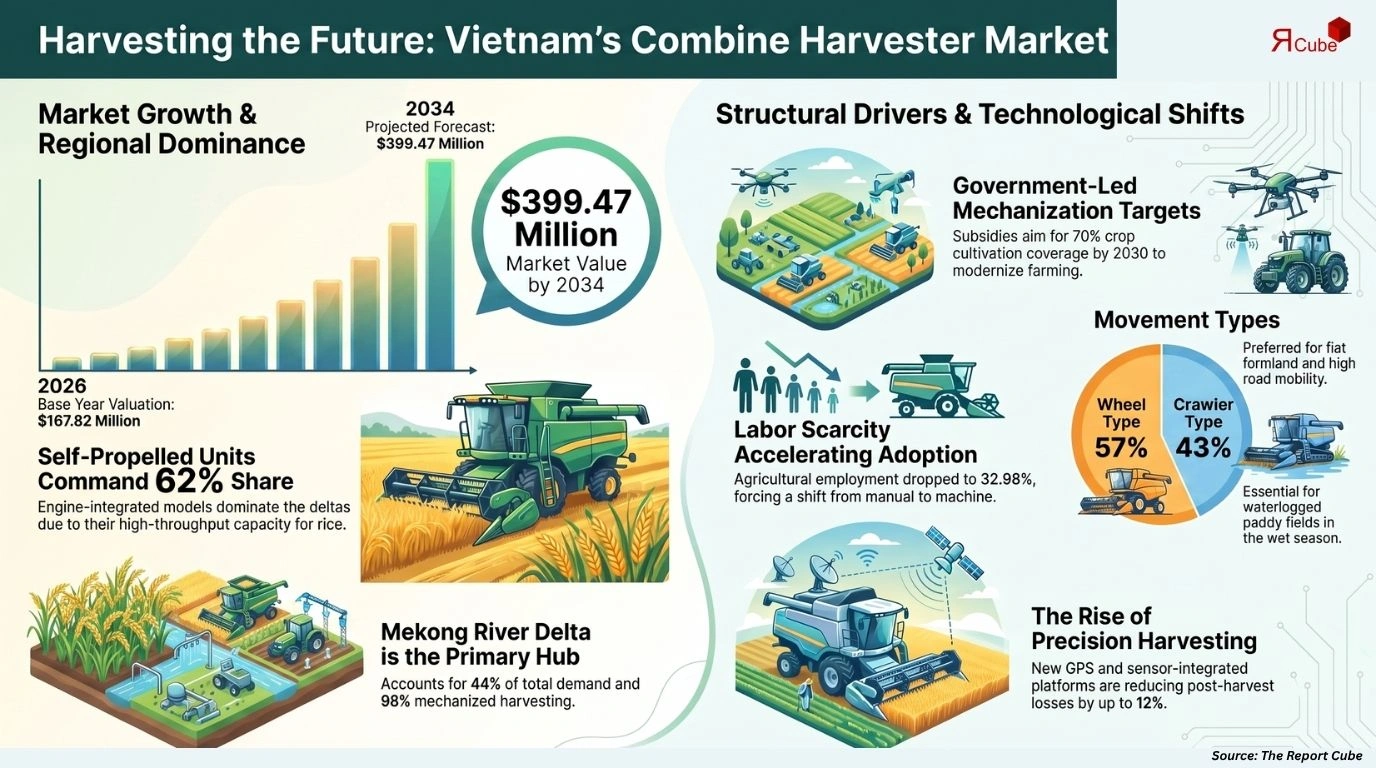
Self-propelled combine harvesters command the leading Vietnam Combine Harvester Market Share at an estimated 62% in 2026, driven by commercial rice farm operators and large-scale cooperative enterprises requiring high-capacity, high-throughput harvesting performance across Mekong and Red River Delta paddy systems. Kubota Corporation and Yanmar Holdings Co. Ltd. supply the dominant volume of self-propelled units through their established Vietnamese dealer and assembly networks. Tractor-pulled combines, representing approximately 23%, serve smallholder cooperatives leveraging existing tractor fleets to reduce capital expenditure. PTO-powered combines at approximately 15% address upland and northern province farming applications where terrain and farm scale limit investment in fully autonomous platforms. Deere & Company and AGCO Corp. supply higher-specification tractor-compatible harvesting systems for commercial operators.
By Type of Movement
|
Type of Movement |
Estimated Share (2026) |
Key Characteristics |
|---|---|---|
|
Wheel Type |
57% |
Suited for flat delta farmland; lower cost; high road mobility between field locations |
|
Crawler Type |
43% |
Rubber-tracked; suited for waterlogged paddy fields; dominant in wet-season harvesting operations |
Wheel type combine harvesters lead the By Movement segment with an estimated 57% market share in 2026, preferred across the flat, well-drained farmland of the Red River Delta and Southeast region for their road mobility advantages between field plots and lower per-unit acquisition cost. Iseki & Co. Ltd. and CNH Industrial N.V. supply competitive wheel-type platforms serving this volume segment. Crawler-type combines, commanding approximately 43%, are essential for waterlogged paddy field conditions prevalent across Mekong Delta wet-season harvesting cycles. Kubota's rubber-tracked platforms and Yanmar's crawler-equipped models are the primary suppliers serving this technically demanding application, where submersible track systems and flotation performance are critical operational requirements.
Vietnam Combine Harvester Market Regional Analysis
|
Region |
Estimated Market Share |
Key Growth Factors |
Consumer Trends |
|---|---|---|---|
|
Mekong River Delta |
44% |
Largest rice production zone; dominant contractor fleet operations; dual-crop intensification |
High crawler-type demand; fleet replacement cycles; cooperative procurement |
|
Red River Delta |
24% |
Intensive multi-crop rotation; expanding commercial farm consolidation |
Wheel-type preference; self-propelled adoption; precision harvesting technology |
|
Southeast |
14% |
Proximity to Ho Chi Minh City logistics hubs; mixed crop profile |
Tractor-pulled and self-propelled adoption; industrial farm procurement |
|
South Central Coast |
11% |
Growing mid-scale farming activity; coastal crop diversification |
Compact and mid-size combine demand; service network expansion |
|
Others (Great Lakes, Upland) |
7% |
Emerging mechanization in highland zones; government coverage extension |
PTO-powered and compact unit adoption; subsidy-driven first-purchase demand |
- Mekong River Delta - Accounting for approximately 44% of total market demand, this region houses Vietnam's highest concentration of rice cooperative fleets, commercial paddy operations, and contractor harvesting businesses. Combine harvesters execute nearly 98% of rice harvesting operations here, with Kubota and Yanmar crawler platforms dominating procurement across An Giang, Dong Thap, and Can Tho provinces.
- Red River Delta - Representing approximately 24% of market demand, this region's intensive multi-crop rotation schedules and expanding vegetable and paddy production zones are driving increasing adoption of self-propelled wheel-type platforms. Private retail dealer networks are reshaping equipment access, moving procurement away from state distribution channels toward service-bundled commercial arrangements.
- Southeast - Contributing approximately 14% of market share, proximity to Ho Chi Minh City's logistics and processing infrastructure supports commercial farm procurement of mid-to-large capacity combine models. CNH Industrial's New Holland brand and AGCO's distribution networks maintain active market engagement across this commercially oriented farming zone.
- South Central Coast - Accounting for approximately 11% of market demand, growing mid-scale farming investments and coastal agricultural diversification are expanding the addressable base for compact self-propelled and tractor-pulled combine models, particularly across Binh Dinh, Quang Ngai, and Phu Yen provinces.
- Others (Great Lakes and Upland Regions) - Contributing approximately 7% of market volume, emerging government-supported mechanization extension programs are enabling first-purchase adoption of PTO-powered and compact combine units across highland farming communities previously reliant on manual harvesting.
Vietnam Combine Harvester Market Share & Competitive Landscape
The Vietnam market's competitive landscape is concentrated among Japanese and global equipment manufacturers at the premium segment, with increasing competition from Chinese-origin suppliers at the mid-market tier. Key players compete across product reliability, after-sales service network depth, financing arrangements, and alignment with government subsidy program eligibility criteria.
|
Company |
Competitive Strength |
Primary Segment Served |
|---|---|---|
|
Kubota Corporation |
Vietnamese assembly plant; localized spare parts; crawler platform leadership |
Mekong Delta; cooperative and commercial rice farming |
|
Yanmar Holdings Co. Ltd. |
Advanced engine systems; AW-series rice combine specialization; strong dealer network |
Paddy rice farms; wet and dry season harvesting |
|
CNH Industrial N.V. |
Multi-brand coverage (New Holland, Case IH); high-capacity commercial platforms |
Southeast region; large commercial enterprises |
|
Deere & Company |
Premium engineering; technology integration; tractor-compatible systems |
Commercial farms; Red River Delta |
|
Iseki & Co. Ltd. |
Compact and mid-scale designs; reliable wheel-type platforms |
Small-to-mid-scale farms; northern provinces |
|
AGCO Corp. |
IDEAL series technology; precision agriculture integration; diversified portfolio |
Commercial operations; export-grade rice production |
Key Companies in the Vietnam Combine Harvester Market
Kubota Corporation
Kubota Corporation, headquartered in Osaka, Japan, and established in 1890, is the world's leading manufacturer of compact and mid-scale agricultural machinery, operating production facilities across Japan, Thailand, and Vietnam. The company maintains a Vietnamese assembly plant that anchors its regional supply chain through localized spare parts availability and technical service infrastructure. In 2025, Kubota expanded its crawler combine harvester lineup for Southeast Asian paddy conditions, reinforcing its dominant position across Mekong Delta cooperative procurement and contractor fleet replacement cycles.
Yanmar Holdings Co. Ltd.
Yanmar Holdings Co. Ltd., established in 1912 and headquartered in Osaka, Japan, specializes in advanced agricultural machinery, marine equipment, and diesel engines for global markets. Yanmar Vietnam participated in a rice straw management field demonstration organized by Vietnam's Ministry of Agriculture and Rural Development in July 2023, reinforcing its engagement with government mechanization programs. In 2021, Yanmar introduced the AW70V and AW82V rice combine harvester models to Vietnam, and has continued expanding its technical dealer network and operator training programs supporting adoption across commercial paddy farming operations.
Vietnam Combine Harvester Market Recent Developments
|
Year |
Company |
Development |
|---|---|---|
|
2025 |
Kubota Corporation |
Expanded crawler combine harvester lineup for Southeast Asian paddy conditions; strengthened Vietnamese assembly plant output capacity |
|
2025 |
AGCO Corp. |
Extended IDEAL combine series precision harvesting technology into Southeast Asian dealer networks targeting Vietnamese commercial rice operators |
|
Mar 2025 |
Vietnam Ministry of Agriculture and Environment |
Reconstituted from MARD-MONRE merger; continued mechanization subsidy disbursement programs for combine harvester procurement |
Vietnam Combine Harvester Market Future Outlook
The Vietnam Combine Harvester Market Forecast projects the market to reach USD 399.47 million by 2034, expanding at an 11.45% CAGR through the forecast period. Continued intensification of rice export programs, expanding cooperative mechanization fleet investments, and rising commercial farm consolidation will sustain strong combine harvester procurement volumes. Kubota Corporation, Yanmar Holdings Co. Ltd., and CNH Industrial N.V. are expected to deepen market penetration through product customization for Vietnam's paddy conditions, after-sales service network expansion, and alignment with government subsidy eligibility criteria through 2034.
Precision agriculture technology adoption - including GPS-guided harvesting systems, real-time yield monitoring, and automated threshing optimization - will increasingly become standard specifications demanded by commercial farm operators and export-grade rice cooperatives. Government mechanization targets of 70% crop cultivation coverage by 2030, combined with the one-million-hectare sustainable rice program, will sustain structured institutional demand for low-loss, high-efficiency combine platforms meeting evolving engine emission and safety certification requirements across all major agricultural provinces.
Vietnam Combine Harvester Market Report Coverage
This Vietnam Combine Harvester Market Report covers the full forecast period 2026–2034 with complete segmentation, regional breakdown, competitive profiling, and demand analysis.
|
Report Attribute |
Details |
|---|---|
|
Market Name |
Vietnam Combine Harvester Market |
|
Market Size (2026) |
USD 167.82 Million |
|
Market Size (2034) |
USD 399.47 Million |
|
Forecast Period |
2026–2034 |
|
CAGR |
11.45% |
|
Base Year |
2026 |
|
Historical Years |
2021–2025 |
|
Forecast Years |
2026–2034 |
|
Segments Covered |
By Type (Self-propelled, Tractor-pulled Combine, PTO-powered Combine); By Type of Movement (Wheel Type, Crawler Type) |
|
Regions Covered |
Mekong River Delta, Red River Delta, Southeast, South Central Coast, Others (Great Lakes, Upland Regions) |
|
Key Companies |
Kubota Corporation, Yanmar Holdings Co. Ltd., CNH Industrial N.V., Deere & Company, Iseki & Co. Ltd., AGCO Corp., Others |
|
Report Format |
PDF, Excel, PPT |
|
Customization |
Available as per client requirements |
Why Choose This Vietnam Combine Harvester Market Report?
- Comprehensive coverage of Vietnam's rapidly expanding combine harvester and agricultural mechanization equipment market.
- Accurate market sizing from USD 167.82 million in 2026 through the 2034 forecast horizon.
- Detailed segmentation by equipment type (Self-propelled, Tractor-pulled, PTO-powered) and movement mechanism (Wheel Type, Crawler Type).
- Regional insights covering Mekong River Delta, Red River Delta, Southeast, South Central Coast, and upland regions with share estimates.
- Competitive profiling of 6 leading global combine harvester suppliers operating across Vietnam.
- Analysis of rice export growth and government mechanization policy reshaping combine harvester procurement demand.
- Forecast data supporting strategic investment, dealer network expansion, and supplier partnership planning decisions.
- Research aligned with Vietnam's agricultural mechanization targets and Ministry of Agriculture and Environment program objectives.
Table of Contents
- Introduction
- Objective of the Study
- Product Definition
- Market Segmentation
- Study Variables
- Research Methodology
- Secondary Data Points
- Companies Interviewed
- Primary Data Points
- Breakdown of Primary Interviews
- Secondary Data Points
- Executive Summary
- Market Dynamics
- Drivers
- Challenges
- Opportunity Assessment
- Recent Trends and Developments
- Policy and Regulatory Landscape
- Vietnam Combine Harvester Market Overview and Forecast Analysis (2021-2034)
- Market Size, By Value, By Growth Rate (CAGR/USD Millions)
- Demand – Supply Trends
- Market Share, By Type
- Self-propelled
- Tractor-pulled Combine
- PTO-powered Combine
- Market Share, By Type of Movement
- Wheel Type
- Crawler Type
- Market Share, By Region
- Southeast
- Red River Delta
- Great Lakes
- Mekong River Delta
- South Central Coast
- Others
- Market Share, By Competitors
- Competition Characteristics
- Revenue Shares
- Self-propelled Vietnam Combine Harvester Market Overview, 2021-2034F
- By Value (USD Million)
- By Type of Movement – Market Size & Forecast 2021-2034, USD Million
- Wheel Type
- Crawler Type
- Tractor-pulled Combine Vietnam Combine Harvester Market Overview, 2021-2034F
- By Value (USD Million)
- By Type of Movement – Market Size & Forecast 2021-2034, USD Million
- Wheel Type
- Crawler Type
- PTO-powered Combine Vietnam Combine Harvester Market Overview, 2021-2034F
- By Value (USD Million)
- By Type of Movement – Market Size & Forecast 2021-2034, USD Million
- Wheel Type
- Crawler Type
- Competitive Outlook (Company Profile - Partial List)
- Kubota Corporation
- Company Overview
- Business Segments
- Strategic Alliances/Partnerships
- Recent Developments
- Yanmar Holdings Co. Ltd.
- Company Overview
- Business Segments
- Strategic Alliances/Partnerships
- Recent Developments
- CNH Industrial N.V.
- Company Overview
- Business Segments
- Strategic Alliances/Partnerships
- Recent Developments
- Deere & Company
- Company Overview
- Business Segments
- Strategic Alliances/Partnerships
- Recent Developments
- Iseki & Co. Ltd.
- Company Overview
- Business Segments
- Strategic Alliances/Partnerships
- Recent Developments
- AGCO Corp.
- Company Overview
- Business Segments
- Strategic Alliances/Partnerships
- Recent Developments
- Others
- Kubota Corporation
- Contact Us & Disclaimer
Top Key Players & Market Share Outlook
- Kubota Corporation
- Yanmar Holdings Co. Ltd.
- CNH Industrial N.V.
- Deere & Company
- Iseki & Co. Ltd.
- AGCO Corp.
- Others
Frequently Asked Questions






