



Build Your Custom Market Intelligence Report
Customize Your ReportUS Compact Track Loader Market Key Highlights
By Power Output:
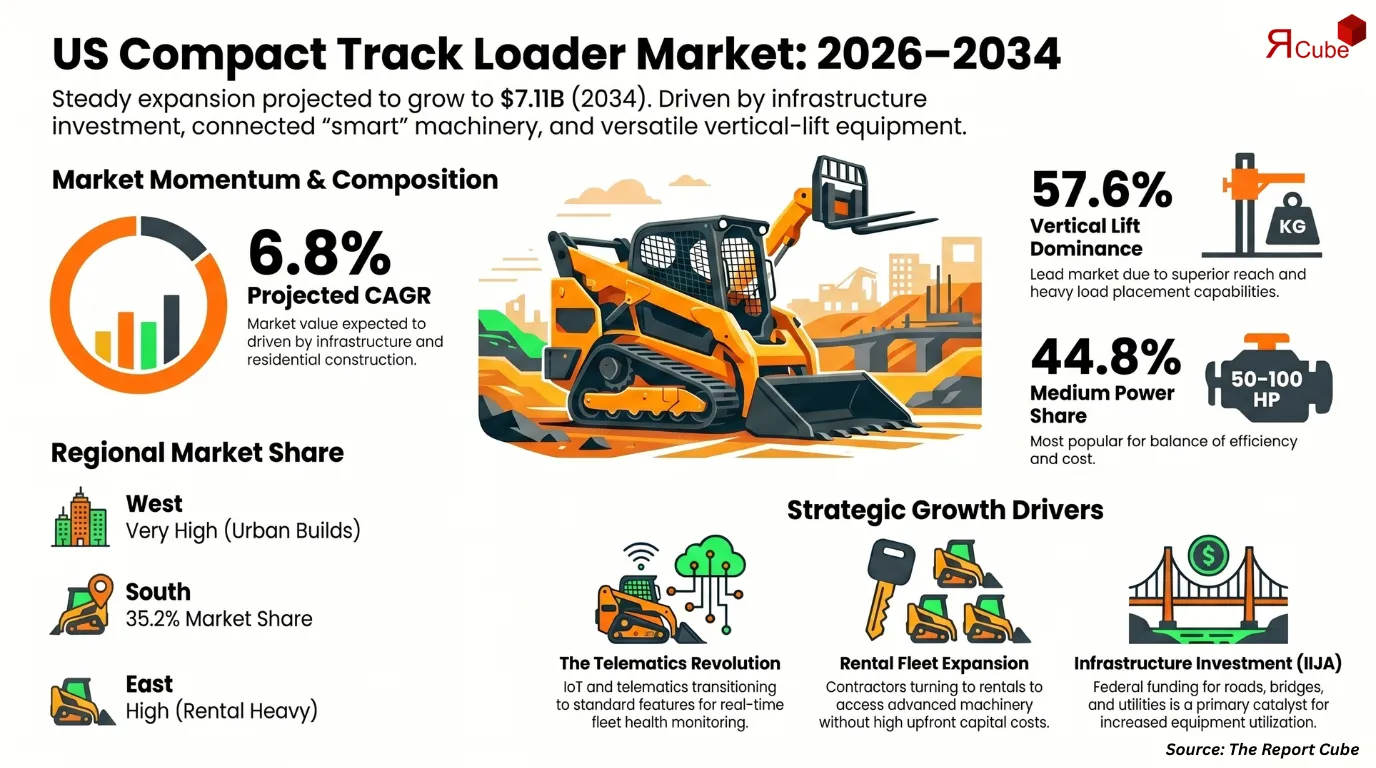
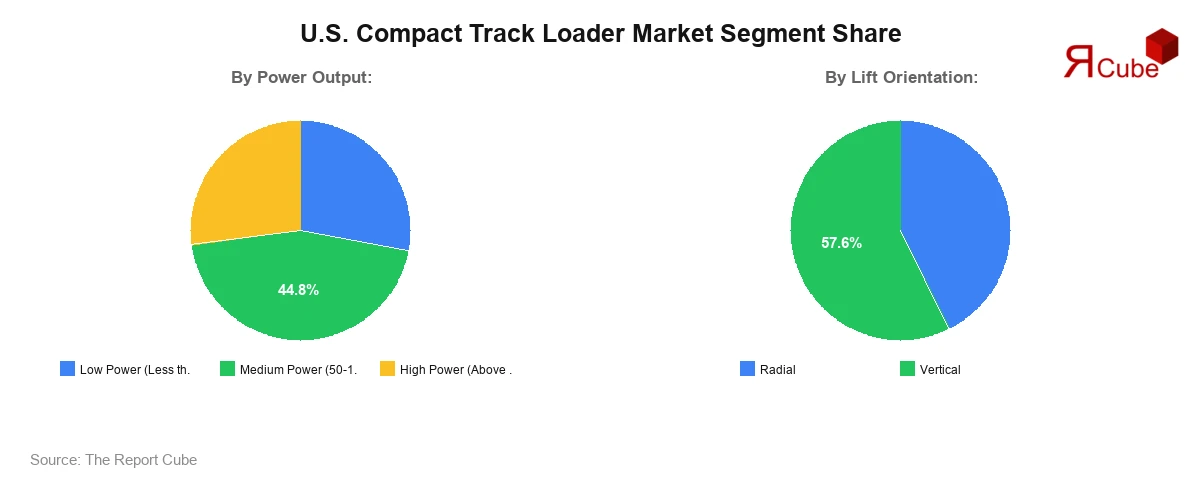
Medium Power (50-100 HP) segment leads the market with approximately 44.8% share.
By Lift Orientation:
Vertical lift segment dominates the market with nearly 57.6% of total revenue.
Regional Outlook:
South region dominates the US Compact Track Loader market with around 35.2% share.
US Compact Track Loader Market Insights & Analysis
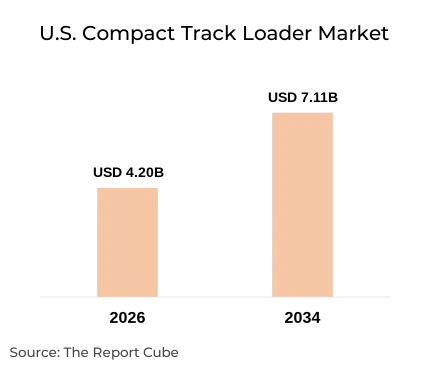
The US Compact Track Loader Market is anticipated to register a CAGR of around 6.8% during the forecast period 2026-2034. The market size is valued at USD 4.20 billion in 2026 and is projected to reach USD 7.11 billion by 2034. Growth in the compact track loader industry in the United States is being supported by sustained investment in transportation infrastructure, residential construction, utility expansion projects, and modernized farming operations. Contractors increasingly prefer compact track loaders because they can operate efficiently on soft, muddy, or uneven surfaces where wheeled equipment often faces performance limitations. Their ability to accommodate dozens of attachments enables operators to perform excavation, grading, trenching, snow removal, material handling, and land-clearing tasks using a single machine platform, improving equipment utilization and reducing fleet costs.
Market participants are focusing heavily on machine productivity, operator comfort, and connected equipment technologies. Recent product introductions from leading manufacturers demonstrate a clear shift toward telematics-enabled machines capable of supporting real-time fleet monitoring, preventive maintenance scheduling, and equipment performance analytics. The introduction of Kubota's SVL97-3 and Caterpillar's next-generation CTL models during 2025 highlights growing demand for higher-capacity equipment with enhanced hydraulic capabilities and attachment versatility. In addition, rental fleet operators across the United States continue expanding their compact equipment portfolios as contractors seek flexible access to advanced machinery without significant upfront capital investments. These factors collectively strengthen the long-term outlook for the US Compact Track Loader market.
US Compact Track Loader Market Impact Analysis
| Factor | Type | Specific Impact on Market | Magnitude | Business Implication |
|---|---|---|---|---|
| Infrastructure And Urban Projects | Market | More road, utility and site jobs lift loader utilization rates | High | Supports volume growth in rental and direct equipment sales |
| Rise In Rental Equipment Demand | Market | Contractors prefer rentals to reduce upfront fleet investment | High | Encourages OEM focus on dealer rental fleets and service plans |
| Adoption Of Telematics And IoT | Technological | Connected machines enable tracking, uptime gains and lower downtime | Medium | Drives value added digital services and data driven maintenance |
| Diversification Into Forestry And Landscaping | Market | New off highway uses broaden demand beyond core construction | Medium | Requires attachment innovation and segment specific positioning |
| Shift Toward Electric And Hybrid Models | Technological | Low emission units gain interest under sustainability mandates | Medium | Demands R&D spend and pilot deployments with key fleet users |
| Competitive Pressure From Major OEMs | Competitive | Large brands use scale, finance and networks to protect share | High | Smaller players must differentiate on niches, support and pricing |
| Macroeconomic And Construction Cyclicality | Environmental | Slowdowns in building activity can delay fleet refresh cycles | Medium | Requires flexible production planning and diversified end markets |
US Compact Track Loader Market Dynamics
Key Driver: Expanding Construction and Infrastructure Activity Across the United States
One of the strongest growth drivers for the US Compact Track Loader market is the steady increase in construction and infrastructure spending. Ongoing road upgrades, bridge rehabilitation programs, utility installation projects, commercial developments, and residential housing construction continue to generate demand for versatile compact equipment. Compact track loaders have become essential on modern jobsites because they can work efficiently in confined spaces while delivering high lifting performance and excellent traction. Their ability to perform multiple tasks through interchangeable attachments allows contractors to maximize productivity while minimizing equipment ownership costs.
Industry professionals increasingly view compact track loaders as a replacement for multiple specialized machines on small and medium-sized projects. Contractors operating in urban environments particularly value their maneuverability and reduced ground disturbance. As federal infrastructure funding continues to move into execution phases and private-sector construction activity remains healthy across several states, demand for medium- and high-capacity compact track loaders is expected to remain strong throughout the forecast period.
Industry Trend: Connected Equipment and Advanced Fleet Management Adoption
A significant trend shaping the compact track loader industry in the United States is the growing integration of smart machine technologies. Equipment owners are increasingly seeking solutions that provide visibility into machine health, operating hours, fuel consumption, maintenance schedules, and operator performance. As a result, telematics systems are rapidly transitioning from premium add-ons to standard features across new machine launches. Manufacturers are investing heavily in digital ecosystems that improve fleet efficiency and reduce unplanned downtime.
The trend is particularly evident among large construction contractors, equipment rental companies, and agricultural operators managing extensive machine fleets. Real-time diagnostics allow operators to identify maintenance issues before they become costly failures, while utilization data supports more informed equipment purchasing decisions. The growing adoption of telematics-enabled compact track loaders is expected to enhance productivity across construction, landscaping, agriculture, and utility sectors while creating additional value for equipment owners.
Book your FREE 30-minute expert consultation today
Contact UsMajor Challenge: Rising Equipment Ownership and Operating Costs
Although demand remains positive, the US Compact Track Loader market continues to face challenges related to equipment affordability. Modern compact track loaders are equipped with advanced hydraulic systems, operator-assistance technologies, emissions-compliant engines, and digital connectivity features that increase acquisition costs. Small contractors and independent operators often face budget constraints when investing in newer models, particularly during periods of elevated financing costs.
Beyond the purchase price, ongoing maintenance expenses can significantly impact ownership economics. Track assemblies, hydraulic components, filtration systems, and electronic control modules require regular servicing to maintain optimal performance. Replacement costs for critical components have increased in recent years due to supply chain pressures and material cost fluctuations. These financial considerations may encourage some buyers to extend replacement cycles or rely on rental solutions, creating challenges for new equipment sales growth.
Opportunity: Emerging Demand for Low-Emission and Alternative-Power Equipment
Growing attention toward sustainability and environmental performance is creating new opportunities within the US Compact Track Loader market. Construction companies, municipalities, and industrial operators are increasingly evaluating equipment that can help reduce emissions and comply with evolving environmental requirements. Manufacturers are responding through investments in electric and hybrid machine development, particularly for urban construction environments and indoor applications where noise and exhaust emissions are critical concerns.
Advancements in battery technology, power management systems, and charging infrastructure are improving the commercial viability of alternative-power compact equipment. While diesel-powered machines continue to dominate overall market demand, early adoption of electric compact track loaders is gaining momentum among environmentally focused contractors and public-sector organizations. As technology matures and operating costs become more competitive, alternative-power equipment is expected to create a meaningful growth avenue for manufacturers operating within the compact track loader industry in the United States.
US Compact Track Loader Market Segment-wise Analysis
By Power Output:
- Low Power (Less than 50 HP)
- Medium Power (50-100 HP)
- High Power (Above 100 HP)
The Medium Power (50-100 HP) segment accounts for the largest share of the US Compact Track Loader market, representing approximately 44.8% of total industry revenue. Machines within this category offer a practical balance between lifting capability, hydraulic performance, fuel efficiency, and operating costs, making them suitable for a wide range of applications. Contractors frequently utilize medium-power models for site preparation, grading, landscaping, trenching, and material handling operations. Their versatility enables equipment owners to perform diverse tasks without transitioning to larger and more expensive machinery.
Demand remains particularly strong among rental companies, which prioritize equipment capable of serving multiple customer segments. Industry estimates suggest that nearly one out of every two compact track loaders sold in the United States falls within the medium-power category. Continuous improvements in hydraulic flow rates, attachment compatibility, and operator comfort are expected to reinforce the segment's leadership position throughout the forecast period.
By Lift Orientation:
- Radial
- Vertical
The Vertical Lift segment dominates the US Compact Track Loader market with an estimated revenue share of 57.6%. Vertical lift machines provide greater lift height and enhanced load placement capabilities compared to radial lift configurations, making them highly suitable for construction, warehousing, agriculture, and material handling applications. Contractors often select vertical lift models when frequent truck loading, pallet movement, or elevated material placement is required.
As construction projects become more productivity-focused, demand for equipment capable of handling heavier loads while maintaining operational efficiency continues to increase. Manufacturers have responded by introducing vertical lift machines with stronger hydraulic systems, higher rated operating capacities, and improved stability characteristics. These performance advantages continue to support strong adoption across commercial construction fleets and equipment rental networks throughout the United States.
Regional Projection of US Compact Track Loader Industry
- West
- East
- South
- Midwest
- Others
The South region represents the largest market for compact track loaders in the United States, accounting for approximately 35.2% of total revenue. States including Texas, Florida, Georgia, Tennessee, and North Carolina continue to experience strong population growth, commercial expansion, and infrastructure investment activity. These economic conditions create sustained demand for compact construction equipment across residential developments, industrial facilities, transportation projects, and utility installations.
The region also benefits from a substantial agricultural base where compact track loaders are widely utilized for livestock management, feed handling, land maintenance, and material movement activities. Favorable operating conditions allow year-round equipment utilization, resulting in higher replacement demand and stronger fleet expansion activity compared to many other regions. As construction and agricultural investments remain robust, the South is expected to maintain its leading position in the US Compact Track Loader market through 2034.
Need insights for a specific region within this market?
Request Regional DataUS Compact Track Loader Market - Regional Analysis
The US compact track loader market in 2026 shows distinct regional demand patterns led by construction intensity, climate, and rental activity.
| Cluster | Demand Level | Key Areas | System Dominance | Core Demand Logic | Growth Nature |
|---|---|---|---|---|---|
| West | Very High | CA, WA, OR, NV | Tier‑4, low‑emission CTL | Urban builds and grading work | Infrastructure and housing led |
| East | High | NY, PA, MA, VA | Rental fleet heavy CTL | Dense metro and utility jobs | Rental fleet refresh driven |
| South | Extremely High | TX, FL, GA, NC | High‑horsepower CTL | Sunbelt builds and earthworks | Fastest growth through 2030 |
| Midwest | Medium | IL, OH, MI, IN | Agriculture‑spec CTL | Farm, landscaping, snow ops | Steady fleet replacement |
| Others | Low to Medium | Mountain and rural belts | Mixed CTL and skid steer | Small contractors and councils | Project and grant dependent |
Government Initiatives & Policies
- Infrastructure Investment and Jobs Act (IIJA): The U.S. federal government continues implementing IIJA funding through 2025 and 2026, supporting transportation, roads, bridges, utilities, and public infrastructure projects that directly increase compact track loader demand.
- EPA Clean Construction Equipment Programs: The U.S. Environmental Protection Agency continues promoting cleaner off-road equipment through emissions reduction initiatives and grants that encourage adoption of low-emission and advanced construction machinery.
US Compact Track Loader Industry Recent Developments
- 2025: Kubota launched the next-generation SVL97-3 Compact Track Loader featuring enhanced performance, improved serviceability, a redesigned sealed cab, integrated KubotaNOW telematics connectivity, and a rated operating capacity of 3,459 pounds. The launch reflects growing demand for connected, multifunctional equipment and strengthens competition within the premium compact track loader segment.
- 2025: Caterpillar Inc. expanded its next-generation compact track loader lineup with the Cat 275 and Cat 285 models. These machines deliver higher lift capacities, stronger breakout forces, enhanced torque output, improved hydraulic performance, and greater operator comfort, supporting heavy-duty construction applications and increasing competitive pressure across the industry.
Why Choose This Report?
- Provides a comprehensive overview of the overall market analysis, encompassing key trends, consumer behavior analysis, and risk assessment to support strategic decision-making.
- Provides accurate, up-to-date insights into market size, segmentation, and emerging opportunities, helping to minimize risk & capitalizing on growth.
- Gives deep understanding of target audience preferences, investment habits, and communication channels for enhanced product development & marketing effectiveness.
- Delivers competitive analysis & benchmarking, uncovering the strengths & weaknesses of market competitors to guide strategies.
- Consolidate comprehensive market intelligence, reducing reasoning & streamlining research efforts.
- Facilitates customized market segmentation & risk mitigation strategies, fine-tuned to the business objectives.
- Aids in identifying both market challenges & untapped opportunities within the industry to drive long-term business growth.
- Provides valuable information based on actual customer data & search trends.
Table of Contents
- Introduction
- Objective of the Study
- Product and Category Definition
- Market Segmentation
- Study Variables
- Research Methodology
- Secondary Data Points
- Breakdown of Secondary Sources
- Primary Data Points
- Breakdown of Primary Interviews
- Secondary Data Points
- Executive Summary
- Market Dynamics
- Emerging Opportunities
- Adoption Trends
- Demand Drivers
- Disruption Analysis (Challenges)
- Industry Analysis and Strategic Insights
- Supply and Value Chain Analysis
- Pricing Analysis
- Go-To-Market Strategy
- BCG Matrix
- Recent Trends and Developments
- Import and Export Analysis
- Regulatory and Policy Landscape
- Region-wise Policies
- Government Initiatives
- US Compact Track Loader Market Overview and Forecast Analysis (2021-2034)
- Market Size, By Value, By Growth Rate (CAGR/USD Billion)
- Market Share, By Power Output
- Low Power (less than 50 HP)
- Medium Power (50-100 HP)
- High Power (above 100 HP)
- Market Share, By Lift Orientation
- Radial
- Vertical
- Market Share, By Operating Capacity
- Low Capacity (up to 1,000 lbs)
- Medium Capacity (1,000 lbs to 2,500 lbs)
- High Capacity (2,500 lbs to 4,000 lbs)
- Very High Capacity (over 4,000 lbs)
- Market Share, By Fuel Type
- Electric
- Hybrid
- Gasoline
- Diesel
- Market Share, By Application
- Agricultural Equipment
- Sports
- Marine Engines
- Industrial Trucks
- Construction Equipment
- Gensets
- Others
- Market Share, By Region
- West
- East
- South
- Midwest
- Others
- Market Share, By Company
- Revenue Shares and Analysis
- Competitive Landscape
- West US Compact Track Loader Market Overview and Forecast Analysis (2021-2034)
- Market Size, By Value, By Growth Rate (CAGR/USD Billion/Million)
- Market Share, By Power Output
- Market Share, By Lift Orientation
- Market Share, By Operating Capacity
- Market Share, By Fuel Type
- Market Share, By Application
- East US Compact Track Loader Market Overview and Forecast Analysis (2021-2034)
- Market Size, By Value, By Growth Rate (CAGR/USD Billion/Million)
- Market Share, By Power Output
- Market Share, By Lift Orientation
- Market Share, By Operating Capacity
- Market Share, By Fuel Type
- Market Share, By Application
- South US Compact Track Loader Market Overview and Forecast Analysis (2021-2034)
- Market Size, By Value, By Growth Rate (CAGR/USD Billion/Million)
- Market Share, By Power Output
- Market Share, By Lift Orientation
- Market Share, By Operating Capacity
- Market Share, By Fuel Type
- Market Share, By Application
- Midwest US Compact Track Loader Market Overview and Forecast Analysis (2021-2034)
- Market Size, By Value, By Growth Rate (CAGR/USD Billion/Million)
- Market Share, By Power Output
- Market Share, By Lift Orientation
- Market Share, By Operating Capacity
- Market Share, By Fuel Type
- Market Share, By Application
- Competitive Analysis, 2026
- Market Share of Key Players
- Competitive Mapping for Each Power Output, Lift Orientation, Operating Capacity, Fuel Type, and Application, and Companies Operating Regionally
- West US Compact Track Loader Companies Share and Competitive Analysis, 2026
- East US Compact Track Loader Companies Share and Competitive Analysis, 2026
- South US Compact Track Loader Companies Share and Competitive Analysis, 2026
- Midwest US Compact Track Loader Companies Share and Competitive Analysis, 2026
- Company Profile (Partial List)
- Takeuchi
- Company Overview
- Product Portfolio
- Strategic Alliances/Partnerships
- Recent Developments
- ASV Holdings, Inc.
- Company Overview
- Product Portfolio
- Strategic Alliances/Partnerships
- Recent Developments
- Bobcat Company
- Company Overview
- Product Portfolio
- Strategic Alliances/Partnerships
- Recent Developments
- Wacker Neuson
- Company Overview
- Product Portfolio
- Strategic Alliances/Partnerships
- Recent Developments
- Kubota
- Company Overview
- Product Portfolio
- Strategic Alliances/Partnerships
- Recent Developments
- John Deere
- Company Overview
- Product Portfolio
- Strategic Alliances/Partnerships
- Recent Developments
- Manitou Group
- Company Overview
- Product Portfolio
- Strategic Alliances/Partnerships
- Recent Developments
- JCB
- Company Overview
- Product Portfolio
- Strategic Alliances/Partnerships
- Recent Developments
- Hyundai Construction Equipment
- Company Overview
- Product Portfolio
- Strategic Alliances/Partnerships
- Recent Developments
- Caterpillar Inc.
- Company Overview
- Product Portfolio
- Strategic Alliances/Partnerships
- Recent Developments
- New Holland Agriculture
- Company Overview
- Product Portfolio
- Strategic Alliances/Partnerships
- Recent Developments
- Others (Partial List)
- Takeuchi
- Contact Us and Disclaimer
Top Key Players & Market Share Outlook
- Takeuchi
- ASV Holdings, Inc.
- Bobcat Company
- Wacker Neuson
- Kubota
- John Deere
- Manitou Group
- JCB
- Hyundai Construction Equipment
- Caterpillar Inc.
- New Holland Agriculture
Frequently Asked Questions






