



Build Your Custom Market Intelligence Report
Customize Your ReportJapan Automotive Telematics Market Insights & Analysis
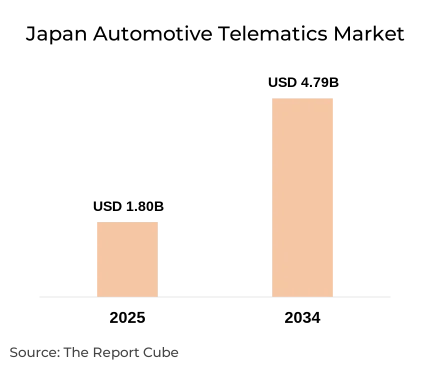
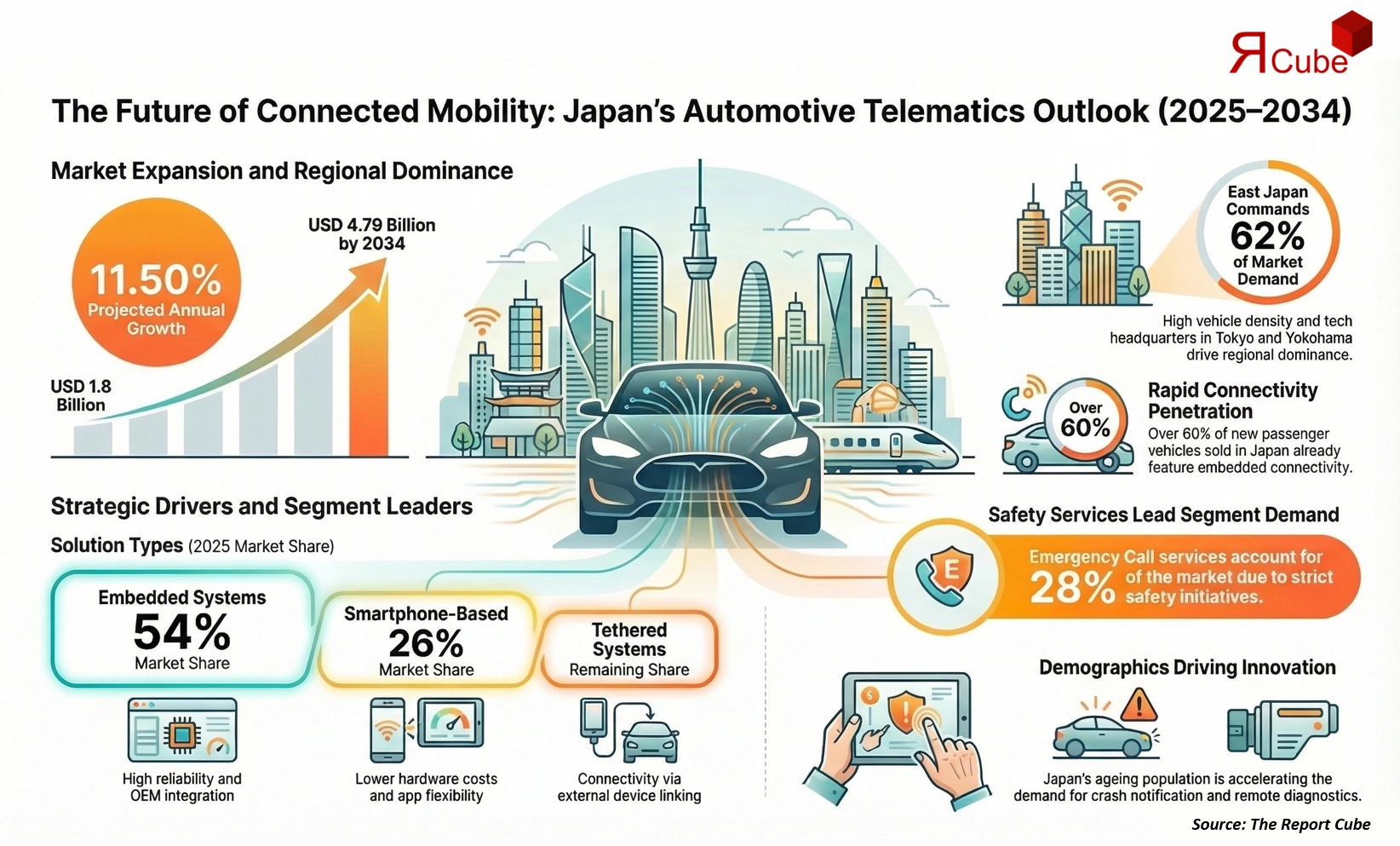
The Japan Automotive Telematics Market is anticipated to register a CAGR of 11.50% during the forecast period 2026-2034. The market size was valued at USD 1.8 billion in 2025 and is projected to reach USD 4.79 billion by 2034. This strong growth trajectory reflects Japan’s rapid transition toward connected vehicles, rising consumer demand for real-time driving intelligence, and increasing integration of digital technologies within automotive platforms.
Japan’s automotive ecosystem has long been at the forefront of technological innovation, and telematics solutions are now becoming a core differentiator for vehicle manufacturers. The growing adoption of advanced driver assistance systems, increasing focus on vehicle safety, and the need for predictive maintenance are accelerating telematics penetration across passenger and commercial vehicles. Automakers are embedding telematics platforms to improve driver experience, enhance operational efficiency, and comply with evolving safety regulations.
Furthermore, Japan’s aging population and dense urban traffic conditions are pushing demand for emergency call services, navigation optimization, and remote diagnostics. Telecom operators and technology providers are actively collaborating with automakers to deliver high-speed, low-latency connectivity through 5G networks. As a result, automotive telematics is transitioning from an optional feature to a standard offering, positioning the Japan Automotive Telematics Market for sustained expansion through 2034.
Japan Automotive Telematics Market Recent Developments
- 2025: Toyota expanded connected car services with enhanced safety analytics and cloud-based vehicle data platforms.
- 2025: NTT Docomo strengthened 5G-enabled vehicle connectivity partnerships with leading Japanese automakers.
Government Initiatives & Policies
- Connected Industries Initiative: Promotes smart mobility and vehicle connectivity across Japan.
- Road Safety Vision Program: Supports adoption of emergency call and crash notification systems.
Japan Automotive Telematics Market Dynamics
Key Driver: Rising Demand for Connected and Safer Vehicles
The primary driver of the Japan Automotive Telematics Market is the rising demand for connected and safer vehicles. Japanese consumers increasingly expect vehicles to offer real-time navigation, emergency response, and predictive maintenance capabilities. Crash notification and emergency call services are gaining strong traction, particularly among elderly drivers and urban commuters. In 2024, over 60% of new passenger vehicles sold in Japan were equipped with some form of embedded connectivity, highlighting rapid market penetration. Automakers are leveraging telematics to enhance brand differentiation while meeting stringent safety standards. These factors collectively fuel sustained demand for advanced telematics services across vehicle categories.
Book your FREE 30-minute expert consultation today
Contact UsIndustry Trends: Integration of Telematics with Infotainment and Mobility Services
An important trend shaping the market is the integration of telematics with infotainment and broader mobility services. Telematics platforms are no longer limited to safety and diagnostics but now support in-car entertainment, voice assistants, and smartphone synchronization. Consumers increasingly prefer seamless digital experiences that mirror smartphone functionality. Additionally, data generated from telematics systems is being used to support usage-based insurance, fleet optimization, and smart city initiatives. As connectivity infrastructure improves, especially with 5G deployment, telematics solutions are becoming more responsive and feature-rich, strengthening their value proposition in Japan’s automotive landscape.
Major Challenge: Data Privacy and System Integration Complexity
Despite robust growth prospects, data privacy concerns and system integration complexity pose challenges to market expansion. Automotive telematics systems collect large volumes of sensitive user and vehicle data, raising concerns around cybersecurity and compliance with Japan’s data protection regulations. Integrating telematics platforms across diverse vehicle models and legacy systems also increases development costs and time-to-market. Smaller suppliers may face difficulties aligning with automaker-specific architectures. These challenges can slow deployment timelines and increase operational risks, particularly for new market entrants.
Opportunity: Expansion of Smartphone-Based and Cloud-Driven Telematics
The growing adoption of smartphone-based and cloud-driven telematics solutions presents a significant opportunity for the Japan Automotive Telematics Market. Smartphone-based systems reduce hardware costs while offering flexible, app-driven functionality. Cloud platforms enable real-time data analytics, over-the-air updates, and scalable service delivery. These solutions are particularly attractive for aftermarket installations and cost-sensitive vehicle segments. As consumers become more comfortable with app-based vehicle management, service providers can unlock recurring revenue streams through subscription models, strengthening long-term market growth.
Japan Automotive Telematics Market Segment-wise Analysis
By Service Type:
- Crash Notification
- Emergency Call
- Turn-by-Turn Navigation
- Remote Diagnostics
- On-Road Assistance
- Infotainment Services
Emergency Call services dominate the service type segment, accounting for approximately 28% of the market share in 2025. This leadership is supported by government safety initiatives and consumer preference for rapid emergency response. Turn-by-turn navigation and infotainment services are also expanding rapidly as urban congestion increases. Remote diagnostics is emerging as a high-growth sub-segment, enabling predictive maintenance and reducing vehicle downtime. The interconnection of safety, convenience, and entertainment services continues to strengthen overall telematics adoption.
By Solution Type:
- Embedded Systems
- Tethered Systems
- Smartphone-Based
Embedded systems lead the solution type segment, holding nearly 54% of the market share, driven by strong OEM integration and reliability advantages. These systems are preferred by automakers for factory-installed connectivity. Smartphone-based solutions are gaining momentum, capturing around 26% share, due to lower costs and flexibility. Tethered systems maintain a stable presence, particularly in transitional vehicle models. This diversified solution landscape ensures broad adoption across vehicle categories and price segments.
Regional Projection of Japan Automotive Telematics Industry
- East Japan
- West Japan
East Japan leads the Japan Automotive Telematics Market, accounting for nearly 62% of total demand. The region benefits from higher vehicle density, advanced digital infrastructure, and strong presence of automotive OEM headquarters. Urban centers such as Tokyo and Yokohama drive demand for navigation, traffic management, and infotainment services. West Japan follows with steady adoption, supported by expanding smart mobility initiatives. East Japan’s dominance is expected to continue through 2034 as connected vehicle ecosystems mature further.
Need insights for a specific region within this market?
Request Regional DataWhy Choose This Report?
- Provides a comprehensive overview of the overall market analysis, encompassing key trends, consumer behavior analysis, and risk assessment to support strategic decision-making.
- Provides accurate, up-to-date insights into market size, segmentation, and emerging opportunities, helping to minimize risk & capitalizing on growth.
- Gives deep understanding of target audience preferences, investment habits, and communication channels for enhanced product development & marketing effectiveness.
- Delivers competitive analysis & benchmarking, uncovering the strengths & weaknesses of market competitors to guide strategies.
- Consolidate comprehensive market intelligence, reducing reasoning & streamlining research efforts.
- Facilitates customized market segmentation & risk mitigation strategies, fine-tuned to the business objectives.
- Aids in identifying both market challenges & untapped opportunities within the industry to drive long-term business growth.
- Provides valuable information based on actual customer data & search trends.
Table of Contents
- Introduction
- Objective of the Study
- Product and Category Definition
- Market Segmentation
- Study Variables
- Research Methodology
- Secondary Data Points
- Breakdown of Secondary Sources
- Primary Data Points
- Breakdown of Primary Interviews
- Secondary Data Points
- Executive Summary
- Market Dynamics
- Drivers
- Challenges
- Opportunity Assessment
- Recent Trends and Developments
- Regulatory and Policy Landscape
- Japan Automotive Telematics Market Overview (2020-2034)
- Market Size, By Value (USD Billion)
- Market Share, By Service Type
- Crash Notification
- Emergency Call
- Turn‑by‑Turn Navigation
- Remote Diagnostics
- On‑Road Assistance
- Infotainment Services
- Market Share, By Solution Type
- Embedded Systems
- Tethered Systems
- Smartphone‑Based
- Market Share, By Vehicle Type
- Passenger Cars
- Light Commercial
- Heavy Commercial
- Bus and Coach
- Market Share, By End User
- OEM Services
- Aftermarket
- Fleet Operators
- Insurance Providers
- Market Share, By Region
- East
- West
- Market Share, By Company
- Revenue Shares
- Competitive Landscape
- East Japan Automotive Telematics Market
- Market Size, By Value (USD Billion)
- Market Share, By Service Type
- Market Share, By Solution Type
- Market Share, By Vehicle Type
- Market Share, By End User
- West Japan Automotive Telematics Market
- Market Size, By Value (USD Billion)
- Market Share, By Service Type
- Market Share, By Solution Type
- Market Share, By Vehicle Type
- Market Share, By End User
- Competitive Outlook and Company Profiles
- Toyota Motor Corporation
- Company Overview
- Product Portfolio
- Strategic Alliances/Partnerships
- Recent Developments
- Nissan Motor Corporation
- Company Overview
- Product Portfolio
- Strategic Alliances/Partnerships
- Recent Developments
- Honda Motor Co.
- Company Overview
- Product Portfolio
- Strategic Alliances/Partnerships
- Recent Developments
- Denso Corporation
- Company Overview
- Product Portfolio
- Strategic Alliances/Partnerships
- Recent Developments
- Panasonic Corporation
- Company Overview
- Product Portfolio
- Strategic Alliances/Partnerships
- Recent Developments
- Fujitsu Limited
- Company Overview
- Product Portfolio
- Strategic Alliances/Partnerships
- Recent Developments
- SoftBank Corp.
- Company Overview
- Product Portfolio
- Strategic Alliances/Partnerships
- Recent Developments
- NTT Docomo Inc.
- Company Overview
- Product Portfolio
- Strategic Alliances/Partnerships
- Recent Developments
- Robert Bosch GmbH
- Company Overview
- Product Portfolio
- Strategic Alliances/Partnerships
- Recent Developments
- Continental AG
- Company Overview
- Product Portfolio
- Strategic Alliances/Partnerships
- Recent Developments
- Others
- Toyota Motor Corporation
- Contact Us and Disclaimer
Top Key Players & Market Share Outlook
- Toyota Motor Corporation
- Nissan Motor Corporation
- Honda Motor Co.
- Denso Corporation
- Panasonic Corporation
- Fujitsu Limited
- SoftBank Corp.
- NTT Docomo Inc.
- Robert Bosch GmbH
- Continental AG
- Others
Frequently Asked Questions






