



Build Your Custom Market Intelligence Report
Customize Your ReportJapan Hybrid Electric Vehicle Market Insights & Analysis
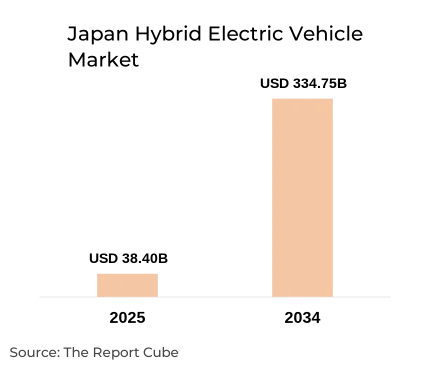
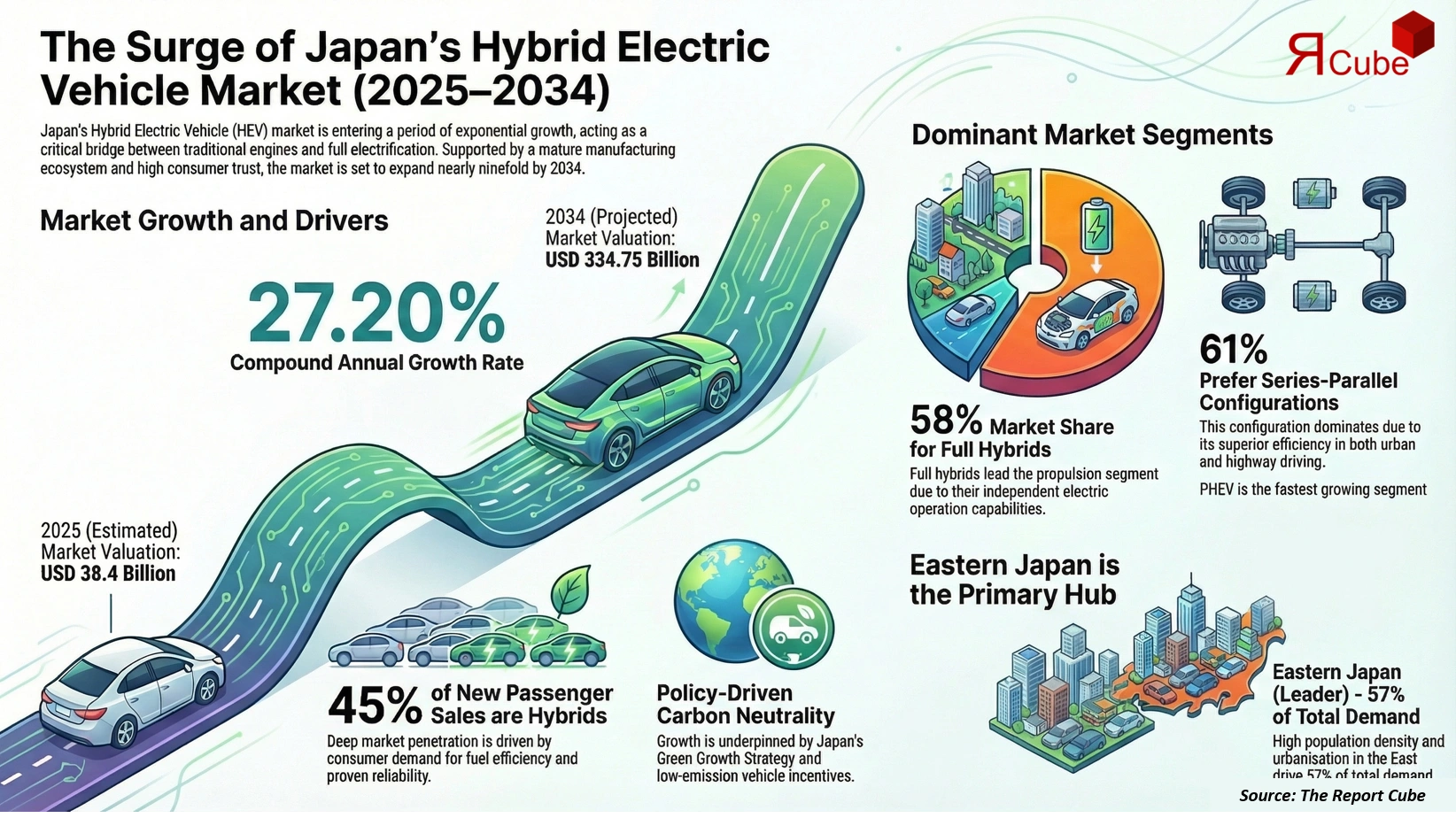
The Japan Hybrid Electric Vehicle Market is anticipated to register a CAGR of 27.20% during the forecast period. The market size was valued at USD 38.4 billion in 2025 and is projected to reach USD 334.75 billion by 2034. This exceptional growth trajectory reflects Japan’s long-standing leadership in hybrid technology, strong consumer acceptance of fuel-efficient vehicles, and consistent policy support for low-emission mobility solutions.
Japan’s automotive landscape has been uniquely positioned to accelerate hybrid electric vehicle (HEV) adoption due to its mature manufacturing ecosystem and early investments in electrification. Hybrid vehicles serve as a practical transition between internal combustion engines and full battery electric vehicles, addressing concerns around charging infrastructure and driving range. As fuel prices remain volatile and emission norms tighten, Japanese consumers increasingly favor hybrids for their balance of efficiency, affordability, and reliability. This preference is further reinforced by the country’s dense urban structure, where regenerative braking and fuel-saving technologies deliver tangible benefits.
In addition, Japan’s automakers continue to innovate across propulsion systems, power electronics, and lightweight materials, enhancing hybrid performance while lowering lifecycle costs. Export demand for Japanese hybrid models is also rising, strengthening domestic production volumes. These interconnected factors collectively underpin the strong expansion outlook for the Japan Hybrid Electric Vehicle Market through 2034.
Japan Hybrid Electric Vehicle Market Recent Developments
- 2025: Toyota expanded next-generation hybrid platforms, improving fuel efficiency and reducing system costs.
- 2025: Honda introduced upgraded hybrid powertrains across mass-market passenger vehicle models.
Government Initiatives & Policies
- Green Growth Strategy: Promotes electrified vehicles to achieve carbon neutrality targets.
- Next-Generation Vehicle Promotion Program: Provides incentives for low-emission vehicle adoption.
Japan Hybrid Electric Vehicle Market Dynamics
Key Driver: Strong Consumer Preference for Fuel-Efficient and Reliable Vehicles
The primary driver of the Japan Hybrid Electric Vehicle Market is the strong and sustained consumer preference for fuel-efficient, low-maintenance vehicles. Japanese consumers are highly cost-conscious regarding long-term ownership, and hybrid vehicles offer lower fuel expenses and proven reliability compared to conventional internal combustion models. In 2024, hybrid vehicles accounted for over 45% of new passenger vehicle sales in Japan, highlighting deep market penetration. This acceptance is rooted in decades of exposure to hybrid technology and confidence in domestic brands. Moreover, rising awareness of environmental impact, coupled with increasing fuel costs, continues to shift purchasing decisions toward hybrids. These behavioral and economic factors together create a robust demand base that consistently drives market growth.
Book your FREE 30-minute expert consultation today
Contact UsIndustry Trends: Continuous Advancements in Hybrid Powertrain Technology
Technological advancement remains a defining trend in the Japan Hybrid Electric Vehicle Market. Automakers are refining hybrid systems to deliver higher power density, smoother transitions between electric and engine modes, and improved battery durability. The shift from early-generation hybrids to highly optimized series-parallel architectures has enhanced overall efficiency by more than 20% over the past decade. Additionally, manufacturers are integrating software-driven energy management systems that adapt performance to real-time driving conditions. Lightweight materials and compact electric motors are also reducing vehicle mass, further improving fuel economy. These advancements not only strengthen domestic sales but also enhance the global competitiveness of Japanese hybrid vehicles.
Major Challenge: Competition from Battery Electric Vehicles
A key challenge facing the Japan Hybrid Electric Vehicle Market is the growing competition from battery electric vehicles (BEVs). As charging infrastructure gradually expands and battery costs decline, BEVs are becoming more viable for certain consumer segments. Government incentives increasingly favor zero-emission vehicles, potentially narrowing the relative advantage of hybrids. Additionally, younger consumers show rising interest in fully electric mobility solutions. While hybrids remain dominant today, this competitive pressure may moderate long-term growth if technological differentiation is not maintained. Automakers must continue innovating to ensure hybrids retain their value proposition as a practical and flexible electrification solution.
Opportunity: Expansion of Plug-In Hybrid and Export Markets
The expansion of plug-in hybrid electric vehicles (PHEVs) presents a significant opportunity for the Japan Hybrid Electric Vehicle Market. PHEVs combine extended electric-only driving capability with the reliability of conventional engines, appealing to both urban and suburban consumers. Export demand for Japanese hybrid vehicles is also accelerating, particularly in Asia-Pacific and European markets with strict emission standards. This dual opportunity enables manufacturers to diversify revenue streams while leveraging existing hybrid expertise. As global regulations evolve, Japan’s leadership in hybrid technology positions it favorably to capture incremental growth across multiple regions.
Japan Hybrid Electric Vehicle Market Segment-wise Analysis
By Propulsion Type:
- Full Hybrid
- Mild Hybrid
- Plug-In Hybrid
- Other Hybrid
The Full Hybrid segment leads the market, accounting for approximately 58% of total market share in 2025. Full hybrids are widely adopted due to their ability to operate independently on electric power at low speeds while maintaining strong fuel efficiency. Mild hybrids follow, offering cost-effective electrification for entry-level models. Plug-in hybrids, although currently holding a smaller share at around 14%, are witnessing the fastest growth as consumers seek extended electric driving ranges. This propulsion mix reflects a balanced transition toward deeper electrification while maintaining affordability and convenience.
By Configuration:
- Series HEV
- Parallel HEV
- Series-Parallel HEV
Series-Parallel HEV configurations dominate the market with an estimated 61% share, driven by their superior flexibility and efficiency across diverse driving conditions. This configuration seamlessly combines the advantages of series and parallel systems, making it ideal for both urban and highway use. Parallel HEVs hold a significant portion due to their simpler architecture and lower costs, while series HEVs are mainly used in specific applications. The dominance of series-parallel systems highlights Japan’s focus on maximizing performance without compromising efficiency.
Regional Projection of Japan Hybrid Electric Vehicle Industry
- Eastern Japan
- Western Japan
Eastern Japan leads the Japan Hybrid Electric Vehicle Market, accounting for nearly 57% of total demand. The region benefits from higher population density, stronger purchasing power, and greater urbanization, which amplify the advantages of hybrid vehicles. Major metropolitan areas drive early adoption of advanced automotive technologies and support higher sales volumes. Western Japan follows closely, supported by regional manufacturing clusters and rising adoption in mid-sized cities. While both regions demonstrate strong growth, Eastern Japan is expected to maintain leadership due to sustained consumer demand and infrastructure advantages.
Need insights for a specific region within this market?
Request Regional DataWhy Choose This Report?
- Provides a comprehensive overview of the overall market analysis, encompassing key trends, consumer behavior analysis, and risk assessment to support strategic decision-making.
- Provides accurate, up-to-date insights into market size, segmentation, and emerging opportunities, helping to minimize risk & capitalizing on growth.
- Gives deep understanding of target audience preferences, investment habits, and communication channels for enhanced product development & marketing effectiveness.
- Delivers competitive analysis & benchmarking, uncovering the strengths & weaknesses of market competitors to guide strategies.
- Consolidate comprehensive market intelligence, reducing reasoning & streamlining research efforts.
- Facilitates customized market segmentation & risk mitigation strategies, fine-tuned to the business objectives.
- Aids in identifying both market challenges & untapped opportunities within the industry to drive long-term business growth.
- Provides valuable information based on actual customer data & search trends.
Table of Contents
- Introduction
- Objective of the Study
- Product and Category Definition
- Market Segmentation
- Study Variables
- Research Methodology
- Secondary Data Points
- Breakdown of Secondary Sources
- Primary Data Points
- Breakdown of Primary Interviews
- Secondary Data Points
- Executive Summary
- Market Dynamics
- Drivers
- Challenges
- Opportunity Assessment
- Recent Trends and Developments
- Regulatory and Policy Landscape
- Japan Hybrid Electric Vehicle Market Overview (2021-2034
- Market Size, By Volume (Thousand Units)
- Market Share, By Propulsion Type
- Full Hybrid
- Mild Hybrid
- Plug‑In Hybrid
- Other Hybrid
- Market Share, By Configuration
- Series HEV
- Parallel HEV
- Series‑Parallel HEV
- Market Share, By Vehicle Type
- Passenger Cars
- Commercial Vehicles
- Two‑Wheelers
- Other Vehicles
- Market Share, By Power Source
- Stored Electricity
- Onboard Generator
- Market Share, By Region
- Eastern
- Western
- Market Share, By Company
- Competition Characteristics
- Revenue Shares & Analysis
- Eastern Japan Hybrid Electric Vehicle Market
- Market Size, By Volume (Thousand Units)
- Market Share, By Propulsion Type
- Market Share, By Configuration
- Market Share, By Vehicle Type
- Market Share, By Power Source
- Western Japan Hybrid Electric Vehicle Market
- Market Size, By Volume (Thousand Units)
- Market Share, By Propulsion Type
- Market Share, By Configuration
- Market Share, By Vehicle Type
- Market Share, By Power Source
- Competitive Outlook and Company Profiles
- Toyota Motor Corporation
- Company Overview
- Hybrid Portfolio
- Strategic Alliances/Partnerships
- Recent Developments
- Honda Motor Co., Ltd.
- Company Overview
- Hybrid Portfolio
- Strategic Alliances/Partnerships
- Recent Developments
- Nissan Motor Co., Ltd.
- Company Overview
- Hybrid Portfolio
- Strategic Alliances/Partnerships
- Recent Developments
- Mitsubishi Motors Corporation
- Company Overview
- Hybrid Portfolio
- Strategic Alliances/Partnerships
- Recent Developments
- Mazda Motor Corporation
- Company Overview
- Hybrid Portfolio
- Strategic Alliances/Partnerships
- Recent Developments
- Subaru Corporation
- Company Overview
- Hybrid Portfolio
- Strategic Alliances/Partnerships
- Recent Developments
- Suzuki Motor Corporation
- Company Overview
- Hybrid Portfolio
- Strategic Alliances/Partnerships
- Recent Developments
- Daihatsu Motor Co., Ltd.
- Company Overview
- Hybrid Portfolio
- Strategic Alliances/Partnerships
- Recent Developments
- Lexus (Toyota Brand)
- Company Overview
- Hybrid Portfolio
- Strategic Alliances/Partnerships
- Recent Developments
- Hino Motors, Ltd.
- Company Overview
- Hybrid Portfolio
- Strategic Alliances/Partnerships
- Recent Developments
- Others
- Toyota Motor Corporation
- Contact Us and Disclaimer
Top Key Players & Market Share Outlook
- Toyota Motor Corporation
- Honda Motor Co., Ltd.
- Nissan Motor Co., Ltd.
- Mitsubishi Motors Corporation
- Mazda Motor Corporation
- Subaru Corporation
- Suzuki Motor Corporation
- Daihatsu Motor Co., Ltd.
- Lexus (Toyota Brand)
- Hino Motors, Ltd.
- Others
Frequently Asked Questions






