



Build Your Custom Market Intelligence Report
Customize Your ReportIndonesia Connected Healthcare Market Statistics and Insights
Market Insight
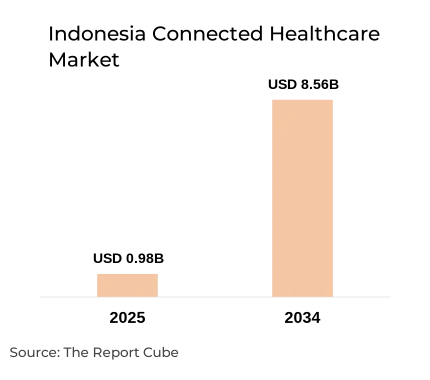
- Indonesia Connected Healthcare Market size valued at USD 0.98 billion in 2025.
- Indonesia Connected Healthcare Market projected to reach USD 8.56 billion by 2034.
- Indonesia Connected Healthcare Market anticipated to register a CAGR of 27.23% during 2026-34.
By Application
- Telemedicine segment dominates with approximately 37.10% market share in 2025.
Competitive Landscape
- More than 10 companies are actively engaged in producing Indonesia Connected Healthcare Market solutions.
- Top 5 companies acquired around 55% of the market share.
- PT Media Dokter Investama (Halodoc), PT Sumo Teknologi Solusi (Alodokter), PT Good Doctor Technology Indonesia (Good Doctor), PT Medika Komunika Teknologi (KlikDokter), PT SehatQ Harsana Emedika (SehatQ), and others.
By Deployment Model
- Cloud-based deployment leads the segment, commanding approximately 64.90% market share in 2025.
Indonesia Connected Healthcare Market Insights & Analysis
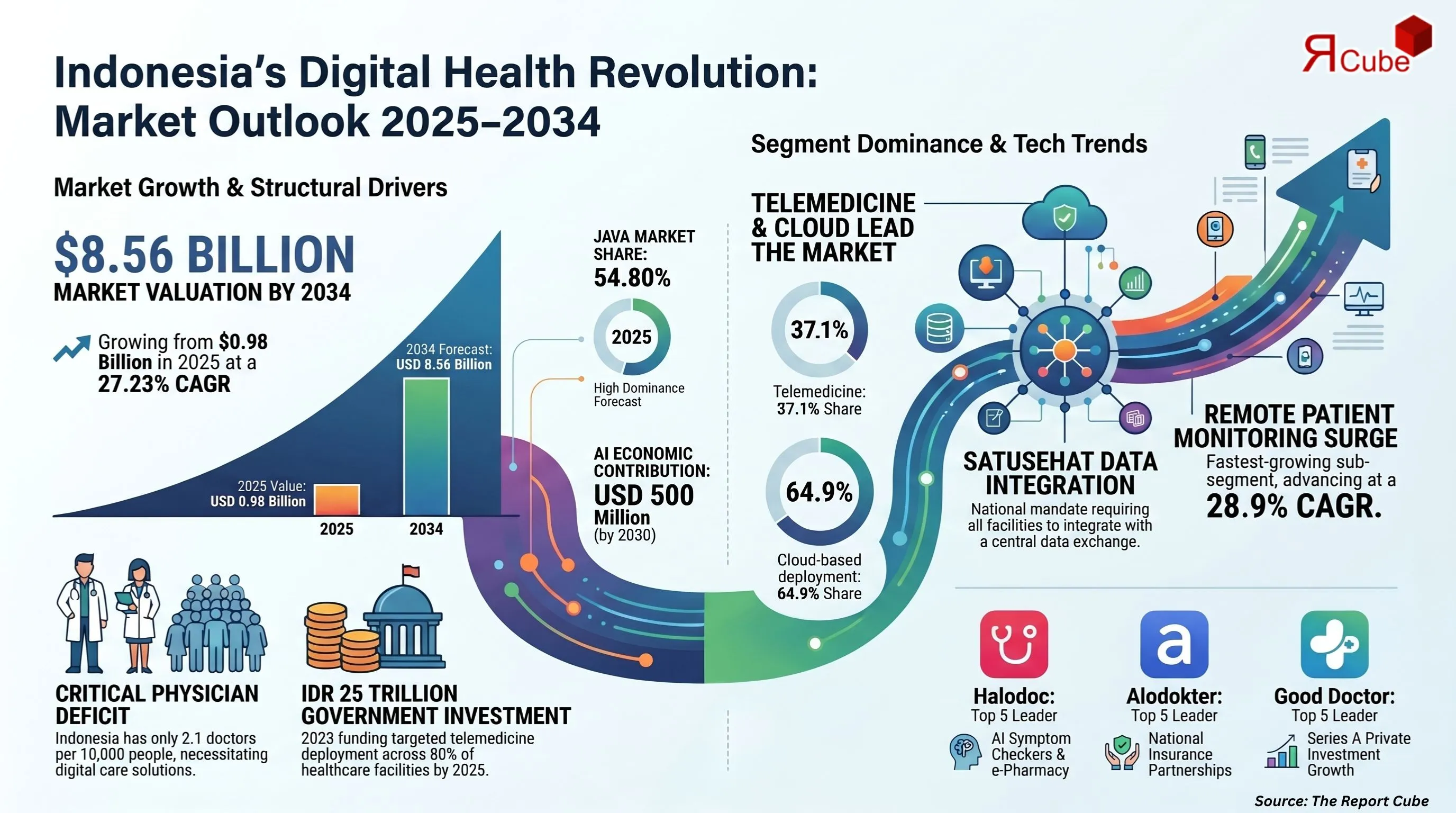
The Indonesia Connected Healthcare Market is anticipated to register a 27.23% CAGR during 2026–2034. The market size was valued at USD 0.98 billion in 2025 and is projected to reach USD 8.56 billion by 2034. Indonesia's connected healthcare ecosystem is experiencing one of the most rapid digital health transformations in Southeast Asia, propelled by a convergence of demographic pressure, government policy reform, and expanding digital infrastructure. The Indonesian government allocated IDR 25 trillion (approximately USD 1.7 billion) in 2023 toward digital healthcare transformation, targeting telemedicine deployment across 80% of the country's healthcare facilities by 2025.
The National Health Digital Transformation Roadmap, along with the SATUSEHAT platform - a national health data integration system - has created a regulatory and technical foundation that is accelerating interoperability between hospitals, clinics, and digital health platforms. Private investment has followed suit, with PT Good Doctor Technology Indonesia securing USD 10 million in Series A funding in October 2023. With JKN (Jaminan Kesehatan Nasional) now covering more than 90% of Indonesia's 273 million population, the urgent push to deliver quality care efficiently is driving rapid connected healthcare adoption at both urban and rural levels.
Indonesia Connected Healthcare Market Dynamics
Key Market Driver Doctor Shortage Accelerating Telemedicine Demand Nationwide
Indonesia operates with approximately 2.1 doctors per 10,000 people - far below the World Health Organization's recommended ratio of 1 per 600 - making the country structurally dependent on digital solutions to bridge the care gap. This physician deficit is particularly acute across the outer islands and rural regions, where 60% of Indonesia's population resides. Telemedicine platforms such as Halodoc and Alodokter now collectively serve over 30 million monthly active users and connect patients with more than 40,000 licensed physicians across digital channels.
The geographic complexity of the 17,000-island archipelago makes physical healthcare distribution inherently inefficient, compelling both providers and policymakers to invest in scalable digital delivery. As the government targets expanded BPJS Kesehatan reimbursement for teleconsultations, demand for verified, platform-based medical care continues to surge, reinforcing telemedicine's role as the market's primary growth engine.
Major Industry Challenge Regulatory Fragmentation Undermining Service Quality Standards
The absence of standardized protocols for telemedicine delivery across Indonesia's provincial health authorities creates significant inconsistencies in care quality and patient data protection. Research published in 2025 by ThinkWell revealed that a substantial number of healthcare facilities continue to rely on informal messaging applications such as WhatsApp for patient-to-provider and facility-to-facility teleconsultations, bypassing specialized platforms and exposing patient records to data security risks.
Indonesia's Personal Data Protection Act (PDP Law), while enacted, lacks granular implementation guidelines specific to telehealth interactions, creating compliance ambiguity for digital health operators. The uneven pace of regulatory harmonization between the Ministry of Health, BPOM (food and drug authority), and provincial health departments slows the deployment of integrated e-prescription and connected imaging solutions. Until enforceable minimum standards for digital healthcare delivery are established nationally, inconsistency will continue to constrain operator scalability and erode patient trust in connected platforms.
Emerging Trend Shaping Outlook AI-Integrated Diagnostics Redefining Preventive Healthcare Delivery
Artificial intelligence is rapidly transitioning from a backend efficiency tool to a frontline clinical capability across Indonesia's connected healthcare ecosystem. In the second half of 2025, Multipolar - an Indonesian IT conglomerate - entered a tri-party agreement with Pelita Harapan University and Tsinghua University of China to accelerate AI deployment across health platforms. Simultaneously, Australia's CSIRO and Indonesia's National Research and Innovation Agency (BRIN) launched a rural healthcare AI integration project in partnership with Universitas Mataram.
AI-powered symptom checkers are now embedded within major telemedicine applications, while machine learning algorithms are enhancing diagnostic accuracy in connected imaging modules by enabling radiologists in Jakarta to remotely analyze scans from Papua without data compression degradation. Healthcare-related AI solutions are projected to contribute over USD 500 million to Indonesia's economy by 2030, establishing AI as the defining technology trend reshaping the country's connected health outlook through 2034.
Need Specific Data, Let’s Customize the Report for You
Request CustomizationIndonesia Connected Healthcare Market Segment-wise Analysis
Indonesia's connected healthcare market is segmented by application and by deployment model, reflecting the dual priorities of expanding service reach and ensuring infrastructure scalability. Both segments are undergoing structural shifts driven by government mandates, rising chronic disease prevalence, and digital literacy improvements across provincial populations.
By Application
- Telemedicine
- Connected Imaging
- In-patient Monitoring
- Remote Patient Monitoring and Wearables
- ePrescription and Medication Management
- Other Applications
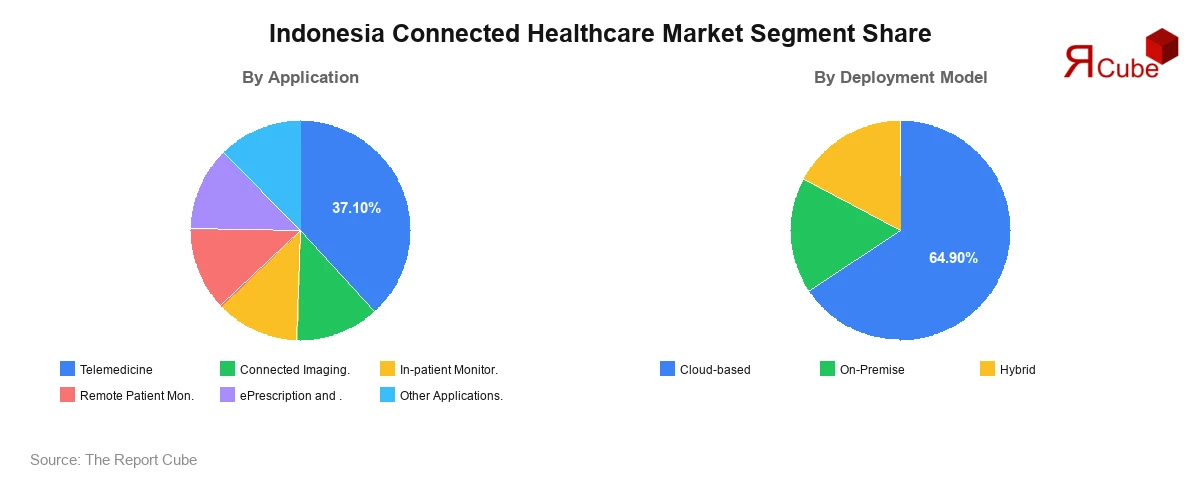
Telemedicine anchors the By Application segment, capturing approximately 37.10% of connected healthcare market revenue in 2025. Its dominance is rooted in Indonesia's structural healthcare access challenges - the vast island geography, physician shortages, and the need for cost-efficient alternatives to in-person consultations have made virtual care a mainstream channel rather than a supplementary one. Platforms integrating e-pharmacy, AI-powered symptom triage, and at-home lab referrals are broadening the telemedicine value proposition beyond consultations alone.
Remote Patient Monitoring (RPM) and Wearables represent the fastest-growing sub-segment, advancing at a 28.9% CAGR, as IoT-enabled biosensors and smartwatches pair with AI analytics to support proactive chronic disease management for Indonesia's aging population. Connected Imaging is gaining momentum from 5G infrastructure expansion, enabling specialists in tier-1 cities to interpret diagnostic scans from remote facilities in real time. In-patient Monitoring systems feed continuous biometric data into hospital command centers, reducing adverse event response times across public and private facilities. ePrescription and Medication Management solutions, integrated with the national formulary, are reducing prescription fraud and improving drug interaction compliance under the JKN framework. Emerging applications including mental health chatbots, veterinary tele-consults, and maternal health monitoring are broadening the total addressable market.
By Deployment Model
- Cloud-based
- On-Premise
- Hybrid
Cloud-based deployment dominates the By Deployment Model segment with approximately 64.90% market share in 2025, driven by the scalability, lower upfront infrastructure cost, and rapid regulatory compliance capabilities that cloud platforms offer to both large hospital networks and independent digital health operators. The Indonesian Ministry of Health's SATUSEHAT platform, which mandates health data interoperability, has further accelerated cloud adoption by requiring facilities to integrate with a centralized national health data exchange - a requirement that on-premise architectures struggle to fulfill efficiently.
On-premise solutions retain relevance among large tertiary hospitals and defense health facilities that require local data sovereignty and operate in areas where internet bandwidth reliability cannot be guaranteed. Hybrid deployment models are gaining traction as mid-tier hospital chains seek the operational control of on-premise environments combined with the analytical and telehealth capabilities of cloud-connected platforms. As 5G network coverage expands across Java, Sumatra, and eventually outer islands, hybrid architectures are expected to represent the fastest-growing deployment category through 2034, enabling flexible service continuity across Indonesia's diverse connectivity landscape.
Regional Projection of Indonesia Connected Healthcare Market
- Java
- Sumatra
- Kalimantan
- Other Regions
Java commands the dominant regional position in Indonesia's connected healthcare market, accounting for approximately 54.80% of total market revenue in 2025. This concentration reflects Java's superior digital infrastructure, highest smartphone penetration, concentration of healthcare facilities, and the location of the national capital Jakarta where most major digital health platform headquarters, data centers, and specialist physician networks are based. Sumatra follows as a secondary growth center, benefiting from expanding BPJS coverage and government digital infrastructure investments. Papua and Maluku, while currently representing a small revenue share, are projected to grow at a 28.9% CAGR through the forecast period the fastest of any regional cluster driven by targeted telemedicine access programs and satellite-based connectivity initiatives under Indonesia's national broadband expansion plan.
Indonesia Connected Healthcare Market: Recent Development (2025)
- Halodoc expanded its AI symptom checker and e-pharmacy network, growing revenue by an estimated 32% year-over-year in 2025.
- SATUSEHAT platform mandated nationwide hospital data integration, onboarding over 2,800 healthcare facilities by mid-2025.
- Alodokter secured a strategic partnership with a national insurer to embed teleconsultations within BPJS supplementary plans.
- KlikDokter reported a 28% increase in active users, driven by its ePrescription module adoption across Sumatra clinics.
Indonesia Connected Healthcare Market Future Outlook (2034)
The Indonesia Connected Healthcare Market is positioned for transformative expansion, projected to reach USD 8.56 billion by 2034 at a 27.23% CAGR. Growth will be propelled by the continued rollout of the SATUSEHAT interoperability platform, the integration of generative AI into diagnostic and triage workflows, and the maturation of remote patient monitoring for chronic disease management under the JKN reimbursement framework. 5G network densification across Sumatra, Kalimantan, and Papua will unlock connected imaging and real-time wearable monitoring in previously underserved regions. Cross-border digital health collaborations - such as the Indonesia-Singapore healthtech corridors and CSIRO-BRIN AI programs - will inject advanced clinical decision support capabilities into local platforms. As over 270 million Indonesians increasingly engage with mobile-first health services, the connected healthcare market will evolve from consultation-centric models toward end-to-end patient journey platforms integrating prevention, diagnostics, treatment, and follow-up care.
Why Choose This Report?
- Provides a comprehensive overview of the overall market analysis, encompassing key trends, consumer behavior analysis, and risk assessment to support strategic decision-making.
- Provides accurate, up-to-date insights into market size, segmentation, and emerging opportunities, helping to minimize risk & capitalizing on growth.
- Gives deep understanding of target audience preferences, investment habits, and communication channels for enhanced product development & marketing effectiveness.
- Delivers competitive analysis & benchmarking, uncovering the strengths & weaknesses of market competitors to guide strategies.
- Consolidate comprehensive market intelligence, reducing reasoning & streamlining research efforts.
- Facilitates customized market segmentation & risk mitigation strategies, fine-tuned to the business objectives.
- Aids in identifying both market challenges & untapped opportunities within the industry to drive long-term business growth.
- Provides valuable information based on actual customer data & search trends.
Table of Contents
- Introduction
- Objective of the study
- Product Definition
- Market Segmentation
- Study Variables
- Research Methodology
- Secondary Data Points
- Companies Interviewed
- Primary Data Points
- Breakdown of Primary Interviews
- Secondary Data Points
- Executive Summary
- Market Dynamics
- Drivers
- Challenges
- Opportunity Assessment
- Recent Trends and Developments
- Policy and Regulatory Landscape
- Indonesia Connected Healthcare Market Overview and Forecast Analysis (2021-2034)
- Market Size, By Value, By growth rate (CAGR/USD Billions)
- Demand - Supply Trends
- Market Share, By Offering
- Solutions
- Services
- Market Share, By Care Setting
- Hospitals
- Clinics and Polyclinics
- Homecare
- Emergency Medical Services
- Pharmacies
- Market Share, By Application
- Telemedicine
- Connected Imaging
- In-patient Monitoring
- Remote Patient Monitoring and Wearables
- ePrescription and Medication Management
- Other Applications
- Market Share, By Deployment Model
- Cloud-based
- On-Premise
- Hybrid
- Market Share, By End User
- Healthcare Providers
- Payers and Insurers
- Patients and Caregivers
- Government and Public Health Agencies
- Market Share, By Region
- Java
- Sumatra
- Kalimantan
- Other Regions
- Market Share, By Competitors
- Competition Characteristics
- Revenue Shares
- Indonesia Solutions Connected Healthcare Market Overview, 2021-2034F
- By Value (USD Million)
- By Care Setting- Market Size & Forecast 2021-2034, USD Million
- By Application- Market Size & Forecast 2021-2034, USD Million
- By Deployment Model- Market Size & Forecast 2021-2034, USD Million
- By End User- Market Size & Forecast 2021-2034, USD Million
- Indonesia Services Connected Healthcare Market Overview, 2021-2034F
- By Value (USD Million)
- By Care Setting- Market Size & Forecast 2021-2034, USD Million
- By Application- Market Size & Forecast 2021-2034, USD Million
- By Deployment Model- Market Size & Forecast 2021-2034, USD Million
- By End User- Market Size & Forecast 2021-2034, USD Million
- Competitive Outlook (Company Profile - Partial List)
- PT Media Dokter Investama (Halodoc)
- Company Overview
- Business Segments
- Strategic Alliances/Partnerships
- Recent Developments
- PT Sumo Teknologi Solusi (Alodokter)
- Company Overview
- Business Segments
- Strategic Alliances/Partnerships
- Recent Developments
- PT Good Doctor Technology Indonesia (Good Doctor)
- Company Overview
- Business Segments
- Strategic Alliances/Partnerships
- Recent Developments
- PT Medika Komunika Teknologi (KlikDokter)
- Company Overview
- Business Segments
- Strategic Alliances/Partnerships
- Recent Developments
- PT SehatQ Harsana Emedika (SehatQ)
- Company Overview
- Business Segments
- Strategic Alliances/Partnerships
- Recent Developments
- PT Telemedika Nusantara (Klinik Pintar)
- Company Overview
- Business Segments
- Strategic Alliances/Partnerships
- Recent Developments
- PT Trustmedis Indonesia
- Company Overview
- Business Segments
- Strategic Alliances/Partnerships
- Recent Developments
- PT Lifepack Global Medika (Lifepack)
- Company Overview
- Business Segments
- Strategic Alliances/Partnerships
- Recent Developments
- PT Medigo Teknologi Indonesia (Medigo)
- Company Overview
- Business Segments
- Strategic Alliances/Partnerships
- Recent Developments
- Others
- PT Media Dokter Investama (Halodoc)
- Contact Us & Disclaimer
Top Key Players & Market Share Outlook
- PT Media Dokter Investama (Halodoc)
- PT Sumo Teknologi Solusi (Alodokter)
- PT Good Doctor Technology Indonesia (Good Doctor)
- PT Medika Komunika Teknologi (KlikDokter)
- PT SehatQ Harsana Emedika (SehatQ)
- PT Telemedika Nusantara (Klinik Pintar)
- PT Trustmedis Indonesia
- PT Lifepack Global Medika (Lifepack)
- PT Medigo Teknologi Indonesia (Medigo)
- Others
Frequently Asked Questions






