



Build Your Custom Market Intelligence Report
Customize Your ReportNorth America Cosmetic Market Insights & Analysis
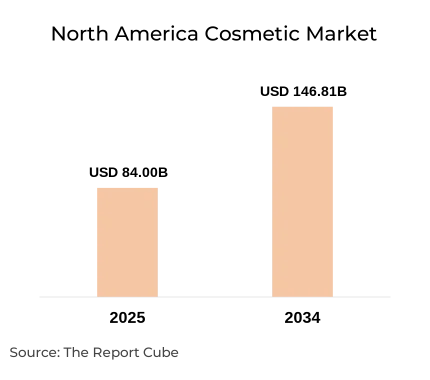
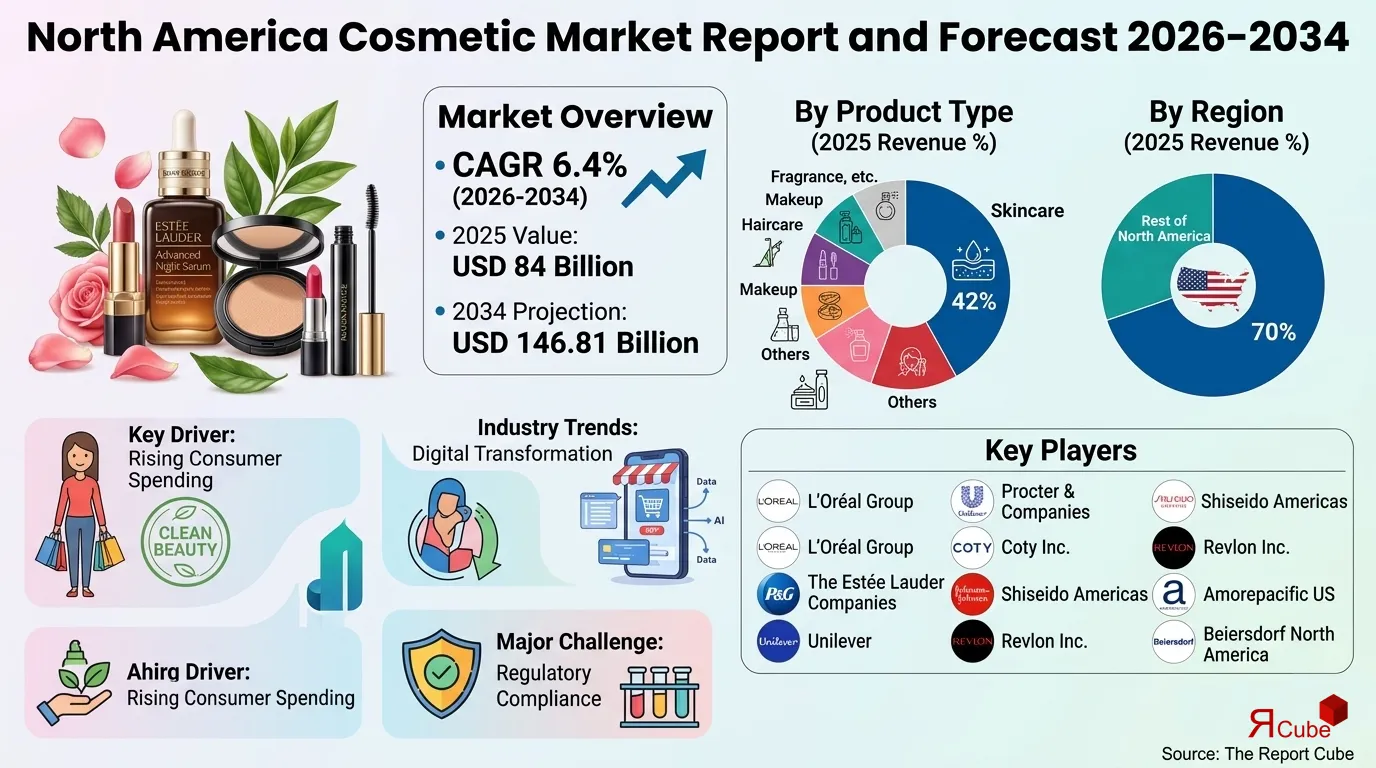
The North America Cosmetic Market is anticipated to register a CAGR of 6.4% during 2026-2034. The market size was valued at USD 84 Billion in 2025 and is projected to reach USD 146.81 Billion by 2034. The industry continues to expand steadily, supported by rising consumer spending on personal grooming, strong product innovation pipelines, and rapid digital transformation across retail channels. Growing demand for premium skincare, clean-label formulations, and dermatologist-tested products has strengthened brand positioning across the United States, Canada, and Mexico.
The market demonstrates a mature yet innovation-driven landscape, where consumer behavior is shaped by ingredient transparency, sustainability, and personalization. Skincare accounts for the highest revenue contribution, followed by haircare and makeup. Social media influence, influencer-led marketing, and celebrity-backed brands continue to shape purchasing decisions. In addition, the shift toward direct-to-consumer (DTC) channels has increased brand margins and customer retention rates. The United States dominates regional revenue, contributing over 70% of total market value in 2025, supported by strong retail infrastructure and high per capita cosmetic spending. Canada and Mexico are witnessing faster relative growth, driven by expanding urban populations and increasing disposable income. As brands intensify investment in R&D and inclusive product development, the North America Cosmetic Market is expected to maintain resilient growth momentum through 2034.
North America Cosmetic Market Recent Developments
- 2025: L'Oréal Group expanded AI-powered skin diagnostic tools across U.S. retail chains.
- 2025: Estée Lauder Companies launched refillable luxury skincare packaging across North America.
Government Initiatives & Policies
- U.S. Modernization of Cosmetics Regulation Act (MoCRA): Strengthens FDA oversight on cosmetic safety and facility registration.
- Canada’s Chemicals Management Plan (CMP): Regulates cosmetic ingredient safety and environmental impact.
North America Cosmetic Market Dynamics
Key Driver: Rising Consumer Spending on Premium and Clean Beauty Products
Increasing disposable income and evolving beauty standards are primary drivers of the North America Cosmetic Market. In 2025, per capita cosmetic spending in the United States exceeded USD 250 annually, reflecting strong consumer engagement. The premium and clean beauty segment is expanding rapidly, accounting for nearly 38% of total cosmetic sales. Consumers increasingly prioritize products free from parabens, sulfates, and synthetic fragrances. Ingredient transparency, cruelty-free certifications, and dermatological testing strongly influence purchasing decisions.
Furthermore, millennials and Gen Z consumers represent over 55% of total cosmetic buyers, favoring sustainable packaging and personalized skincare regimens. Subscription-based models and AI-powered skin assessments have enhanced customer loyalty. The expansion of multicultural beauty products tailored to diverse skin tones has broadened addressable markets. Retailers report double-digit growth in inclusive shade ranges and dermatologist-recommended formulations. This strong alignment between product innovation and consumer expectations continues to stimulate consistent market expansion across North America.
Industry Trends: Digital Transformation and Omnichannel Retail Expansion
The rapid adoption of e-commerce and omnichannel strategies remains a defining trend in the North America Cosmetic Market. Online retail contributes nearly 32% of total cosmetic sales in 2025, compared to 18% in 2020. Social commerce platforms, livestream shopping events, and influencer-driven product launches are reshaping brand-consumer engagement. Personalized recommendation engines powered by artificial intelligence increase conversion rates by up to 20% across leading beauty websites.
Brands are integrating augmented reality (AR) virtual try-on tools to enhance customer experience. Major players invest heavily in data analytics to optimize product assortments and inventory management. Subscription-based beauty boxes and DTC platforms allow brands to collect first-party consumer data, strengthening retention strategies. Additionally, sustainability reporting and ESG disclosures are increasingly integrated into brand messaging. Refillable packaging models and carbon-neutral production commitments are emerging as competitive differentiators, reinforcing long-term brand equity and supporting steady industry growth.
Major Challenge: Regulatory Compliance and Ingredient Scrutiny
Despite steady expansion, regulatory complexity presents a significant challenge for cosmetic manufacturers. The implementation of MoCRA in the United States increases reporting requirements for adverse events and mandates facility registration. Compliance costs have risen by approximately 8–10% for mid-sized cosmetic brands. Ingredient restrictions and labeling transparency standards continue to tighten, requiring reformulation and supply chain adjustments.
Additionally, cross-border trade between the United States, Canada, and Mexico requires adherence to multiple regulatory frameworks. Differences in ingredient approval timelines can delay product launches by several months. Increasing consumer activism and social media scrutiny also amplify reputational risks associated with product recalls. Smaller brands may struggle with regulatory audits and documentation standards. As oversight strengthens, companies must invest in regulatory affairs expertise and quality assurance systems to sustain competitive positioning in the North America Cosmetic Market.
Opportunity: Growth in Men’s Grooming and Personalized Skincare
The expanding men’s grooming segment presents a substantial growth opportunity within the North America Cosmetic Market. Men’s cosmetic products currently represent nearly 18% of total regional sales and are projected to grow faster than the overall market. Rising awareness around skincare routines, beard grooming, and anti-aging solutions supports this momentum.
Personalized skincare solutions powered by AI diagnostics are also transforming consumer engagement. Customized serums and subscription-based skincare regimens improve brand loyalty and increase repeat purchase rates by nearly 25%. Brands are leveraging biotechnology-derived ingredients and microbiome-friendly formulations to differentiate products. In Mexico and Canada, rising urbanization and digital accessibility are accelerating adoption of mid-premium grooming products. Companies that combine innovation, personalization, and targeted marketing campaigns are well-positioned to capitalize on these emerging revenue streams.
North America Cosmetic Market Segment-wise Analysis
By Product Type:
- Skincare
- Haircare
- Makeup
- Fragrances
Skincare leads the North America Cosmetic Market, accounting for approximately 42% of total revenue in 2025. Rising demand for anti-aging creams, serums, sunscreens, and dermatologist-recommended formulations supports this dominance. Consumers increasingly prioritize preventive skincare, particularly products containing retinol, hyaluronic acid, and vitamin C. Haircare holds around 24% share, driven by demand for sulfate-free shampoos and scalp treatment products. Makeup maintains steady growth through inclusive shade expansions and long-wear formulations. Fragrances benefit from premiumization and seasonal product launches. Skincare remains the leading sub-segment due to repeat purchase frequency and high consumer trust in clinical formulations.
By Distribution Channel:
- Supermarkets & Hypermarkets
- Specialty Stores
- Online Retail
- Direct-to-Consumer (DTC)
Online Retail dominates the distribution landscape, contributing nearly 32% market share in 2025. Growth is supported by influencer marketing, subscription models, and seamless mobile checkout systems. Specialty stores account for approximately 28% share, benefiting from in-store consultations and product demonstrations. Supermarkets and hypermarkets maintain strong mass-market penetration, particularly in Mexico and suburban U.S. regions. DTC channels are expanding rapidly, enabling brands to retain higher margins and collect valuable consumer data. The leading sub-segment, Online Retail, continues to grow due to convenience, competitive pricing, and enhanced digital experiences that encourage impulse purchases and customer loyalty.
Regional Projection of North America Cosmetic Industry
- United States
- Canada
- Mexico
- Rest of North America
The United States leads the North America Cosmetic Market, contributing nearly 70% of total regional revenue in 2025. High consumer spending, strong brand presence, and advanced retail infrastructure underpin its dominance. The country benefits from a robust innovation ecosystem, with major players investing heavily in R&D and digital marketing. Canada represents approximately 18% of market share, supported by premium skincare demand and regulatory alignment with U.S. standards. Mexico holds nearly 10% share and demonstrates higher growth potential due to expanding middle-class populations and increasing digital penetration. The United States remains the primary revenue generator, supported by diverse product offerings, strong e-commerce adoption, and high brand loyalty across demographic groups.
Why Choose This Report?
- Provides a comprehensive overview of the overall market analysis, encompassing key trends, consumer behavior analysis, and risk assessment to support strategic decision-making.
- Provides accurate, up-to-date insights into market size, segmentation, and emerging opportunities, helping to minimize risk & capitalizing on growth.
- Gives deep understanding of target audience preferences, investment habits, and communication channels for enhanced product development & marketing effectiveness.
- Delivers competitive analysis & benchmarking, uncovering the strengths & weaknesses of market competitors to guide strategies.
- Consolidate comprehensive market intelligence, reducing reasoning & streamlining research efforts.
- Facilitates customized market segmentation & risk mitigation strategies, fine-tuned to the business objectives.
- Aids in identifying both market challenges & untapped opportunities within the industry to drive long-term business growth.
- Provides valuable information based on actual customer data & search trends.
Table of Contents
- Introduction
- Objective of the Study
- Cosmetic Market Definition
- Market Segmentation
- Study Variables
- Research Methodology
- Secondary Data Points
- Breakdown of Secondary Sources
- Primary Data Points
- Breakdown of Primary Interviews
- Secondary Data Points
- Executive Summary
- Market Dynamics
- Drivers
- Challenges
- Opportunity Assessment
- Recent Trends and Developments
- Regulatory and Policy Landscape
- North America Cosmetic Market Overview (2021–2034)
- Market Size, By Value (USD Billion)
- Market Share, By Product Type
- Skincare
- Haircare
- Makeup
- Fragrances
- Bath & Body Products
- Other Cosmetics
- Market Share, By Category
- Mass Market
- Premium
- Luxury
- Market Share, By Gender
- Women
- Men
- Unisex
- Market Share, By Distribution Channel
- Supermarkets & Hypermarkets
- Specialty Stores
- Online Retail
- Pharmacies & Drug Stores
- Direct-to-Consumer (DTC)
- Market Share, By Company
- Competition Characteristics
- Revenue Shares & Analysis
- Market Share, By Country
- United States Cosmetic Market
- Market Size, By Value
- Market Share, By Product Type
- Market Share, By Distribution Channel
- Canada Cosmetic Market
- Market Size, By Value
- Market Share, By Product Type
- Market Share, By Distribution Channel
- Mexico Cosmetic Market
- Market Size, By Value
- Market Share, By Product Type
- Market Share, By Distribution Channel
- United States Cosmetic Market
- Competitive Outlook and Company Profiles
- L'Oréal Group
- Company Overview
- Cosmetic Product Portfolio
- Strategic Alliances/Partnerships
- Recent Developments
- The Estée Lauder Companies
- Company Overview
- Cosmetic Product Portfolio
- Strategic Alliances/Partnerships
- Recent Developments
- Procter & Gamble
- Company Overview
- Beauty & Personal Care Portfolio
- Strategic Alliances/Partnerships
- Recent Developments
- Unilever
- Company Overview
- Beauty & Personal Care Portfolio
- Strategic Alliances/Partnerships
- Recent Developments
- Coty Inc.
- Company Overview
- Cosmetics & Fragrance Portfolio
- Strategic Alliances/Partnerships
- Recent Developments
- Johnson & Johnson
- Company Overview
- Skin & Personal Care Portfolio
- Strategic Alliances/Partnerships
- Recent Developments
- Shiseido Americas
- Company Overview
- Cosmetic Product Portfolio
- Strategic Alliances/Partnerships
- Recent Developments
- Revlon Inc.
- Company Overview
- Makeup & Cosmetic Portfolio
- Strategic Alliances/Partnerships
- Recent Developments
- Amorepacific US
- Company Overview
- Skincare & Beauty Portfolio
- Strategic Alliances/Partnerships
- Recent Developments
- Beiersdorf North America
- Company Overview
- Skincare Product Portfolio
- Strategic Alliances/Partnerships
- Recent Developments
- L'Oréal Group
- Contact Us / Disclaimer
Top Key Players & Market Share Outlook
- L'Oréal Group
- The Estée Lauder Companies
- Procter & Gamble
- Unilever
- Coty Inc.
- Johnson & Johnson
- Shiseido Americas
- Revlon Inc.
- Amorepacific US
- Beiersdorf North America & Others
Frequently Asked Questions






