




Build Your Custom Market Intelligence Report
Customize Your ReportAustralia Baby & Child-Specific Products Market Insights & Analysis
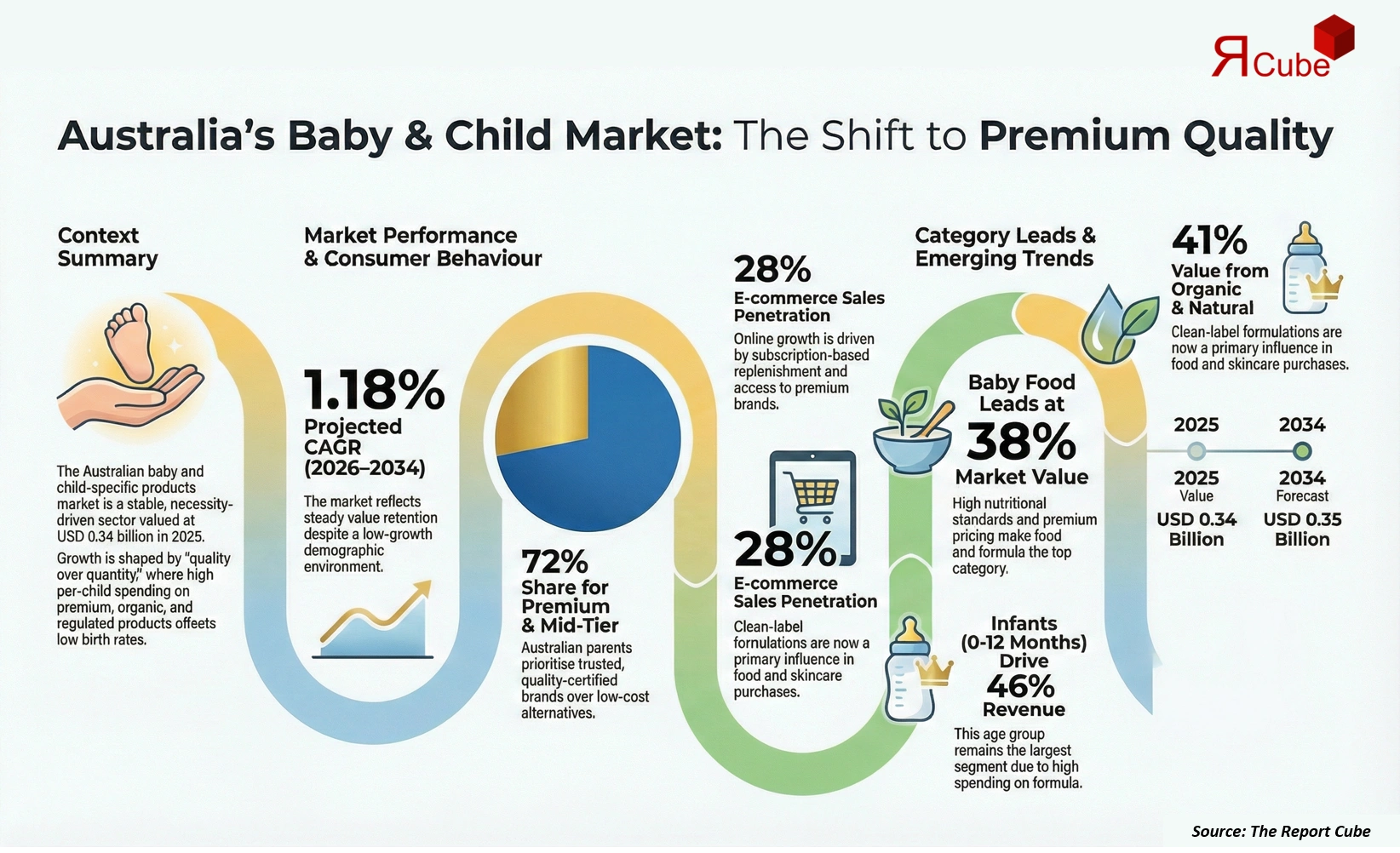
The Australia Baby & Child-Specific Products Market is anticipated to register a CAGR of 1.18% during 2026-2034. The market size was valued at USD 0.34 Billion in 2025 and is projected to reach USD 0.35 Billion by 2034. the market is a stable, necessity-driven segment supported by consistent household demand, high product safety standards, and strong parental awareness around child health and development. Despite modest population growth and relatively low birth rates compared to emerging economies, Australian parents demonstrate high per-child spending, particularly on nutrition, hygiene, and developmental products. In 2025, more than 96% of households with infants and toddlers regularly purchased branded baby and child-specific products, reflecting strong trust in regulated, quality-certified offerings. The market is shaped by premiumization rather than volume expansion, with parents prioritizing organic ingredients, clean-label formulations, and products aligned with pediatric recommendations. This consumption pattern supports steady value retention across baby food, infant formula, diapers, skincare, and learning products.
Market behavior is also influenced by Australia’s well-developed retail ecosystem and high penetration of modern trade and e-commerce. Supermarkets, pharmacies, specialty baby stores, and online platforms ensure broad accessibility across urban and regional areas. In 2025, online channels accounted for nearly 28% of total sales value, driven by convenience, subscription-based replenishment, and access to premium and imported brands. Australian consumers place strong emphasis on product origin, safety certifications, and environmental responsibility, encouraging brands to focus on traceability, sustainable packaging, and ethical sourcing. Although overall market growth remains limited by demographic factors, consistent replacement demand and premium purchasing behavior support long-term market stability.
Australia Baby & Child-Specific Products Market Recent Developments
- 2025: Bellamy’s Organic expanded its locally sourced organic baby food portfolio.
- 2025: Bubs Australia increased production capacity for infant formula targeting domestic demand.
Government Initiatives & Policies
- Food Standards Australia New Zealand (FSANZ) Infant Nutrition Regulations: Regulatory framework ensuring safety, labeling, and nutritional standards.
- Australian Competition & Consumer Commission (ACCC) Product Safety Standards: Oversight ensuring safety compliance for children’s products.
Australia Baby & Child-Specific Products Market Dynamics
Key Driver: High Parental Spending and Safety Awareness
The primary driver of the Australia baby and child-specific products market is high parental spending combined with strong awareness of child safety, nutrition, and developmental needs. Australian parents are highly informed and cautious buyers, prioritizing product quality, clinical backing, and regulatory compliance. In 2025, premium and mid-tier products accounted for more than 72% of total market value, highlighting a preference for trusted brands over low-cost alternatives. Products positioned around organic nutrition, dermatologically tested skincare, and age-appropriate learning continue to see consistent demand. This focus on quality over quantity supports stable revenue generation even in a low-growth demographic environment.
Major Challenge: Low Birth Rates and Market Saturation
A major challenge facing the market is Australia’s relatively low birth rate and high level of product penetration. With most households already using branded baby and child products, opportunities for volume-driven growth are limited. Intense competition among established multinational and domestic brands further constrains expansion, particularly in core categories such as diapers and infant formula. Additionally, strict regulatory requirements increase compliance costs and limit rapid product innovation. These factors require brands to rely on premiumization, line extensions, and brand loyalty rather than aggressive market expansion.
Industry Trends: Organic, Clean-Label, and Sustainable Products
An important industry trend is the rising demand for organic, clean-label, and environmentally responsible baby and child products. Australian consumers show strong preference for products free from artificial additives, harsh chemicals, and unnecessary preservatives. In 2025, organic and natural formulations accounted for approximately 41% of baby food and skincare sales value. Sustainable packaging, cruelty-free testing, and locally sourced ingredients are increasingly influential in purchase decisions. These trends are reshaping product development and marketing strategies across both domestic and international brands.
Opportunity Ahead: E-commerce Growth and Premium Local Brands
Future opportunities lie in continued e-commerce expansion and the growth of premium Australian brands. Online platforms enable direct engagement with parents, subscription-based replenishment, and targeted education on product benefits. Locally produced brands with strong quality credentials and sustainability narratives are gaining trust among consumers. Companies that leverage digital channels, transparent sourcing, and differentiated product positioning can strengthen customer loyalty and capture incremental value growth despite modest overall market expansion.
Australia Baby & Child-Specific Products Market Segment-wise Analysis
By Product Type:
- Baby Food & Infant Formula
- Diapers & Wipes
- Baby Skincare & Toiletries
- Feeding & Nursing Products
- Baby Apparel & Footwear
- Toys & Learning Products
- Others
Baby food and infant formula represent the leading product type, accounting for approximately 38% of total market value in 2025 due to high nutritional standards and premium pricing. Diapers and wipes follow, supported by consistent replacement demand. Baby skincare and learning products show steady growth as parents focus on holistic child development and gentle personal care.
By Age Group:
- Infants (0–12 Months)
- Toddlers (1–3 Years)
- Children (4–12 Years)
Infants represent the largest age group segment, contributing nearly 46% of total market revenue in 2025, driven by higher spending on formula, diapers, and skincare. Toddlers follow with demand for feeding products and learning items, while the children segment contributes through apparel, toys, and hygiene products.
Regional Projection of Australia Baby & Child-Specific Products Industry
- New South Wales
- Victoria
- Queensland
- Western Australia
- South Australia
New South Wales leads the market with approximately 34% share in 2025, supported by higher population density and strong retail infrastructure. Victoria follows closely, driven by urban consumption and premium brand adoption. Queensland contributes steady demand through growing young families, while Western Australia and South Australia maintain stable consumption supported by organized retail and online access.
Why Choose This Report?
- Provides a comprehensive overview of the overall market analysis, encompassing key trends, consumer behavior analysis, and risk assessment to support strategic decision-making.
- Provides accurate, up-to-date insights into market size, segmentation, and emerging opportunities, helping to minimize risk & capitalizing on growth.
- Gives deep understanding of target audience preferences, investment habits, and communication channels for enhanced product development & marketing effectiveness.
- Delivers competitive analysis & benchmarking, uncovering the strengths & weaknesses of market competitors to guide strategies.
- Consolidate comprehensive market intelligence, reducing reasoning & streamlining research efforts.
- Facilitates customized market segmentation & risk mitigation strategies, fine-tuned to the business objectives.
- Aids in identifying both market challenges & untapped opportunities within the industry to drive long-term business growth.
- Provides valuable information based on actual customer data & search trends.
Table of Contents
- Introduction
- Objective of the Study
- Product/Category Definition
- Market Segmentation
- Study Variables
- Research Methodology
- Secondary Data Points
- Breakdown of Secondary Sources
- Primary Data Points
- Breakdown of Primary Interviews
- Secondary Data Points
- Executive Summary
- Market Dynamics
- Drivers
- Challenges
- Opportunity Assessment
- Recent Trends and Developments
- Policy and Regulatory Landscape
- Australia Baby & Child-Specific Products Market Overview (2020-2034)
- Market Size, By Value (AUD Million / USD Million)
- Market Share, By Product Type
- Baby Food & Infant Formula
- Diapers & Wipes
- Baby Skincare & Toiletries
- Feeding & Nursing Products
- Baby Apparel & Footwear
- Toys & Learning Products
- Others
- Market Share, By Age Group
- Infants (0–12 Months)
- Toddlers (1–3 Years)
- Children (4–12 Years)
- Market Share, By Distribution Channel
- Supermarkets & Hypermarkets
- Specialty Baby Stores
- Online Retail
- Pharmacies & Drugstores
- Others
- Market Share, By Price Tier
- Premium
- Mid-Tier
- Economy
- Market Share, By Region
- New South Wales
- Victoria
- Queensland
- Western Australia
- South Australia
- Market Share, By Company
- Revenue Shares
- Competitive Landscape
- Segment-wise & Category-wise Market Forecast (2026-2034)
- By Product Type
- By Age Group
- By Distribution Channel
- By Price Tier
- By Region
- New South Wales Australia Baby & Child-Specific Products Market
- Market Size, By Value (AUD Million / USD Million)
- Market Share, By Product Type
- Market Share, By Distribution Channel
- Market Share, By Price Tier
- Market Share, By Key Cities
- Victoria Australia Baby & Child-Specific Products Market
- Market Size, By Value (AUD Million / USD Million)
- Market Share, By Product Type
- Market Share, By Distribution Channel
- Market Share, By Price Tier
- Market Share, By Key Cities
- Queensland Australia Baby & Child-Specific Products Market
- Market Size, By Value (AUD Million / USD Million)
- Market Share, By Product Type
- Market Share, By Distribution Channel
- Market Share, By Price Tier
- Market Share, By Key Cities
- Western Australia Baby & Child-Specific Products Market
- Market Size, By Value (AUD Million / USD Million)
- Market Share, By Product Type
- Market Share, By Distribution Channel
- Market Share, By Price Tier
- Market Share, By Key Cities
- South Australia Baby & Child-Specific Products Market
- Market Size, By Value (AUD Million / USD Million)
- Market Share, By Product Type
- Market Share, By Distribution Channel
- Market Share, By Price Tier
- Market Share, By Key Cities
- Competitive Outlook & Company Profiles
- Johnson & Johnson
- Company Overview
- Product Portfolio
- Strategic Alliances/Partnerships
- Recent Developments
- Nestlé
- Company Overview
- Product Portfolio
- Strategic Alliances/Partnerships
- Recent Developments
- Danone
- Company Overview
- Product Portfolio
- Strategic Alliances/Partnerships
- Recent Developments
- Reckitt
- Company Overview
- Product Portfolio
- Strategic Alliances/Partnerships
- Recent Developments
- Procter & Gamble
- Company Overview
- Product Portfolio
- Strategic Alliances/Partnerships
- Recent Developments
- Unilever
- Company Overview
- Product Portfolio
- Strategic Alliances/Partnerships
- Recent Developments
- The Honest Company
- Company Overview
- Product Portfolio
- Strategic Alliances/Partnerships
- Recent Developments
- Bubs Australia
- Company Overview
- Product Portfolio
- Strategic Alliances/Partnerships
- Recent Developments
- Bellamy’s Organic
- Company Overview
- Product Portfolio
- Strategic Alliances/Partnerships
- Recent Developments
- Others
- Johnson & Johnson
- Contact Us / Disclaimer
Top Key Players & Market Share Outlook
- Johnson & Johnson
- Nestlé
- Danone
- Reckitt
- Procter & Gamble
- Unilever
- The Honest Company
- Bubs Australia
- Bellamy’s Organic
- Others
Frequently Asked Questions






