



Build Your Custom Market Intelligence Report
Customize Your ReportAustralia Deodorants Market Insights & Analysis
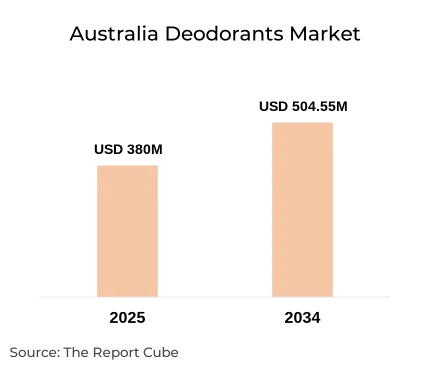
The Australia Deodorants Market is anticipated to register a CAGR of 3.20% during 2026–2034. The market size was valued at USD 380 million in 2025 and is projected to reach USD 504.55 million by 2034.
The Australia deodorants market represents a mature yet steadily evolving personal care segment, supported by high hygiene awareness, daily-use consumption patterns, and strong retail penetration. Deodorant usage is deeply embedded in Australian lifestyles due to climatic conditions, outdoor activities, and rising health-conscious grooming habits. More than 85% of Australian consumers use deodorants daily, ensuring consistent baseline demand across genders and age groups.
While overall growth remains moderate, product innovation, premiumization, and the rising popularity of natural and aluminum-free formulations are reshaping market dynamics. Consumers are increasingly seeking skin-friendly, long-lasting, and eco-conscious deodorant solutions. Brands are responding with reformulations, sustainable packaging, and gender-neutral offerings, supporting incremental value growth through the forecast period.
Australia Deodorants Market Recent Developments
- 2025: Unilever expanded Rexona’s aluminum-free deodorant range across major Australian retailers.
- 2025: Black Chicken Remedies introduced a refillable natural deodorant packaging format.
Government Initiatives & Policies
- Australian Industrial Chemicals Introduction Scheme (AICIS): Regulates ingredient safety and compliance for personal care products.
- National Waste Policy Action Plan: Encourages sustainable packaging and waste reduction across consumer goods.
Australia Deodorants Market Dynamics
Key Driver: High Hygiene Awareness and Daily-Use Consumption
The primary driver of the Australia deodorants market is consistent daily usage supported by strong hygiene awareness. Australia’s warm climate and active lifestyle encourage regular deodorant application, sustaining high volume demand. Consumers prioritize odor protection, sweat control, and skin comfort, particularly for long-working hours and outdoor activities. Brand loyalty remains strong in mass segments, while younger consumers actively explore new formulations. The men’s deodorant segment continues to grow steadily, supported by grooming-focused marketing and product differentiation.
Book your FREE 30-minute expert consultation today
Contact UsIndustry Trends: Shift Toward Natural, Aluminum-Free, and Unisex Products
A notable industry trend is the shift toward natural and organic deodorants. Concerns over skin sensitivity and long-term health effects of aluminum compounds are driving trial of plant-based and alcohol-free formulations. Natural and eco-premium deodorants are growing at nearly twice the pace of conventional products. Additionally, unisex fragrances and minimalist branding are gaining popularity, reflecting changing gender norms. Sustainable packaging, including refill systems and recyclable containers, is increasingly influencing purchasing decisions.
Major Challenge: Market Saturation and Price Competition
The Australian deodorants market faces saturation due to high penetration and limited scope for volume expansion. Intense competition among established multinational brands leads to frequent price promotions, impacting margins. Private-label offerings further intensify price pressure in supermarkets. Additionally, convincing mass consumers to trade up to premium or natural alternatives remains challenging due to higher price points and performance perception gaps.
Opportunity: Growth of Natural & Eco-Premium Deodorants
The fastest-growing opportunity lies in the natural and eco-premium segment. Consumers are increasingly willing to pay for clean-label products that align with sustainability and wellness values. Local brands leveraging ethical sourcing, cruelty-free claims, and transparent ingredient lists are gaining traction. Expansion of online retail and direct-to-consumer channels enables brands to educate consumers and build trust, creating long-term growth potential despite overall market maturity.
Australia Deodorants Market Segment-wise Analysis
By Product Type:
- Spray Deodorants
- Roll-On Deodorants
- Stick Deodorants
- Cream & Gel Deodorants
Spray deodorants dominate the market, accounting for approximately 44% of total sales in 2025, driven by ease of application and strong brand presence. Roll-ons remain popular for daily personal use, while stick deodorants show steady growth in men’s grooming segments. Cream and gel formats are expanding gradually, particularly within the natural and sensitive-skin categories.
By Distribution Channel:
- Supermarkets & Hypermarkets
- Pharmacies & Drug Stores
- Online Retail
- Convenience Stores
Supermarkets and hypermarkets account for nearly 52% market share, supported by high footfall and promotional strategies. Pharmacies play a key role in premium and sensitive-skin deodorants. Online retail, contributing around 21%, is the fastest-growing channel, driven by subscription models and natural brand discovery.
Need insights for a specific region within this market?
Request Regional DataRegional Projection of Australia Deodorants Industry
- New South Wales
- Victoria
- Queensland
- Western Australia
- Rest of Australia
New South Wales leads the Australia deodorants market, contributing approximately 32% of national revenue, supported by population density and strong retail infrastructure. Victoria follows closely, driven by urban consumption and premium product adoption. Queensland benefits from climatic conditions that encourage frequent usage. Western Australia and the rest of Australia show stable demand, supported by consistent household penetration. New South Wales is expected to retain leadership through 2034.
Why Choose This Report?
- Provides a comprehensive overview of market size, trends, and demand patterns.
- Offers accurate segmentation and regional performance insights.
- Analyzes consumer preferences and evolving formulation trends.
- Delivers competitive benchmarking and strategic insights.
- Reduces research time through consolidated market intelligence.
- Supports product positioning and market entry strategies.
- Identifies challenges and growth opportunities.
- Backed by real consumer behavior and retail data.
Table of Contents
- Introduction
- Objective of the Study
- Deodorants Definition
- Market Segmentation
- Study Variables
- Research Methodology
- Secondary Data Points
- Breakdown of Secondary Sources
- Primary Data Points
- Breakdown of Primary Interviews
- Secondary Data Points
- Executive Summary
- Market Dynamics
- Drivers
- Challenges
- Opportunity Assessment
- Recent Trends and Developments
- Regulatory and Policy Landscape
- Australia Deodorants Market Overview (2026–2034)
- Market Size, By Value (AUD Million)
- Market Share, By Product Type
- Spray Deodorants
- Roll-On Deodorants
- Stick Deodorants
- Cream & Gel Deodorants
- Other Forms
- Market Share, By Formulation
- Alcohol-Based
- Alcohol-Free
- Natural & Organic
- Market Share, By Gender
- Men
- Women
- Unisex
- Market Share, By Distribution Channel
- Supermarkets & Hypermarkets
- Pharmacies & Drug Stores
- Online Retail
- Convenience Stores
- Specialty Stores
- Market Share, By Price Tier
- Mass
- Premium
- Natural & Eco-Premium
- Market Share, By Company
- Competition Characteristics
- Revenue Shares & Analysis
- Market Share, By Region
- New South Wales Deodorants Market
- Market Size, By Value
- Market Share, By Product Type
- Market Share, By Distribution Channel
- Victoria Deodorants Market
- Market Size, By Value
- Market Share, By Product Type
- Market Share, By Distribution Channel
- Queensland Deodorants Market
- Market Size, By Value
- Market Share, By Product Type
- Market Share, By Distribution Channel
- Western Australia Deodorants Market
- Market Size, By Value
- Market Share, By Product Type
- Market Share, By Distribution Channel
- Rest of Australia Deodorants Market
- Market Size, By Value
- Market Share, By Product Type
- Market Share, By Distribution Channel
- New South Wales Deodorants Market
- Competitive Outlook and Company Profiles
- Unilever (Rexona, Lynx)
- Company Overview
- Deodorant Product Portfolio
- Strategic Alliances/Partnerships
- Recent Developments
- Procter & Gamble (Old Spice)
- Company Overview
- Deodorant Product Portfolio
- Strategic Alliances/Partnerships
- Recent Developments
- Beiersdorf (NIVEA)
- Company Overview
- Deodorant Product Portfolio
- Strategic Alliances/Partnerships
- Recent Developments
- Colgate-Palmolive (Speed Stick)
- Company Overview
- Deodorant Product Portfolio
- Strategic Alliances/Partnerships
- Recent Developments
- Black Chicken Remedies
- Company Overview
- Natural Deodorant Portfolio
- Strategic Alliances/Partnerships
- Recent Developments
- Others
- Company Overview
- Business Segments
- Strategic Alliances/Partnerships
- Recent Developments
- Unilever (Rexona, Lynx)
- Contact Us / Disclaimer
Top Key Players & Market Share Outlook
- Unilever (Rexona, Lynx)
- Procter & Gamble (Old Spice)
- Beiersdorf (NIVEA)
- Colgate-Palmolive (Speed Stick)
- Black Chicken Remedies
- Others (Local, Natural, and Emerging Deodorant Brands)
Frequently Asked Questions






