



Build Your Custom Market Intelligence Report
Customize Your ReportAustralia Jewellery Market Insights & Analysis
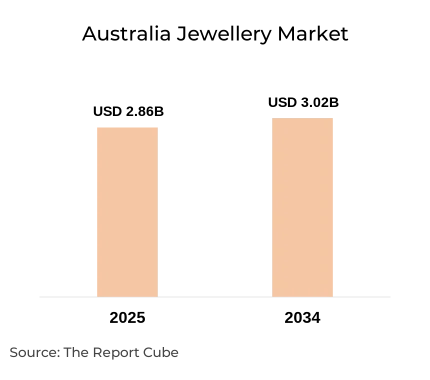
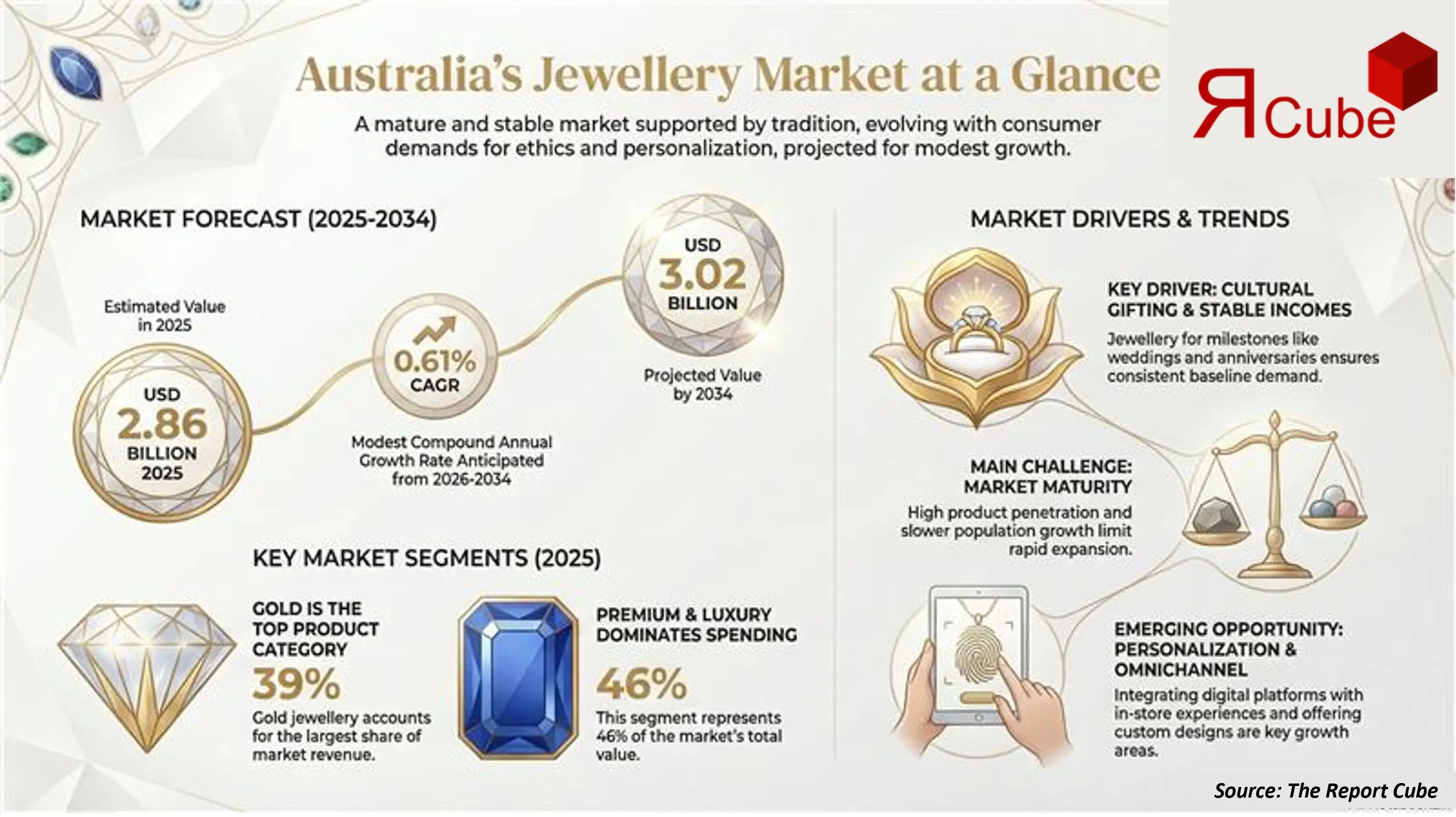
The Australia Jewellery Market is anticipated to register a CAGR of 0.61% during 2026-2034. The market size was valued at USD 2.86 Billion in 2025 and is projected to reach USD 3.02 Billion by 2034. The Australian jewellery market represents a mature consumer goods segment shaped by stable household incomes, high urbanization, and strong cultural associations with gifting, weddings, and milestone celebrations. Demand is largely driven by gold and diamond jewellery, supported by Australia’s affluent consumer base and preference for quality craftsmanship. While overall growth remains modest due to market maturity and high penetration, replacement purchases, brand-driven upgrades, and steady immigration continue to sustain baseline demand. Consumers increasingly value design authenticity, ethical sourcing, and brand heritage, influencing purchasing decisions across both domestic and international jewellery brands operating in Australia.
Market dynamics are also influenced by evolving consumer preferences, including rising interest in minimalist designs, everyday wear jewellery, and ethically sourced materials. Younger consumers are gradually shifting toward lighter pieces and mixed-material jewellery, while premium buyers continue to favor established luxury brands and heritage collections. E-commerce and omnichannel retail strategies are gaining importance, enabling brands to reach customers beyond traditional high-street stores. At the same time, physical retail remains relevant for high-value purchases where trust and in-person experience matter. Together, these factors support a stable but slowly evolving jewellery market landscape in Australia over the forecast period.
Australia Jewellery Market Recent Developments
- 2025: Tiffany & Co. expanded its retail footprint in Australia with refreshed store formats focused on experiential luxury.
- 2025: Tanishq strengthened its international sourcing and design collaborations to cater to global and diaspora demand.
Government Initiatives & Policies
- Australian Trade and Investment Support: Policies supporting luxury goods retail, international trade, and consumer confidence.
- Ethical Sourcing Frameworks: Regulations promoting transparency and responsible sourcing in precious metals and gemstones.
Australia Jewellery Market Dynamics
Key Driver: Cultural Gifting Traditions and Stable Disposable Income
In Australia, the jewellery market is primarily driven by cultural gifting traditions and relatively stable disposable incomes. Jewellery remains a preferred choice for weddings, anniversaries, and personal milestones, ensuring consistent baseline demand. Urban consumers, particularly in major metropolitan areas, demonstrate a willingness to invest in quality pieces that combine design appeal with long-term value. Additionally, Australia’s multicultural population contributes to diverse jewellery preferences, supporting demand for gold, diamond, and gemstone jewellery across different communities. These structural drivers help maintain market stability despite limited overall volume growth.
Major Challenge: Market Maturity and Limited Volume Expansion
A key challenge facing the Australia jewellery market is its mature nature, which limits rapid volume expansion. High product penetration and slower population growth constrain incremental demand. Consumers are also becoming more value-conscious, often delaying discretionary purchases during periods of economic uncertainty. Rising operational costs for retailers, including rent and labor, further pressure margins. While premium brands remain resilient, mid-tier players face intense competition from both luxury brands and affordable fashion jewellery alternatives.
Industry Trends: Ethical, Minimalist, and Everyday Wear Jewellery
An important trend shaping the market is growing consumer interest in ethical sourcing, minimalist aesthetics, and everyday wear jewellery. Shoppers increasingly seek transparency regarding gemstone origins and sustainable practices. Lightweight designs and mixed-material jewellery are gaining popularity among younger consumers, while established luxury brands continue to emphasize craftsmanship and heritage. These trends are influencing product development, marketing narratives, and brand positioning across the Australian jewellery landscape.
Opportunity Ahead: Omnichannel Expansion and Premium Personalization
Future opportunities lie in omnichannel retail expansion and personalized jewellery offerings. Brands that integrate digital platforms with in-store experiences can better engage consumers throughout the purchase journey. Customization, bespoke designs, and limited-edition collections offer avenues to drive higher average transaction values. As consumers increasingly seek emotional connection and uniqueness, personalization is expected to support incremental growth within this otherwise mature market.
Australia Jewellery Market Segment-wise Analysis
By Product Type:
- Gold Jewellery
- Diamond Jewellery
- Pearl & Gemstone Jewellery
- Platinum & Silver Jewellery
- Others
Gold jewellery dominates the Australia jewellery market, accounting for approximately 39% of total market revenue in 2025. Its dominance is supported by cultural preference, long-term value perception, and widespread acceptance across age groups. Diamond jewellery follows, driven by bridal demand and premium gifting occasions. Pearl and gemstone jewellery hold a smaller but stable share, supported by Australia’s association with high-quality pearls and colored stones. These shares reflect retail sales patterns and consumer spending behavior across product categories.
By Price Segment:
- Premium & Luxury
- Mid-Tier
- Affordable & Fashion
The premium and luxury segment accounts for approximately 46% of total market value in 2025, reflecting strong demand for branded jewellery, high-quality materials, and craftsmanship. Mid-tier jewellery follows, catering to aspirational consumers seeking balance between quality and price. Affordable and fashion jewellery represents a smaller share but benefits from impulse purchases and trend-driven demand, particularly among younger consumers.
Regional Projection of Australia Jewellery Industry
- Northwest Italy
- Northeast Italy
- Central Italy
- South Italy
- Islands (Sicilia & Sardegna)
Northwest Italy leads the regional segmentation with an estimated 33% share, driven by high-value jewellery manufacturing, design hubs, and export-oriented brands. Northeast Italy follows with around 24%, supported by artisanal craftsmanship and specialized workshops. Central Italy accounts for approximately 21%, benefiting from heritage brands and tourism-driven sales. South Italy and the islands of Sicilia and Sardegna together represent about 22%, supported by traditional designs and regional consumer demand. These regional shares are derived from production concentration, retail presence, and historical industry distribution.
Why Choose This Report?
- Provides a comprehensive overview of the overall market analysis, encompassing key trends, consumer behavior analysis, and risk assessment to support strategic decision-making.
- Provides accurate, up-to-date insights into market size, segmentation, and emerging opportunities, helping to minimize risk & capitalizing on growth.
- Gives deep understanding of target audience preferences, investment habits, and communication channels for enhanced product development & marketing effectiveness.
- Delivers competitive analysis & benchmarking, uncovering the strengths & weaknesses of market competitors to guide strategies.
- Consolidate comprehensive market intelligence, reducing reasoning & streamlining research efforts.
- Facilitates customized market segmentation & risk mitigation strategies, fine-tuned to the business objectives.
- Aids in identifying both market challenges & untapped opportunities within the industry to drive long-term business growth.
- Provides valuable information based on actual customer data & search trends.
Table of Contents
- Introduction
- Objective of the Study
- Product/Category Definition
- Market Segmentation
- Study Variables
- Research Methodology
- Secondary Data Points
- Breakdown of Secondary Sources
- Primary Data Points
- Breakdown of Primary Interviews
- Secondary Data Points
- Executive Summary
- Market Dynamics
- Drivers
- Challenges
- Opportunity Assessment
- Recent Trends and Developments
- Policy and Regulatory Landscape
- Italy Jewellery Market Overview (2020-2034)
- Market Size, By Volume (Tonnes) & Value (EUR Million)
- Market Share, By Product Type
- Gold Jewellery
- Diamond Jewellery
- Pearl & Gemstone Jewellery
- Platinum & Silver Jewellery
- Others
- Market Share, By Price Segment
- Premium & Luxury
- Mid-Tier
- Affordable & Fashion
- Market Share, By Distribution Channel
- Brand Boutiques
- Multi-Brand Retailers
- Online Retail
- Department Stores
- Jewellery Chains
- Others
- Market Share, By End User
- Women
- Men
- Youth & Millennials
- Gift & Special Occasions
- Market Share, By Region
- Northwest Italy
- Northeast Italy
- Central Italy
- South Italy
- Islands (Sicilia & Sardegna)
- Market Share, By Company
- Revenue Shares
- Competitive Landscape
- Segment-wise & Industry-wise Market Forecast (2026-2034)
- By Product Type
- By Price Segment
- By Distribution Channel
- By End User
- By Region
- Northwest Italy Jewellery Market
- Market Size, By Volume & Value (EUR Million)
- Market Share, By Product Type
- Market Share, By Price Segment
- Market Share, By Distribution Channel
- Market Share, By Key Cities
- Northeast Italy Jewellery Market
- Market Size, By Volume & Value (EUR Million)
- Market Share, By Product Type
- Market Share, By Price Segment
- Market Share, By Distribution Channel
- Market Share, By Key Cities
- Central Italy Jewellery Market
- Market Size, By Volume & Value (EUR Million)
- Market Share, By Product Type
- Market Share, By Price Segment
- Market Share, By Distribution Channel
- Market Share, By Key Cities
- South Italy Jewellery Market
- Market Size, By Volume & Value (EUR Million)
- Market Share, By Product Type
- Market Share, By Price Segment
- Market Share, By Distribution Channel
- Market Share, By Key Cities
- Islands (Sicilia & Sardegna) Jewellery Market
- Market Size, By Volume & Value (EUR Million)
- Market Share, By Product Type
- Market Share, By Price Segment
- Market Share, By Distribution Channel
- Market Share, By Key Cities
- Competitive Outlook & Company Profiles
- Tanishq (Tata Group)
- Company Overview
- Product Portfolio
- Strategic Alliances/Partnerships
- Recent Developments
- Mia by Tanishq
- Company Overview
- Product Portfolio
- Strategic Alliances/Partnerships
- Recent Developments
- Cartier (Richemont)
- Company Overview
- Product Portfolio
- Strategic Alliances/Partnerships
- Recent Developments
- Tiffany & Co.
- Company Overview
- Product Portfolio
- Strategic Alliances/Partnerships
- Recent Developments
- Bulgari (LVMH)
- Company Overview
- Product Portfolio
- Strategic Alliances/Partnerships
- Recent Developments
- Damiani
- Company Overview
- Product Portfolio
- Strategic Alliances/Partnerships
- Recent Developments
- Pomellato
- Company Overview
- Product Portfolio
- Strategic Alliances/Partnerships
- Recent Developments
- Boccia Italia
- Company Overview
- Product Portfolio
- Strategic Alliances/Partnerships
- Recent Developments
- Mikimoto
- Company Overview
- Product Portfolio
- Strategic Alliances/Partnerships
- Recent Developments
- Chopard
- Company Overview
- Product Portfolio
- Strategic Alliances/Partnerships
- Recent Developments
- Others
- Tanishq (Tata Group)
- Contact Us / Disclaimer
List of Figure
List of Table
Top Key Players & Market Share Outlook
- Tanishq (Tata Group)
- Mia by Tanishq
- Cartier (Richemont)
- Tiffany & Co.
- Bulgari (LVMH)
- Damiani
- Pomellato
- Boccia Italia
- Mikimoto
- Chopard
- Others
Frequently Asked Questions