



Build Your Custom Market Intelligence Report
Customize Your ReportIndia Crane Market Insights & Analysis
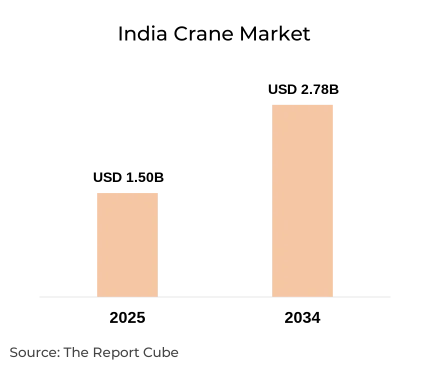
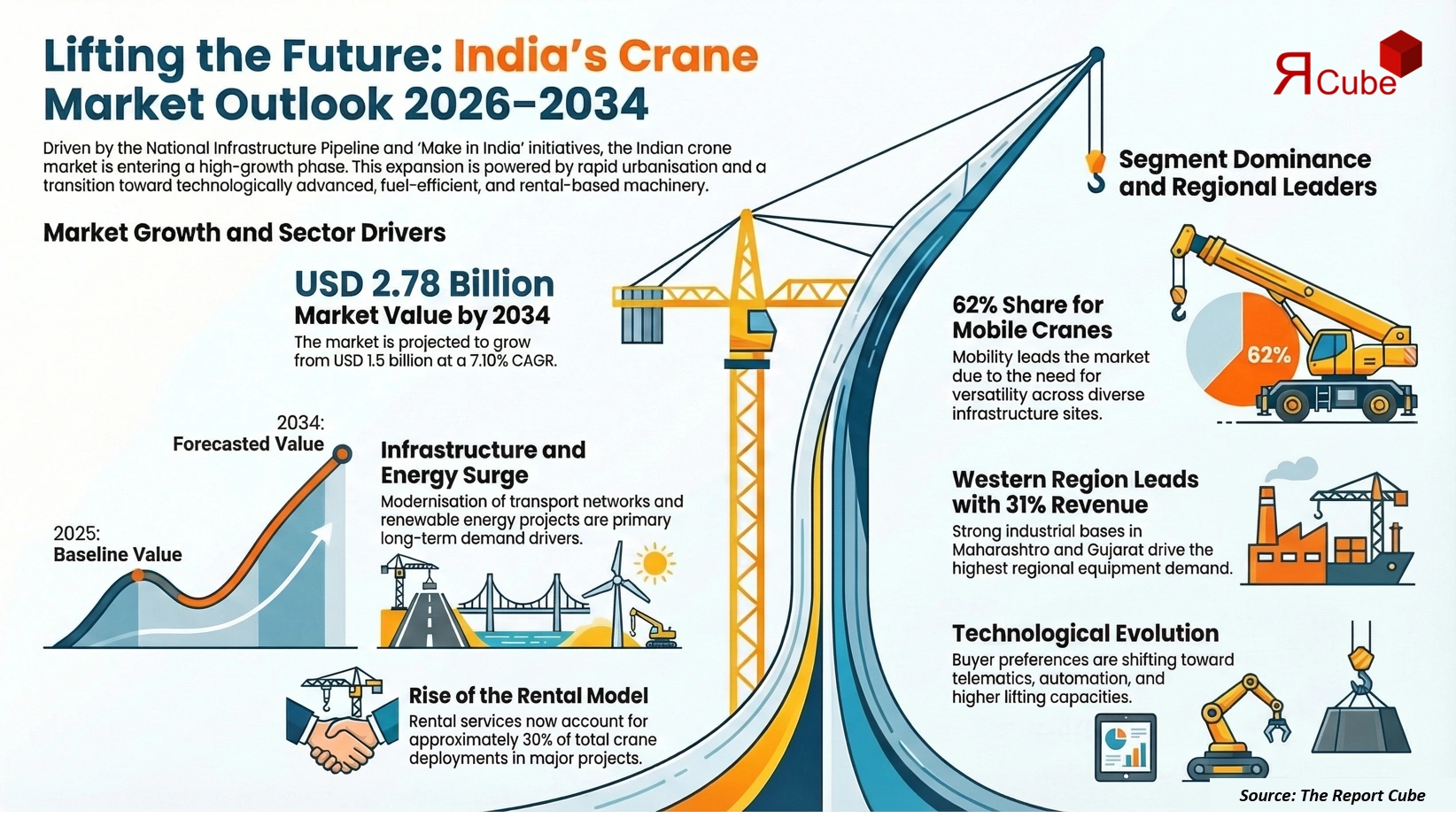
The India Crane Market is anticipated to register a CAGR of 7.10% during 2026-2034. The market size was valued at USD 1.5 billion in 2025 and is projected to reach USD 2.78 billion by 2034. The market is witnessing strong momentum, driven by large-scale infrastructure development, rapid urbanization, and sustained investments across construction, manufacturing, power, ports, and logistics sectors. Cranes have become indispensable equipment across India’s infrastructure value chain, supporting activities ranging from high-rise construction and metro rail development to industrial plant expansion and renewable energy installations.
India’s ongoing focus on modernizing transportation networks, including highways, railways, ports, and airports, has significantly increased the demand for advanced lifting solutions. Government-backed initiatives such as smart cities, industrial corridors, and affordable housing projects are creating long-term demand for both mobile and stationary cranes. Additionally, rising private sector participation in real estate, oil & gas, and heavy engineering projects is further strengthening equipment utilization rates across regions.
Technological advancements, including higher load capacities, fuel-efficient engines, telematics, and automation features, are also reshaping buyer preferences. Domestic manufacturers are increasingly competing with global brands by offering cost-effective, customized crane solutions suited to Indian operating conditions. Collectively, these factors position the India Crane Market for sustained and resilient growth through 2034.
India Crane Market Recent Developments
- 2025: Action Construction Equipment expanded its mobile crane portfolio with higher lifting capacity models for infrastructure projects.
- 2025: Sany India introduced upgraded crawler cranes optimized for metro rail and renewable energy installations.
Government Initiatives & Policies
- National Infrastructure Pipeline (NIP): Accelerates public infrastructure investments across transport, energy, and urban development.
- Make in India Initiative: Encourages domestic manufacturing of heavy equipment, including cranes and construction machinery.
India Crane Market Dynamics
Key Driver: Accelerated Infrastructure and Construction Investments
Accelerated infrastructure and construction spending remains the primary growth driver of the India Crane Market. India is investing heavily in highways, metro rail networks, ports, airports, industrial parks, and renewable energy projects. Infrastructure expenditure has grown at over 10% annually over the past five years, directly translating into higher demand for lifting and material-handling equipment. Cranes are critical for bridge construction, precast concrete handling, steel erection, and heavy machinery installation. Additionally, the rapid pace of urbanization and the expansion of commercial and residential real estate projects in Tier I and Tier II cities are further increasing crane utilization. These developments are creating consistent demand across both rental and ownership models, supporting long-term market expansion.
Book your FREE 30-minute expert consultation today
Contact UsIndustry Trends: Shift Toward Advanced, Fuel-Efficient, and Rental-Based Cranes
A key trend shaping the India Crane Market is the shift toward technologically advanced and fuel-efficient cranes, alongside growing preference for rental solutions. Contractors increasingly favor cranes equipped with telematics, load monitoring systems, and enhanced safety features to improve productivity and compliance. At the same time, rising capital costs are encouraging small and mid-sized contractors to adopt crane rental services instead of outright purchases. The rental segment now accounts for an estimated 30% of total crane deployments in major infrastructure projects. This trend is prompting manufacturers to collaborate with rental companies and offer standardized, durable models designed for high utilization, thereby reshaping competitive strategies across the industry.
Major Challenge: High Capital Costs and Skilled Operator Shortages
Despite favorable growth drivers, high capital costs associated with advanced cranes pose a major challenge for the India Crane Market. Modern cranes with higher lifting capacities and safety features require significant upfront investment, limiting adoption among smaller contractors. Additionally, the industry faces a shortage of skilled crane operators and maintenance professionals, which can lead to operational inefficiencies and safety risks. Training and certification programs remain fragmented across regions, increasing downtime and ownership costs. These challenges can slow adoption rates, particularly in price-sensitive and rural markets, impacting overall market penetration.
Opportunity: Renewable Energy and Industrial Expansion Projects
The rapid expansion of renewable energy and industrial manufacturing presents a substantial opportunity for the India Crane Market. Wind energy installations, solar power plants, and green hydrogen projects require specialized cranes capable of handling heavy components at significant heights. India’s renewable energy capacity additions are expected to grow at over 8% annually, creating sustained demand for crawler and tower cranes. Simultaneously, industrial expansion in steel, cement, petrochemicals, and heavy engineering sectors is driving demand for overhead and gantry cranes. Manufacturers that offer application-specific solutions and after-sales support stand to gain a competitive edge over the forecast period.
India Crane Market Segment-wise Analysis
By Machine Type:
- Mobile Cranes
- Tower Cranes
- Crawler Cranes
- Overhead Cranes
Mobile cranes dominate the India Crane Market by machine type, accounting for approximately 34% of total market revenue in 2025. Their versatility, ease of transportation, and suitability for diverse applications make them the preferred choice for construction and infrastructure projects. Mobile cranes are widely used in road construction, urban development, and industrial maintenance, offering quick setup and flexibility. Tower cranes follow closely, driven by high-rise residential and commercial construction in metropolitan regions. Crawler and overhead cranes maintain steady demand, particularly in heavy industry and power generation projects.
By Mobility:
- Static Cranes
- Mobile Cranes
Mobile cranes lead the market by mobility, holding nearly 62% market share in 2025. Their dominance is attributed to increasing infrastructure projects requiring frequent relocation and adaptability across sites. Mobile cranes reduce project timelines and logistics complexity, making them cost-effective for contractors. Static cranes, including tower and overhead cranes, remain essential for fixed-location projects such as factories, warehouses, and high-rise developments. The balance between mobility and load capacity continues to influence purchasing decisions across end-user segments.
Regional Projection of India Crane Industry
- North
- West
- South
- East
The Western region leads the India Crane Market, contributing approximately 31% of total revenue in 2025. States such as Maharashtra and Gujarat benefit from strong industrial bases, port infrastructure, and large-scale urban development projects. The region hosts major manufacturing hubs, refineries, and logistics centers, driving consistent demand for mobile, crawler, and overhead cranes. The Southern region follows closely, supported by metro rail expansion, renewable energy installations, and IT-driven commercial construction. Meanwhile, Northern and Eastern regions are emerging growth markets due to increasing government infrastructure investments and industrial corridor development.
Need insights for a specific region within this market?
Request Regional DataWhy Choose This Report?
- Provides a comprehensive overview of the overall market analysis, encompassing key trends, consumer behavior analysis, and risk assessment to support strategic decision-making.
- Provides accurate, up-to-date insights into market size, segmentation, and emerging opportunities, helping to minimize risk & capitalizing on growth.
- Gives deep understanding of target audience preferences, investment habits, and communication channels for enhanced product development & marketing effectiveness.
- Delivers competitive analysis & benchmarking, uncovering the strengths & weaknesses of market competitors to guide strategies.
- Consolidate comprehensive market intelligence, reducing reasoning & streamlining research efforts.
- Facilitates customized market segmentation & risk mitigation strategies, fine-tuned to the business objectives.
- Aids in identifying both market challenges & untapped opportunities within the industry to drive long-term business growth.
- Provides valuable information based on actual customer data & search trends.
Table of Contents
- Introduction
- Objective of the Study
- Product and Category Definition
- Market Segmentation
- Study Variables
- Research Methodology
- Secondary Data Points
- Breakdown of Secondary Sources
- Primary Data Points
- Breakdown of Primary Interviews
- Secondary Data Points
- Executive Summary
- Market Dynamics
- Drivers
- Challenges
- Opportunity Assessment
- Recent Trends and Developments
- Regulatory and Policy Landscape
- India Crane Market Overview (2020-2034)
- Market Size, By Value (USD Billion)
- Market Share, By Machine Type
- Mobile Cranes
- Tower Cranes
- Crawler Cranes
- Overhead Cranes
- Other Cranes
- Market Share, By Mobility
- Static Cranes
- Mobile Cranes
- Market Share, By Application
- Construction
- Infrastructure
- Mining
- Oil and Gas
- Industrial
- Market Share, By Lifting Capacity
- Sub 20 Tons
- 20-100 Tons
- 100-300 Tons
- Above 300 Tons
- Market Share, By Region
- North
- West
- Central
- South
- East
- Market Share, By Company
- Revenue Shares & Analysis
- Competition Characteristics
- North India Crane Market
- Market Size, By Value (USD Billion)
- Market Share, By Machine Type
- Market Share, By Mobility
- Market Share, By Application
- Market Share, By Lifting Capacity
- West and Central India Crane Market
- Market Size, By Value (USD Billion)
- Market Share, By Machine Type
- Market Share, By Mobility
- Market Share, By Application
- Market Share, By Lifting Capacity
- South India Crane Market
- Market Size, By Value (USD Billion)
- Market Share, By Machine Type
- Market Share, By Mobility
- Market Share, By Application
- Market Share, By Lifting Capacity
- East India Crane Market
- Market Size, By Value (USD Billion)
- Market Share, By Machine Type
- Market Share, By Mobility
- Market Share, By Application
- Market Share, By Lifting Capacity
- Competitive Outlook and Company Profiles
- Action Construction Equipment
- Company Overview
- Product Portfolio
- Strategic Alliances/Partnerships
- Recent Developments
- Escorts Kubota
- Company Overview
- Product Portfolio
- Strategic Alliances/Partnerships
- Recent Developments
- TIL Limited
- Company Overview
- Product Portfolio
- Strategic Alliances/Partnerships
- Recent Developments
- Kobelco India
- Company Overview
- Product Portfolio
- Strategic Alliances/Partnerships
- Recent Developments
- Sany India
- Company Overview
- Product Portfolio
- Strategic Alliances/Partnerships
- Recent Developments
- Liebherr India
- Company Overview
- Product Portfolio
- Strategic Alliances/Partnerships
- Recent Developments
- Konecranes India
- Company Overview
- Product Portfolio
- Strategic Alliances/Partnerships
- Recent Developments
- Zoomlion India
- Company Overview
- Product Portfolio
- Strategic Alliances/Partnerships
- Recent Developments
- Anupam Industries
- Company Overview
- Product Portfolio
- Strategic Alliances/Partnerships
- Recent Developments
- Meltech Cranes
- Company Overview
- Product Portfolio
- Strategic Alliances/Partnerships
- Recent Developments
- Others
- Action Construction Equipment
- Contact Us and Disclaimer
Top Key Players & Market Share Outlook
- Action Construction Equipment
- Escorts Kubota
- TIL Limited
- Kobelco India
- Sany India
- Liebherr India
- Konecranes India
- Zoomlion India
- Anupam Industries
- Meltech Cranes
- Others
Frequently Asked Questions






