



Build Your Custom Market Intelligence Report
Customize Your ReportUAE Robotics in Construction Market Insights & Analysis
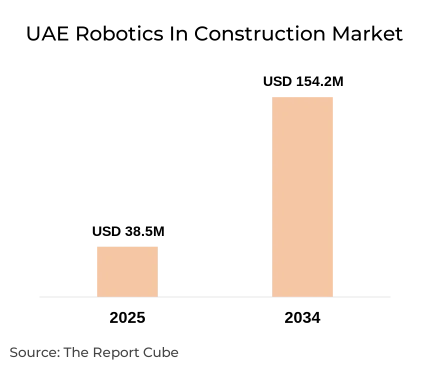
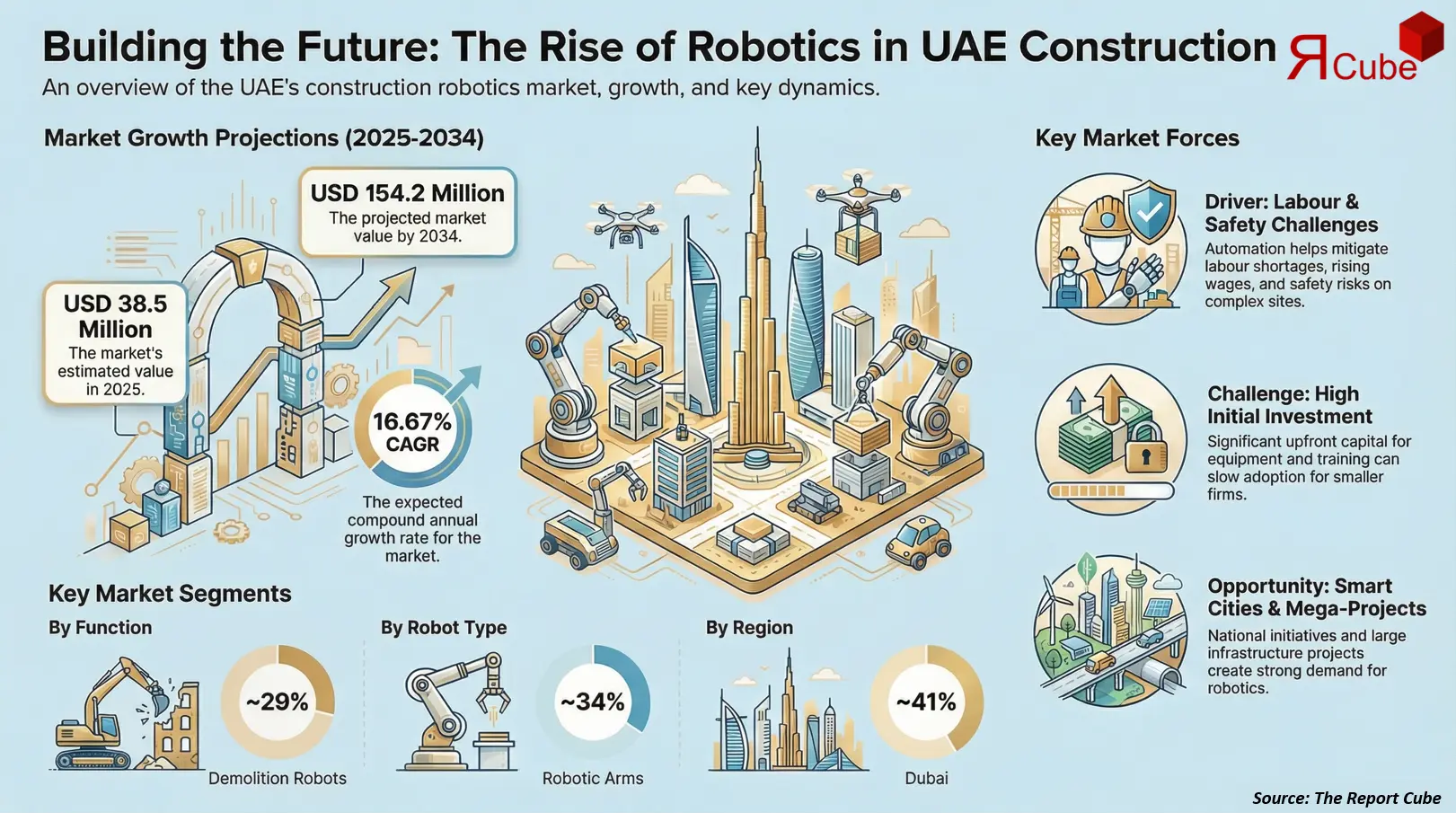
The UAE Robotics in Construction Market is anticipated to register a CAGR of 16.67% during the forecast period. The market size was valued at USD 38.5 million and is projected to reach USD 154.2 million by 2034. This rapid expansion reflects the UAE’s strategic push toward construction automation, smart infrastructure, and labor productivity enhancement across large-scale urban and industrial developments.
The UAE construction sector is undergoing a technological shift as developers face rising labor costs, tight project timelines, and increasing safety requirements. Robotics adoption is gaining momentum across demolition, bricklaying, inspection, and material handling functions, helping contractors reduce manual dependency while improving precision and efficiency. Government-backed smart city initiatives and sustainability targets further encourage the deployment of robotics-enabled construction workflows.
Moreover, the country’s strong investment in digital construction, Building Information Modeling (BIM), and prefabrication methods is creating a conducive environment for robotic integration. Robotics solutions are increasingly aligned with modular construction and 3D printing strategies, enabling faster project execution and reduced material wastage. As a result, the UAE Robotics in Construction Market is emerging as a high-growth niche within the broader construction technology landscape.
UAE Robotics in Construction Market Recent Developments
- 2025: Leading UAE contractors expanded the use of robotic bricklaying systems for high-rise residential projects.
- 2025: Robotics providers introduced autonomous inspection robots for large infrastructure and energy construction sites.
Government Initiatives & Policies
- UAE Smart Construction Program: Supports automation, robotics, and digital tools to enhance construction productivity.
- Dubai Industrial Strategy 2030: Encourages advanced manufacturing and robotics adoption across construction and infrastructure.
UAE Robotics in Construction Market Dynamics
Key Driver: Rising Demand for Automation to Address Labor and Safety Challenges
The primary driver of the UAE Robotics in Construction Market is the growing need to address labor shortages, rising wages, and safety risks on construction sites. Construction projects in the UAE are becoming larger and more complex, increasing reliance on skilled labor that is often scarce. Robotics solutions help mitigate these challenges by automating repetitive, hazardous, and precision-intensive tasks such as demolition, material transport, and structural inspection. For instance, demolition robots significantly reduce worker exposure to unsafe environments while improving operational control. Additionally, robotics-enabled workflows enhance consistency and reduce rework, directly supporting cost optimization. As developers focus on timely project delivery and risk reduction, automation through robotics is becoming a strategic necessity rather than an optional upgrade.
Book your FREE 30-minute expert consultation today
Contact UsIndustry Trends: Integration of Robotics with Digital Construction Technologies
An important trend shaping the market is the integration of construction robotics with digital technologies such as BIM, IoT sensors, and AI-based project management systems. Robotics platforms are increasingly connected to digital models, enabling precise execution of layouts, real-time progress tracking, and predictive maintenance of equipment. Drones and autonomous vehicles are widely used for surveying and site monitoring, providing accurate data that supports decision-making. 3D printing robots are also gaining attention for rapid prototyping and structural component fabrication. This convergence of robotics and digital construction enhances transparency, reduces delays, and improves resource utilization, reinforcing the long-term adoption of robotics across UAE construction projects.
Major Challenge: High Initial Investment and Integration Complexity
Despite strong growth potential, high initial investment remains a major challenge for the UAE Robotics in Construction Market. Robotics systems require significant upfront capital for equipment procurement, software integration, and workforce training. Small and mid-sized contractors often face budget constraints that limit large-scale deployment. Additionally, integrating robotics into existing construction workflows can be complex, particularly for legacy projects not designed for automation. Interoperability issues between different digital platforms may further slow adoption. These factors can delay return on investment and restrict market penetration, especially outside large flagship developments.
Opportunity: Expansion of Smart Cities and Mega Infrastructure Projects
The expansion of smart cities and mega infrastructure projects presents a substantial opportunity for the UAE Robotics in Construction Market. Projects aligned with smart city development emphasize automation, efficiency, and sustainability, creating strong demand for robotics solutions. Robotics-enabled construction supports faster execution, reduced waste, and improved quality control, aligning with national sustainability goals. Furthermore, public-private partnerships and increased foreign investment are accelerating the adoption of advanced construction technologies. As robotics solutions mature and become more cost-effective, wider adoption across residential, commercial, and industrial projects is expected, unlocking long-term growth opportunities.
UAE Robotics in Construction Market Segment-wise Analysis
By Function:
- Demolition Robots
- Bricklaying Robots
- Material Handling
- 3D Printing
- Inspection & Survey
- Finishing & Assembly
- Layout & Mapping
- Other Functions
Demolition Robots dominate the functional segmentation, accounting for nearly 29% of the market share. Their leadership is driven by strong safety benefits and efficiency gains in controlled demolition tasks. Inspection & Survey and Bricklaying Robots are also witnessing rapid adoption, supported by infrastructure expansion and housing development. 3D Printing functions are emerging steadily, particularly for prefabrication and structural components. Collectively, these segments highlight a shift toward automated, precision-driven construction practices across the UAE.
By Robot Type:
- Robotic Arms
- Autonomous Vehicles
- Drones & UAVs
- Exoskeletons
- Service Robots
- Other Types
Robotic Arms lead the robot type segment with approximately 34% market share, owing to their versatility in tasks such as bricklaying, welding, and assembly. Drones & UAVs follow closely, widely used for surveying, inspection, and progress monitoring. Exoskeletons are gaining traction to enhance worker productivity and reduce fatigue, especially in labor-intensive tasks. Autonomous vehicles and service robots further support material transport and on-site logistics, strengthening overall operational efficiency.
Regional Projection of UAE Robotics in Construction Industry
- Dubai
- Abu Dhabi
- Sharjah
- Northern Emirates
- Others
Dubai leads the UAE Robotics in Construction Market, holding nearly 41% market share. The city’s dominance is supported by large-scale real estate developments, smart city initiatives, and early adoption of construction automation. Abu Dhabi follows, driven by government infrastructure projects and industrial construction. Dubai’s advanced regulatory framework, strong investment inflows, and focus on innovation position it as the primary hub for robotics-enabled construction, sustaining leadership throughout the forecast period.
Need insights for a specific region within this market?
Request Regional DataWhy Choose This Report?
- Provides a comprehensive overview of the overall market analysis, encompassing key trends, consumer behavior analysis, and risk assessment to support strategic decision-making.
- Provides accurate, up-to-date insights into market size, segmentation, and emerging opportunities, helping to minimize risk & capitalizing on growth.
- Gives deep understanding of target audience preferences, investment habits, and communication channels for enhanced product development & marketing effectiveness.
- Delivers competitive analysis & benchmarking, uncovering the strengths & weaknesses of market competitors to guide strategies.
- Consolidate comprehensive market intelligence, reducing reasoning & streamlining research efforts.
- Facilitates customized market segmentation & risk mitigation strategies, fine-tuned to the business objectives.
- Aids in identifying both market challenges & untapped opportunities within the industry to drive long-term business growth.
- Provides valuable information based on actual customer data & search trends.
Table of Contents
- Introduction
- Objective of the Study
- Product and Category Definition
- Market Segmentation
- Study Variables
- Research Methodology
- Secondary Data Points
- Breakdown of Secondary Sources
- Primary Data Points
- Breakdown of Primary Interviews
- Secondary Data Points
- Executive Summary
- Market Dynamics
- Drivers
- Challenges
- Opportunity Assessment
- Recent Trends and Developments
- Regulatory and Policy Landscape
- UAE Robotics in Construction Market Overview (2020-2034)
- Market Size, By Value (USD Million)
- Market Share, By Function
- Demolition Robots
- Bricklaying Robots
- Material Handling
- 3D Printing
- Inspection & Survey
- Finishing & Assembly
- Layout & Mapping
- Other Functions
- Market Share, By Robot Type
- Robotic Arms
- Autonomous Vehicles
- Drones & UAVs
- Exoskeletons
- Service Robots
- Other Types
- Market Share, By Automation
- Fully Autonomous
- Semi-Autonomous
- Market Share, By Application
- Residential Projects
- Commercial Projects
- Industrial Projects
- Public Infrastructure
- Energy & Utilities
- Other Applications
- Market Share, By End User
- Construction Contractors
- Developers & Owners
- Government Agencies
- Engineering Firms
- Facility Managers
- Market Share, By Region
- Dubai
- Abu Dhabi
- Sharjah
- Northern
- Others
- Market Share, By Company
- Competition Characteristics
- Revenue Shares & Analysis
- Dubai Robotics in Construction Market
- Market Size, By Value (USD Million)
- Market Share, By Function
- Market Share, By Robot Type
- Market Share, By Automation
- Market Share, By Application
- Market Share, By End User
- Abu Dhabi Robotics in Construction Market
- Market Size, By Value (USD Million)
- Market Share, By Function
- Market Share, By Robot Type
- Market Share, By Automation
- Market Share, By Application
- Market Share, By End User
- Sharjah & Northern Emirates Robotics in Construction Market
- Market Size, By Value (USD Million)
- Market Share, By Function
- Market Share, By Robot Type
- Market Share, By Automation
- Market Share, By Application
- Market Share, By End User
- Other UAE Regions Robotics in Construction Market
- Market Size, By Value (USD Million)
- Market Share, By Function
- Market Share, By Robot Type
- Market Share, By Automation
- Market Share, By Application
- Market Share, By End User
- Competitive Outlook and Company Profiles
- Brokk AB
- Company Overview
- Product Portfolio
- Strategic Alliances/Partnerships
- Recent Developments
- Husqvarna AB
- Company Overview
- Product Portfolio
- Strategic Alliances/Partnerships
- Recent Developments
- Built Robotics Inc.
- Company Overview
- Product Portfolio
- Strategic Alliances/Partnerships
- Recent Developments
- FBR Ltd
- Company Overview
- Product Portfolio
- Strategic Alliances/Partnerships
- Recent Developments
- Advanced Construction Robotics Inc.
- Company Overview
- Product Portfolio
- Strategic Alliances/Partnerships
- Recent Developments
- Construction Robotics LLC
- Company Overview
- Product Portfolio
- Strategic Alliances/Partnerships
- Recent Developments
- Komatsu Ltd.
- Company Overview
- Product Portfolio
- Strategic Alliances/Partnerships
- Recent Developments
- ABB Ltd.
- Company Overview
- Product Portfolio
- Strategic Alliances/Partnerships
- Recent Developments
- Canvas Robotics
- Company Overview
- Product Portfolio
- Strategic Alliances/Partnerships
- Recent Developments
- Ekso Bionics
- Company Overview
- Product Portfolio
- Strategic Alliances/Partnerships
- Recent Developments
- Others
- Brokk AB
- Contact Us and Disclaimer
Top Key Players & Market Share Outlook
- Brokk AB
- Husqvarna AB
- Built Robotics Inc.
- FBR Ltd
- Advanced Construction Robotics Inc.
- Construction Robotics LLC
- Komatsu Ltd.
- ABB Ltd.
- Canvas Robotics
- Ekso Bionics
- Others
Frequently Asked Questions






