



Build Your Custom Market Intelligence Report
Customize Your ReportSouth Korea Dairy Blends Market Insights & Analysis
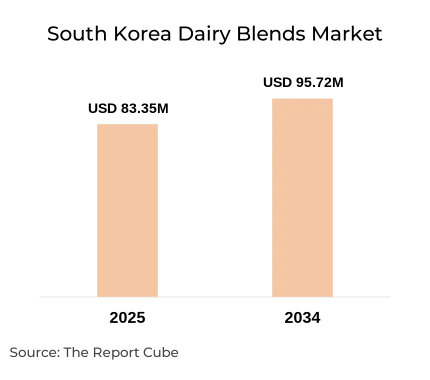
The South Korea Dairy Blends Market is anticipated to register a CAGR of 1.55% during the forecast period. The market size was valued at USD 83.35 million and is projected to reach USD 95.72 million by 2034. This steady growth reflects South Korea’s mature dairy consumption landscape, where innovation, health positioning, and premiumization are increasingly shaping purchasing decisions rather than volume-led expansion.
The market is primarily supported by evolving consumer preferences toward functional, hybrid, and value-added dairy products. Dairy blends are gaining relevance as manufacturers combine traditional dairy with vegetable fats or plant-based ingredients to improve texture, shelf life, and nutritional profiles. This trend aligns with South Korea’s fast-paced urban lifestyle, where convenience foods, ready-to-eat meals, and bakery applications rely heavily on stable and versatile dairy blend formulations.
Additionally, the influence of Western-style diets, premium bakery culture, and café consumption continues to support demand for butter blends, cream blends, and cheese blends. While overall dairy intake remains relatively stable, blended products allow manufacturers to address cost efficiency, sustainability considerations, and dietary diversity. As a result, the South Korea Dairy Blends Market is expected to maintain consistent growth through incremental product innovation and expanding applications across foodservice and packaged food sectors.
South Korea Dairy Blends Market Recent Developments
- 2025: Kerry Group expanded functional dairy blend solutions tailored for bakery and ready-meal manufacturers in Asia.
- 2025: FrieslandCampina introduced clean-label dairy-plant blends targeting premium foodservice applications.
Government Initiatives & Policies
- Food Industry Innovation Strategy: Supports development of functional and value-added food ingredients.
- Korean Green Food Policy: Encourages sustainable sourcing and reduced environmental impact in food manufacturing.
South Korea Dairy Blends Market Dynamics
Key Driver: Rising Demand for Functional and Value-Added Dairy Ingredients
A key driver for the South Korea Dairy Blends Market is the increasing demand for functional and value-added dairy ingredients. South Korean consumers are highly health-conscious and actively seek products offering balanced nutrition, improved digestibility, and enhanced taste. Dairy blends allow manufacturers to fortify products with proteins, vitamins, and healthier fat compositions while maintaining familiar dairy flavors. In 2024, over 60% of new dairy-related product launches in South Korea emphasized functional benefits such as reduced fat, added calcium, or plant-based integration. This demand extends beyond retail into foodservice, where cafés, bakeries, and quick-service restaurants increasingly rely on blended dairy formulations to ensure consistency and cost control. As food manufacturers continue to innovate around wellness-driven positioning, dairy blends remain a practical solution supporting both nutritional and operational goals.
Book your FREE 30-minute expert consultation today
Contact UsIndustry Trends: Growth of Dairy-Plant and Hybrid Blend Formulations
An important industry trend is the growing adoption of dairy-plant hybrid blends. These formulations combine traditional dairy with plant-based oils or proteins to reduce saturated fat content and enhance sustainability credentials. South Korea’s younger consumer base is particularly receptive to hybrid products that balance taste familiarity with perceived environmental and health benefits. Dairy-plant blends are increasingly used in spreads, creamers, and bakery fats, where texture and performance are critical. At the same time, clean-label positioning is gaining traction, prompting manufacturers to simplify ingredient lists while maintaining functionality. This trend reflects a broader shift toward flexible consumption rather than strict dairy or plant-only preferences, allowing dairy blends to occupy a strong middle ground within the evolving food landscape.
Major Challenge: Market Maturity and Limited Volume Growth
The South Korea Dairy Blends Market faces the challenge of operating within a mature dairy environment characterized by limited volume growth. Per capita dairy consumption has largely stabilized, leaving minimal room for significant expansion through traditional channels. Price sensitivity among consumers also restricts aggressive premium pricing for blended products. Additionally, fluctuations in global dairy commodity prices can impact production costs, creating margin pressures for manufacturers. Regulatory scrutiny around labeling and ingredient transparency further adds complexity, particularly for blends incorporating vegetable or plant-based components. These factors collectively limit rapid market acceleration, requiring companies to rely on differentiation, formulation innovation, and targeted applications to sustain growth.
Opportunity: Expanding Applications in Bakery, Foodservice, and Ready Meals
Expanding application areas present a clear opportunity for the South Korea Dairy Blends Market. The country’s thriving bakery and café culture continues to drive demand for butter blends, cream blends, and cheese blends that offer consistent performance and extended shelf life. Ready-to-eat meals and convenience foods also increasingly rely on dairy blends for sauces, fillings, and toppings. Foodservice operators favor blends due to their cost stability and functional advantages under high-volume operations. As urbanization and dual-income households increase reliance on prepared foods, demand for application-specific dairy blends is expected to grow, supporting steady market expansion through 2034.
South Korea Dairy Blends Market Segment-wise Analysis
By Product Type:
- Butter Blends
- Milk Blends
- Yogurt Blends
- Cream Blends
- Cheese Blends
Butter blends lead the product type segment, accounting for approximately 34% of the market share. Their dominance is driven by extensive use in bakery, confectionery, and foodservice applications, where texture consistency and flavor stability are essential. Cream blends follow closely, supported by rising demand from cafés and dessert manufacturers. Cheese blends are gaining traction in ready meals and snacks, while milk and yogurt blends remain niche, primarily used in functional beverages and processed dairy products. The continued growth of bakery and café consumption ensures butter blends remain the leading sub-segment throughout the forecast period.
By Source:
- Dairy Only
- Dairy-Vegetable
- Dairy-Plant
- Other Sources
Dairy-only blends currently dominate the market with an estimated 48% share, reflecting strong consumer trust in traditional dairy ingredients. However, dairy-vegetable blends are witnessing faster growth and account for nearly 27% of the market, driven by cost optimization and improved functional properties. Dairy-plant blends, while smaller in share, are expanding rapidly as manufacturers respond to sustainability and wellness trends. This gradual shift highlights a balanced transition rather than disruption, with blended sourcing strategies becoming central to long-term product development.
Regional Projection of South Korea Dairy Blends Industry
- North
- South
- East
- West
The South region leads the South Korea Dairy Blends Market, accounting for approximately 36% of total demand. This dominance is supported by high population density, strong foodservice activity, and the presence of major food manufacturing hubs. The capital region within the North follows closely, driven by premium bakery and café consumption. The South region’s leadership is reinforced by advanced cold-chain infrastructure and proximity to major distribution networks, enabling efficient supply of blended dairy products. As regional consumption patterns remain stable, the South is expected to maintain its leading position through the forecast period.
Need insights for a specific region within this market?
Request Regional DataWhy Choose This Report?
- Provides a comprehensive overview of the overall market analysis, encompassing key trends, consumer behavior analysis, and risk assessment to support strategic decision-making.
- Provides accurate, up-to-date insights into market size, segmentation, and emerging opportunities, helping to minimize risk & capitalizing on growth.
- Gives deep understanding of target audience preferences, investment habits, and communication channels for enhanced product development & marketing effectiveness.
- Delivers competitive analysis & benchmarking, uncovering the strengths & weaknesses of market competitors to guide strategies.
- Consolidate comprehensive market intelligence, reducing reasoning & streamlining research efforts.
- Facilitates customized market segmentation & risk mitigation strategies, fine-tuned to the business objectives.
- Aids in identifying both market challenges & untapped opportunities within the industry to drive long-term business growth.
- Provides valuable information based on actual customer data & search trends.
Table of Contents
- Introduction
- Objective of the Study
- Product and Category Definition
- Market Segmentation
- Study Variables
- Research Methodology
- Secondary Data Points
- Breakdown of Secondary Sources
- Primary Data Points
- Breakdown of Primary Interviews
- Secondary Data Points
- Executive Summary
- Market Dynamics
- Drivers
- Challenges
- Opportunity Assessment
- Recent Trends and Developments
- Regulatory and Policy Landscape
- South Korea Dairy Blends Market Overview (2020-2034)
- Market Size, By Value (USD Million)
- Market Share, By Product Type
- Butter Blends
- Milk Blends
- Yogurt Blends
- Cream Blends
- Cheese Blends
- Market Share, By Source
- Dairy Only
- Dairy‑Vegetable
- Dairy‑Plant
- Other Sources
- Market Share, By Form
- Liquid Form
- Powder Form
- Pastes Form
- Market Share, By Application
- Bakery Foods
- Confectionery
- Beverages
- Infant Nutrition
- Sports Nutrition
- Other Uses
- Market Share, By Region
- North
- South
- East
- West
- Market Share, By Company
- Competition Characteristics
- Revenue Shares & Analysis
- North Region Dairy Blends Market
- Market Size, By Value (USD Million)
- Market Share, By Product Type
- Market Share, By Source
- Market Share, By Form
- Market Share, By Application
- South Region Dairy Blends Market
- Market Size, By Value (USD Million)
- Market Share, By Product Type
- Market Share, By Source
- Market Share, By Form
- Market Share, By Application
- East Region Dairy Blends Market
- Market Size, By Value (USD Million)
- Market Share, By Product Type
- Market Share, By Source
- Market Share, By Form
- Market Share, By Application
- West Region Dairy Blends Market
- Market Size, By Value (USD Million)
- Market Share, By Product Type
- Market Share, By Source
- Market Share, By Form
- Market Share, By Application
- Competitive Outlook and Company Profiles
- Fonterra Co‑operative Group
- Company Overview
- Product Portfolio
- Strategic Alliances/Partnerships
- Recent Developments
- Arla Foods Amba
- Company Overview
- Product Portfolio
- Strategic Alliances/Partnerships
- Recent Developments
- Lactalis Group
- Company Overview
- Product Portfolio
- Strategic Alliances/Partnerships
- Recent Developments
- FrieslandCampina N.V.
- Company Overview
- Product Portfolio
- Strategic Alliances/Partnerships
- Recent Developments
- Kerry Group plc
- Company Overview
- Product Portfolio
- Strategic Alliances/Partnerships
- Recent Developments
- Cargill Incorporated
- Company Overview
- Product Portfolio
- Strategic Alliances/Partnerships
- Recent Developments
- Nestlé S.A.
- Company Overview
- Product Portfolio
- Strategic Alliances/Partnerships
- Recent Developments
- Danone S.A.
- Company Overview
- Product Portfolio
- Strategic Alliances/Partnerships
- Recent Developments
- Agropur Cooperative
- Company Overview
- Product Portfolio
- Strategic Alliances/Partnerships
- Recent Developments
- Saputo Inc.
- Company Overview
- Product Portfolio
- Strategic Alliances/Partnerships
- Recent Developments
- Others
- Fonterra Co‑operative Group
- Contact Us and Disclaimer
Top Key Players & Market Share Outlook
- Fonterra Co‑operative Group
- Arla Foods Amba
- Lactalis Group
- FrieslandCampina N.V.
- Kerry Group plc
- Cargill Incorporated
- Nestlé S.A.
- Danone S.A.
- Agropur Cooperative
- Saputo Inc.
- Others
Frequently Asked Questions






