



Build Your Custom Market Intelligence Report
Customize Your ReportGlobal Data Center Asset Management Market Insights & Analysis
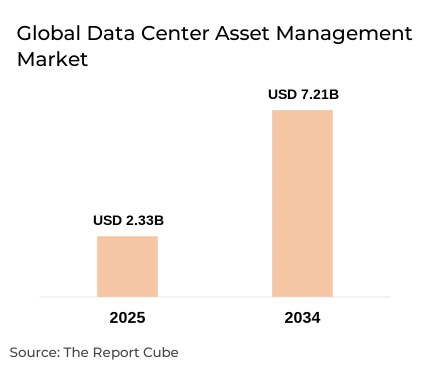
The Global Data Center Asset Management Market is anticipated to register a CAGR of 13.38% during 2026-2034. The market size was valued at USD 2.33 billion in 2025 and is projected to reach USD 7.21 billion by 2034. This strong growth reflects the rapid expansion of hyperscale and enterprise data centers, driven by cloud adoption, artificial intelligence workloads, and the exponential rise in digital data generation. Organizations increasingly rely on asset management solutions to maintain real-time visibility, operational efficiency, and cost optimization across complex data center environments.
The growing scale and complexity of modern data centers have elevated the importance of structured asset lifecycle management. Data center operators are under pressure to maximize equipment utilization, reduce downtime, and comply with regulatory standards related to energy efficiency and data security. Asset management platforms enable centralized tracking of hardware, software licenses, and supporting infrastructure, helping organizations make data-driven investment and maintenance decisions.
Furthermore, the shift toward hybrid IT architectures is reinforcing demand for unified asset management frameworks. As enterprises operate assets across on-premises and cloud environments, integrated solutions are becoming critical for ensuring transparency and governance. These interconnected factors collectively position the global data center asset management market for sustained and accelerated growth over the forecast period.
Global Data Center Asset Management Market Recent Developments
- 2025: Vertiv launched a cloud-enabled DCIM monitoring platform improving data center asset visibility, uptime, and capacity planning.
- 2025: Schneider Electric enhanced EcoStruxure DCIM with AI-driven thermal analytics for predictive, sensor-based cooling optimization.
Government Initiatives & Policies
- U.S. Data Center Energy Efficiency Initiative: Supports adoption of monitoring and asset optimization technologies to reduce energy consumption.
- EU Digital Infrastructure Sustainability Policy: Encourages smart asset utilization and reporting standards across data centers.
Global Data Center Asset Management Market Dynamics
Key Driver: Rapid Expansion of Hyperscale and Enterprise Data Centers
The accelerating deployment of hyperscale and enterprise data centers is a primary driver of the global data center asset management market. As organizations invest heavily in expanding digital infrastructure, the volume of servers, storage systems, networking equipment, and power assets is increasing at an unprecedented rate. Managing these assets manually is no longer feasible, particularly in facilities housing tens of thousands of components. Asset management solutions provide automated discovery, tracking, and lifecycle monitoring, enabling operators to reduce asset losses, improve utilization rates, and extend equipment life. With global data traffic expected to more than double by 2030, the demand for scalable and intelligent asset management systems continues to rise steadily.

Book your FREE 30-minute expert consultation today
Contact UsIndustry Trends: Integration of AI and Advanced Analytics
An important trend reshaping the market is the integration of artificial intelligence and advanced analytics into asset management platforms. These technologies enable predictive insights into asset performance, failure risks, and maintenance schedules. By analyzing historical usage patterns and environmental data, AI-driven systems can reduce unplanned downtime and optimize capital expenditure. Approximately 40% of large data center operators have begun deploying analytics-enabled asset management tools, reflecting growing confidence in data-driven operations. This trend aligns with broader digital transformation initiatives and supports more resilient, efficient, and sustainable data center operations.
Major Challenge: High Implementation Complexity and Integration Costs
Despite strong demand, implementation complexity remains a major challenge for the global data center asset management market. Integrating asset management platforms with existing infrastructure management, IT service management, and monitoring systems can be resource-intensive. Many legacy data centers operate on fragmented systems, increasing deployment time and costs. Additionally, skilled personnel are required to configure and maintain advanced platforms, which can strain budgets, particularly for mid-sized operators. These barriers can delay adoption, even as the long-term operational benefits remain compelling.
Opportunity: Growth of Cloud and Hybrid Deployment Models
The increasing adoption of cloud and hybrid deployment models presents a significant opportunity for market expansion. As enterprises distribute workloads across on-premises and cloud environments, unified asset visibility becomes essential. Asset management solutions designed for hybrid architectures enable organizations to manage physical and virtual assets through a single interface. This capability improves governance, compliance, and cost control. With hybrid IT adoption expected to exceed 70% among large enterprises by the end of the decade, vendors offering flexible, deployment-agnostic solutions are well positioned to capture substantial market share.
Global Data Center Asset Management Market Segment-wise Analysis
By Component:
- Hardware
- Software
- Services
Software represents the leading component segment in the global data center asset management market, accounting for an estimated 46% market share in 2025. Software platforms form the core of asset visibility, analytics, and reporting capabilities, enabling centralized control across facilities. Hardware components, including sensors and tracking devices, support real-time data capture, while services play a critical role in implementation, customization, and ongoing optimization. The dominance of software reflects growing demand for scalable, analytics-driven solutions that integrate seamlessly with existing IT ecosystems.
By Deployment:
- On-premises
- Cloud
On-premises deployment currently leads the market, holding approximately 58% share in 2025, driven by security and compliance requirements among large enterprises and regulated industries. However, cloud deployment is experiencing faster growth due to its flexibility, lower upfront costs, and ease of scalability. Organizations with distributed data center footprints increasingly favor cloud-based platforms to enable remote access and centralized management, gradually narrowing the gap between the two deployment models.
Regional Projection of Global Data Center Asset Management Industry
- North America
- Europe
- Asia Pacific
- Middle East and Africa
- South and Central America
North America leads the global data center asset management market, contributing nearly 39% of total revenue in 2025. The region benefits from a high concentration of hyperscale data centers, advanced digital infrastructure, and early adoption of intelligent management solutions. Strong investments in cloud services and AI workloads further reinforce demand. Europe follows closely, driven by regulatory compliance and sustainability initiatives, while Asia Pacific represents the fastest-growing region due to rapid digitalization and expanding data center capacity.
Need insights for a specific region within this market?
Request Regional DataWhy Choose This Report?
- Provides a comprehensive overview of the overall market analysis, encompassing key trends, consumer behavior analysis, and risk assessment to support strategic decision-making.
- Provides accurate, up-to-date insights into market size, segmentation, and emerging opportunities, helping to minimize risk & capitalizing on growth.
- Gives deep understanding of target audience preferences, investment habits, and communication channels for enhanced product development & marketing effectiveness.
- Delivers competitive analysis & benchmarking, uncovering the strengths & weaknesses of market competitors to guide strategies.
- Consolidate comprehensive market intelligence, reducing reasoning & streamlining research efforts.
- Facilitates customized market segmentation & risk mitigation strategies, fine-tuned to the business objectives.
- Aids in identifying both market challenges & untapped opportunities within the industry to drive long-term business growth.
- Provides valuable information based on actual customer data & search trends.
Table of Contents
- Introduction
- Objective of the Study
- Product and Category Definition
- Market Segmentation
- Study Variables
- Research Methodology
- Secondary Data Points
- Breakdown of Secondary Sources
- Primary Data Points
- Breakdown of Primary Interviews
- Secondary Data Points
- Executive Summary
- Market Dynamics
- Drivers
- Challenges
- Opportunity Assessment
- Regulatory and Policy Landscape
- Global Data Center Asset Management Market Overview (2020-2034)
- Market Size, By Value (USD Million)
- Market Share, By Component
- Hardware
- Software
- Services
- Market Share, By Deployment
- On-premises
- Cloud
- Market Share, By Application
- Inventory Management
- Capacity Planning
- Power and Energy Management
- Change Management
- Compliance and Security
- Other Applications
- Market Share, By Data Center Type
- Small
- Medium
- Large
- Market Share, By End User
- IT and Telecom
- BFSI
- Government and Defense
- Healthcare
- Manufacturing
- Other End Users
- Market Share, By Region
- North America
- Europe
- Asia Pacific
- Middle East and Africa
- South and Central America
- Market Share, By Company
- Competition Characteristics
- Revenue Shares & Analysis
- North America Data Center Asset Management Market
- Market Size, By Value (USD Million)
- Market Share, By Component
- Market Share, By Deployment
- Market Share, By Application
- Market Share, By Data Center Type
- Market Share, By End User
- Market Share, By Country
- United States
- Canada
- Europe Data Center Asset Management Market
- Market Size, By Value (USD Million)
- Market Share, By Component
- Market Share, By Deployment
- Market Share, By Application
- Market Share, By Data Center Type
- Market Share, By End User
- Market Share, By Country
- Germany
- United Kingdom
- France
- Italy
- Spain
- Rest of Europe
- Asia Pacific Data Center Asset Management Market
- Market Size, By Value (USD Million)
- Market Share, By Component
- Market Share, By Deployment
- Market Share, By Application
- Market Share, By Data Center Type
- Market Share, By End User
- Market Share, By Country
- China
- Japan
- India
- South Korea
- Australia
- Rest of Asia Pacific
- Middle East and Africa Data Center Asset Management Market
- Market Size, By Value (USD Million)
- Market Share, By Component
- Market Share, By Deployment
- Market Share, By Application
- Market Share, By Data Center Type
- Market Share, By End User
- Market Share, By Country
- Saudi Arabia
- United Arab Emirates
- South Africa
- Rest of Middle East and Africa
- South and Central America Data Center Asset Management Market
- Market Size, By Value (USD Million)
- Market Share, By Component
- Market Share, By Deployment
- Market Share, By Application
- Market Share, By Data Center Type
- Market Share, By End User
- Market Share, By Country
- Brazil
- Mexico
- Rest of South and Central America
- Competitive Outlook and Company Profiles
- Schneider Electric
- Company Overview
- Product Portfolio
- Strategic Alliances Partnerships
- Recent Developments
- Vertiv Group
- Company Overview
- Product Portfolio
- Strategic Alliances Partnerships
- Recent Developments
- Nlyte Software
- Company Overview
- Product Portfolio
- Strategic Alliances Partnerships
- Recent Developments
- Sunbird Software
- Company Overview
- Product Portfolio
- Strategic Alliances Partnerships
- Recent Developments
- Device42
- Company Overview
- Product Portfolio
- Strategic Alliances Partnerships
- Recent Developments
- BGIS
- Company Overview
- Product Portfolio
- Strategic Alliances Partnerships
- Recent Developments
- EkkoSense
- Company Overview
- Product Portfolio
- Strategic Alliances Partnerships
- Recent Developments
- FNT GmbH
- Company Overview
- Product Portfolio
- Strategic Alliances Partnerships
- Recent Developments
- Panduit Corp.
- Company Overview
- Product Portfolio
- Strategic Alliances Partnerships
- Recent Developments
- Eaton
- Company Overview
- Product Portfolio
- Strategic Alliances Partnerships
- Recent Developments
- Others
- Schneider Electric
- Contact Us and Disclaimer
Top Key Players & Market Share Outlook
- Schneider Electric
- Vertiv Group
- Nlyte Software
- Sunbird Software
- Device42
- BGIS
- EkkoSense
- FNT GmbH
- Panduit Corp.
- Eaton
- Others
Frequently Asked Questions






