



Build Your Custom Market Intelligence Report
Customize Your ReportGlobal Diamond Jewelry Market Insights & Analysis
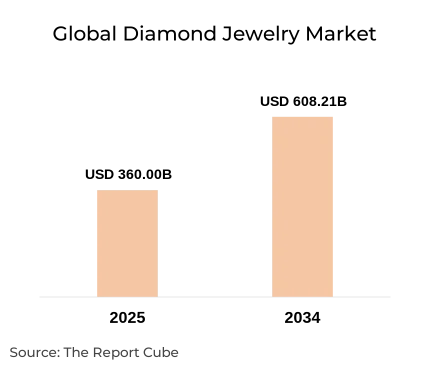
The Global Diamond Jewelry Market is anticipated to register a CAGR of 6% during 2020–2034. The market size was valued at USD 360 billion in 2025 and is projected to reach USD 608.21 billion by 2034. Diamond jewelry continues to symbolize luxury, emotional value, and long-term investment, sustaining strong demand across both mature and emerging economies.
Rising disposable incomes, expanding middle-class populations, and strong cultural significance of diamond jewelry in weddings and celebrations are key growth enablers. In parallel, evolving consumer preferences toward personalization, ethical sourcing, and branded luxury experiences are reshaping purchasing behavior. By 2025, branded jewelry accounted for nearly 38% of global diamond jewelry sales, reflecting growing trust in established players.
Technological advancements in diamond cutting, design customization, and omnichannel retailing are further enhancing consumer engagement. Additionally, the rapid emergence of lab-grown diamonds is expanding affordability and sustainability-driven demand. These combined factors position the Global Diamond Jewelry Market for steady, long-term expansion through 2034.
Global Diamond Jewelry Market Recent Developments
- 2025: De Beers Group expanded its lab-grown diamond jewelry collections across global retail channels.
- 2025: Tiffany & Co. launched new ethically sourced diamond bridal collections targeting younger consumers.
Government Initiatives & Policies
- Kimberley Process Certification Scheme: International initiative ensuring conflict-free diamond trade.
- India Gems & Jewellery Export Promotion Council Programs: Government-backed initiatives supporting diamond manufacturing and exports.
Global Diamond Jewelry Market Dynamics
Key Driver: Rising Luxury Consumption and Emotional Value of Diamonds
The primary driver of the Global Diamond Jewelry Market is sustained global demand for luxury goods combined with the deep emotional and cultural significance of diamonds. Diamond jewelry remains closely associated with life milestones such as engagements, weddings, anniversaries, and inheritance, ensuring consistent baseline demand regardless of short-term economic cycles.
Growing disposable incomes in Asia Pacific, the Middle East, and parts of Africa are expanding the luxury consumer base. In developed markets, higher spending on premium and customized jewelry continues to drive value growth. Marketing strategies emphasizing storytelling, heritage, and craftsmanship further reinforce diamonds as symbols of prestige and permanence.
Book your FREE 30-minute expert consultation today
Contact UsIndustry Trends: Growth of Lab-Grown Diamonds and Omnichannel Retail
A major trend shaping the market is the rapid rise of lab-grown diamond jewelry, driven by affordability, ethical sourcing, and environmental considerations. Lab-grown diamonds are increasingly accepted by millennials and Gen Z consumers, particularly for fashion and everyday jewelry.
Another significant trend is the expansion of omnichannel retail models. Leading brands are integrating online platforms with physical stores, offering virtual try-ons, customization tools, and seamless purchasing experiences. Digital channels accounted for nearly 21% of global diamond jewelry sales in 2025, reflecting changing consumer buying habits.
Major Challenge: Price Volatility and Ethical Sourcing Concerns
Price volatility of natural diamonds due to supply constraints, mining regulations, and geopolitical factors poses a challenge for market stability. Additionally, increasing consumer scrutiny regarding ethical sourcing, environmental impact, and labor practices places pressure on manufacturers and retailers to maintain transparent supply chains.
Compliance with international certification standards and traceability requirements increases operational costs, particularly for small and independent jewelers.
Opportunity: Personalization, Emerging Markets, and Sustainable Jewelry
Personalized and custom-designed diamond jewelry presents a significant growth opportunity, as consumers increasingly seek unique and meaningful products. Advances in digital design and 3D visualization are enabling cost-effective customization at scale.
Emerging markets such as India, China, and Southeast Asia offer strong growth potential due to cultural affinity for gold and diamond jewelry. Additionally, sustainability-focused collections and lab-grown diamond offerings are unlocking new customer segments and enhancing brand differentiation.
Global Diamond Jewelry Market Segment-wise Analysis
By Product Type:
- Rings
- Necklaces
- Earrings
- Bracelets
- Others
Among product types, rings dominate the Global Diamond Jewelry Market, accounting for approximately 44% of total revenue in 2025. This leadership is primarily driven by the enduring cultural and emotional significance of engagement and wedding rings across regions. In North America, Europe, India, and China, diamond rings remain a symbolic cornerstone of matrimonial traditions, ensuring consistent demand regardless of economic fluctuations.
Necklaces and earrings follow as the second- and third-largest segments, supported by gifting occasions, festive purchases, and increasing demand for everyday luxury jewelry. Earrings, in particular, are gaining popularity among younger consumers due to their versatility and relatively lower price points. Bracelets and other jewelry categories, including pendants and customized sets, are experiencing gradual growth driven by fashion trends and personalization. Collectively, product diversification enables brands to target multiple consumer demographics and price tiers, strengthening overall market resilience.
By Diamond Type:
- Natural Diamond Jewelry
- Lab-Grown Diamond Jewelry
Natural diamond jewelry continues to hold the majority market share, accounting for nearly 72% of global revenue in 2025. High-net-worth individuals and luxury consumers strongly prefer natural diamonds due to their rarity, long-term value retention, and emotional legacy appeal. Established brands emphasize provenance, craftsmanship, and heritage to sustain premium pricing in this segment.
However, lab-grown diamond jewelry represents the fastest-growing segment, expanding at a CAGR exceeding 9%. These diamonds appeal strongly to millennials and Gen Z consumers due to affordability, sustainability, and ethical sourcing advantages. Lab-grown diamonds are increasingly used in fashion jewelry and entry-level bridal segments, enabling brands to expand customer bases while protecting margins through cost efficiencies.
Need insights for a specific region within this market?
Request Regional DataRegional Projection of Global Diamond Jewelry Industry
- North America
- Europe
- Asia Pacific
- Middle East & Africa
- South America
Asia Pacific leads the global market with over 41% share in 2025, driven by strong demand in China and India. North America and Europe follow, supported by high per-capita spending on luxury jewelry. The Middle East remains a premium market with strong preference for high-value diamond pieces.
Why Choose This Report?
- Provides in-depth analysis of global and regional diamond jewelry trends.
- Delivers accurate market sizing, segmentation, and long-term forecasts.
- Analyzes consumer preferences, luxury spending patterns, and pricing dynamics.
- Offers competitive benchmarking of leading jewelry brands.
- Examines sustainability and ethical sourcing impacts.
- Supports strategic planning and investment decisions.
- Identifies emerging opportunities across product and regional markets.
- Uses real demand and trade trend analysis.
Table of Contents
- Introduction
- Objective of the Study
- Diamond Jewelry Definition
- Market Segmentation
- Study Variables
- Research Methodology
- Secondary Data Points
- Breakdown of Secondary Sources
- Primary Data Points
- Breakdown of Primary Interviews
- Secondary Data Points
- Executive Summary
- Market Dynamics
- Drivers
- Challenges
- Opportunity Assessment
- Recent Trends and Developments
- Regulatory and Policy Landscape
- Global Diamond Jewelry Market Overview (2026–2034)
- Market Size, By Value (USD Billion)
- Market Share, By Product Type
- Rings
- Necklaces
- Earrings
- Bracelets
- Others
- Market Share, By Diamond Type
- Natural Diamond Jewelry
- Lab-Grown Diamond Jewelry
- Market Share, By Distribution Channel
- Brand Stores
- Multi-Brand Retailers
- Online Retailers
- Independent Jewelers
- Duty-Free/Retail Shops
- Market Share, By End User
- Women
- Men
- Unisex
- Market Share, By Price Tier
- Mass Luxury
- Premium Luxury
- Ultra Luxury
- Market Share, By Company
- Competition Characteristics
- Revenue Shares & Analysis
- Market Share, By Region
- North America Diamond Jewelry Market
- Market Size, By Value
- Market Share, By Product Type
- Market Share, By Distribution Channel
- Europe Diamond Jewelry Market
- Market Size, By Value
- Market Share, By Product Type
- Market Share, By Distribution Channel
- Asia Pacific Diamond Jewelry Market
- Market Size, By Value
- Market Share, By Product Type
- Market Share, By Distribution Channel
- Middle East and Africa Diamond Jewelry Market
- Market Size, By Value
- Market Share, By Product Type
- Market Share, By Distribution Channel
- South America Diamond Jewelry Market
- Market Size, By Value
- Market Share, By Product Type
- Market Share, By Distribution Channel
- North America Diamond Jewelry Market
- Competitive Outlook and Company Profiles
- De Beers Group
- Company Overview
- Diamond Jewelry Portfolio
- Strategic Alliances/Partnerships
- Recent Developments
- Richemont (Cartier)
- Company Overview
- Diamond Jewelry Portfolio
- Strategic Alliances/Partnerships
- Recent Developments
- Tiffany & Co.
- Company Overview
- Diamond Jewelry Portfolio
- Strategic Alliances/Partnerships
- Recent Developments
- Chow Tai Fook
- Company Overview
- Diamond Jewelry Portfolio
- Strategic Alliances/Partnerships
- Recent Developments
- Bulgari (LVMH)
- Company Overview
- Diamond Jewelry Portfolio
- Strategic Alliances/Partnerships
- Recent Developments
- Others
- Company Overview
- Business Segments
- Strategic Alliances/Partnerships
- Recent Developments
- De Beers Group
- Contact Us / Disclaimer
Top Key Players & Market Share Outlook
- De Beers Group
- Richemont (Cartier)
- Tiffany & Co.
- Chow Tai Fook
- Bulgari (LVMH)
- Others
Frequently Asked Questions






