




Build Your Custom Market Intelligence Report
Customize Your ReportAsia-Pacific Digital Education Market Statistics and Insights
Market Size Statistics
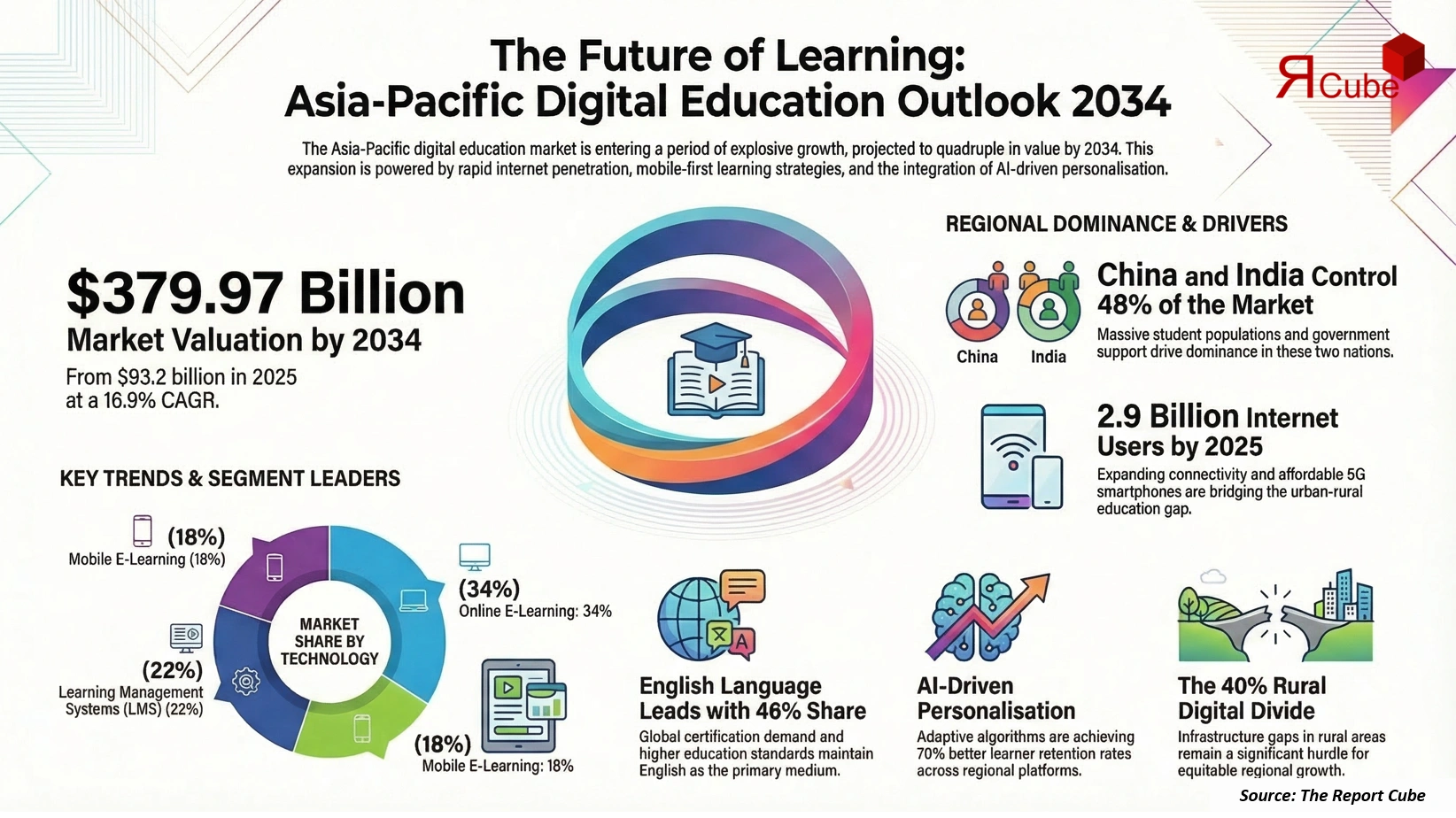
- Asia-Pacific digital education market reached USD 93.2 billion during 2025 valuation
- Market projected to achieve USD 379.97 billion by 2034 regionally
- Market expected to expand at 16.90% CAGR
By Technology
- Online e-learning dominates holding approximately 34% market share
Competition
- More than 10 companies are actively engaged in producing Asia-Pacific Digital Education Market
- Top 5 companies acquired around 51% of the market share
- BYJU’S, Coursera Inc., edX, Udacity, UpGrad, and others
By Language Type
- English language leads accounting for nearly 46% market share
Asia-Pacific Digital Education Market Insights & Analysis
The Asia-Pacific Digital Education Market is anticipated to register a 16.90% during 2026–2034. The market size was valued at USD 93.2 billion and is projected to reach USD 379.97 billion by 2034. The Asia-Pacific Digital Education Market is witnessing robust growth driven by rising internet penetration, widespread smartphone adoption, and increasing acceptance of online learning across academic and professional segments. Governments and educational institutions across the region are actively promoting digital learning platforms to improve accessibility, scalability, and education quality.
Rapid growth in working-age population and demand for skill-based, vocational, and certification courses are accelerating adoption of digital education solutions. Corporate upskilling, competitive exam preparation, and lifelong learning programs are further strengthening market demand. Additionally, advancements in cloud computing, AI-driven personalized learning, and interactive content delivery are enhancing learner engagement. These factors collectively support sustained expansion of the Asia-Pacific Digital Education Market.
Asia-Pacific Digital Education Market Dynamics
Key Market Driver: Expanding internet access and mobile learning adoption
The Asia-Pacific Digital Education Market continues to surge, driven by booming internet connectivity (over 2.9B users in 2025) and widespread mobile learning adoption. Affordable 5G-enabled smartphones, enhanced broadband (e.g., India's Jio-led rural push), and data costs dropping below $0.50/GB have bridged urban-rural gaps. In 2026, platforms like BYJU'S and Tencent Class serve 500M+ learners via mobile-first apps. Flexible, self-paced models appeal to 1B+ students and upskilling professionals amid hybrid work trends.
Major Industry Challenge: Digital divide and content standardization issues
Persistent digital divides hinder equitable growth, with 40% of rural APAC lacking reliable high-speed internet or devices (UNESCO 2025). Low digital literacy in countries like Indonesia and Pakistan exacerbates this. Content challenges persist: fragmented curricula, absent pan-APAC quality standards, 20+ languages, and differing accreditation (e.g., India's NEP vs. China's gaokao) complicate localization. Providers face scalability hurdles, especially with 2026 data privacy laws in Australia and Japan.
Emerging Trend Shaping Outlook: AI-driven personalized and adaptive learning
AI personalization dominates 2026 outlooks, with platforms like Duolingo and Khan Academy APAC deploying adaptive algorithms for 70% better retention. Tools analyze behavior for custom paths, virtual tutors, and predictive assessments—evident in Singapore's SkillsFuture AI pilots. Generative AI (e.g., chat-based simulations) boosts engagement in K-12, higher ed, and corporate training, projected to capture 25% market share by 2027 per McKinsey.
Need Specific Data, Let’s Customize the Report for You
Contact UsAsia-Pacific Digital Education Market Segment-wise Analysis
Segment-wise evaluation highlights how technology adoption and language preferences influence platform selection, content development, and revenue contribution across the Asia-Pacific region.
By Technology
- Online E-Learning
- Learning Management System
- Mobile E-Learning
- Rapid E-Learning
- Virtual Classroom
- Others
Online e-learning leads the Asia-Pacific Digital Education Market with approximately 34% market share due to widespread adoption for academic and professional courses. Learning management systems account for nearly 22%, driven by institutional and corporate training usage. Mobile e-learning contributes around 18%, supported by smartphone penetration. Virtual classrooms and rapid e-learning collectively account for the remaining share, driven by real-time interaction and content customization needs.
By Language Type
- English
- Mandarin
- Spanish
- German
- Other Languages
English dominates with approximately 46% market share due to its use in higher education, professional certifications, and global skill development programs. Mandarin accounts for nearly 27%, driven by large-scale adoption in China. Other languages collectively contribute the remaining share, supported by regional localization initiatives and multilingual content expansion.
Country Projection of Asia-Pacific Digital Education Market
Country performance reflects differences in digital infrastructure, education policies, and population demographics across Asia-Pacific.
- China
- India
- Japan
- Southeast Asia
- Rest of Asia-Pacific
China and India together account for over 48% market share due to large student populations and strong government support for digital education. Japan contributes steady growth driven by corporate training and advanced digital infrastructure. Southeast Asia represents a high-growth region supported by mobile learning adoption and e-learning startups. The rest of Asia-Pacific continues to expand through education digitization initiatives
Asia-Pacific Digital Education Market Future Outlook (2034)
The Asia-Pacific Digital Education Market is projected to reach USD 379.97 billion by 2034, expanding at a CAGR of 16.90%. Growth will be driven by increasing demand for flexible education models, skill-based learning, and digital literacy. AI-enabled personalization, immersive technologies, and multilingual content expansion will shape future market evolution. Strong participation from private platforms, universities, and governments will accelerate adoption. Long-term market growth will be supported by demographic trends, digital transformation, and continuous focus on education accessibility and quality across the region.
Why Choose This Report?
- Provides comprehensive insights into Asia-Pacific Digital Education Market dynamics
- Offers accurate market size, segmentation, and growth forecasts
- Supports strategic planning with competitive benchmarking
- Enhances understanding of digital learning and edtech trends
- Consolidates market intelligence for efficient research
- Identifies emerging opportunities and market challenges
- Supports investment and expansion strategies
- Based on real market behavior and regional analysis
Table of Contents
- Introduction
- Objective of the study
- Product Definition
- Market Segmentation
- Study Variables
- Research Methodology
- Secondary Data Points
- Companies Interviewed
- Primary Data Points
- BreakDown of Primary Interviews
- Secondary Data Points
- Executive Summary
- Market Dynamics
- Drivers
- Challenges
- Opportunity Assessment
- Recent Trends and Developments
- Policy and Regulatory Landscape
- Asia Pacific Digital Education Market Overview (2021-2034)
- Market Size, By Value (in USD Billions)
- Market Share, By Technology
- Online E-Learning
- Learning Management System
- Mobile E-Learning
- Rapid E-Learning
- Virtual Classroom
- Others
- Market Share, By Language Type
- English
- Mandarin
- Spanish
- German
- Other Languages
- Market Share, By Course Type
- Self-Learning
- Instructor Based
- Market Share, By Deployment Type
- Cloud Based
- On Premise
- Market Share, By Type of Business
- Business to Business
- Business to Customer
- Market Share, By End User
- Academic
- K-12
- Higher Education
- Vocational Training
- Corporate
- Small and Medium Enterprises
- Large Enterprises
- Government
- Academic
- Market Share, By Country
- China
- India
- Japan
- Southeast Asia
- Rest of Asia-Pacific
- Market Share, By Competitors
- Competition Characteristics
- Revenue Shares
- Asia Pacific Online E-Learning Digital Education Market Overview, 2021-2034F
- By Value (USD Million)
- By Language Type- Market Size & Forecast 2021-2034, USD Million
- By Course Type- Market Size & Forecast 2021-2034, USD Million
- By Deployment Type- Market Size & Forecast 2021-2034, USD Million
- By Type of Business- Market Size & Forecast 2021-2034, USD Million
- By End User- Market Size & Forecast 2021-2034, USD Million
- Asia Pacific Learning Management System Digital Education Market Overview, 2021-2034F
- By Value (USD Million)
- By Language Type- Market Size & Forecast 2021-2034, USD Million
- By Course Type- Market Size & Forecast 2021-2034, USD Million
- By Deployment Type- Market Size & Forecast 2021-2034, USD Million
- By Type of Business- Market Size & Forecast 2021-2034, USD Million
- By End User- Market Size & Forecast 2021-2034, USD Million
- Asia Pacific Mobile E-Learning Digital Education Market Overview, 2021-2034F
- By Value (USD Million)
- By Language Type- Market Size & Forecast 2021-2034, USD Million
- By Course Type- Market Size & Forecast 2021-2034, USD Million
- By Deployment Type- Market Size & Forecast 2021-2034, USD Million
- By Type of Business- Market Size & Forecast 2021-2034, USD Million
- By End User- Market Size & Forecast 2021-2034, USD Million
- Asia Pacific Rapid E-Learning Digital Education Market Overview, 2021-2034F
- By Value (USD Million)
- By Language Type- Market Size & Forecast 2021-2034, USD Million
- By Course Type- Market Size & Forecast 2021-2034, USD Million
- By Deployment Type- Market Size & Forecast 2021-2034, USD Million
- By Type of Business- Market Size & Forecast 2021-2034, USD Million
- By End User- Market Size & Forecast 2021-2034, USD Million
- Asia Pacific Virtual Classroom Digital Education Market Overview, 2021-2034F
- By Value (USD Million)
- By Language Type- Market Size & Forecast 2021-2034, USD Million
- By Course Type- Market Size & Forecast 2021-2034, USD Million
- By Deployment Type- Market Size & Forecast 2021-2034, USD Million
- By Type of Business- Market Size & Forecast 2021-2034, USD Million
- By End User- Market Size & Forecast 2021-2034, USD Million
- Asia Pacific Others Digital Education Market Overview, 2021-2034F
- By Value (USD Million)
- By Language Type- Market Size & Forecast 2021-2034, USD Million
- By Course Type- Market Size & Forecast 2021-2034, USD Million
- By Deployment Type- Market Size & Forecast 2021-2034, USD Million
- By Type of Business- Market Size & Forecast 2021-2034, USD Million
- By End User- Market Size & Forecast 2021-2034, USD Million
- Competitive Outlook (Company Profile - Partial List)
- UpGrad
- Company Overview
- Business Segments
- Strategic Alliances/Partnerships
- Recent Developments
- edX
- Company Overview
- Business Segments
- Strategic Alliances/Partnerships
- Recent Developments
- Udacity
- Company Overview
- Business Segments
- Strategic Alliances/Partnerships
- Recent Developments
- BYJU'S
- Company Overview
- Business Segments
- Strategic Alliances/Partnerships
- Recent Developments
- Chegg Inc
- Company Overview
- Business Segments
- Strategic Alliances/Partnerships
- Recent Developments
- Blackboard
- Company Overview
- Business Segments
- Strategic Alliances/Partnerships
- Recent Developments
- Instructure
- Company Overview
- Business Segments
- Strategic Alliances/Partnerships
- Recent Developments
- Coursera Inc
- Company Overview
- Business Segments
- Strategic Alliances/Partnerships
- Recent Developments
- Edureka
- Company Overview
- Business Segments
- Strategic Alliances/Partnerships
- Recent Developments
- Others
- UpGrad
- Contact Us & Disclaimer
Top Key Players & Market Share Outlook
- UpGrad
- edX
- Udacity
- BYJU'S
- Chegg Inc
- Blackboard
- Instructure
- Coursera Inc
- Edureka
- Others
Frequently Asked Questions






