



Build Your Custom Market Intelligence Report
Customize Your ReportJapan Downstream Processing Market Key Takeaways
- Market valued at USD 2.40 billion in 2026, reflecting robust biopharmaceutical manufacturing growth.
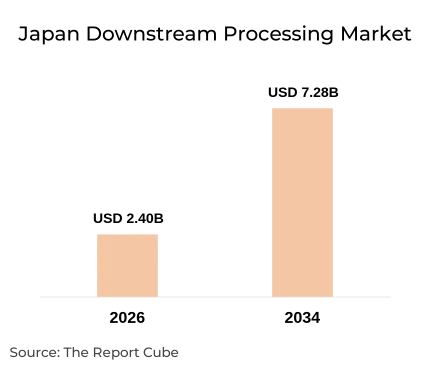
- Industry projected to reach USD 7.28 billion by 2034, expanding at a 14.87% CAGR.
- Purification by chromatography dominates technique segment due to stringent biologics purity requirements.
- Vaccine production application leads demand amid Japan's expanding biologics pipeline and immunotherapy programs.
- Kanto region maintains leadership through dense pharmaceutical manufacturing and bioprocessing infrastructure clusters.
- Kyushu-Okinawa emerges as fastest-growing region driven by increasing bioprocessing facility investments.
- Leading companies include Repligen Corp, Sartorius AG, Thermo Fisher Scientific, Danaher Corp, and Asahi Kasei.
- Single-use bioprocessing systems and continuous downstream manufacturing are reshaping Japan's biologics production landscape.
Japan Downstream Processing Market Insights & Analysis
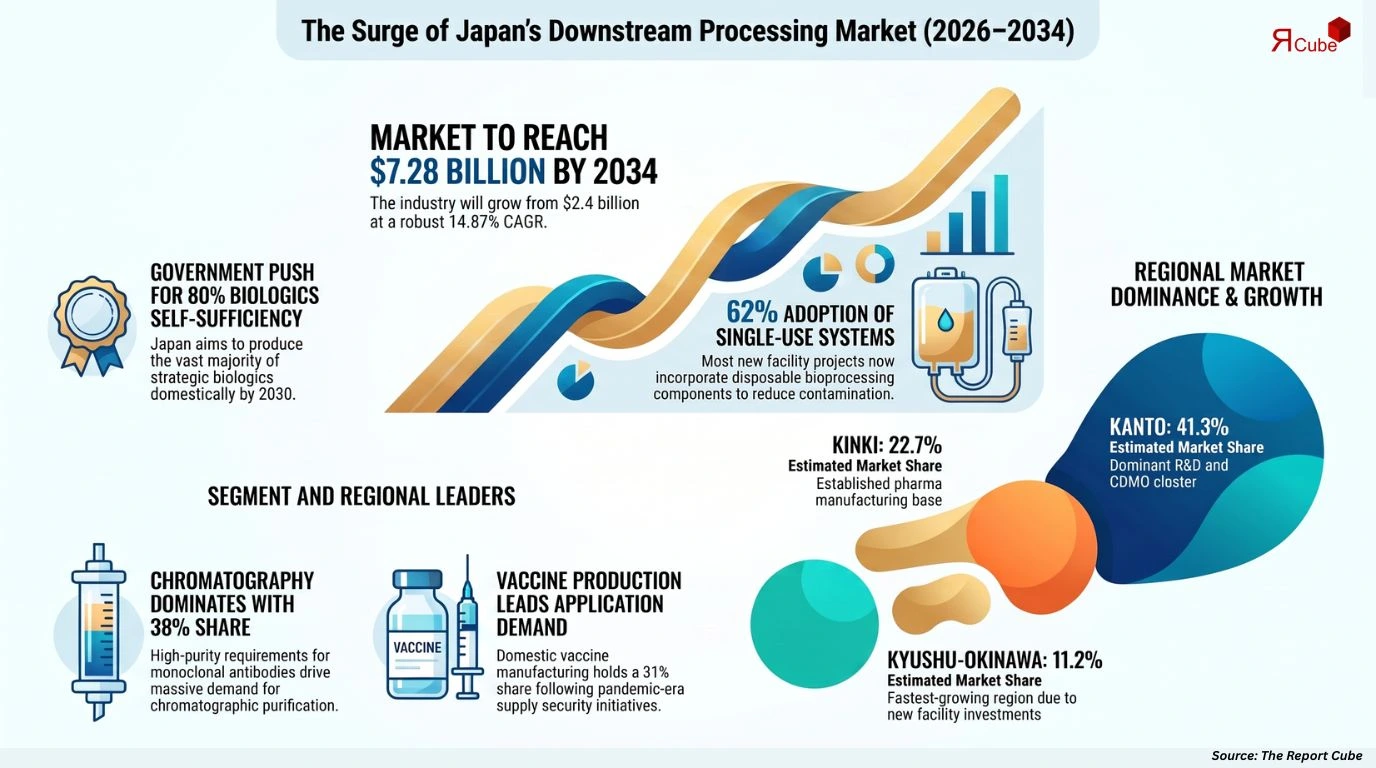
The Japan Downstream Processing Market is anticipated to register a 14.87% CAGR during 2026–2034. The market size was valued at USD 2.40 billion in 2026 and is projected to reach USD 7.28 billion by 2034. Japan's biopharmaceutical sector continues expanding through accelerated regulatory pathways, strong government investment in domestic biologics manufacturing, and a growing pipeline of monoclonal antibodies, vaccines, and biosimilars. The Ministry of Economy, Trade and Industry (METI) has directed substantial funding toward life sciences infrastructure, reinforcing downstream processing capacity across major industrial corridors.
The market continues benefiting from Japan's strategic ambition to strengthen domestic pharmaceutical self-sufficiency, particularly following supply disruptions exposed during the COVID-19 pandemic. Investments in continuous bioprocessing, membrane-based filtration, and high-performance chromatography systems are gaining traction across contract development and manufacturing organizations (CDMOs) and integrated pharmaceutical firms. Asahi Kasei Corp and Sartorius AG have expanded Japanese operations targeting the Japan biopharmaceutical upstream and downstream integration market, supporting long-term capacity growth across Kanto and Chubu manufacturing hubs.
Japan Downstream Processing Market Dynamics
Japan's downstream processing sector continues expanding as pharmaceutical manufacturers, CDMOs, and biotechnology companies scale biologics production to serve both domestic and export markets. Increasing regulatory harmonization with ICH guidelines, rising investment in advanced separation technologies, and a government-backed push for biopharmaceutical self-reliance are creating sustained demand for high-performance downstream processing equipment and consumables across the country.
|
Factor |
Type |
Specific Impact on Market |
Magnitude |
|---|---|---|---|
|
Expanding biologics and biosimilar pipeline |
Driver |
Accelerates demand for purification and formulation systems |
Very High |
|
Government biopharmaceutical self-sufficiency policy |
Driver |
Boosts domestic CDMO capacity and downstream equipment procurement |
High |
|
Single-use technology adoption |
Trend |
Reduces cross-contamination risk and accelerates batch turnaround |
High |
|
Skilled bioprocess workforce shortage |
Challenge |
Slows adoption of advanced continuous processing platforms |
Moderate |
|
Continuous downstream manufacturing |
Trend |
Improves yield consistency and reduces manufacturing footprint |
Very High |
Key Market Driver: Biologics Pipeline Driving Purification Demand
Japan's biopharmaceutical companies have significantly expanded their monoclonal antibody, recombinant protein, and vaccine pipelines, generating consistent demand for high-efficiency downstream processing systems. Domestic approvals for biologics have grown approximately 18% over the past three years, compelling manufacturers to invest heavily in protein-A chromatography, tangential flow filtration, and viral clearance systems. Government programs under the METI Life Sciences Strategic Plan are channeling over JPY 500 billion into domestic biologics manufacturing infrastructure, directly elevating procurement of downstream processing technologies across contract and captive manufacturing facilities.
Major Industry Challenge: Regulatory Complexity in Bioprocess Validation
Japan's Pharmaceuticals and Medical Devices Agency (PMDA) enforces stringent process validation requirements for biologic drug substances, requiring manufacturers to conduct exhaustive comparability studies when modifying downstream unit operations. This regulatory burden adds substantial time and cost to equipment changeovers, delaying adoption of next-generation separation and formulation platforms. Manufacturers must maintain extensive process characterization data, complicating integration of continuous chromatography and membrane adsorber systems into existing GMP-compliant production workflows while managing parallel regulatory submissions across Japan's approval framework.
Emerging Trend Shaping Outlook: Single-Use Downstream Processing Systems
Single-use downstream processing technologies, including disposable chromatography columns, single-use tangential flow filtration assemblies, and pre-sterilized formulation containers, are rapidly gaining adoption across Japanese biopharmaceutical manufacturers and CDMOs. These systems eliminate cleaning validation requirements, reduce turnaround time between batches, and minimize contamination risks in multi-product facilities. Repligen Corp and Sartorius AG have specifically expanded single-use downstream product portfolios targeting the Japanese market, and industry surveys indicate over 62% of new bioprocessing facility projects in Japan now incorporate single-use components at one or more downstream unit operations.
Need Specific Data, Let’s Customize the Report for You
Request CustomizationJapan Downstream Processing Market Segment-wise Analysis
Japan's downstream processing market operates across a broad range of techniques and applications, each driven by distinct regulatory, technological, and demand dynamics. The market reflects Japan's sophisticated biopharmaceutical ecosystem, where precision, yield optimization, and GMP compliance govern technology selection across both established manufacturers and emerging biotech firms.
By Technique
- Cell Disruption
- Purification by Chromatography
- Formulation
- Solid-liquid Separation
- Filtration
- Centrifugation
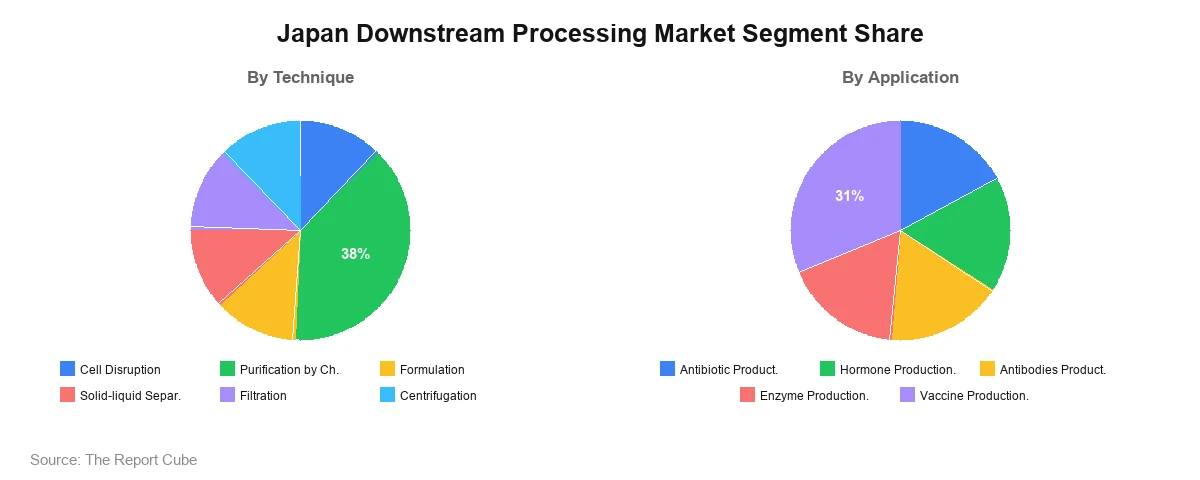
Purification by chromatography dominates the technique segment with an estimated 38% market share, driven by its indispensable role in isolating monoclonal antibodies, recombinant proteins, and vaccine antigens to the purity standards mandated by Japan's PMDA. Protein-A affinity chromatography, ion exchange chromatography, and size exclusion chromatography remain the primary platforms deployed across Japanese biopharmaceutical manufacturing facilities. The stringent purity thresholds required for injectable biologics, particularly in oncology and autoimmune indications, make chromatographic purification a non-negotiable step in virtually every downstream processing workflow operating within Japan's regulated pharmaceutical sector.
Filtration and centrifugation collectively account for a significant share of the technique market and are growing steadily as manufacturers scale up fermentation and cell culture volumes. Tangential flow filtration and depth filtration have gained particular traction for clarification and concentration steps preceding final formulation. Solid-liquid separation equipment is experiencing renewed interest as Japanese CDMOs expand capacity for microbial fermentation-derived products, including enzymes and certain antibiotic intermediates. Formulation technologies, including aseptic filling and lyophilization-ready processing, are becoming increasingly critical as Japanese manufacturers target export markets with stringent packaging and stability requirements. Cell disruption equipment, while a smaller segment, supports growing enzyme and intracellular protein production programs.
By Application
- Antibiotic Production
- Hormone Production
- Antibodies Production
- Enzyme Production
- Vaccine Production
Vaccine production leads the application segment with an estimated 31% market share, reflecting Japan's strategic investment in domestic vaccine manufacturing capacity following pandemic-era supply vulnerabilities. The Japanese government's commitment to producing over 300 million vaccine doses annually through domestic facilities has directly accelerated procurement of high-performance downstream processing systems capable of handling viral vector, mRNA lipid nanoparticle, and recombinant protein antigen workflows. Boehringer Ingelheim and Asahi Kasei Corp have both expanded vaccine-focused bioprocessing capacity in Japan, reinforcing demand for clarification, purification, and sterile fill-finish downstream technologies.
Antibodies production represents the second-largest and fastest-growing application, underpinned by Japan's expanding monoclonal antibody pipeline targeting oncology, immunology, and ophthalmology indications. Enzyme production is experiencing solid growth as Japanese manufacturers supply industrial enzymes for food, textile, and diagnostic applications alongside pharmaceutical-grade enzyme therapies for rare metabolic disorders. The Japan hormone and recombinant protein production market is also contributing to downstream processing demand as insulin, growth hormone, and erythropoietin manufacturers modernize their purification train with advanced chromatography and ultrafiltration platforms. Antibiotic production, while a mature segment, maintains stable downstream processing demand driven by export-oriented manufacturing for generic antibiotic active pharmaceutical ingredients.
Regional Projection of Japan Downstream Processing Market
Japan's downstream processing market exhibits distinct regional variation shaped by pharmaceutical cluster density, infrastructure maturity, government investment programs, and proximity to contract manufacturing and research hubs. Regional market dynamics reflect Japan's concentrated industrial geography, with Kanto serving as the dominant bioprocessing hub and emerging regions attracting new capacity investments.
|
Region |
Estimated Market Share |
Key Growth Factors |
Consumer Trends |
|---|---|---|---|
|
Kanto |
41.3% |
Dense pharma cluster, CDMO concentration, R&D infrastructure |
High adoption of continuous processing and single-use systems |
|
Kinki |
22.7% |
Established pharmaceutical manufacturers, academic biotech linkages |
Increasing investment in chromatography and formulation technologies |
|
Central/Chubu |
18.4% |
Industrial manufacturing base, growing CDMO presence |
Rising demand for filtration and centrifugation equipment |
|
Kyushu-Okinawa |
11.2% |
Government-backed bioprocessing investments, new facility construction |
Rapid adoption of single-use downstream platforms |
|
Others |
6.4% |
Distributed pharmaceutical production, regional biotech development |
Steady demand for standard separation and purification equipment |
- Kanto: Kanto dominates the Japan Downstream Processing Market with approximately 41.3% share, anchored by Tokyo, Kanagawa, and Saitama pharmaceutical clusters housing major CDMOs, university spin-offs, and integrated biopharmaceutical manufacturers operating advanced GMP-compliant downstream processing facilities.
- Kinki: Kinki maintains a strong second position, supported by Osaka's established pharmaceutical manufacturing base and close collaboration between industry and academic bioprocessing research centers in Kyoto and Kobe.
- Central/Chubu: Central/Chubu contributes a meaningful share driven by Nagoya's industrial infrastructure, which increasingly hosts bioprocessing equipment suppliers and pharmaceutical ingredient manufacturers expanding downstream capabilities to serve export markets.
- Kyushu-Okinawa: Kyushu-Okinawa is the fastest-growing region as government-directed life sciences investment programs attract new CDMO and biologics manufacturing facility construction, particularly in Fukuoka and Kumamoto prefectures targeting domestic vaccine and biologic production scale-up.
- Others: Other regions including Tohoku and Hokkaido contribute modestly through distributed pharmaceutical production operations and regional biotech development initiatives supported by local government industrial promotion programs.
Japan Downstream Processing Market: Recent Development (2025)
- Sartorius AG expanded its Osaka bioprocessing application laboratory supporting Japanese CDMO downstream workflow optimization.
- Repligen Corp launched next-generation single-use chromatography columns designed specifically for Japan's high-purity biologics requirements.
- Asahi Kasei Corp announced a strategic capacity expansion for hollow fiber filtration module manufacturing serving Japan's domestic pharmaceutical sector.
- Thermo Fisher Scientific Inc partnered with a leading Kanto CDMO to deploy integrated downstream processing platforms for vaccine production.
Japan Downstream Processing Market Future Outlook (2034)
The Japan Downstream Processing Market is projected to expand at a 14.87% CAGR, reaching approximately USD 7.28 billion by 2034. Continued government prioritization of domestic biopharmaceutical self-sufficiency, accelerating CDMO capacity investment, and deepening integration of artificial intelligence in bioprocess monitoring and optimization will collectively sustain long-term market expansion. Japan's national life sciences strategy targets domestic production of over 80% of strategic biologics by 2030, creating structural demand for advanced downstream processing technologies across purification, filtration, and formulation disciplines throughout the forecast period.
Future market growth will be reinforced by increasing adoption of continuous downstream processing, AI-driven process analytical technology platforms, and end-of-life single-use system management frameworks. Manufacturers are expected to prioritize downstream bioprocessing automation and digital twin integration to reduce batch failures, improve regulatory compliance documentation, and increase overall equipment effectiveness across GMP production suites. Danaher Corp and Eppendorf are positioned to lead technology adoption cycles through their integrated bioprocessing platforms, while domestic players including Asahi Kasei Corp strengthen competitive positioning through proprietary membrane and chromatography media technologies aligned with Japan's precision biologics manufacturing requirements.
Japan Downstream Processing Market Report Coverage
|
Report Attribute |
Details |
|---|---|
|
Market Name |
Japan Downstream Processing Market |
|
Market Size (2026) |
USD 2.40 Billion |
|
Market Size (2034) |
USD 7.28 Billion |
|
Forecast Period |
2026–2034 |
|
CAGR |
14.87% |
|
Base Year |
2026 |
|
Historical Years |
2021–2025 |
|
Forecast Years |
2026–2034 |
|
Segments Covered |
By Technique, By Application, By Product |
|
Regions Covered |
Kanto, Kinki, Central/Chubu, Kyushu-Okinawa, Others |
|
Key Companies |
Repligen Corp, Eppendorf, Dover Corp, Corning Inc, Boehringer Ingelheim, Asahi Kasei Corp, Sartorius AG, Danaher Corp, Thermo Fisher Scientific Inc, Others |
|
Report Format |
PDF, Excel, PPT |
|
Customization |
Available as per client requirements |
Why Choose This Report?
- Comprehensive analysis of Japan's biopharmaceutical downstream processing landscape through 2034.
- Accurate market sizing with validated CAGR forecast across all key segments.
- Detailed technique segmentation highlighting chromatography, filtration, and formulation opportunities.
- Regional breakdown covering Kanto, Kinki, Chubu, Kyushu-Okinawa, and emerging prefectures.
- Competitive profiling of leading global and domestic downstream processing vendors.
- Insight into single-use technology adoption and continuous bioprocessing transformation.
- Strategic analysis of Japan's government biopharmaceutical self-sufficiency investment programs.
- Data-driven research aligned with PMDA regulatory requirements and ICH biopharmaceutical standards.
Table of Contents
- Introduction
- Objective of the Study
- Product Definition
- Market Segmentation
- Study Variables
- Research Methodology
- Secondary Data Points
- Companies Interviewed
- Primary Data Points
- Breakdown of Primary Interviews
- Secondary Data Points
- Executive Summary
- Market Dynamics
- Drivers
- Challenges
- Opportunity Assessment
- Recent Trends and Developments
- Policy and Regulatory Landscape
- Japan Downstream Processing Market Overview and Forecast Analysis (2021-2034)
- Market Size, By Value, By Growth Rate (CAGR/USD Billions)
- Demand – Supply Trends
- Market Share, By Product
- Chromatography Systems
- Filters
- Evaporators
- Centrifuges
- Dryers
- Others
- Market Share, By Technique
- Cell Disruption
- Purification by Chromatography
- Formulation
- Solid-liquid separation
- Filtration
- Centrifugation
- Market Share, By Application
- Antibiotic Production
- Hormone Production
- Antibodies Production
- Enzyme Production
- Vaccine Production
- Market Share, By Region
- Kanto
- Kinki
- Central/Chubu
- Kyushu-Okinawa
- Others
- Market Share, By Competitors
- Competition Characteristics
- Revenue Shares
- Chromatography Systems Japan Downstream Processing Market Overview, 2021-2034F
- By Value (USD Million)
- By Technique – Market Size & Forecast 2021-2034, USD Million
- Cell Disruption
- Purification by Chromatography
- Formulation
- Solid-liquid separation
- Filtration
- Centrifugation
- Filters Japan Downstream Processing Market Overview, 2021-2034F
- By Value (USD Million)
- By Technique – Market Size & Forecast 2021-2034, USD Million
- Cell Disruption
- Purification by Chromatography
- Formulation
- Solid-liquid separation
- Filtration
- Centrifugation
- Evaporators Japan Downstream Processing Market Overview, 2021-2034F
- By Value (USD Million)
- By Technique – Market Size & Forecast 2021-2034, USD Million
- Cell Disruption
- Purification by Chromatography
- Formulation
- Solid-liquid separation
- Filtration
- Centrifugation
- Centrifuges Japan Downstream Processing Market Overview, 2021-2034F
- By Value (USD Million)
- By Technique – Market Size & Forecast 2021-2034, USD Million
- Cell Disruption
- Purification by Chromatography
- Formulation
- Solid-liquid separation
- Filtration
- Centrifugation
- Dryers Japan Downstream Processing Market Overview, 2021-2034F
- By Value (USD Million)
- By Technique – Market Size & Forecast 2021-2034, USD Million
- Cell Disruption
- Purification by Chromatography
- Formulation
- Solid-liquid separation
- Filtration
- Centrifugation
- Others Japan Downstream Processing Market Overview, 2021-2034F
- By Value (USD Million)
- By Technique – Market Size & Forecast 2021-2034, USD Million
- Cell Disruption
- Purification by Chromatography
- Formulation
- Solid-liquid separation
- Filtration
- Centrifugation
- Competitive Outlook (Company Profile – Partial List)
- Repligen Corp
- Company Overview
- Business Segments
- Strategic Alliances/Partnerships
- Recent Developments
- Eppendorf
- Company Overview
- Business Segments
- Strategic Alliances/Partnerships
- Recent Developments
- Dover Corp
- Company Overview
- Business Segments
- Strategic Alliances/Partnerships
- Recent Developments
- Corning Inc
- Company Overview
- Business Segments
- Strategic Alliances/Partnerships
- Recent Developments
- Boehringer Ingelheim
- Company Overview
- Business Segments
- Strategic Alliances/Partnerships
- Recent Developments
- Asahi Kasei Corp
- Company Overview
- Business Segments
- Strategic Alliances/Partnerships
- Recent Developments
- Sartorius AG
- Company Overview
- Business Segments
- Strategic Alliances/Partnerships
- Recent Developments
- Danaher Corp
- Company Overview
- Business Segments
- Strategic Alliances/Partnerships
- Recent Developments
- Thermo Fisher Scientific Inc
- Company Overview
- Business Segments
- Strategic Alliances/Partnerships
- Recent Developments
- Others
- Repligen Corp
- Contact Us & DisclaimerRepligen Corp
Eppendorf
Dover Corp
Corning Inc
Boehringer Ingelheim
Asahi Kasei Corp
Sartorius AG
Danaher Corp
Thermo Fisher Scientific Inc
Others
Top Key Players & Market Share Outlook
- Repligen Corp
- Eppendorf
- Dover Corp
- Corning Inc
- Boehringer Ingelheim
- Asahi Kasei Corp
- Sartorius AG
- Danaher Corp
- Thermo Fisher Scientific Inc
- Others
Frequently Asked Questions






