



Build Your Custom Market Intelligence Report
Customize Your ReportIndia Drone Detection Radar Market Statistics and Insights
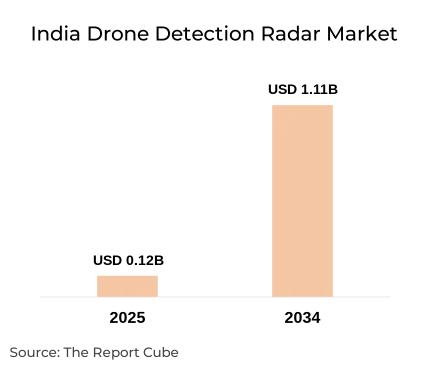
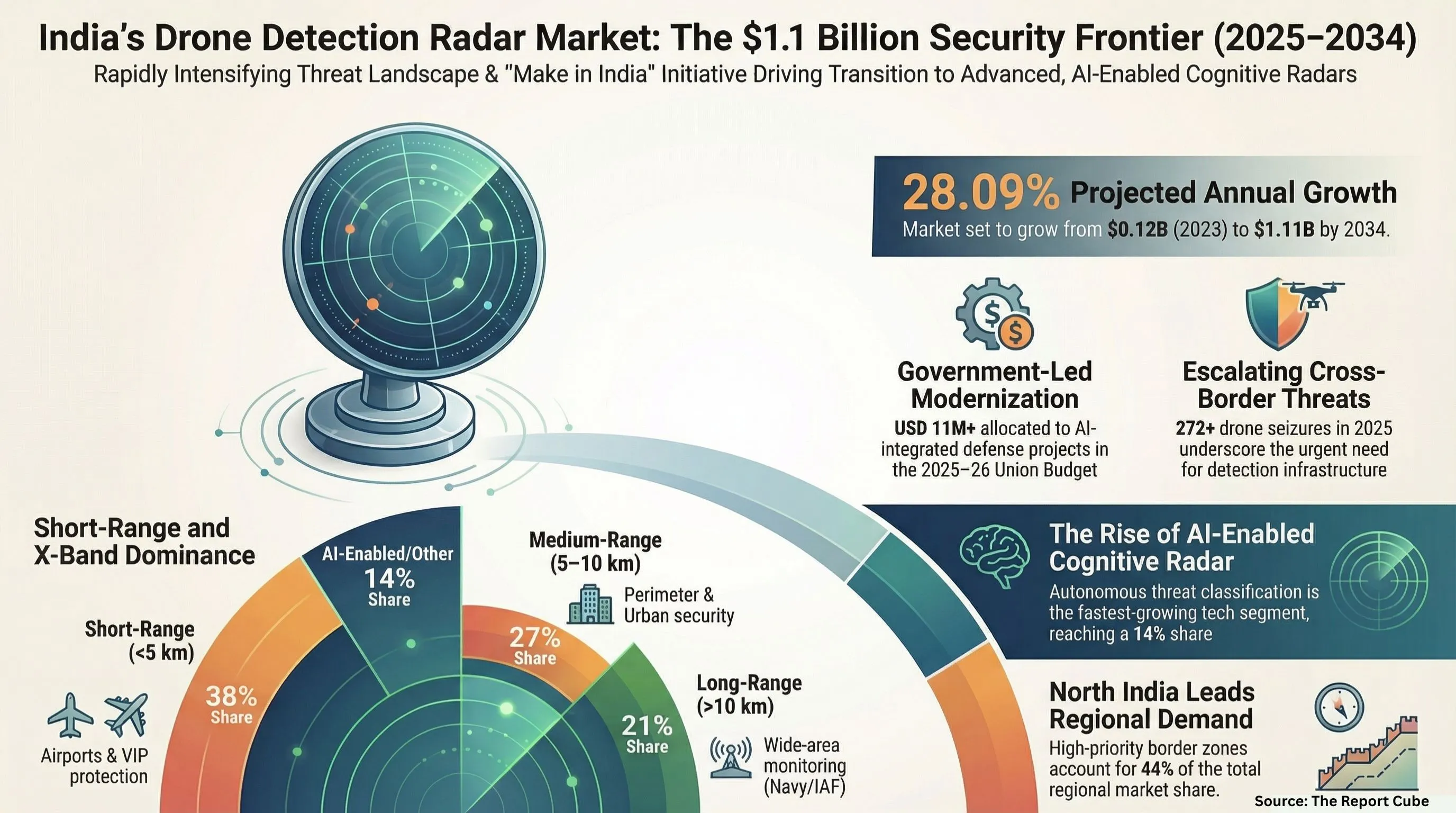
- India Drone Detection Radar Market was valued at USD 0.12 billion in 2025.
- India Drone Detection Radar Market is projected to reach USD 1.11 billion by 2034.
- India Drone Detection Radar Market is anticipated to register a CAGR of 28.09% during 2026–2034.
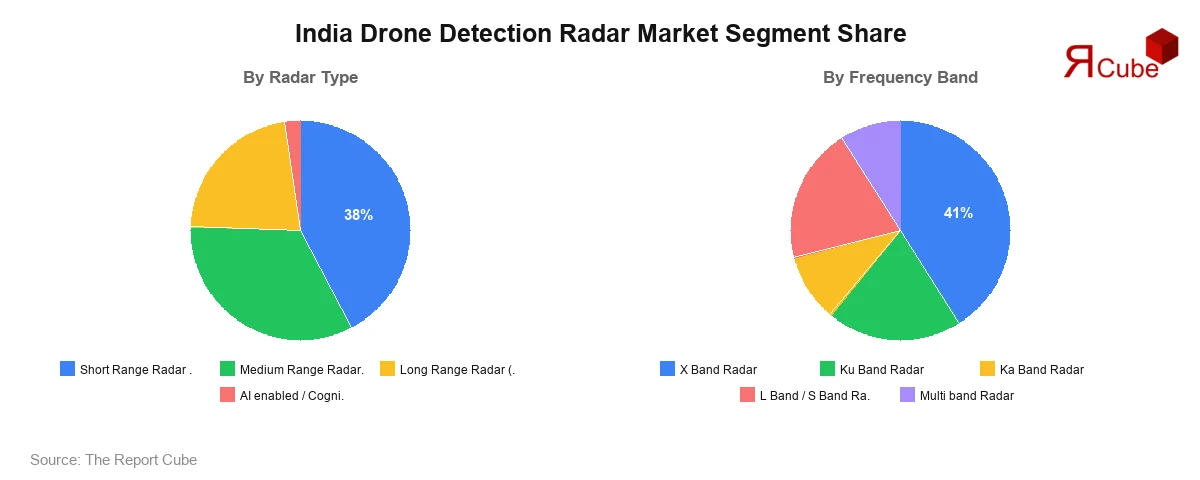
By Radar Type Short Range Radar dominates the segment with approximately 38% market share.
Competitive Landscape
- More than 10 companies are actively engaged in producing India Drone Detection Radar Market solutions.
- Top 5 companies acquired around 62% of the market share.
- Bharat Electronics Limited, Zen Technologies, Grene Robotics, Paras Defense, Adani Defense & Aerospace, and others.
By Frequency Band X Band Radar leads this segment, accounting for approximately 41% market share.
India Drone Detection Radar Market Insights & Analysis
The India Drone Detection Radar Market is anticipated to register a 28.09% CAGR during 2026–2034. The market size was valued at USD 0.12 billion in 2025 and is projected to reach USD 1.11 billion by 2034. India's rapidly intensifying aerial threat landscape is at the heart of this expansion. Security agencies recorded the seizure of over 272 drones along sensitive border frontiers between January and November 2025, with each interception linked to recoveries of weapons, narcotics, and explosive materials—underscoring the strategic urgency of advanced detection infrastructure. The Union Budget 2025–26 allocated over USD 11 million specifically to AI integrated defense projects, a clear signal of the government's commitment to technology led national security.
Meanwhile, in February 2025, the Ministry of Home Affairs and the Bureau of Civil Aviation Security jointly approved phased deployment of anti-drone radar systems at major civil airports including Delhi, Mumbai, Srinagar, and Jammu. The Punjab government had earlier committed USD 6.2 million to procure nine dedicated anti drone systems along the 532 km international border. Initiatives such as Make in India and Atmanirbhar Bharat are further propelling indigenous radar manufacturing, incentivizing domestic players to design, test, and commercialize advanced drone detection platforms tailored to India's complex operational terrain.
India Drone Detection Radar Market Dynamics
Key Market Driver Escalating Cross Border UAV Infiltration Incidents
India's northern and western borders have witnessed a dramatic surge in drone based infiltration, with the Border Security Force averaging 24 hostile drone interceptions per month in 2025. The recovery of weapons, RDX/IED materials, and narcotics linked directly to these incursions has compelled defense agencies to treat radar based detection as a nonnegotiable operational requirement.
The Indian Army's May 2025 Request for Information for Ground Based Counter UAS systems—mandating a minimum 50% indigenous content under the Buy Indian category—reflects both the institutional urgency and the structural demand stimulus for domestically developed drone detection radar systems. This threat driven procurement cycle is expected to sustain above average investment in radar systems through 2034.
Major Industry Challenge Spectrum Congestion in Dense Operational Environments
Radar systems operating across X Band, Ku Band, and Ka Band frequencies face significant interference challenges in high density electromagnetic environments such as airports, urban corridors, and military bases where multiple communication, navigation, and surveillance systems operate simultaneously. Managing spectral coexistence without degrading detection sensitivity or generating false positives requires sophisticated signal processing architectures that are still maturing in Indian indigenous manufacturing pipelines.
The challenge is compounded by the miniaturization of commercial drones—which increasingly present low radar cross sections—demanding higher resolution waveforms that inherently consume wider spectrum allocations. Regulatory frameworks for spectrum assignment to counter drone radar systems remain an area of ongoing coordination between the Ministry of Defense and the Department of Telecommunications.
Emerging Trend Shaping Outlook AI Enabled Cognitive Radar Integration Gaining Momentum
The integration of machine learning and AI driven signal classification into drone detection radar platforms is rapidly transforming detection accuracy, particularly for low altitude, slow moving micro UAVs that evade conventional radar thresholds. India's defense modernization roadmap explicitly incorporates AI enabled surveillance, and the 2025–26 Union Budget's USD 11 million allocation to AI defense projects is directly catalyzing cognitive radar development.
Grene Robotics and Infinity Radar are among indigenous firms actively embedding autonomous threat classification layers into their radar products, enabling real time discrimination between authorized and hostile drones without human intervention. India's Sudarshan Chakra air defense initiative, targeting a nationwide layered air defense network by 2035, is designed to incorporate cognitive radar nodes as a foundational detection tier, signaling long term, policy backed demand for this technology segment.
Need Specific Data, Let’s Customize the Report for You
Request CustomizationIndia Drone Detection Radar Market Segment Wise Analysis
The India Drone Detection Radar Market exhibits distinct segmentation across radar range and operational frequency band, with each dimension reflecting differentiated procurement priorities between defense establishments, civil aviation authorities, and critical infrastructure operators. Across both dimensions, the market rewards platforms that offer scalability, spectrum flexibility, and the capacity to integrate with larger networked surveillance architectures.
By Radar Type
- Short Range Radar (less than 5 km)
- Medium Range Radar (5–10 km)
- Long Range Radar (greater than 10 km)
- AI enabled / Cognitive Radar
Short Range Radar commands the largest share of this segment at approximately 38%, driven by its widespread deployment at airports, military installations, border outposts, and VIP protection zones where localized, high resolution detection of low altitude micro drones is paramount. The Odisha Police's 2025 procurement of anti-drone systems equipped with radar, RF analysis, and optical sensors for protecting public events represents a clear illustration of the segment's expanding civilian adoption. Medium Range Radar (5–10 km) accounts for roughly 27% of the segment, suited for defense perimeter protection and semi urban surveillance corridors.
Long Range Radar (greater than 10 km) contributes around 21% and is primarily procured by the Indian Air Force and Navy for wide area airspace monitoring. AI enabled/Cognitive Radar, while currently contributing approximately 14%, is the fastest growing sub segment as the government's defense AI allocation accelerates the commercialization of autonomous threat classification radar modules by indigenous developers including Grene Robotics and Infinity Radar.
By Frequency Band
- X Band Radar
- Ku Band Radar
- Ka Band Radar
- L Band / S Band Radar
- Multi band Radar
X Band Radar leads this segment with approximately 41% market share, reflecting its superior angular resolution, compact form factor, and proven efficacy in detecting small, slow flying UAVs at close to medium ranges—characteristics that align precisely with India's dominant threat profile along its border regions. Ku Band Radar commands around 22% share, valued for its precision tracking capability in adverse weather conditions and its compatibility with integrated airspace management systems at civil airports. Ka Band Radar holds an approximately 13% share and is gaining traction for ultra-high resolution imaging applications in critical infrastructure protection.
L Band and S Band Radar collectively account for roughly 15% and are preferred for long range surveillance roles where deep atmospheric penetration is critical, including maritime domain awareness and high altitude terrain monitoring. Multi band Radar platforms, which offer adaptive frequency agility for complex threat environments, constitute around 9% of the segment today but are positioned for rapid adoption as India's layered air defense architecture matures toward 2034.
Regional Projection of India Drone Detection Radar Market
- North India
- West and Central India
- South India
- East India
North India holds the dominant regional share of approximately 44%, underpinned by the high density of sensitive border zones across Punjab, Jammu & Kashmir, and Uttarakhand, where hostile drone activity has been most concentrated and defense radar procurement is most institutionalized. The Punjab government's USD 6.2 million anti drone procurement and the Ministry of Home Affairs mandated deployments at Srinagar and Jammu airports are direct contributors to this region's market leadership.
West and Central India contribute approximately 26%, driven by infrastructure protection needs around Mumbai's international airport and industrial corridors. South India accounts for roughly 18% and East India for the remaining 12%, with both regions seeing gradual adoption linked to civil aviation expansion and emerging state level security procurement frameworks.
India Drone Detection Radar Market: Recent Development (2025)
- Adani Defense & Aerospace unveiled a vehicle mounted counter drone radar system at Aero India 2025, integrating detection up to 10 km.
- Bharat Electronics Limited reported defense radar revenues exceeding INR 14,000 crore, driven by indigenous counter UAV contracts.
- Paras Defense, valued at INR 3,911 crore, expanded its radar division capacity to address rising government counter drone tenders.
- Zen Technologies secured multiple state police contracts in 2025 for mobile radar equipped anti drone training and detection units.
India Drone Detection Radar Market Future Outlook (2034)
The India Drone Detection Radar Market is poised to reach USD 1.11 billion by 2034, sustaining a robust CAGR of 28.09% through the forecast period. The convergence of India's Sudarshan Chakra layered air defense initiative, the 100 city Smart Cities Mission integrating counter drone infrastructure, and the continued expansion of the Digital Sky Platform—which had already registered 10,208 commercial drones by September 2024 will collectively generate multi, tier radar procurement demand spanning military, civil aviation, and urban security.
AI driven cognitive radar systems will progressively displace legacy passive sensors as the default detection architecture, accelerating indigenous R&D pipelines. Long term growth will also be shaped by policy mandates for minimum 50% domestic content in defense acquisitions, positioning companies such as Bharat Electronics Limited, Grene Robotics, and Zen Technologies as central beneficiaries of India's self, reliant surveillance technology ecosystem through 2034.
Why Choose This Report?
- Provides a comprehensive overview of the overall market analysis, encompassing key trends, consumer behavior analysis, and risk assessment to support strategic decision making.
- Provides accurate, up to date insights into market size, segmentation, and emerging opportunities, helping to minimize risk & capitalizing on growth.
- Gives deep understanding of target audience preferences, investment habits, and communication channels for enhanced product development & marketing effectiveness.
- Delivers competitive analysis & benchmarking, uncovering the strengths & weaknesses of market competitors to guide strategies.
- Consolidate comprehensive market intelligence, reducing reasoning & streamlining research efforts.
- Facilitates customized market segmentation & risk mitigation strategies, fine tuned to the business objectives.
- Aids in identifying both market challenges & untapped opportunities within the industry to drive long term business growth.
- Provides valuable information based on actual customer data & search trends.
Table of Contents
- Introduction
- Objective of the study
- Product Definition
- Market Segmentation
- Study Variables
- Research Methodology
- Secondary Data Points
- Companies Interviewed
- Primary Data Points
- Breakdown of Primary Interviews
- Secondary Data Points
- Executive Summary
- Market Dynamics
- Drivers
- Challenges
- Opportunity Assessment
- Recent Trends and Developments
- Policy and Regulatory Landscape
- India Drone Detection Radar Market Overview (2021-2034)
- Market Size, By Value (in USD Billions)
- Market Share, By Radar Type
- Short-Range Radar (<5 km)
- Medium-Range Radar (5–10 km)
- Long-Range Radar (>10 km)
- AI-enabled / Cognitive Radar
- Market Share, By Frequency Band
- X-Band Radar
- Ku-Band Radar
- Ka-Band Radar
- L-Band / S-Band Radar
- Multi-band Radar
- Market Share, By Platform
- Ground-based Radar
- Naval Radar
- Airborne Radar
- Vehicle-mounted / Portable Radar
- Market Share, By Detection Range
- Very Short Range (<2 km)
- Short Range (2–5 km
- Medium Range (5–10 km)
- Long Range (>10 km)
- Market Share, By End User
- Military & Defense
- Homeland Security / Border Protection
- Airports & Aviation Security
- Critical Infrastructure
- Government & Public Safety
- Commercial & Industrial Facilities
- Event & Stadium Security
- Market Share, By Region
- North India
- West and Central India
- South India
- East India
- Market Share, By Competitors
- Competition Characteristics
- Revenue Shares
- India Short-Range Radar (<5 km) Drone Detection Radar Market Overview, 2021-2034F
- By Value (USD Million)
- By Frequency Band- Market Size & Forecast 2021-2034, USD Million
- By Platform- Market Size & Forecast 2021-2034, USD Million
- By Detection Range- Market Size & Forecast 2021-2034, USD Million
- By End User- Market Size & Forecast 2021-2034, USD Million
- India Medium-Range Radar (5–10 km) Drone Detection Radar Market Overview, 2021-2034F
- By Value (USD Million)
- By Frequency Band- Market Size & Forecast 2021-2034, USD Million
- By Platform- Market Size & Forecast 2021-2034, USD Million
- By Detection Range- Market Size & Forecast 2021-2034, USD Million
- By End User- Market Size & Forecast 2021-2034, USD Million
- India Long-Range Radar (>10 km) Drone Detection Radar Market Overview, 2021-2034F
- By Value (USD Million)
- By Frequency Band- Market Size & Forecast 2021-2034, USD Million
- By Platform- Market Size & Forecast 2021-2034, USD Million
- By Detection Range- Market Size & Forecast 2021-2034, USD Million
- By End User- Market Size & Forecast 2021-2034, USD Million
- India AI-enabled / Cognitive Radar Drone Detection Radar Market Overview, 2021-2034F
- By Value (USD Million)
- By Frequency Band- Market Size & Forecast 2021-2034, USD Million
- By Platform- Market Size & Forecast 2021-2034, USD Million
- By Detection Range- Market Size & Forecast 2021-2034, USD Million
- By End User- Market Size & Forecast 2021-2034, USD Million
- Competitive Outlook (Company Profile - Partial List)
- Bharat Electronics Limited
- Company Overview
- Business Segments
- Strategic Alliances/Partnerships
- Recent Developments
- Zen Technologies
- Company Overview
- Business Segments
- Strategic Alliances/Partnerships
- Recent Developments
- Grene Robotics
- Company Overview
- Business Segments
- Strategic Alliances/Partnerships
- Recent Developments
- Infinity Radar
- Company Overview
- Business Segments
- Strategic Alliances/Partnerships
- Recent Developments
- Paras Defense
- Company Overview
- Business Segments
- Strategic Alliances/Partnerships
- Recent Developments
- Kotai Electronics Pvt. Ltd
- Company Overview
- Business Segments
- Strategic Alliances/Partnerships
- Recent Developments
- Vaimanika Aerospace
- Company Overview
- Business Segments
- Strategic Alliances/Partnerships
- Recent Developments
- DSE India
- Company Overview
- Business Segments
- Strategic Alliances/Partnerships
- Recent Developments
- Adani Defense & Aerospace
- Company Overview
- Business Segments
- Strategic Alliances/Partnerships
- Recent Developments
- Others
- Bharat Electronics Limited
- Contact Us & Disclaimer
Top Key Players & Market Share Outlook
- Bharat Electronics Limited
- Zen Technologies
- Grene Robotics
- Infinity Radar
- Paras Defense
- Kotai Electronics Pvt. Ltd
- Vaimanika Aerospace
- DSE India
- Adani Defense & Aerospace
- Others
Frequently Asked Questions






