



Build Your Custom Market Intelligence Report
Customize Your ReportGlobal Dry Shampoo Market Insights & Analysis
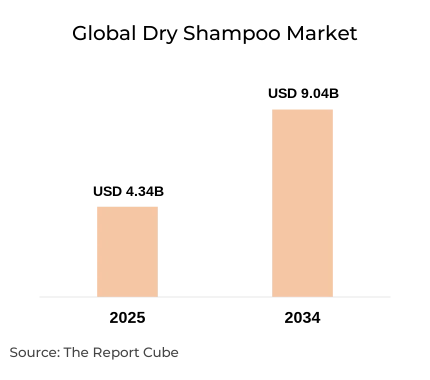
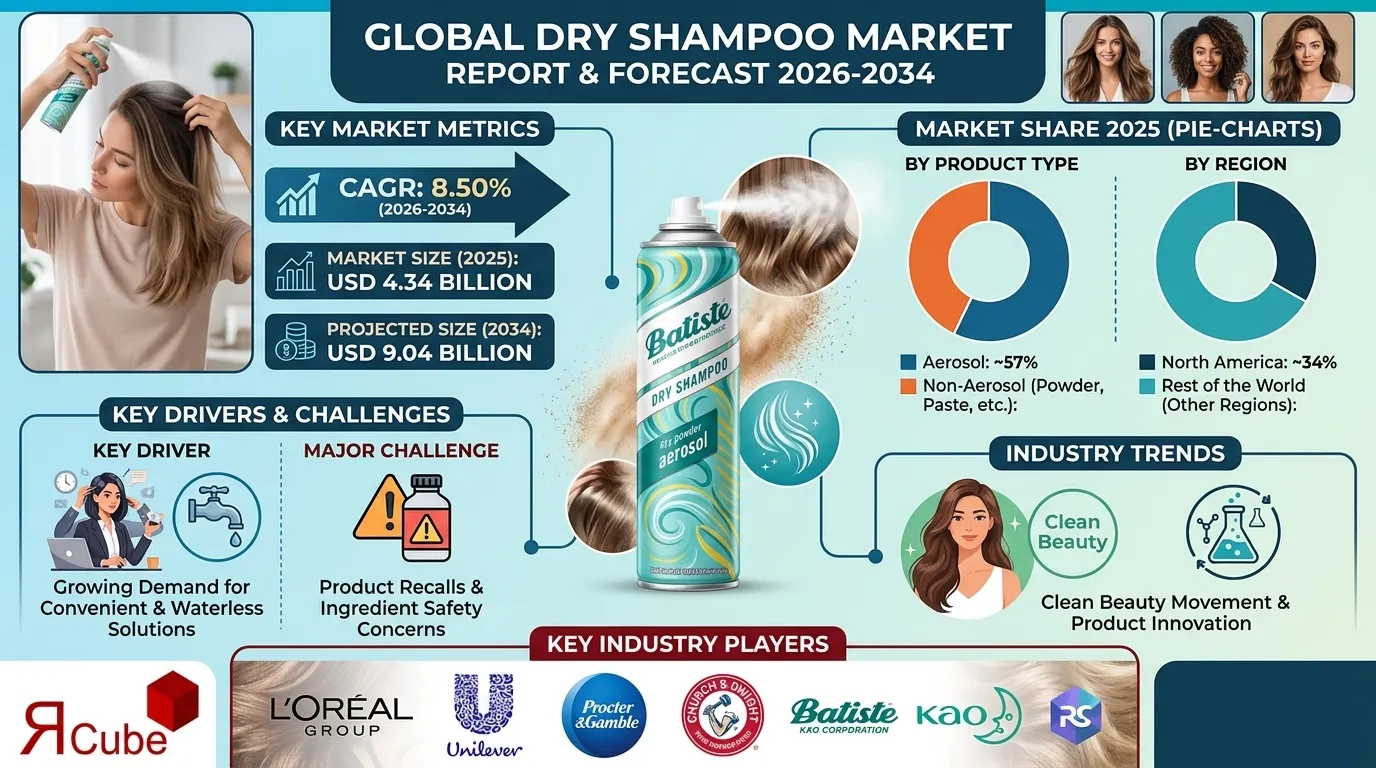
The Global Dry Shampoo Market is anticipated to register a CAGR of 8.50% during 2026-2034.The market size was valued at USD 4.34 Billion in 2025 and is projected to reach USD 9.04 Billion by 2034.The Global Dry Shampoo Market is experiencing consistent expansion, driven by shifting consumer lifestyles, urbanization, and growing demand for convenient personal care solutions. As modern consumers balance busy schedules with grooming expectations, dry shampoo has emerged as a time-saving alternative to traditional hair washing. The product’s ability to absorb oil, refresh hair instantly, and extend blowouts aligns strongly with fast-paced urban living. Between 2021 and 2024, global demand for waterless beauty products increased by nearly 21%, reflecting sustainability concerns and rising water conservation awareness. The surge in travel, gym culture, and hybrid work environments has further amplified product adoption across both developed and emerging markets.
Additionally, premiumization trends in the beauty and personal care industry are positively influencing revenue growth. Brands are introducing scalp-care-focused formulas enriched with botanical extracts, keratin, charcoal, and rice starch to enhance performance. Social media platforms and influencer-driven marketing campaigns have significantly increased product visibility among younger consumers. E-commerce expansion and direct-to-consumer channels have improved product accessibility, especially in Asia Pacific and Latin America. With evolving product innovation, expanding distribution networks, and increasing demand for multifunctional hair care solutions, the Global Dry Shampoo Market is positioned for sustainable growth through 2034.
Global Dry Shampoo Market Recent Developments
- 2025: L’Oréal launched a plant-based aerosol dry shampoo under its professional haircare segment.
- 2025: Unilever expanded its sulfate-free dry shampoo range targeting sensitive scalp consumers.
Government Initiatives & Policies
- EU Cosmetics Regulation (EC) No 1223/2009: Ensures safety standards for cosmetic ingredients.
- U.S. FDA Cosmetics Safety Modernization Act (MoCRA): Strengthens cosmetic product safety oversight.
Global Dry Shampoo Market Dynamics
Key Driver: Growing Demand for Convenient and Waterless Hair Care Solutions
The increasing preference for convenience-driven beauty products remains the primary growth catalyst for the Global Dry Shampoo Market. Urban consumers, particularly working professionals and students, are seeking quick grooming alternatives that save time without compromising hair appearance. Surveys indicate that over 58% of women aged 18–40 use dry shampoo at least once per week. The rise in fitness activities and outdoor lifestyles further boosts usage frequency, as consumers seek instant hair refreshment after workouts.
Water scarcity awareness and environmental consciousness are also encouraging adoption. Dry shampoo significantly reduces water consumption compared to traditional hair washing routines, aligning with sustainability goals. Brands are promoting eco-friendly packaging and non-aerosol variants to attract environmentally aware buyers. Additionally, men’s grooming is emerging as a fast-growing segment, contributing to nearly 24% of incremental market revenue in 2025. The integration of scalp-nourishing ingredients and residue-free formulas enhances repeat purchases. Collectively, convenience, sustainability, and lifestyle alignment continue to drive steady demand growth worldwide.
Industry Trends: Clean Beauty Movement and Product Innovation
The clean beauty movement is reshaping product development strategies in the dry shampoo industry. Consumers increasingly demand paraben-free, talc-free, and benzene-free formulations. Regulatory scrutiny over aerosol contaminants has prompted manufacturers to enhance quality control and transparency. Nearly 46% of new product launches in 2024 featured natural or plant-derived ingredients, signaling a strong shift toward safer alternatives.
Innovation is also expanding into foam-based and tinted dry shampoos designed for diverse hair colors and textures. Brands are investing in dermatologically tested and scalp-friendly variants to address sensitivity concerns. Powder-based non-aerosol formats are gaining traction due to lower environmental impact. Packaging innovation, including recyclable aluminum cans and refillable containers, supports sustainability commitments. Additionally, AI-driven personalization tools on e-commerce platforms are helping consumers select products tailored to hair type and lifestyle. These evolving trends reinforce brand differentiation and drive competitive intensity within the Global Dry Shampoo Market.
Major Challenge: Product Recalls and Ingredient Safety Concerns
One of the significant challenges impacting the Global Dry Shampoo Market is safety-related recalls and regulatory scrutiny. In recent years, concerns regarding benzene contamination in aerosol products have led to multiple product withdrawals, affecting brand trust and consumer confidence. Such incidents create reputational risks and short-term revenue declines for leading manufacturers.
Ingredient transparency and compliance requirements are becoming increasingly stringent across regions. Meeting evolving regulatory standards requires continuous testing and reformulation, which may increase operational costs. Smaller brands often struggle to meet global compliance benchmarks, limiting international expansion. Moreover, consumer skepticism toward aerosol formats can shift demand toward non-aerosol variants, disrupting established supply chains. Addressing safety concerns through enhanced quality assurance and transparent labeling will remain essential for sustained growth.
Opportunity: Expansion in Emerging Markets and Male Grooming Segment
Emerging economies in Asia Pacific, the Middle East, and Latin America present substantial growth opportunities due to rising disposable incomes and increasing beauty awareness. Rapid urbanization and social media influence are accelerating product adoption among younger demographics. The Asia Pacific region alone is projected to register double-digit annual growth through 2034.
The male grooming segment offers untapped potential, as evolving fashion trends encourage frequent styling and appearance maintenance. Men’s dry shampoo variants tailored for short hair and oil control are witnessing rising demand. Strategic collaborations with salons, fitness centers, and online beauty influencers further enhance market penetration. Additionally, subscription-based direct-to-consumer models are strengthening brand loyalty and recurring revenue streams. These emerging avenues create long-term expansion potential across diverse consumer segments.
Global Dry Shampoo Market Segment-wise Analysis
By Product Type:
- Aerosol Dry Shampoo
- Non-Aerosol Dry Shampoo
- Powder Dry Shampoo
- Foam & Other Formats
Aerosol dry shampoo dominates the segment, accounting for approximately 57% of total market revenue in 2025 due to ease of application and quick absorption properties. Consumers prefer aerosol sprays for uniform distribution and instant styling benefits. However, non-aerosol and powder formats are expanding steadily, particularly among environmentally conscious buyers. Foam-based innovations are gaining niche popularity for residue-free application. While aerosol remains the leading segment, diversification into alternative formats is gradually reshaping competitive dynamics.
By Distribution Channel:
- Supermarkets & Hypermarkets
- Specialty Stores
- Online Retail
- Pharmacies & Drug Stores
Online retail leads the distribution landscape with nearly 36% market share in 2025, driven by convenience, product comparisons, and influencer marketing. Supermarkets & hypermarkets account for approximately 30%, benefiting from impulse purchases and strong shelf visibility. Specialty beauty stores maintain premium brand positioning, while pharmacies attract health-conscious consumers seeking dermatologist-recommended products. Direct-to-consumer digital channels are expanding rapidly, enabling brands to gather consumer insights and personalize offerings. The shift toward omnichannel retail strategies continues to strengthen overall market accessibility and revenue growth.
Regional Projection of Global Dry Shampoo Industry
- North America
- Europe
- Asia Pacific
- Rest of the World
North America leads the Global Dry Shampoo Market, accounting for approximately 34% of total revenue in 2025. The United States remains the primary contributor due to high consumer awareness, strong brand presence, and advanced retail infrastructure. Europe follows closely, driven by clean beauty trends and regulatory compliance standards. Asia Pacific is projected to register the fastest growth rate, supported by expanding urban populations and rising beauty expenditures in China, India, and South Korea. While North America maintains leadership through product innovation and marketing investments, Asia Pacific offers significant long-term expansion opportunities fueled by demographic shifts and digital commerce growth.
Why Choose This Report?
- Provides a comprehensive overview of the overall market analysis, encompassing key trends, consumer behavior analysis, and risk assessment to support strategic decision-making.
- Provides accurate, up-to-date insights into market size, segmentation, and emerging opportunities, helping to minimize risk & capitalizing on growth.
- Gives deep understanding of target audience preferences, investment habits, and communication channels for enhanced product development & marketing effectiveness.
- Delivers competitive analysis & benchmarking, uncovering the strengths & weaknesses of market competitors to guide strategies.
- Consolidate comprehensive market intelligence, reducing reasoning & streamlining research efforts.
- Facilitates customized market segmentation & risk mitigation strategies, fine-tuned to the business objectives.
- Aids in identifying both market challenges & untapped opportunities within the industry to drive long-term business growth.
- Provides valuable information based on actual customer data & search trends.
Table of Contents
- Introduction
- Objective of the Study
- Dry Shampoo Definition
- Market Segmentation
- Study Variables
- Research Methodology
- Secondary Data Points
- Breakdown of Secondary Sources
- Primary Data Points
- Breakdown of Primary Interviews
- Secondary Data Points
- Executive Summary
- Market Dynamics
- Drivers
- Challenges
- Opportunity Assessment
- Recent Trends and Developments
- Regulatory and Policy Landscape
- Global Dry Shampoo Market Overview (2021–2034)
- Market Size, By Value (USD Billion)
- Market Share, By Product Type
- Aerosol Dry Shampoo
- Non‑Aerosol Dry Shampoo
- Powder Dry Shampoo
- Foam & Other Formats
- Market Share, By Ingredient Type
- Natural
- Synthetic
- Market Share, By Hair Type
- Normal Hair
- Oily Hair
- Dry Hair
- Color‑Treated Hair
- Market Share, By Gender
- Women
- Men
- Unisex
- Market Share, By Distribution Channel
- Supermarkets & Hypermarkets
- Specialty Stores
- Online Retail
- Pharmacies & Drug Stores
- Direct‑to‑Consumer (DTC)
- Market Share, By Company
- Competition Characteristics
- Revenue Shares & Analysis
- Market Share, By Region
- North America Dry Shampoo Market
- Market Size, By Value
- Market Share, By Product Type
- Market Share, By Distribution Channel
- Europe Dry Shampoo Market
- Market Size, By Value
- Market Share, By Product Type
- Market Share, By Distribution Channel
- Asia Pacific Dry Shampoo Market
- Market Size, By Value
- Market Share, By Product Type
- Market Share, By Distribution Channel
- Middle East and Africa Dry Shampoo Market
- Market Size, By Value
- Market Share, By Product Type
- Market Share, By Distribution Channel
- South America Dry Shampoo Market
- Market Size, By Value
- Market Share, By Product Type
- Market Share, By Distribution Channel
- North America Dry Shampoo Market
- Competitive Outlook and Company Profiles
- L’Oréal Group
- Company Overview
- Dry Shampoo Portfolio
- Strategic Alliances/Partnerships
- Recent Developments
- Unilever
- Company Overview
- Hair Care & Dry Shampoo Portfolio
- Strategic Alliances/Partnerships
- Recent Developments
- Procter & Gamble
- Company Overview
- Hair Care Portfolio
- Strategic Alliances/Partnerships
- Recent Developments
- Church & Dwight (Batiste)
- Company Overview
- Dry Shampoo Portfolio
- Strategic Alliances/Partnerships
- Recent Developments
- Kao Corporation
- Company Overview
- Hair Care & Styling Portfolio
- Strategic Alliances/Partnerships
- Recent Developments
- Others
- Company Overview
- Business Segments
- Strategic Alliances/Partnerships
- Recent Developments
- L’Oréal Group
- Contact Us / Disclaimer
Top Key Players & Market Share Outlook
- L’Oréal Group
- Unilever
- Procter & Gamble
- Church & Dwight (Batiste)
- Kao Corporation
- Batiste
Frequently Asked Questions






