




Build Your Custom Market Intelligence Report
Customize Your ReportJapan Electric Vehicle Aftermarket Market Insights & Analysis
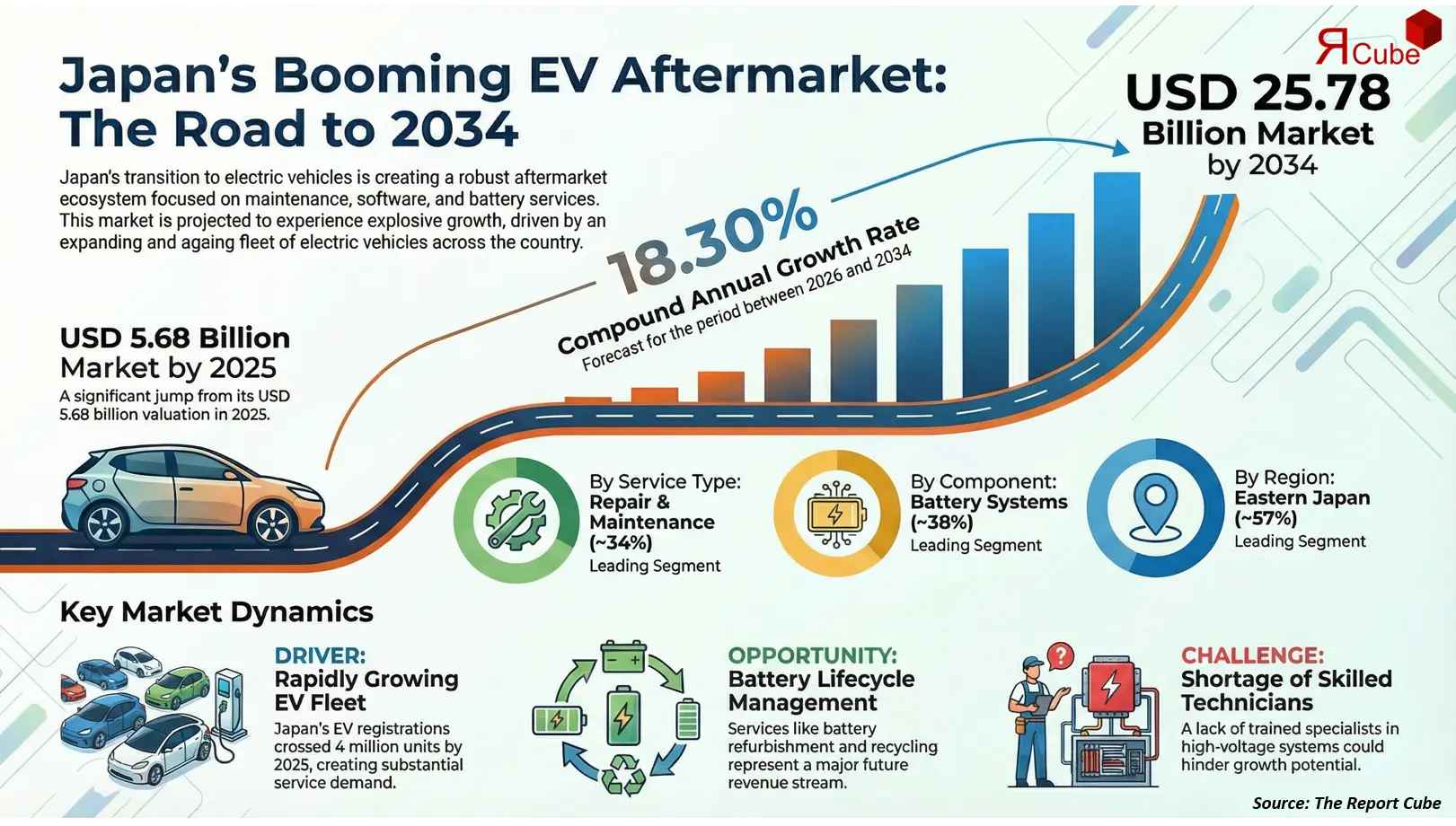
The Japan Electric Vehicle Aftermarket Market is anticipated to register a CAGR of 18.30% during the forecast period 2026-2034. The market size was valued at USD 5.68 billion in 2025 and is projected to reach USD 25.78 billion by 2034. This rapid expansion is closely linked to Japan’s accelerating electric vehicle adoption, aging EV parc, and increasing demand for specialized maintenance, software upgrades, and charging-related services.
As Japan transitions toward carbon neutrality, electric vehicles are moving beyond early adoption into mass-market penetration. This shift is creating a robust aftermarket ecosystem focused on extending vehicle lifespan, enhancing performance, and ensuring battery reliability. Unlike conventional vehicles, EVs require advanced diagnostics, software-driven maintenance, and high-voltage component servicing, increasing the value of aftermarket services. The growing number of EVs reaching post-warranty stages is also driving higher spending on parts replacement, battery health checks, and thermal management services.
Furthermore, Japan’s strong domestic manufacturing base and technology leadership support innovation across the EV aftermarket value chain. OEMs, tier-1 suppliers, and independent service providers are expanding digital platforms and service networks to capture recurring revenue streams. With consumers prioritizing reliability, safety, and performance optimization, the Japan Electric Vehicle Aftermarket Market is positioned for sustained, long-term growth throughout the forecast period.
Japan Electric Vehicle Aftermarket Market Recent Developments
- 2025: Nissan expanded certified EV service programs focusing on battery diagnostics and software upgrades.
- 2025: Autobacs Seven introduced dedicated EV maintenance zones across major urban outlets.
Government Initiatives & Policies
- Green Growth Strategy: Promotes EV adoption, charging infrastructure, and advanced mobility services.
- Next Generation Vehicle Promotion Program: Supports EV maintenance training and aftermarket ecosystem development.
Japan Electric Vehicle Aftermarket Market Dynamics
Key Driver: Rapid Growth of Electric Vehicle Parc Across Japan
The primary driver of the Japan Electric Vehicle Aftermarket Market is the rapid increase in the country’s electric vehicle parc. Government incentives, stricter emission regulations, and rising fuel costs have significantly boosted EV adoption among private and commercial users. By 2025, EV registrations in Japan crossed 4 million units, creating a substantial base for aftermarket services. As vehicles age, demand rises for battery health assessments, drivetrain servicing, and component replacements. Unlike internal combustion vehicles, EVs rely heavily on software and electronics, increasing the frequency of updates and diagnostics. This expanding installed base ensures consistent aftermarket demand, supporting stable revenue growth for service providers and parts manufacturers throughout the forecast period.
Book your FREE 30-minute expert consultation today
Contact UsIndustry Trends: Shift Toward Software-Driven and Digital Aftermarket Services
A major trend reshaping the market is the shift toward software-centric aftermarket services. Over-the-air updates, advanced diagnostics, and predictive maintenance are becoming standard across EV platforms. Japanese automakers and suppliers are integrating AI-enabled monitoring systems to track battery degradation, thermal efficiency, and power electronics performance. This trend is increasing demand for software upgrades and subscription-based services within the aftermarket. Additionally, digital service platforms are enabling faster turnaround times and improved customer experience. As EV technology evolves, the aftermarket is moving from purely mechanical services to a data-driven model, enhancing value creation and long-term customer retention.
Major Challenge: Shortage of Skilled EV Technicians and Infrastructure
Despite strong growth prospects, the Japan Electric Vehicle Aftermarket Market faces challenges related to workforce readiness and infrastructure. EV servicing requires specialized training in high-voltage systems, battery safety, and advanced electronics, skills that are still limited across independent workshops. Additionally, high initial investment in diagnostic tools and safety equipment can restrict smaller service providers from entering the market. Regional disparities in charging and service infrastructure further complicate service accessibility. These constraints may slow market penetration in certain areas, particularly outside major urban centers, impacting short-term growth momentum.
Opportunity: Expansion of Battery Services and Lifecycle Management
Battery lifecycle management represents a significant growth opportunity within the EV aftermarket. As batteries account for nearly 35-40% of an EV’s total cost, services such as refurbishment, second-life applications, and recycling are gaining traction. Japanese firms are investing in battery health analytics and reuse programs to reduce ownership costs and environmental impact. The development of standardized battery service solutions is expected to unlock new revenue streams for aftermarket players. This focus on sustainability and cost optimization positions battery-related services as a high-growth opportunity through 2034.
Japan Electric Vehicle Aftermarket Market Segment-wise Analysis
By Service Type:
- Repair & Maintenance
- Parts Replacement
- Charging Services
- Software Upgrades
- Customization
Repair & Maintenance leads the service type segment, accounting for approximately 34% of the market share in 2025. This dominance is driven by routine inspections, battery diagnostics, and drivetrain servicing as EVs age. Parts Replacement follows closely, supported by demand for batteries, power electronics, and sensors. Software Upgrades are the fastest-growing sub-segment, reflecting the increasing role of digital features and performance optimization. Charging Services are also expanding rapidly, supported by urban charging networks and fleet electrification. Together, these services form a comprehensive aftermarket ecosystem catering to evolving EV owner needs.
By Component:
- Battery Systems
- Electric Drivetrain
- Thermal Management
- Charging Hardware
- Electronics & Sensors
Battery Systems dominate the component segment, holding nearly 38% market share, driven by high replacement and servicing costs. Electric Drivetrain components account for a significant share due to wear-related maintenance over time. Thermal Management systems are gaining importance as efficient temperature control directly impacts battery life and vehicle range. Electronics & Sensors are witnessing steady growth, supported by increasing vehicle automation and connectivity. The strong performance of battery-related components underscores their central role in shaping aftermarket demand.
Regional Projection of Japan Electric Vehicle Aftermarket Industry
- Eastern Japan
- Western Japan
Eastern Japan leads the market, contributing approximately 57% of total aftermarket revenue. The region benefits from higher EV adoption rates, dense urban populations, and advanced service infrastructure centered around Tokyo and surrounding prefectures. Western Japan follows, supported by growing EV penetration in Osaka and neighboring regions. Eastern Japan’s dominance is reinforced by early adoption trends, higher disposable incomes, and strong OEM presence, ensuring sustained leadership throughout the forecast period.
Need insights for a specific region within this market?
Request Regional DataWhy Choose This Report?
- Provides a comprehensive overview of the overall market analysis, encompassing key trends, consumer behavior analysis, and risk assessment to support strategic decision-making.
- Provides accurate, up-to-date insights into market size, segmentation, and emerging opportunities, helping to minimize risk & capitalizing on growth.
- Gives deep understanding of target audience preferences, investment habits, and communication channels for enhanced product development & marketing effectiveness.
- Delivers competitive analysis & benchmarking, uncovering the strengths & weaknesses of market competitors to guide strategies.
- Consolidate comprehensive market intelligence, reducing reasoning & streamlining research efforts.
- Facilitates customized market segmentation & risk mitigation strategies, fine-tuned to the business objectives.
- Aids in identifying both market challenges & untapped opportunities within the industry to drive long-term business growth.
- Provides valuable information based on actual customer data & search trends.
Table of Contents
- Introduction
- Objective of the Study
- Product and Category Definition
- Market Segmentation
- Study Variables
- Research Methodology
- Secondary Data Points
- Breakdown of Secondary Sources
- Primary Data Points
- Breakdown of Primary Interviews
- Secondary Data Points
- Executive Summary
- Market Dynamics
- Drivers
- Challenges
- Opportunity Assessment
- Recent Trends and Developments
- Regulatory and Policy Landscape
- Japan Electric Vehicle Aftermarket Overview (2020-2034)
- Market Size, By Value (USD Billion)
- Market Share, By Service Type
- Repair & Maintenance
- Parts Replacement
- Charging Services
- Software Upgrades
- Customization
- Market Share, By Component
- Battery Systems
- Electric Drivetrain
- Thermal Management
- Charging Hardware
- Electronics & Sensors
- Market Share, By Vehicle Type
- Passenger EVs
- Light Commercial
- Heavy Commercial
- Market Share, By Propulsion
- Battery EV
- Plug-in Hybrid
- Hybrid EV
- Fuel Cell EV
- Market Share, By Channel Type
- OEM Workshops
- Independent Garages
- Online Platforms
- Market Share, By Customer
- Private Owners
- Fleet Operators
- Ride-hailing
- Market Share, By Region
- Eastern
- Western
- Market Share, By Company
- Revenue Shares & Analysis
- Competitive Landscape
- Eastern Japan EV Aftermarket
- Market Size, By Value (USD Billion)
- Market Share, By Service Type
- Market Share, By Component
- Market Share, By Vehicle Type
- Market Share, By Propulsion
- Market Share, By Channel Type
- Market Share, By Customer
- Market Share, By Prefecture Group
- Kanto Region
- Tohoku Region
- Hokkaido Region
- Western Japan EV Aftermarket
- Market Size, By Value (USD Billion)
- Market Share, By Service Type
- Market Share, By Component
- Market Share, By Vehicle Type
- Market Share, By Propulsion
- Market Share, By Channel Type
- Market Share, By Customer
- Market Share, By Prefecture Group
- Kansai/Kinki Region
- Chubu Region
- Chugoku Region
- Shikoku Region
- Kyushu-Okinawa Region
- Competitive Outlook and Company Profiles
- Nissan Motor Co.
- Company Overview
- Aftermarket Portfolio
- Strategic Alliances/Partnerships
- Recent Developments
- Toyota Motor Corp.
- Company Overview
- Aftermarket Portfolio
- Strategic Alliances/Partnerships
- Recent Developments
- Honda Motor Co.
- Company Overview
- Aftermarket Portfolio
- Strategic Alliances/Partnerships
- Recent Developments
- Panasonic Holdings
- Company Overview
- Aftermarket Portfolio
- Strategic Alliances/Partnerships
- Recent Developments
- Denso Corporation
- Company Overview
- Aftermarket Portfolio
- Strategic Alliances/Partnerships
- Recent Developments
- Mitsubishi Electric
- Company Overview
- Aftermarket Portfolio
- Strategic Alliances/Partnerships
- Recent Developments
- Hitachi Astemo
- Company Overview
- Aftermarket Portfolio
- Strategic Alliances/Partnerships
- Recent Developments
- Aisin Corporation
- Company Overview
- Aftermarket Portfolio
- Strategic Alliances/Partnerships
- Recent Developments
- Bridgestone Corp.
- Company Overview
- Aftermarket Portfolio
- Strategic Alliances/Partnerships
- Recent Developments
- Autobacs Seven
- Company Overview
- Aftermarket Portfolio
- Strategic Alliances/Partnerships
- Recent Developments
- Others
- Nissan Motor Co.
- Contact Us and Disclaimer
Top Key Players & Market Share Outlook
- Nissan Motor Co.
- Toyota Motor Corp.
- Honda Motor Co.
- Panasonic Holdings
- Denso Corporation
- Mitsubishi Electric
- Hitachi Astemo
- Aisin Corporation
- Bridgestone Corp.
- Autobacs Seven
- Others
Frequently Asked Questions






