



Build Your Custom Market Intelligence Report
Customize Your ReportAsia Pacific EV Charging Infrastructure Market Insights & Analysis
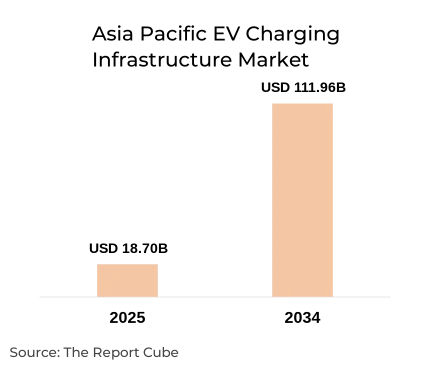
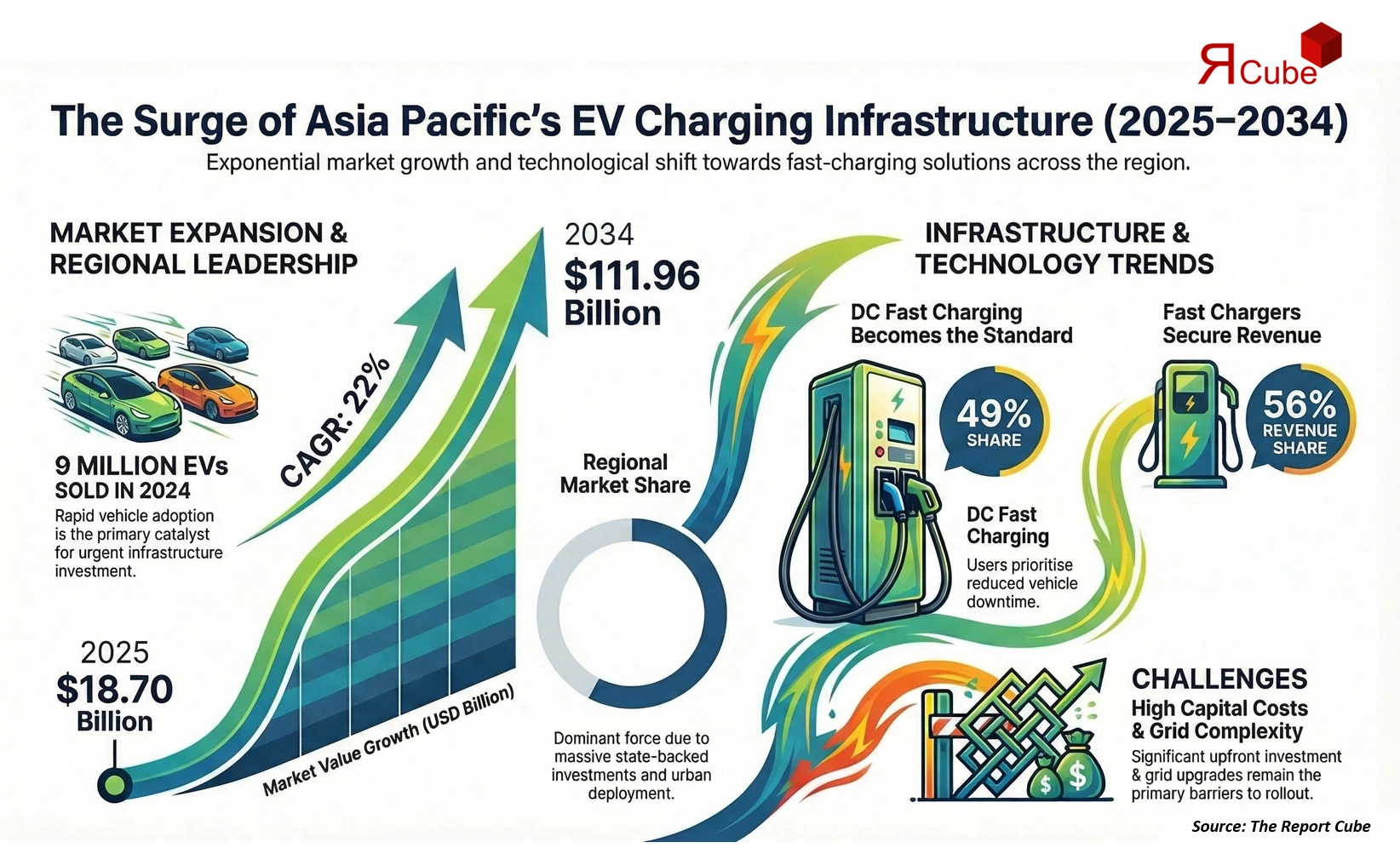
The Asia Pacific EV Charging Infrastructure Market is anticipated to register a CAGR of 22% during 2026-2034. The market size was valued at USD 18.7 billion in 2025 and is projected to reach USD 111.96 billion by 2034. The market is experiencing exponential growth, driven by accelerating electric vehicle (EV) adoption, ambitious decarbonization targets, and large-scale public and private investments across the Asia Pacific region. Governments are prioritizing charging infrastructure as a foundational requirement to support national EV roadmaps and reduce dependence on fossil fuels.
China dominates the regional landscape with the world’s largest installed base of public EV chargers, supported by strong state-owned utility participation and favorable policy frameworks. India, Japan, and South Korea are rapidly scaling charging networks through public-private partnerships, while Australia is focusing on highway fast-charging corridors to support long-distance EV travel. The increasing penetration of electric buses, commercial fleets, and two-wheelers is further accelerating demand for diverse charging solutions.
Technological advancements such as ultra-fast DC charging, smart grid integration, and wireless charging pilots are reshaping the competitive landscape. Utilities, energy companies, and equipment manufacturers are collaborating to deploy interoperable and scalable charging ecosystems. As EV adoption expands beyond metropolitan centers into tier-2 and tier-3 cities, the Asia Pacific EV Charging Infrastructure Market is expected to remain one of the fastest-growing clean energy segments globally through 2034.
Asia Pacific EV Charging Infrastructure Market Recent Developments
- 2025: ABB launched next-generation ultra-fast DC chargers optimized for high-power commercial EV applications.
- 2025: Tata Power expanded its public charging network across major Indian highways and urban centers.
Government Initiatives & Policies
- China New Energy Vehicle Infrastructure Plan: National program supporting large-scale public and private EV charging deployment.
- India National Electric Mobility Mission: Policy framework promoting EV adoption and nationwide charging infrastructure rollout.
Asia Pacific EV Charging Infrastructure Market Dynamics
Key Driver: Rapid Electric Vehicle Adoption Across Passenger and Commercial Segments
The rapid increase in electric vehicle sales is the primary driver of the Asia Pacific EV Charging Infrastructure Market. EV sales across the region surpassed 9 million units in 2024, with China accounting for more than 60% of total volume. This surge has created an urgent need for accessible, reliable, and fast charging networks. Governments are mandating minimum charger-to-vehicle ratios and incentivizing private sector participation to bridge infrastructure gaps. Commercial fleet electrification, particularly in logistics and public transportation, is further boosting demand for depot and fast-charging solutions. As EV ownership expands among private consumers, workplace and residential charging installations are also rising, reinforcing sustained infrastructure investment.
Book your FREE 30-minute expert consultation today
Contact UsIndustry Trends: Shift Toward Fast and Smart Charging Technologies
The market is witnessing a clear shift from slow chargers to fast and ultra-fast charging solutions. DC fast chargers now account for nearly 48% of new public charging installations in the region, driven by consumer demand for reduced charging times. Smart charging systems integrated with energy management software are gaining traction, enabling load balancing, dynamic pricing, and grid optimization. Wireless charging pilots, particularly in South Korea and Japan, represent an emerging trend aimed at improving convenience and reducing physical infrastructure constraints. These innovations are enhancing user experience while supporting grid stability.
Major Challenge: High Capital Costs and Grid Integration Complexity
Despite strong growth, high upfront capital costs remain a significant challenge for EV charging infrastructure deployment. Fast-charging stations require substantial investment in power electronics, grid upgrades, and land acquisition. In developing Asia Pacific markets, limited grid capacity and inconsistent power supply add complexity to large-scale deployments. Interoperability issues between different charging standards also hinder seamless user experiences. These challenges can slow infrastructure rollout, particularly in rural and semi-urban areas, impacting overall market penetration.
Opportunity: Expansion of Public-Private Partnerships and Renewable Integration
Public-private partnerships present a major growth opportunity for the Asia Pacific EV Charging Infrastructure Market. Governments are increasingly collaborating with utilities, oil marketing companies, and private investors to accelerate deployment. Integrating renewable energy sources such as solar and wind with charging stations is gaining momentum, reducing operational costs and carbon intensity. Battery energy storage systems are also being deployed alongside chargers to manage peak demand. These integrated solutions enhance economic viability and create long-term opportunities for infrastructure providers.
Asia Pacific EV Charging Infrastructure Market Segment-wise Analysis
By Charger Type:
- Slow Charger
- Fast Charger
Fast chargers lead the market, accounting for approximately 56% of total revenue share in 2025. Their dominance is driven by increasing adoption along highways, commercial hubs, and fleet depots where reduced downtime is critical. Slow chargers remain relevant for residential and workplace settings due to lower installation costs and grid requirements. However, ongoing investments in fast-charging corridors are expected to further strengthen the fast charger segment’s leadership during the forecast period.
By Charging Mode:
- AC Charging
- DC Fast
- Wireless
DC fast charging represents the leading charging mode, holding nearly 49% market share in 2025. This dominance is attributed to its ability to deliver rapid charging for passenger and commercial EVs. AC charging continues to support residential and low-power applications, while wireless charging, though currently niche, is expected to witness high growth due to pilot deployments and technological advancements improving efficiency and safety.
Regional Projection of Asia Pacific EV Charging Infrastructure Industry
- China
- Japan
- South Korea
- India
China leads the Asia Pacific EV Charging Infrastructure Market with an estimated 58% regional market share in 2025. The country benefits from extensive state-backed investments, strong domestic manufacturing, and widespread urban deployment. Japan and South Korea focus on advanced charging technologies and interoperability standards, while India represents the fastest-growing market due to government incentives and rising EV adoption. Australia is steadily expanding its network, particularly along intercity travel routes, supporting long-term regional growth.
Need insights for a specific region within this market?
Request Regional DataWhy Choose This Report?
- Provides a comprehensive overview of the overall market analysis, encompassing key trends, consumer behavior analysis, and risk assessment to support strategic decision-making.
- Provides accurate, up-to-date insights into market size, segmentation, and emerging opportunities, helping to minimize risk & capitalizing on growth.
- Gives deep understanding of target audience preferences, investment habits, and communication channels for enhanced product development & marketing effectiveness.
- Delivers competitive analysis & benchmarking, uncovering the strengths & weaknesses of market competitors to guide strategies.
- Consolidate comprehensive market intelligence, reducing reasoning & streamlining research efforts.
- Facilitates customized market segmentation & risk mitigation strategies, fine-tuned to the business objectives.
- Aids in identifying both market challenges & untapped opportunities within the industry to drive long-term business growth.
- Provides valuable information based on actual customer data & search trends.
Table of Contents
- Introduction
- Objective of the Study
- Product and Category Definition
- Market Segmentation
- Study Variables
- Research Methodology
- Secondary Data Points
- Breakdown of Secondary Sources
- Primary Data Points
- Breakdown of Primary Interviews
- Secondary Data Points
- Executive Summary
- Market Dynamics
- Drivers
- Challenges
- Opportunity Assessment
- Recent Trends and Developments
- Regulatory and Policy Landscape
- Asia Pacific EV Charging Infrastructure Market Overview (2020-2034)
- Market Size, By Value (USD Billion)
- Market Share, By Charger Type
- Slow Charger
- Fast Charger
- Market Share, By Charging Mode
- AC Charging
- DC Fast
- Wireless
- Market Share, By Installation
- Public Charging
- Private Charging
- Market Share, By Vehicle Type
- Passenger Cars
- Commercial Vehicles
- Market Share, By Application
- Residential
- Workplace
- Highway Corridors
- Market Share, By Country
- China
- Japan
- South Korea
- India
- Australia
- Rest of Asia Pacific
- Market Share, By Company
- Market Share, By Company
- Competition Characteristics
- Revenue Shares & Analysis
- China EV Charging Infrastructure Market
- Market Size, By Value (USD Billion)
- Market Share, By Charger Type
- Market Share, By Charging Mode
- Market Share, By Installation
- Market Share, By Vehicle Type
- Market Share, By Application
- Japan EV Charging Infrastructure Market
- Market Size, By Value (USD Billion)
- Market Share, By Charger Type
- Market Share, By Charging Mode
- Market Share, By Installation
- Market Share, By Vehicle Type
- Market Share, By Application
- South Korea EV Charging Infrastructure Market
- Market Size, By Value (USD Billion)
- Market Share, By Charger Type
- Market Share, By Charging Mode
- Market Share, By Installation
- Market Share, By Vehicle Type
- Market Share, By Application
- India EV Charging Infrastructure Market
- Market Size, By Value (USD Billion)
- Market Share, By Charger Type
- Market Share, By Charging Mode
- Market Share, By Installation
- Market Share, By Vehicle Type
- Market Share, By Application
- Australia EV Charging Infrastructure Market
- Market Size, By Value (USD Billion)
- Market Share, By Charger Type
- Market Share, By Charging Mode
- Market Share, By Installation
- Market Share, By Vehicle Type
- Market Share, By Application
- Competitive Outlook and Company Profiles
- ABB
- Company Overview
- Product Portfolio
- Strategic Alliances/Partnerships
- Recent Developments
- Siemens
- Company Overview
- Product Portfolio
- Strategic Alliances/Partnerships
- Recent Developments
- Delta Electronics
- Company Overview
- Product Portfolio
- Strategic Alliances/Partnerships
- Recent Developments
- BYD
- Company Overview
- Product Portfolio
- Strategic Alliances/Partnerships
- Recent Developments
- StarCharge
- Company Overview
- Product Portfolio
- Strategic Alliances/Partnerships
- Recent Developments
- State Grid Corporation of China
- Company Overview
- Product Portfolio
- Strategic Alliances/Partnerships
- Recent Developments
- Tata Power
- Company Overview
- Product Portfolio
- Strategic Alliances/Partnerships
- Recent Developments
- TGOOD
- Company Overview
- Product Portfolio
- Strategic Alliances/Partnerships
- Recent Developments
- EVCOME
- Company Overview
- Product Portfolio
- Strategic Alliances/Partnerships
- Recent Developments
- SRE Power
- Company Overview
- Product Portfolio
- Strategic Alliances/Partnerships
- Recent Developments
- Others
- ABB
- Contact Us and Disclaimer
Top Key Players & Market Share Outlook
- ABB
- Siemens
- Delta Electronics
- BYD
- StarCharge
- State Grid Corporation of China
- Tata Power
- TGOOD
- EVCOME
- SRE Power
- Others
Frequently Asked Questions






