



Build Your Custom Market Intelligence Report
Customize Your ReportAustralia Sustainable Aviation Fuel (SAF) Market Key Highlights
By Fuel Type:
Biofuel segment leads the market, accounting for nearly 58% of total revenue in 2025.
By Feedstock:
Lipid feedstock segment dominates the market, representing around 46% share.
Regional Outlook:
New South Wales leads the market with approximately 34% share.
Government Initiatives & Policies
- Australian Renewable Energy Agency (ARENA) SAF Funding Program: Provides capital support for SAF production and infrastructure development across Australia.
- Australian Government Powering the Regions Fund: Supports industrial decarbonization including aviation fuel transition projects.
Australia Sustainable Aviation Fuel (SAF) Market Insights & Analysis
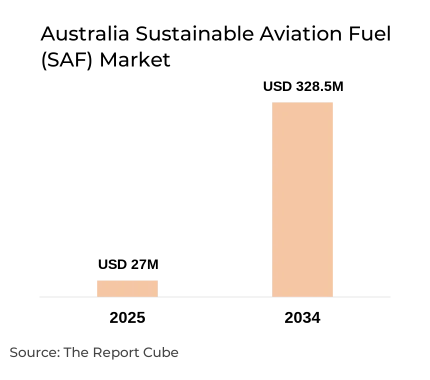
The Australia Sustainable Aviation Fuel (SAF) Market is anticipated to register a CAGR of 32% during 2026-2034. The market size was valued at USD 27 million in 2025 and is projected to reach USD 328.50 million by 2034. Australia’s aviation sector is undergoing structural transformation as airlines, fuel suppliers, and airport operators align with national decarbonization targets and global net-zero aviation commitments.
The growth trajectory reflects a transition from pilot-scale trials to commercial-scale imports, blending, and infrastructure investments. In 2025, large-volume SAF imports into Sydney marked a turning point, demonstrating supply chain readiness and blending capability within existing fuel systems. Domestic production initiatives are also accelerating, with feasibility studies underway for waste-based and advanced biofuel facilities across Queensland and Western Australia. Airlines are setting clear SAF adoption targets, with major carriers aiming for 10% SAF usage by 2030. Infrastructure upgrades at airports and fuel terminals are strengthening long-term scalability, while international partnerships with technology providers are positioning Australia as a regional SAF hub in the Asia-Pacific corridor.
Australia Sustainable Aviation Fuel (SAF) Market Dynamics
Market Driver: Airline Net-Zero Commitments and Aviation Decarbonization Targets
Rising pressure to decarbonize aviation is the primary force behind SAF market expansion in Australia. The aviation sector contributes nearly 2-3% of global CO₂ emissions, and domestic airlines face increasing regulatory and investor scrutiny to reduce carbon intensity. Major Australian carriers have committed to blending SAF into operations, targeting up to 10% usage by 2030 and net-zero emissions by 2050. SAF can reduce lifecycle greenhouse gas emissions by up to 80% compared to conventional Jet A-1 fuel, making it the most viable short-to-medium-term solution for aviation decarbonization. Additionally, corporate travel clients increasingly demand lower-carbon flight options, encouraging airlines to integrate SAF procurement strategies into long-term fuel contracts. This alignment between regulatory direction, investor expectations, and consumer demand is accelerating commercial deployment.
Book your FREE 30-minute expert consultation today
Contact UsIndustry Trends: Infrastructure Development and International Supply Partnerships
A clear market trend is the rapid build-out of storage, blending, and distribution infrastructure. Fuel suppliers are retrofitting Jet A-1 tanks to accommodate blended SAF volumes without disrupting existing supply chains. Large-scale SAF imports in 2025 demonstrated that Australia can integrate unblended SAF into airport fuel systems at commercial volumes. Partnerships between airlines, airports, and energy companies are reshaping the value chain, creating vertically integrated SAF ecosystems. Another emerging trend is diversification of feedstocks beyond lipid sources, including municipal solid waste and industrial gases. Technology pathways such as HEFA-SPK remain dominant; however, FT-SPK and ATJ-SPK are gaining traction as Australia explores long-term domestic production capacity. These trends indicate a shift from reliance on imports toward building sovereign SAF production capability.
Market Challenge: Limited Domestic Production and High Cost Premium
One of the main constraints facing the SAF market is limited domestic production capacity. Currently, Australia relies heavily on imported SAF volumes, which increases exposure to global supply volatility. SAF costs remain significantly higher than traditional jet fuel, with price premiums ranging between 2 to 4 times conventional fuel prices depending on feedstock and technology. This cost gap affects airline profitability and slows large-scale adoption. Feedstock availability also presents logistical challenges, particularly for lipid-based sources that compete with renewable diesel markets. Scaling advanced pathways such as power-to-liquid requires substantial capital investment and renewable electricity capacity, which are still developing in the region.
Market Opportunity: Development of Domestic Waste-to-Fuel Ecosystems
Australia possesses strong potential to develop waste-to-fuel ecosystems leveraging agricultural residues, municipal solid waste, and industrial emissions. The country generates over 75 million tonnes of waste annually, offering scalable feedstock streams for advanced SAF production. Establishing regional biorefineries near feedstock sources could reduce logistics costs and create local employment opportunities. Hydrogen-based and power-to-liquid technologies also align with Australia’s renewable energy expansion strategy, particularly in Western Australia and Queensland. By integrating renewable hydrogen production with SAF synthesis, Australia could position itself as a leading exporter within the Asia-Pacific aviation market. Long-term supply agreements with domestic airlines and cargo operators further enhance investment attractiveness.
Australia Sustainable Aviation Fuel (SAF) Market Segment-wise Analysis
By Fuel Type:
- Biofuel
- Hydrogen Fuel
- Power-to-Liquid Fuel
- Gas-to-Liquid Fuel
- Other SAF Types
Biofuel dominates the Australia SAF market with approximately 58% share in 2025, primarily driven by HEFA-SPK technology utilizing lipid feedstocks. Immediate compatibility with existing aircraft engines and fuel systems supports rapid deployment. Bio-based SAF blends of up to 50% are already certified for commercial aviation, reducing lifecycle emissions significantly. Early commercial imports and blending initiatives have focused on biofuel pathways due to established certification standards and lower technological complexity compared to synthetic fuels.
By Feedstock:
- Lipid Feedstock
- Lignocellulosic Biomass
- Municipal Solid Waste
- Industrial Waste Gases
- Others
Lipid feedstock leads with nearly 46% share, supported by the availability of used cooking oil and animal fats. These feedstocks are compatible with HEFA processing and allow faster commercialization. However, diversification toward lignocellulosic biomass and municipal waste is expected to increase as Australia expands domestic production capabilities.
Regional Projection of Australia Sustainable Aviation Fuel (SAF) Industry
- New South Wales
- Victoria
- Queensland
- Western Australia
- South Australia
- Others
New South Wales holds approximately 34% market share due to Sydney’s role as a primary aviation hub and site of major SAF import and blending activities. Queensland follows with increasing production feasibility projects and renewable energy integration potential. Western Australia shows strong long-term opportunity due to abundant renewable resources suitable for power-to-liquid pathways. Regional growth is closely linked to airport infrastructure modernization and state-level decarbonization initiatives.
Australia Sustainable Aviation Fuel (SAF) Market Recent Developments
- 2025: Qantas Group partnered with Sydney Airport and Ampol Limited to complete Australia’s largest commercial import of nearly 2 million litres of unblended SAF into Sydney, enabling blending into the airport’s fuel system and supporting Qantas’ 10% SAF target by 2030.
- 2025: Ampol Limited imported almost 2 million litres of SAF to its Kurnell facility, blending and supplying it into Sydney Airport’s network, marking its first major SAF infrastructure-scale operation.
- 2025: Viva Energy secured funding from the Australian Renewable Energy Agency to establish SAF storage and blending infrastructure, including refurbishment of Jet A-1 tanks for large-scale integration.
- 2025: Virgin Australia entered an agreement with Viva Energy to source blended SAF for flights from Queensland, integrating SAF into scheduled commercial operations.
- 2025: Sydney Airport confirmed integration of nearly 2 million litres of SAF into its fuel system, capable of powering approximately 900 Sydney-Auckland flights while avoiding an estimated 3,400 tonnes of emissions.
Need insights for a specific region within this market?
Request Regional DataWhy Choose This Report?
- Provides a comprehensive overview of the overall market analysis, encompassing key trends, consumer behavior analysis, and risk assessment to support strategic decision-making.
- Provides accurate, up-to-date insights into market size, segmentation, and emerging opportunities, helping to minimize risk & capitalizing on growth.
- Gives deep understanding of target audience preferences, investment habits, and communication channels for enhanced product development & marketing effectiveness.
- Delivers competitive analysis & benchmarking, uncovering the strengths & weaknesses of market competitors to guide strategies.
- Consolidate comprehensive market intelligence, reducing reasoning & streamlining research efforts.
- Facilitates customized market segmentation & risk mitigation strategies, fine-tuned to the business objectives.
- Aids in identifying both market challenges & untapped opportunities within the industry to drive long-term business growth.
- Provides valuable information based on actual customer data & search trends.
Table of Contents
- Introduction
- Objective of the Study
- Product and Category Definition
- Market Segmentation
- Study Variables
- Research Methodology
- Secondary Data Points
- Breakdown of Secondary Sources
- Primary Data Points
- Breakdown of Primary Interviews
- Secondary Data Points
- Executive Summary
- Market Dynamics
- Drivers
- Challenges
- Opportunity Assessment
- Recent Trends and Developments
- Regulatory and Policy Landscape
- Australia Sustainable Aviation Fuel (SAF) Market Overview (2021-2034)
- Market Size, By Value (USD Million)
- Market Share, By Fuel Type
- Biofuel
- Hydrogen Fuel
- Power-to-Liquid Fuel
- Gas-to-Liquid Fuel
- Other SAF Types
- Market Share, By Feedstock
- Lipid Feedstock
- Lignocellulosic Biomass
- Municipal Solid Waste
- Industrial Waste Gases
- Others
- Market Share, By Technology
- HEFA-SPK
- FT-SPK
- ATJ-SPK
- HDCJ
- Others
- Market Share, By End User
- Commercial Airlines
- Cargo Airlines
- Business Aviation
- Military Aviation
- Others
- Market Share, By Region
- New South Wales
- Victoria
- Queensland
- Western Australia
- South Australia
- Others
- Market Share, By Company
- Revenue Shares and Analysis
- Competitive Landscape
- New South Wales Sustainable Aviation Fuel (SAF) Market
- Market Size, By Value (USD Million)
- Market Share, By Fuel Type
- Market Share, By Feedstock
- Market Share, By Technology
- Market Share, By End User
- Victoria Sustainable Aviation Fuel (SAF) Market
- Market Size, By Value (USD Million)
- Market Share, By Fuel Type
- Market Share, By Feedstock
- Market Share, By Technology
- Market Share, By End User
- Queensland Sustainable Aviation Fuel (SAF) Market
- Market Size, By Value (USD Million)
- Market Share, By Fuel Type
- Market Share, By Feedstock
- Market Share, By Technology
- Market Share, By End User
- Western Australia Sustainable Aviation Fuel (SAF) Market
- Market Size, By Value (USD Million)
- Market Share, By Fuel Type
- Market Share, By Feedstock
- Market Share, By Technology
- Market Share, By End User
- South Australia Sustainable Aviation Fuel (SAF) Market
- Market Size, By Value (USD Million)
- Market Share, By Fuel Type
- Market Share, By Feedstock
- Market Share, By Technology
- Market Share, By End User
- Competitive Outlook and Company Profiles
- Qantas Group
- Company Overview
- Product Portfolio
- Strategic Alliances/Partnerships
- Recent Developments
- Ampol Limited
- Company Overview
- Product Portfolio
- Strategic Alliances/Partnerships
- Recent Developments
- Viva Energy
- Company Overview
- Product Portfolio
- Strategic Alliances/Partnerships
- Recent Developments
- Jet Zero Australia
- Company Overview
- Product Portfolio
- Strategic Alliances/Partnerships
- Recent Developments
- Wagner Sustainable Fuels
- Company Overview
- Product Portfolio
- Strategic Alliances/Partnerships
- Recent Developments
- Virgin Australia
- Company Overview
- Product Portfolio
- Strategic Alliances/Partnerships
- Recent Developments
- BP Australia
- Company Overview
- Product Portfolio
- Strategic Alliances/Partnerships
- Recent Developments
- Shell Australia
- Company Overview
- Product Portfolio
- Strategic Alliances/Partnerships
- Recent Developments
- GrainCorp
- Company Overview
- Product Portfolio
- Strategic Alliances/Partnerships
- Recent Developments
- Renewable Developments Australia (RDA)
- Company Overview
- Product Portfolio
- Strategic Alliances/Partnerships
- Recent Developments
- Boeing Australia
- Company Overview
- Product Portfolio
- Strategic Alliances/Partnerships
- Recent Developments
- Airbus Australia
- Company Overview
- Product Portfolio
- Strategic Alliances/Partnerships
- Recent Developments
- Neste
- Company Overview
- Product Portfolio
- Strategic Alliances/Partnerships
- Recent Developments
- Licella
- Company Overview
- Product Portfolio
- Strategic Alliances/Partnerships
- Recent Developments
- Sydney Airport
- Company Overview
- Product Portfolio
- Strategic Alliances/Partnerships
- Recent Developments
- Brisbane Airport Corp
- Company Overview
- Product Portfolio
- Strategic Alliances/Partnerships
- Recent Developments
- LanzaJet
- Company Overview
- Product Portfolio
- Strategic Alliances/Partnerships
- Recent Developments
- Others
- Qantas Group
- Contact Us and Disclaimer
Top Key Players & Market Share Outlook
- Qantas Group
- Ampol Limited
- Viva Energy
- Jet Zero Australia
- Wagner Sustainable Fuels
- Virgin Australia
- BP Australia
- Shell Australia
- GrainCorp
- Renewable Developments Australia (RDA)
- Boeing Australia
- Airbus Australia
- Neste
- Licella
- Sydney Airport
- Brisbane Airport Corp
- LanzaJet
- Others
Frequently Asked Questions






