



Build Your Custom Market Intelligence Report
Customize Your ReportAustralia Aviation Hydrogen Infrastructure Market Key Highlights
By Infrastructure Type:
Hydrogen production segment leads the market, accounting for nearly 34% of total revenue.
By Hydrogen Source:
Green hydrogen segment dominates the market with around 61% share.
Regional Outlook:
Queensland holds approximately 32% market share.
Government Initiatives & Policies
- Australian National Hydrogen Strategy: Framework accelerating hydrogen production, infrastructure development, and export capacity.
- ARENA Hydrogen Funding Programs: Financial support for renewable hydrogen pilot projects, including aviation-focused initiatives.
Australia Aviation Hydrogen Infrastructure Market Insights & Analysis
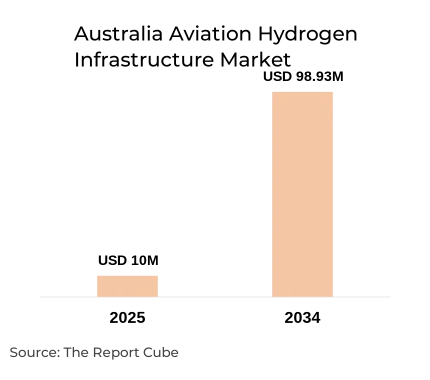
The Australia Aviation Hydrogen Infrastructure Market is anticipated to register a CAGR of 29% during 2026-2034. The market size was valued at USD 10 million in 2025 and is projected to reach USD 98.93 million by 2034. Aviation hydrogen infrastructure is emerging as a cornerstone of Australia’s long-term decarbonization roadmap, particularly for regional and short-haul aviation.
Australia’s abundant renewable energy capacity positions it as a strategic hub for green hydrogen production. More than 90 GW of renewable energy projects are in various planning and construction stages nationwide, creating a strong supply foundation for aviation-grade hydrogen. Airports are transitioning from conceptual pilots to infrastructure planning, including on-site electrolyzers, cryogenic storage tanks, and dedicated refueling systems. Collaboration between aircraft developers, energy companies, and airport operators is reshaping the ecosystem, aligning infrastructure rollout with aircraft certification timelines. This synchronized development reduces commercialization risk and enhances investor confidence in long-term scalability.
Australia Aviation Hydrogen Infrastructure Market Dynamics
Market Driver: National Decarbonization Targets and Regional Aviation Demand
Australia’s commitment to achieving net-zero emissions by 2050 is a primary catalyst for aviation hydrogen infrastructure growth. Aviation accounts for nearly 3% of national emissions, and regional air transport plays a critical role in connecting remote communities. Hydrogen-powered aircraft offer a viable pathway to reduce lifecycle emissions by up to 75% when powered by renewable energy. Government-backed funding programs have accelerated pilot deployments at regional airports. Airlines serving regional routes are increasingly participating in hydrogen trials, aiming to reduce fuel volatility exposure and carbon-related regulatory risks. This convergence of environmental policy and regional mobility needs directly supports infrastructure expansion across production, storage, and distribution segments.
Book your FREE 30-minute expert consultation today
Contact UsIndustry Trends: Integration of Liquid Hydrogen Systems and Airport-Based Production
A significant trend shaping the market is the shift toward liquid hydrogen systems for long-range and higher-capacity aircraft. Liquid hydrogen offers higher energy density compared to compressed hydrogen, making it suitable for regional turboprop and emerging hydrogen-electric aircraft platforms. Airports are exploring on-site electrolysis facilities to minimize transportation costs and ensure supply reliability. Cryogenic storage systems and modular refueling units are increasingly being tested in partnership with aviation technology providers. Additionally, airport operators are integrating hydrogen into broader energy management systems, linking hydrogen production with solar and wind farms. This vertical integration reduces supply chain complexity and strengthens operational resilience.
Market Challenge: Infrastructure Cost and Technical Standardization
Developing hydrogen aviation infrastructure involves significant capital expenditure and technical complexity. Cryogenic storage tanks, specialized refueling equipment, and safety systems require high upfront investment. Industry estimates indicate that establishing a medium-scale airport hydrogen refueling facility can exceed USD 8-12 million, depending on capacity and liquefaction requirements. In addition, harmonized safety standards and certification frameworks are still evolving globally, which may slow project approvals. Workforce training and emergency response preparedness further add to operational costs. These factors create entry barriers for smaller airports and regional operators, potentially limiting rapid nationwide rollout.
Market Opportunity: Regional Hydrogen Corridors and Export Integration
Strong growth opportunities lie in establishing hydrogen aviation corridors linking regional airports. Proposed routes between Brisbane and Gladstone highlight the feasibility of commercial hydrogen-powered regional flights. Integrating aviation hydrogen infrastructure with Australia’s broader hydrogen export strategy enhances long-term scalability. Surplus hydrogen production can be redirected to aviation during peak demand cycles, optimizing asset utilization. Furthermore, partnerships between energy producers and airport operators create cross-sector revenue streams. As aircraft manufacturers advance hydrogen propulsion platforms, early infrastructure readiness will position Australia as a global leader in hydrogen aviation deployment.
Australia Aviation Hydrogen Infrastructure Market Segment-wise Analysis
By Infrastructure Type:
- Hydrogen Production
- Hydrogen Storage
- Hydrogen Distribution
- Airport Refueling
- Onsite Power
Hydrogen production leads the infrastructure segment with approximately 34% share in 2025. The segment’s dominance is driven by large-scale green hydrogen investments in Queensland and Western Australia, where renewable energy resources are abundant. Electrolyzer deployment is expanding, with pilot facilities ranging from 1 MW to 10 MW capacity at select airports. Production capacity growth directly influences downstream infrastructure, including storage and refueling networks, reinforcing its central role in the ecosystem.
By Hydrogen Source:
- Green Hydrogen
- Blue Hydrogen
- Grey Hydrogen
- Others
Green hydrogen accounts for nearly 61% market share, reflecting Australia’s strong renewable energy penetration. Solar and wind integration reduces carbon intensity, aligning aviation decarbonization objectives with national climate goals. Blue hydrogen remains limited due to carbon capture cost considerations, while grey hydrogen adoption continues to decline in aviation-focused projects.
Regional Projection of Australia Aviation Hydrogen Infrastructure Industry
- New South Wales
- Victoria
- Queensland
- Western Australia
- South Australia
- Others
Queensland leads the Australia Aviation Hydrogen Infrastructure Market with around 32% share, supported by early pilot routes and strong government-industry collaboration. Brisbane and Gladstone airports are central to hydrogen aviation trials, while Western Australia benefits from large-scale renewable hydrogen production projects. New South Wales and Victoria are gradually expanding feasibility studies and infrastructure planning, strengthening national network connectivity.
Australia Aviation Hydrogen Infrastructure Market Recent Developments
- 2025: AMSL Aero secured AUD 3 million in Australian Government funding for its “Liquid Hydrogen Powered Aircraft for Regional and Remote Australia” project, advancing liquid hydrogen storage and refueling capabilities to support its Vertiia hydrogen-electric aircraft platform.
- 2025: Stralis Aircraft partnered with CQ University to develop and test a liquid-hydrogen-powered propulsion system, targeting a commercial Brisbane-Gladstone hydrogen route by 2027 and accelerating regional hydrogen infrastructure readiness.
- 2025: AMSL Aero and Stralis Aircraft, together with Fabrum, completed a world-first aviation trial filling aircraft tanks with on-site produced liquid hydrogen, validating refueling and cryogenic storage systems for future commercial deployment.
Need insights for a specific region within this market?
Request Regional DataWhy Choose This Report?
- Provides a comprehensive overview of the overall market analysis, encompassing key trends, consumer behavior analysis, and risk assessment to support strategic decision-making.
- Provides accurate, up-to-date insights into market size, segmentation, and emerging opportunities, helping to minimize risk & capitalizing on growth.
- Gives deep understanding of target audience preferences, investment habits, and communication channels for enhanced product development & marketing effectiveness.
- Delivers competitive analysis & benchmarking, uncovering the strengths & weaknesses of market competitors to guide strategies.
- Consolidate comprehensive market intelligence, reducing reasoning & streamlining research efforts.
- Facilitates customized market segmentation & risk mitigation strategies, fine-tuned to the business objectives.
- Aids in identifying both market challenges & untapped opportunities within the industry to drive long-term business growth.
- Provides valuable information based on actual customer data & search trends.
Table of Contents
- Introduction
- Objective of the Study
- Product and Category Definition
- Market Segmentation
- Study Variables
- Research Methodology
- Secondary Data Points
- Breakdown of Secondary Sources
- Primary Data Points
- Breakdown of Primary Interviews
- Secondary Data Points
- Executive Summary
- Market Dynamics
- Drivers
- Challenges
- Opportunity Assessment
- Recent Trends and Developments
- Regulatory and Policy Landscape
- Australia Aviation Hydrogen Infrastructure Market Overview (2021-2034)
- Market Size, By Value (USD Million)
- Market Share, By Infrastructure Type
- Hydrogen Production
- Hydrogen Storage
- Hydrogen Distribution
- Airport Refueling
- Onsite Power
- Market Share, By Hydrogen Source
- Green Hydrogen
- Blue Hydrogen
- Grey Hydrogen
- Others
- Market Share, By Application
- Airport Operations
- Aircraft Operations
- Ground Support
- Airport Buildings
- Others
- Market Share, By End User
- Airlines
- Airport Operators
- Fuel Suppliers
- Infrastructure Developers
- Technology Providers
- Others
- Market Share, By System
- Liquid Hydrogen
- Compressed Hydrogen
- Fuel Cell Systems
- Hydrogen Combustion
- Market Share, By Region
- New South Wales
- Victoria
- Queensland
- Western Australia
- South Australia
- Others
- Market Share, By Company
- Revenue Shares & Analysis
- Competitive Landscape
- New South Wales Aviation Hydrogen Infrastructure Market
- Market Size, By Value (USD Million)
- Market Share, By Infrastructure Type
- Market Share, By Hydrogen Source
- Market Share, By Application
- Market Share, By End User
- Victoria Aviation Hydrogen Infrastructure Market
- Market Size, By Value (USD Million)
- Market Share, By Infrastructure Type
- Market Share, By Hydrogen Source
- Market Share, By Application
- Market Share, By End User
- Queensland Aviation Hydrogen Infrastructure Market
- Market Size, By Value (USD Million)
- Market Share, By Infrastructure Type
- Market Share, By Hydrogen Source
- Market Share, By Application
- Market Share, By End User
- Western Australia Aviation Hydrogen Infrastructure Market
- Market Size, By Value (USD Million)
- Market Share, By Infrastructure Type
- Market Share, By Hydrogen Source
- Market Share, By Application
- Market Share, By End User
- South Australia Aviation Hydrogen Infrastructure Market
- Market Size, By Value (USD Million)
- Market Share, By Infrastructure Type
- Market Share, By Hydrogen Source
- Market Share, By Application
- Market Share, By End User
- Competitive Outlook and Company Profiles
- AMSL Aero
- Company Overview
- Product Portfolio
- Strategic Alliances/Partnerships
- Recent Developments
- Stralis Aircraft
- Company Overview
- Product Portfolio
- Strategic Alliances/Partnerships
- Recent Developments
- BOC (A Linde Company)
- Company Overview
- Product Portfolio
- Strategic Alliances/Partnerships
- Recent Developments
- Skytrans Airlines
- Company Overview
- Product Portfolio
- Strategic Alliances/Partnerships
- Recent Developments
- Brisbane Airport Corp.
- Company Overview
- Product Portfolio
- Strategic Alliances/Partnerships
- Recent Developments
- Omni Tanker
- Company Overview
- Product Portfolio
- Strategic Alliances/Partnerships
- Recent Developments
- Fortescue (FFI)
- Company Overview
- Product Portfolio
- Strategic Alliances/Partnerships
- Recent Developments
- Dovetail Electric Aviation
- Company Overview
- Product Portfolio
- Strategic Alliances/Partnerships
- Recent Developments
- H2 Energy Company (h2ec)
- Company Overview
- Product Portfolio
- Strategic Alliances/Partnerships
- Recent Developments
- Aeria Management Group
- Company Overview
- Product Portfolio
- Strategic Alliances/Partnerships
- Recent Developments
- Gladstone Airport Corp.
- Company Overview
- Product Portfolio
- Strategic Alliances/Partnerships
- Recent Developments
- Hypersonix Launch Systems
- Company Overview
- Product Portfolio
- Strategic Alliances/Partnerships
- Recent Developments
- Pure Hydrogen
- Company Overview
- Product Portfolio
- Strategic Alliances/Partnerships
- Recent Developments
- GPA Engineering
- Company Overview
- Product Portfolio
- Strategic Alliances/Partnerships
- Recent Developments
- Australian Gas Infrastructure Group (AGIG)
- Company Overview
- Product Portfolio
- Strategic Alliances/Partnerships
- Recent Developments
- Aviation Australia
- Company Overview
- Product Portfolio
- Strategic Alliances/Partnerships
- Recent Developments
- Woodside Energy
- Company Overview
- Product Portfolio
- Strategic Alliances/Partnerships
- Recent Developments
- Others
- AMSL Aero
- Contact Us and Disclaimer
Top Key Players & Market Share Outlook
- AMSL Aero
- Stralis Aircraft
- BOC (A Linde Company)
- Skytrans Airlines
- Brisbane Airport Corp.
- Omni Tanker
- Fortescue (FFI)
- Dovetail Electric Aviation
- H2 Energy Company (h2ec)
- Aeria Management Group
- Gladstone Airport Corp.
- Hypersonix Launch Systems
- Pure Hydrogen
- GPA Engineering
- Australian Gas Infrastructure Group (AGIG)
- Aviation Australia
- Woodside Energy
- Others
Frequently Asked Questions






