



Build Your Custom Market Intelligence Report
Customize Your ReportAustralia Defense Aircraft Modernization Market Key Highlights
By Aircraft Type:
Fighter aircraft segment leads the market, accounting for nearly 34% of total revenue.
By System Upgrade:
Avionics upgrade segment dominates the market, representing around 28% share.
Regional Outlook:
New South Wales leads the market with approximately 29% share.
Government Initiatives & Policies
- Australian Defence Strategic Review (2023 Implementation Phase): Framework guiding long-term air combat capability modernization and sovereign industrial capacity development.
- Integrated Investment Program (IIP): Multi-billion-dollar funding allocation supporting aircraft upgrades, ISR systems, and digital combat integration.
Australia Defense Aircraft Modernization Market Insights & Analysis
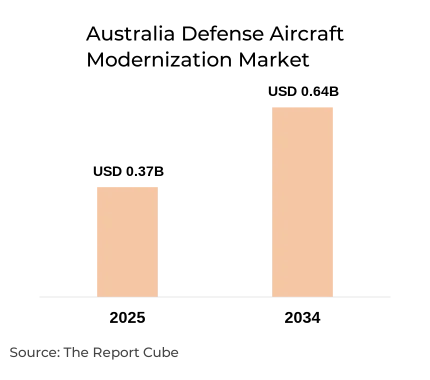
The Australia Defense Aircraft Modernization Market is anticipated to register a CAGR of 6.3% during 2026-2034. The market size was valued at USD 0.37 billion in 2025 and is projected to reach USD 0.64 billion by 2034. Aircraft modernization in Australia is increasingly driven by strategic deterrence requirements, Indo-Pacific regional security shifts, and the need to extend service life of existing fleets while integrating next-generation combat technologies.
Defense expenditure in Australia continues to rise, reaching nearly 2.1% of GDP, with a significant portion allocated toward air combat capability upgrades. Programs such as AIR6015, AIR5428, and broader autonomous combat initiatives are reshaping the modernization landscape. Rather than full fleet replacement, the Australian Defence Force (ADF) prioritizes phased system upgrades including radar modernization, electronic warfare suites, digital connectivity, and structural reinforcement. Industry partnerships between global OEMs and domestic suppliers are strengthening sovereign manufacturing capabilities. The market benefits from a balanced mix of fighter aircraft upgrades, unmanned aerial vehicle integration, and advanced training system deployment, creating long-term modernization pipelines across multiple aircraft categories.
Australia Defense Aircraft Modernization Market Dynamics
Key Driver: Rising Indo-Pacific Security Demands and Fleet Sustainment Requirements
Growing geopolitical tensions in the Indo-Pacific region are compelling Australia to enhance air superiority and surveillance capabilities. The Royal Australian Air Force (RAAF) operates a mix of advanced fighters, maritime patrol aircraft, and surveillance platforms that require continuous upgrades to maintain operational readiness. More than 60% of the current fleet is expected to undergo avionics, sensor, or electronic warfare enhancements before 2030. Fleet sustainment strategies focus on service life extension programs that can extend aircraft usability by 10-15 years. Modernization reduces the need for costly full replacements while preserving combat capability. This approach supports fiscal discipline while ensuring technological parity with allied forces. Continuous investment in ISR systems, radar upgrades, and network-centric warfare platforms remains a central growth catalyst for the market.
Book your FREE 30-minute expert consultation today
Contact UsIndustry Trends: Digitalization, Autonomous Combat Platforms, and Advanced Training Integration
A major trend shaping the market is the integration of digital combat ecosystems and autonomous collaborative aircraft. Programs such as MQ-28 Ghost Bat demonstrate Australia’s commitment to manned-unmanned teaming capabilities. Modernization initiatives increasingly incorporate AI-enabled mission systems, advanced radar arrays, and secure data links to improve situational awareness. Additionally, digital cockpit upgrades and synthetic training environments are transforming pilot readiness. Simulation-based training devices reduce operational costs by nearly 35% compared to traditional flight hours. Another notable trend includes increased local manufacturing participation, with domestic firms supplying structural components, composite materials, and precision engineering systems. These digital and industrial shifts collectively enhance national defense resilience and technological independence.
Major Challenge: Budget Allocation Constraints and Integration Complexity
Although defense budgets are expanding, modernization programs must compete with submarine acquisition, cyber defense, and land systems investments. Aircraft upgrade cycles require precise integration with existing platforms, which can increase costs and extend timelines. System interoperability between legacy platforms and next-generation digital systems presents technical hurdles. Furthermore, supply chain volatility for advanced avionics components and semiconductor technologies may delay delivery schedules. Workforce specialization requirements in aerospace engineering and systems integration also create resource bottlenecks. These constraints collectively slow modernization timelines and require careful strategic planning to maintain operational readiness.
Opportunity: Expansion of Sovereign Aerospace Manufacturing and Export Potential
Australia’s emphasis on sovereign capability development presents substantial opportunities for domestic aerospace firms. Local manufacturing and maintenance facilities are increasingly involved in component production, structural upgrades, and systems integration. Export opportunities for autonomous aircraft platforms and composite structures are expanding through strategic defense partnerships. Investment in digital engineering and predictive maintenance systems can further strengthen competitiveness. Additionally, modernization programs targeting unmanned aerial vehicles and special mission aircraft create new high-growth subsegments. By aligning modernization goals with industrial policy objectives, Australia can enhance both defense preparedness and aerospace sector economic growth.
Australia Defense Aircraft Modernization Market Segment-wise Analysis
By Aircraft Type:
- Fighter Aircraft
- Transport Aircraft
- Maritime Patrol Aircraft
- Reconnaissance Aircraft
- Training Aircraft
- Special Mission Aircraft
- Rotary-Wing Helicopters
- Unmanned Aerial Vehicles
- Others
Fighter aircraft modernization leads with approximately 34% share, supported by continuous upgrades to radar systems, electronic warfare suites, and mission computers. The F-35 and related combat aircraft platforms require periodic software block updates and sensor enhancements to maintain interoperability with allied forces. These upgrades improve detection range, targeting accuracy, and survivability. Increasing focus on integrating autonomous collaborative systems with fighter jets further strengthens this segment’s dominance.
By System Upgrade:
- Avionics Upgrade
- Propulsion Upgrade
- Weapon System Integration
- Sensor and Radar Upgrade
- Electronic Warfare Systems
- Communication and Navigation
- Structural and Airframe
- Others
Avionics upgrades account for around 28% market share, driven by digital cockpit modernization and enhanced mission management systems. Advanced radar displays, real-time data fusion, and secure communication modules improve pilot decision-making and reduce response time by nearly 20%. Integration of encrypted data links and satellite-based navigation systems further strengthens operational coordination across joint defense programs.
Regional Projection of Australia Defense Aircraft Modernization Industry
- New South Wales
- Victoria
- Queensland
- Western Australia
- South Australia
- Others
New South Wales leads the market with nearly 29% share due to the concentration of major aerospace facilities, defense contractors, and RAAF bases. Victoria and Queensland follow closely, supported by aircraft maintenance hubs and component manufacturing clusters. South Australia continues to expand its aerospace footprint through sovereign defense initiatives and industrial collaboration programs. Regional distribution aligns closely with defense infrastructure and strategic airbase locations, reinforcing balanced national modernization efforts.
Australia Defense Aircraft Modernization Market Recent Developments
- 2025: Boeing Defence Australia secured a multi-year contract valued at approximately A$1.4 billion under the AIR6015 Autonomous Collaborative Platforms - Air program to deliver additional MQ-28 Ghost Bat aircraft, expanding autonomous combat capabilities for the Royal Australian Air Force through 2028.
- 2025: Lockheed Martin Australia delivered advanced flight training devices to the Royal Australian Air Force under AIR5428 Phase 1 Pilot Training System, enhancing integrated classroom-to-cockpit pilot training throughput in partnership with Pilatus Australia.
- 2025: Raytheon Australia received a A$277 million contract extension to manage and upgrade the Collins-class submarine combat system for the Royal Australian Navy, strengthening long-term system integration and electronic warfare support capabilities.
Need insights for a specific region within this market?
Request Regional DataWhy Choose This Report?
- Provides a comprehensive overview of the overall market analysis, encompassing key trends, consumer behavior analysis, and risk assessment to support strategic decision-making.
- Provides accurate, up-to-date insights into market size, segmentation, and emerging opportunities, helping to minimize risk & capitalizing on growth.
- Gives deep understanding of target audience preferences, investment habits, and communication channels for enhanced product development & marketing effectiveness.
- Delivers competitive analysis & benchmarking, uncovering the strengths & weaknesses of market competitors to guide strategies.
- Consolidate comprehensive market intelligence, reducing reasoning & streamlining research efforts.
- Facilitates customized market segmentation & risk mitigation strategies, fine-tuned to the business objectives.
- Aids in identifying both market challenges & untapped opportunities within the industry to drive long-term business growth.
- Provides valuable information based on actual customer data & search trends.
Table of Contents
- Introduction
- Objective of the Study
- Product and Category Definition
- Market Segmentation
- Study Variables
- Research Methodology
- Secondary Data Points
- Breakdown of Secondary Sources
- Primary Data Points
- Breakdown of Primary Interviews
- Secondary Data Points
- Executive Summary
- Market Dynamics
- Drivers
- Challenges
- Opportunity Assessment
- Recent Trends and Developments
- Regulatory and Policy Landscape
- Australia Defense Aircraft Modernization Market Overview (2021-2034)
- Market Size, By Value (USD Billion)
- Market Share, By Aircraft Type
- Fighter Aircraft
- Transport Aircraft
- Maritime Patrol Aircraft
- Reconnaissance Aircraft
- Training Aircraft
- Special Mission Aircraft
- Rotary-Wing Helicopters
- Unmanned Aerial Vehicles
- Others
- Market Share, By System Upgrade
- Avionics Upgrade
- Propulsion Upgrade
- Weapon System Integration
- Sensor and Radar Upgrade
- Electronic Warfare Systems
- Communication and Navigation
- Structural and Airframe
- Others
- Market Share, By Modernization Type
- Service Life Extension
- Mid-Life Upgrade
- Capability Enhancement
- Digitalization and Connectivity
- Others
- Market Share, By End User
- Royal Australian Air Force
- Australian Army Aviation
- Royal Australian Navy Aviation
- Joint Defense Programs
- Others
- Market Share, By Region
- New South Wales
- Victoria
- Queensland
- Western Australia
- South Australia
- Others
- Market Share, By Company
- Revenue Shares & Analysis
- Competitive Landscape
- New South Wales Defense Aircraft Modernization Market
- Market Size, By Value (USD Billion/Million)
- Market Share, By Aircraft Type
- Market Share, By System Upgrade
- Market Share, By Modernization Type
- Market Share, By End User
- Victoria Defense Aircraft Modernization Market
- Market Size, By Value (USD Billion/Million)
- Market Share, By Aircraft Type
- Market Share, By System Upgrade
- Market Share, By Modernization Type
- Market Share, By End User
- Queensland Defense Aircraft Modernization Market
- Market Size, By Value (USD Billion/Million)
- Market Share, By Aircraft Type
- Market Share, By System Upgrade
- Market Share, By Modernization Type
- Market Share, By End User
- Western Australia Defense Aircraft Modernization Market
- Market Size, By Value (USD Billion/Million)
- Market Share, By Aircraft Type
- Market Share, By System Upgrade
- Market Share, By Modernization Type
- Market Share, By End User
- South Australia Defense Aircraft Modernization Market
- Market Size, By Value (USD Billion/Million)
- Market Share, By Aircraft Type
- Market Share, By System Upgrade
- Market Share, By Modernization Type
- Market Share, By End User
- Competitive Outlook and Company Profiles
- BAE Systems Australia
- Company Overview
- Product Portfolio
- Strategic Alliances/Partnerships
- Recent Developments
- Boeing Defence Australia
- Company Overview
- Product Portfolio
- Strategic Alliances/Partnerships
- Recent Developments
- Lockheed Martin Australia
- Company Overview
- Product Portfolio
- Strategic Alliances/Partnerships
- Recent Developments
- Northrop Grumman Australia
- Company Overview
- Product Portfolio
- Strategic Alliances/Partnerships
- Recent Developments
- Airbus Australia Pacific
- Company Overview
- Product Portfolio
- Strategic Alliances/Partnerships
- Recent Developments
- Raytheon Australia
- Company Overview
- Product Portfolio
- Strategic Alliances/Partnerships
- Recent Developments
- Thales Australia
- Company Overview
- Product Portfolio
- Strategic Alliances/Partnerships
- Recent Developments
- Leonardo Australia
- Company Overview
- Product Portfolio
- Strategic Alliances/Partnerships
- Recent Developments
- Sikorsky Australia
- Company Overview
- Product Portfolio
- Strategic Alliances/Partnerships
- Recent Developments
- Pilatus Australia
- Company Overview
- Product Portfolio
- Strategic Alliances/Partnerships
- Recent Developments
- RUAG Australia
- Company Overview
- Product Portfolio
- Strategic Alliances/Partnerships
- Recent Developments
- Tasman Aviation
- Company Overview
- Product Portfolio
- Strategic Alliances/Partnerships
- Recent Developments
- Marand Precision Engineering
- Company Overview
- Product Portfolio
- Strategic Alliances/Partnerships
- Recent Developments
- Rosebank Engineering
- Company Overview
- Product Portfolio
- Strategic Alliances/Partnerships
- Recent Developments
- Nova Systems
- Company Overview
- Product Portfolio
- Strategic Alliances/Partnerships
- Recent Developments
- Quickstep Holdings
- Company Overview
- Product Portfolio
- Strategic Alliances/Partnerships
- Recent Developments
- Others
- BAE Systems Australia
- Contact Us and Disclaimer
Top Key Players & Market Share Outlook
- BAE Systems Australia
- Boeing Defence Australia
- Lockheed Martin Australia
- Northrop Grumman Australia
- Airbus Australia Pacific
- Raytheon Australia
- Thales Australia
- Leonardo Australia
- Sikorsky Australia
- Pilatus Australia
- RUAG Australia
- Tasman Aviation
- Marand Precision Engineering
- Rosebank Engineering
- Nova Systems
- Quickstep Holdings
- Others
Frequently Asked Questions






