



Build Your Custom Market Intelligence Report
Customize Your ReportGlobal FCEV Refueling Infrastructure Market Insights & Analysis
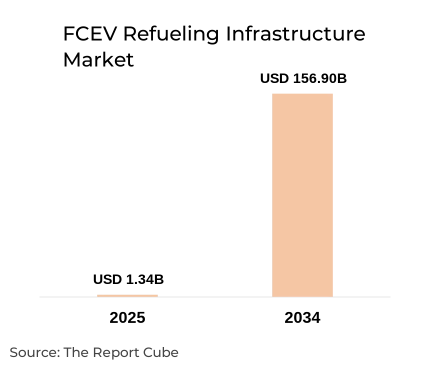
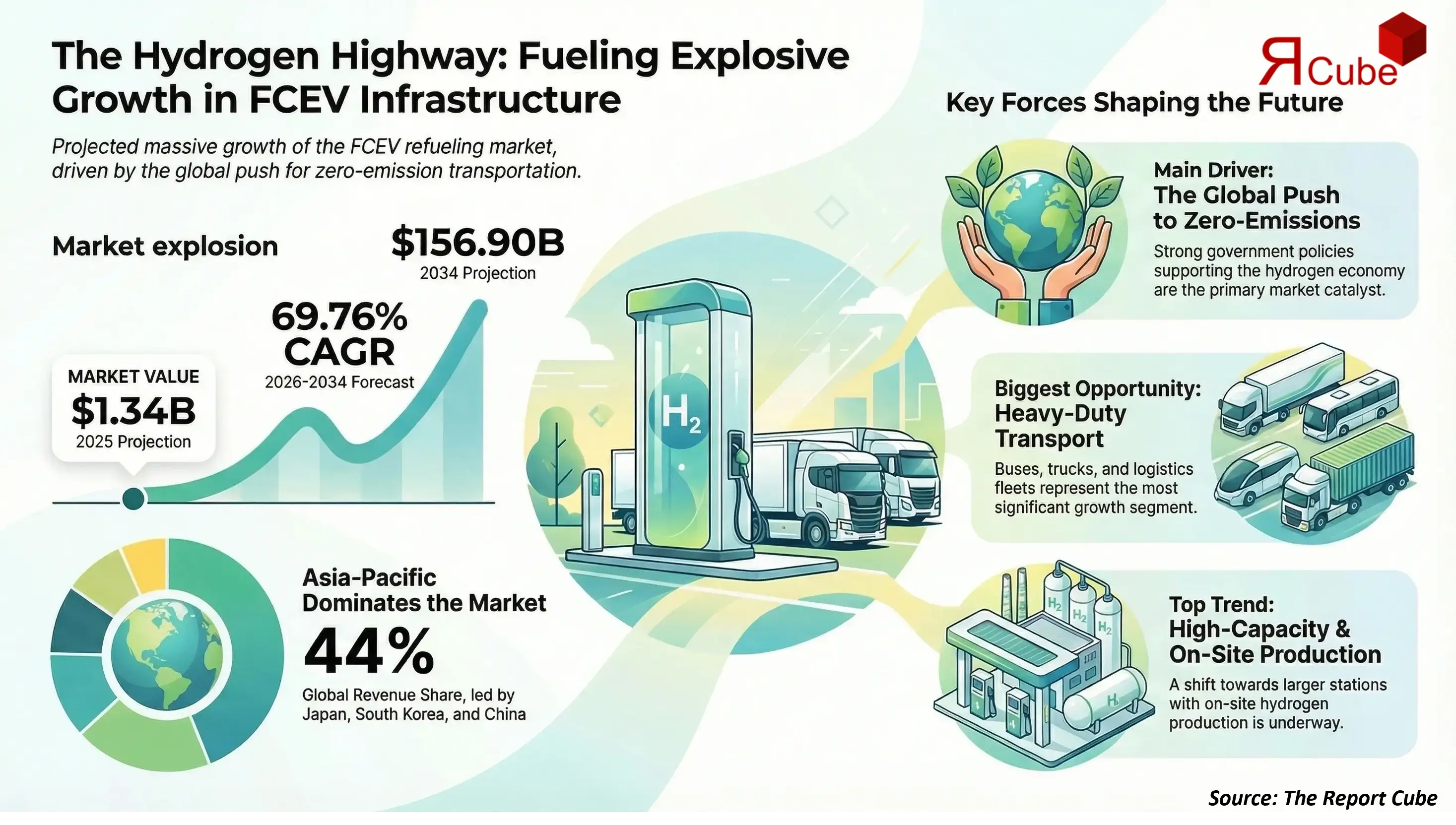
The Global FCEV Refueling Infrastructure Market is anticipated to register a CAGR of 69.76% during the forecast period 2026-2034. The market size was valued at USD 1.34 Billion in 2025 and is projected to reach USD 156.90 Billion by 2034. This extraordinary growth reflects the accelerating global push toward hydrogen-based mobility as governments and automotive manufacturers seek zero-emission alternatives for long-range, heavy-duty, and high-utilization transport applications. Fuel Cell Electric Vehicles (FCEVs) are increasingly viewed as a complementary solution to battery electric vehicles, particularly where fast refueling, long driving range, and high payload capacity are critical.
The development of FCEV refueling infrastructure is a foundational requirement for scaling hydrogen mobility ecosystems. Hydrogen refueling stations enable rapid energy replenishment comparable to conventional fueling, addressing one of the key limitations of battery-powered transport in certain use cases. As hydrogen strategies gain momentum across Europe, Asia Pacific, and North America, investments in refueling infrastructure are accelerating. Public-private partnerships, national hydrogen roadmaps, and large-scale demonstration projects are driving deployment of fixed, mobile, and on-site hydrogen refueling stations, positioning infrastructure expansion as the primary catalyst for FCEV market growth.
Global FCEV Refueling Infrastructure Market Recent Developments
- 2025: Air Liquide expanded its hydrogen refueling station network across Europe to support passenger and heavy-duty FCEVs.
- 2025: Nel and ITM Power advanced high-capacity electrolyzer-integrated refueling stations for commercial fleet applications.
Government Initiatives & Policies
- EU Hydrogen Strategy: Supports large-scale hydrogen infrastructure deployment across transport corridors.
- Japan Basic Hydrogen Strategy: Promotes nationwide hydrogen refueling networks for fuel cell vehicles.
Global FCEV Refueling Infrastructure Market Dynamics
Key Driver: Global Hydrogen Economy and Zero-Emission Mobility Push
The primary driver of the global FCEV refueling infrastructure market is the rapid emergence of the hydrogen economy and strong policy support for zero-emission mobility. Governments worldwide are identifying hydrogen as a strategic energy carrier capable of decarbonizing transport, industry, and power generation. Fuel cell vehicles, particularly in buses, trucks, and fleet operations, benefit from hydrogen’s fast refueling and long-range capabilities. As automakers expand FCEV offerings, the parallel development of refueling infrastructure becomes essential, driving substantial public and private investment into hydrogen stations.
Major Challenge: High Capital Costs and Early-Stage Utilization
A major challenge facing the FCEV refueling infrastructure market is the high capital cost associated with station development and early-stage utilization rates. Hydrogen refueling stations require significant investment in compression, storage, dispensing, and safety systems. In the early phases of deployment, low vehicle volumes can limit station utilization and economic viability. Addressing this challenge requires coordinated rollout strategies, fleet-based adoption, and policy incentives to improve utilization and reduce financial risk for infrastructure developers.
Industry Trends: Shift Toward High-Capacity and On-Site Production Stations
An important trend shaping the market is the shift toward high-capacity hydrogen refueling stations and on-site hydrogen production. As heavy-duty vehicles and commercial fleets adopt FCEVs, demand for higher throughput stations is increasing. On-site production using electrolysis reduces dependence on hydrogen transport logistics and supports integration with renewable energy sources. This trend enhances supply reliability, lowers long-term operating costs, and aligns with sustainability objectives, making high-capacity and on-site stations increasingly attractive.
Opportunity Ahead: Heavy-Duty Transport and Fleet-Based Adoption
Significant growth opportunities lie in heavy-duty transport segments such as buses, trucks, port vehicles, and logistics fleets. These applications benefit most from hydrogen’s operational advantages and centralized refueling patterns. Fleet-based adoption enables predictable demand, higher station utilization, and faster infrastructure payback. As cities and logistics operators commit to zero-emission targets, hydrogen refueling infrastructure tailored to fleet operations is expected to see rapid expansion over the forecast period.
Global FCEV Refueling Infrastructure Market Segment-wise Analysis
By Station Type:
- Fixed Hydrogen Refueling Stations
- Mobile Hydrogen Refueling Stations
- On-Site Production Stations
- Off-Site Supply Stations
Fixed hydrogen refueling stations dominate the market, accounting for approximately 48% of total revenue in 2025. These stations form the backbone of permanent hydrogen corridors in urban and intercity locations. On-site production stations are the fastest-growing segment due to reduced logistics dependency and improved sustainability. Mobile stations play a critical role in early market development, pilot projects, and remote applications, enabling flexible deployment as demand evolves.
By Pressure and Capacity:
- Low and Medium Capacity Stations
- High Capacity Stations
- Standard Pressure Stations
- High Pressure Stations
High-pressure stations represent the largest share of the market, contributing nearly 55% of total revenue in 2025, as they are essential for modern passenger and commercial FCEVs. High-capacity stations are experiencing rapid growth driven by fleet and heavy-duty vehicle adoption. Low and medium capacity stations remain relevant for early deployments and regions with lower vehicle density, supporting gradual infrastructure scaling.
Regional Projection of Global FCEV Refueling Infrastructure Industry
- North America
- Europe
- Asia Pacific
- Middle East and Africa
- South America
Asia Pacific leads the global FCEV refueling infrastructure market, accounting for approximately 44% of total revenue in 2025. Japan, South Korea, and China are investing heavily in hydrogen mobility ecosystems supported by strong government policies and domestic automotive manufacturers. Europe follows, driven by hydrogen corridor initiatives and decarbonization mandates. North America shows strong growth potential supported by state-level hydrogen programs and commercial fleet pilots. The Middle East and Africa and South America represent emerging markets linked to green hydrogen production potential.
Why Choose This Report?
- Provides a comprehensive overview of the FCEV refueling infrastructure market and hydrogen mobility trends.
- Delivers accurate, up-to-date insights into market size, segmentation, and long-term growth opportunities.
- Offers deep understanding of hydrogen station technologies and deployment models.
- Presents competitive analysis & benchmarking of leading global infrastructure providers.
- Consolidates market intelligence to support strategic planning and investment decisions.
- Supports customized segmentation and regional market assessments.
- Identifies challenges and untapped opportunities in the hydrogen transport ecosystem.
- Grounded in real-world policy frameworks, pilot projects, and infrastructure rollouts.
Table of Contents
- Introduction
- Objective of the Study
- Product and Category Definition
- Market Segmentation
- Study Variables
- Research Methodology
- Secondary Data Points
- Breakdown of Secondary Sources
- Primary Data Points
- Breakdown of Primary Interviews
- Secondary Data Points
- Executive Summary
- Market Dynamics
- Drivers
- Challenges
- Opportunity Assessment
- Recent Trends and Developments
- Regulatory and Policy Landscape
- Global FCEV Refueling Infrastructure Market Overview (2020-2034)
- Market Size, By Value (USD Billion)
- Market Share, By Station Type
- Fixed Hydrogen Refueling Stations
- Mobile Hydrogen Refueling Stations
- On Site Production Stations
- Off Site Supply Stations
- Market Share, By Pressure and Capacity
- Low and Medium Capacity Stations
- High Capacity Stations
- Standard Pressure Stations
- High Pressure Stations
- Market Share, By Hydrogen Type
- Gray Hydrogen
- Blue Hydrogen
- Green Hydrogen
- Market Share, By Application
- Passenger Fuel Cell Electric Vehicles FCEV
- Buses and Coaches
- Trucks and Heavy Commercial Vehicles
- Fleet Vehicles and Taxis
- Industrial and Logistics Applications
- Market Share, By End User
- Public and Commercial Refueling Operators
- Oil and Gas and Energy Companies
- Fleet Owners and Logistics Operators
- Government and Municipal Agencies
- Industrial and Utility End Users
- Market Share, By Deployment Model
- Standalone Hydrogen Refueling Stations
- Co Located Refueling at Existing Fuel Stations
- Depot Based and Private Refueling Facilities
- Market Share, By Region
- North America
- Europe
- Asia Pacific
- Middle East and Africa
- South America
- Market Share, By Company
- Revenue Shares
- Competitive Landscape
- North America FCEV Refueling Infrastructure Market
- Market Size, By Value (USD Billion)
- Market Share, By Station Type
- Market Share, By Pressure and Capacity
- Market Share, By Hydrogen Type
- Market Share, By Application
- Market Share, By End User
- Market Share, By Deployment Model
- Market Share, By Country
- United States
- Canada
- Mexico
- Europe FCEV Refueling Infrastructure Market
- Market Size, By Value (USD Billion)
- Market Share, By Station Type
- Market Share, By Pressure and Capacity
- Market Share, By Hydrogen Type
- Market Share, By Application
- Market Share, By End User
- Market Share, By Deployment Model
- Market Share, By Country
- Germany
- United Kingdom
- France
- Italy
- Spain
- Northern and Nordic Countries
- Rest of Europe
- Asia Pacific FCEV Refueling Infrastructure Market
- Market Size, By Value (USD Billion)
- Market Share, By Station Type
- Market Share, By Pressure and Capacity
- Market Share, By Hydrogen Type
- Market Share, By Application
- Market Share, By End User
- Market Share, By Deployment Model
- Market Share, By Country
- China
- Japan
- South Korea
- India
- Australia
- Rest of Asia Pacific
- Middle East and Africa FCEV Refueling Infrastructure Market
- Market Size, By Value (USD Billion)
- Market Share, By Station Type
- Market Share, By Pressure and Capacity
- Market Share, By Hydrogen Type
- Market Share, By Application
- Market Share, By End User
- Market Share, By Deployment Model
- Market Share, By Country
- Saudi Arabia
- United Arab Emirates
- South Africa
- Rest of Middle East and Africa
- South America FCEV Refueling Infrastructure Market
- Market Size, By Value (USD Billion)
- Market Share, By Station Type
- Market Share, By Pressure and Capacity
- Market Share, By Hydrogen Type
- Market Share, By Application
- Market Share, By End User
- Market Share, By Deployment Model
- Market Share, By Country
- Brazil
- Argentina
- Rest of South America
- Competitive Outlook and Company Profiles
- Air Liquide
- Company Overview
- Refueling Infrastructure Portfolio
- Strategic Alliances and Partnerships
- Recent Developments
- Linde
- Company Overview
- Refueling Infrastructure Portfolio
- Strategic Alliances and Partnerships
- Recent Developments
- Air Products and Chemicals
- Company Overview
- Refueling Infrastructure Portfolio
- Strategic Alliances and Partnerships
- Recent Developments
- Nel
- Company Overview
- Refueling Infrastructure Portfolio
- Strategic Alliances and Partnerships
- Recent Developments
- ITM Power
- Company Overview
- Refueling Infrastructure Portfolio
- Strategic Alliances and Partnerships
- Recent Developments
- McPhy Energy
- Company Overview
- Refueling Infrastructure Portfolio
- Strategic Alliances and Partnerships
- Recent Developments
- Shell
- Company Overview
- Hydrogen Refueling Network and Projects
- Strategic Alliances and Partnerships
- Recent Developments
- TotalEnergies
- Company Overview
- Hydrogen Refueling Network and Projects
- Strategic Alliances and Partnerships
- Recent Developments
- Hyundai Motor Company
- Company Overview
- Hydrogen Mobility and Infrastructure Partnerships
- Strategic Alliances and Partnerships
- Recent Developments
- Toyota Motor Corporation
- Company Overview
- Hydrogen Mobility and Infrastructure Partnerships
- Strategic Alliances and Partnerships
- Recent Developments
- Others
- Air Liquide
- Contact Us and Disclaimer
Top Key Players & Market Share Outlook
- Air Liquide
- Linde
- Air Products and Chemicals
- Nel
- ITM Power
- McPhy Energy
- Shell
- TotalEnergies
- Hyundai Motor Company
- Toyota Motor Corporation
- Others
Frequently Asked Questions






