



Build Your Custom Market Intelligence Report
Customize Your ReportAsia Pacific General Aviation Market Insights & Analysis
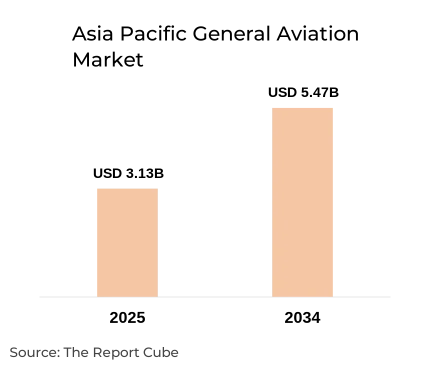
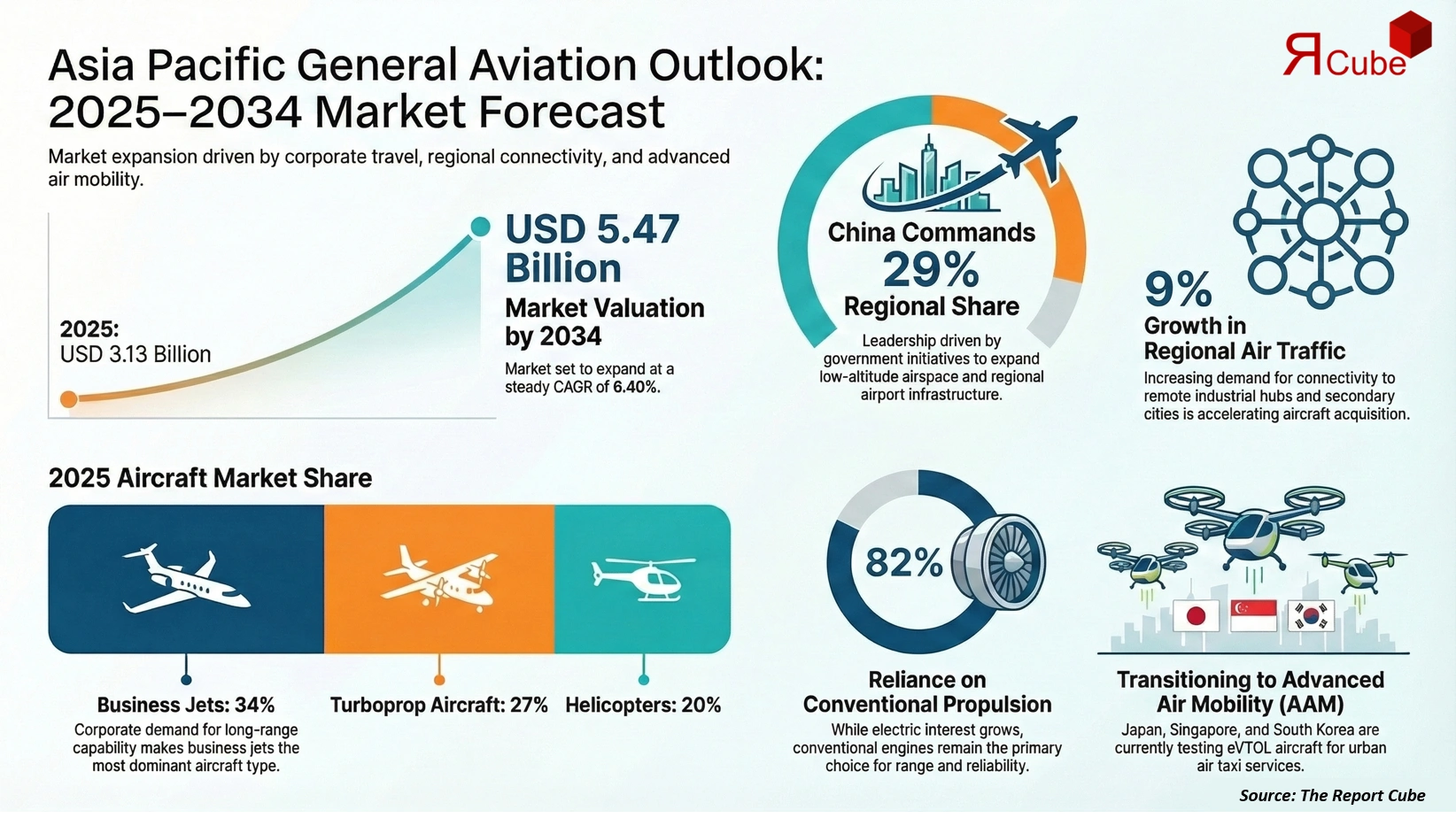
The Asia Pacific General Aviation Market is anticipated to register a CAGR of 6.40% during the forecast period. The market size was valued at USD 3.13 billion in 2025 and is projected to reach USD 5.47 billion by 2034. This robust growth trajectory reflects the region’s expanding business travel needs, rising private aviation adoption, and increasing use of general aviation for medical, tourism, and emergency services.
The Asia Pacific region is witnessing a gradual shift in aviation demand patterns, where flexibility, time efficiency, and regional connectivity are becoming increasingly important. General aviation aircraft are gaining traction as governments and private operators invest in airport infrastructure, air mobility ecosystems, and pilot training programs. Countries such as China, India, and Australia are actively promoting regional air connectivity, which is accelerating demand for business jets, turboprops, and helicopters.
Moreover, rising high-net-worth individuals, corporate expansion into tier-2 and tier-3 cities, and growing interest in advanced air mobility solutions are reshaping the competitive landscape. The entry of electric and hybrid aircraft concepts is also strengthening long-term growth prospects. As a result, the Asia Pacific General Aviation Market is evolving into a dynamic and strategically important segment of the global aviation industry.
Asia Pacific General Aviation Market Recent Developments
- 2025: Embraer Executive Jets expanded its Asia Pacific service network to support growing business jet operations.
- 2025: Textron Aviation announced increased aircraft deliveries to Asia Pacific operators amid rising regional demand.
Government Initiatives & Policies
- China General Aviation Development Plan: Focuses on expanding low-altitude airspace access and regional airport infrastructure.
- India UDAN & General Aviation Policy: Supports regional connectivity and private aircraft operations.
Asia Pacific General Aviation Market Dynamics
Key Driver: Rising Demand for Business and Regional Air Connectivity
The primary driver of the Asia Pacific General Aviation Market is the rising demand for business and regional air connectivity. Rapid economic growth across emerging economies has increased the need for efficient corporate travel solutions, especially in regions with limited commercial airline coverage. Business jets and turboprop aircraft enable executives to access remote industrial hubs, mining regions, and secondary cities without relying on congested commercial airports. Additionally, governments are encouraging regional aviation to stimulate local economies, which directly supports general aviation usage. In 2024, regional air traffic in Asia Pacific grew by over 9%, highlighting strong underlying demand. This sustained focus on connectivity continues to drive aircraft acquisitions and fleet expansion across the region.
Book your FREE 30-minute expert consultation today
Contact UsIndustry Trends: Adoption of Advanced Air Mobility and Sustainable Aviation
A major trend shaping the market is the growing interest in advanced air mobility (AAM) and sustainable aviation technologies. Several Asia Pacific countries are actively testing eVTOL and hybrid-elctreic aircraft for urban air mobility, air taxi services, and emergency response. Governments in Singapore, Japan, and South Korea are investing in pilot programs to integrate AAM into urban transport systems. Alongside this, operators are increasingly prioritizing fuel-efficient turboprops and next-generation business jets to reduce operating costs and emissions. This dual focus on innovation and sustainability is influencing procurement strategies and encouraging manufacturers to localize product offerings for Asia Pacific markets.
Major Challenge: Infrastructure and Regulatory Fragmentation
Despite strong growth potential, infrastructure gaps and regulatory fragmentation pose significant challenges to the Asia Pacific General Aviation Market. Many countries lack sufficient general aviation airports, maintenance facilities, and trained personnel, limiting operational scalability. Regulatory frameworks also vary widely across the region, increasing compliance complexity for cross-border operations. In emerging markets, lengthy approval processes and airspace restrictions can delay aircraft utilization and reduce operational efficiency. These constraints particularly affect small operators and new entrants, potentially slowing short-term growth despite favorable demand fundamentals.
Opportunity: Expansion of Medical, Tourism, and Charter Aviation
The expanding use of general aviation for medical evacuation, tourism, and charter services presents a major opportunity for the market. Air ambulance services are growing rapidly in countries with vast geographies and limited ground infrastructure, such as Australia and Indonesia. Similarly, helicopter and turboprop operations are increasingly used for tourism in island destinations and remote natural attractions. Charter aviation is also gaining popularity among high-net-worth individuals seeking flexible travel options. These diversified applications create resilient revenue streams and reduce dependence on traditional business aviation demand.
Asia Pacific General Aviation Market Segment-wise Analysis
By Aircraft Type:
- Business Jets
- Turboprop Aircraft
- Piston Aircraft
- Helicopters
- eVTOL / AAM
Business Jets dominate the aircraft type segment, accounting for nearly 34% of the market share in 2025. Their leadership is supported by strong demand from corporate users and charter operators seeking speed and long-range capability. Turboprop Aircraft follow closely, holding around 27% share, due to their cost efficiency and suitability for short regional routes. Helicopters account for approximately 20% of demand, driven by medical, offshore, and tourism applications. While eVTOL and AAM currently represent a small share, they are expected to grow rapidly post-2030 as regulatory approvals and infrastructure mature, positioning them as a key future growth segment.
By Propulsion Type:
- Conventional Engines
- Hybrid Electric
- Fully Electric
Conventional Engines currently dominate the propulsion segment with over 82% market share, reflecting their proven reliability and established infrastructure. Most business jets, turboprops, and helicopters in Asia Pacific continue to rely on conventional propulsion systems due to range and payload requirements. However, Hybrid Electric aircraft are gaining momentum, particularly for short-haul and training applications, supported by government sustainability initiatives. Fully Electric aircraft remain in the early adoption phase but are attracting strong interest for urban and regional mobility. Over the forecast period, gradual electrification is expected to reshape fleet composition and investment priorities.
Regional Projection of Asia Pacific General Aviation Industry
- China
- India
- Japan
- Australia
- South Korea
- Singapore
- Rest of Asia Pacific
China leads the Asia Pacific General Aviation Market, accounting for approximately 29% of total regional revenue. Strong government support for general aviation development, expanding low-altitude airspace access, and rising business aviation demand underpin this leadership. Australia follows, supported by extensive use of general aviation for medical, charter, and remote connectivity services. India is emerging as a high-growth market due to policy reforms and rising private aircraft adoption. Japan, South Korea, and Singapore are focusing on advanced air mobility and premium business aviation, collectively strengthening the region’s long-term growth outlook.
Need insights for a specific region within this market?
Request Regional DataWhy Choose This Report?
- Provides a comprehensive overview of the overall market analysis, encompassing key trends, consumer behavior analysis, and risk assessment to support strategic decision-making.
- Provides accurate, up-to-date insights into market size, segmentation, and emerging opportunities, helping to minimize risk & capitalizing on growth.
- Gives deep understanding of target audience preferences, investment habits, and communication channels for enhanced product development & marketing effectiveness.
- Delivers competitive analysis & benchmarking, uncovering the strengths & weaknesses of market competitors to guide strategies.
- Consolidate comprehensive market intelligence, reducing reasoning & streamlining research efforts.
- Facilitates customized market segmentation & risk mitigation strategies, fine-tuned to the business objectives.
- Aids in identifying both market challenges & untapped opportunities within the industry to drive long-term business growth.
- Provides valuable information based on actual customer data & search trends.
Table of Contents
- Introduction
- Objective of the Study
- Product and Category Definition
- Market Segmentation
- Study Variables
- Research Methodology
- Secondary Data Points
- Breakdown of Secondary Sources
- Primary Data Points
- Breakdown of Primary Interviews
- Secondary Data Points
- Executive Summary
- Market Dynamics
- Drivers
- Challenges
- Opportunity Assessment
- Recent Trends and Developments
- Regulatory and Policy Landscape
- Asia Pacific General Aviation Market Overview (2020-2034)
- Market Size, By Value (USD Billion)
- Market Share, By Aircraft Type
- Business Jets
- Turboprop Aircraft
- Piston Aircraft
- Helicopters
- eVTOL / AAM
- Market Share, By Propulsion Type
- Conventional Engines
- Hybrid Electric
- Fully Electric
- Market Share, By Ownership Model
- Private Ownership
- Corporate Fleets
- Charter Operators
- Fractional Ownership
- Market Share, By End User
- Business Transport
- Personal Flying
- Training Schools
- EMS & Rescue
- Aerial Services
- Market Share, By Country
- China
- India
- Japan
- Australia
- South Korea
- Singapore
- Rest of Asia Pacific
- Market Share, By Company
- Revenue Shares & Analysis
- Competition Characteristics
- China General Aviation Market
- Market Size, By Value (USD Billion)
- Market Share, By Aircraft Type
- Market Share, By Propulsion Type
- Market Share, By Ownership Model
- Market Share, By End User
- India General Aviation Market
- Market Size, By Value (USD Billion)
- Market Share, By Aircraft Type
- Market Share, By Propulsion Type
- Market Share, By Ownership Model
- Market Share, By End User
- Japan General Aviation Market
- Market Size, By Value (USD Billion)
- Market Share, By Aircraft Type
- Market Share, By Propulsion Type
- Market Share, By Ownership Model
- Market Share, By End User
- Australia General Aviation Market
- Market Size, By Value (USD Billion)
- Market Share, By Aircraft Type
- Market Share, By Propulsion Type
- Market Share, By Ownership Model
- Market Share, By End User
- South Korea General Aviation Market
- Market Size, By Value (USD Billion)
- Market Share, By Aircraft Type
- Market Share, By Propulsion Type
- Market Share, By Ownership Model
- Market Share, By End User
- Competitive Outlook and Company Profiles
- Textron Aviation
- Company Overview
- Product Portfolio
- Strategic Alliances/Partnerships
- Recent Developments
- Bombardier Aviation
- Company Overview
- Product Portfolio
- Strategic Alliances/Partnerships
- Recent Developments
- Gulfstream Aerospace
- Company Overview
- Product Portfolio
- Strategic Alliances/Partnerships
- Recent Developments
- Embraer Executive Jets
- Company Overview
- Product Portfolio
- Strategic Alliances/Partnerships
- Recent Developments
- Dassault Aviation
- Company Overview
- Product Portfolio
- Strategic Alliances/Partnerships
- Recent Developments
- Pilatus Aircraft
- Company Overview
- Product Portfolio
- Strategic Alliances/Partnerships
- Recent Developments
- Cirrus Aircraft
- Company Overview
- Product Portfolio
- Strategic Alliances/Partnerships
- Recent Developments
- Diamond Aircraft
- Company Overview
- Product Portfolio
- Strategic Alliances/Partnerships
- Recent Developments
- Piper Aircraft
- Company Overview
- Product Portfolio
- Strategic Alliances/Partnerships
- Recent Developments
- Honda Aircraft
- Company Overview
- Product Portfolio
- Strategic Alliances/Partnerships
- Recent Developments
- Others
- Textron Aviation
- Contact Us and Disclaimer
Top Key Players & Market Share Outlook
- Textron Aviation
- Bombardier Aviation
- Gulfstream Aerospace
- Embraer Executive Jets
- Dassault Aviation
- Pilatus Aircraft
- Cirrus Aircraft
- Diamond Aircraft
- Piper Aircraft
- Honda Aircraft
- Others
Frequently Asked Questions