



Build Your Custom Market Intelligence Report
Customize Your ReportKey Highlights
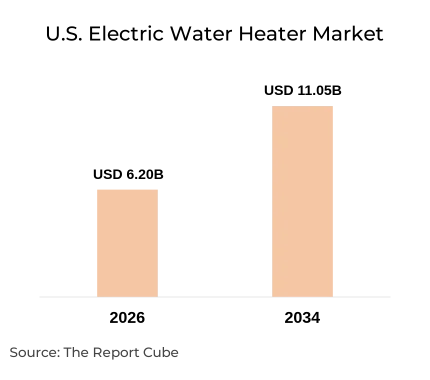
- The U.S. Electric Water Heater Market was valued at USD 6.20 billion in 2026, supported by replacement demand and commercial hot-water requirements.
- Market size is forecast to reach USD 11.06 billion by 2034, expanding at a CAGR of 7.50% during 2026-2034.
- By product type, storage water heaters lead the market, while non-storage systems are positioned for faster expansion in compact and point-of-use settings.
- By application, commercial users lead demand, driven by hotels, hospitals, restaurants, educational institutions and offices.
- Regional share data was not supplied, Northeast, Midwest, South and West are covered qualitatively without assigned shares.
- Federal efficiency standards for consumer water heaters, with compliance required from May 6, 2029, are the most significant regulatory driver and favor heat pump technology.
- Competition is led by established manufacturers including A. O. Smith, Rheem, Bradford White and GE Appliances, supported by wholesale distribution networks.
Market Outlook
The U.S. Electric Water Heater Market covers equipment that uses electricity to heat water for homes, businesses and institutions, including storage, tankless and heat pump systems. Hot water is a basic requirement for sanitation, hygiene and food preparation, so demand follows housing stock, commercial building activity and equipment replacement cycles rather than short-term consumer trends.
Demand in the U.S. Electric Water Heater Industry comes from households, multifamily properties, hotels, hospitals, restaurants, schools, offices and light industrial facilities. Replacement of failed or aging units creates recurring purchases, while electrification initiatives and efficiency regulation are shifting interest toward heat pump models. Wholesale plumbing distribution remains central because contractors typically select and install the equipment.
The market is valued at USD 6.20 billion in 2026 and is forecast to reach USD 11.06 billion by 2034 at a CAGR of 7.50%. Growth is expected to rest on replacement demand, commercial hot-water needs and efficiency upgrades. Manufacturers with broad portfolios, heat pump capability and strong contractor channels are best placed to capture expansion.
Government Regulations
The U.S. Department of Energy regulates water heater efficiency under the Energy Policy and Conservation Act. Its final rule on energy conservation standards for consumer water heaters, published in the Federal Register on May 6, 2024, took effect on July 5, 2024, with compliance required on and after May 6, 2029. DOE states that electric storage models above 35 gallons will in practice require heat pump technology, and projects that more than half of newly manufactured electric storage water heaters will use it, compared with about 3% at the time of the rule. Commercial water heating equipment is covered by separate DOE standards. Manufacturers must redesign product lines, qualify new components and certify compliance, which raises development costs but favors firms already producing heat pump units.
U.S. Electric Water Heater Market Dynamics
The U.S. Electric Water Heater Market is shaped by replacement cycles, efficiency regulation, building electrification and the cost of adopting heat pump technology. Commercial and institutional buyers value reliability and capacity, while residential buyers weigh purchase price, installation requirements and operating costs against gas alternatives.
|
Factor |
Type |
Specific Impact on Market |
Magnitude |
|---|---|---|---|
|
Replacement of aging units |
Driver |
Creates recurring demand across residential and commercial installations |
High |
|
Federal efficiency standards |
Driver |
Pushes manufacturers and buyers toward heat pump models from 2029 |
High |
|
Higher heat pump installed cost |
Challenge |
Upfront cost, space and electrical needs may slow adoption |
Medium-High |
|
Competition from gas and other fuels |
Challenge |
Fuel price and infrastructure differences affect electric share |
Medium |
|
Commercial hot-water demand |
Opportunity |
Hotels, hospitals and institutions need high-capacity systems |
Medium-High |
|
Heat pump product expansion |
Trend |
Wider portfolios and connected controls broaden the addressable base |
High |
Growth Drivers: Efficiency Standards and Replacement Demand
DOE’s amended consumer water heater standards require compliance from May 6, 2029, and the Department expects them to move more than half of new electric storage water heaters to heat pump technology. Because most purchases replace failed units, the rule reshapes demand at the point of replacement. Manufacturers and distributors that prepare compliant portfolios early can secure contractor relationships and capture the shift toward higher-value, more efficient products across the forecast period.
Market Opportunities: Heat Pump Water Heater Portfolio Expansion
Heat pump water heaters remain a small share of electric storage sales, which leaves wide room for adoption as standards approach. Manufacturers can address installation barriers through compact designs, lower-voltage models, connected controls and contractor training. DOE has noted newer product formats such as 120-volt heat pump units that suit existing electrical setups. Companies that reduce installation complexity and cost can convert replacement purchases into heat pump sales and improve revenue per unit.
Industry Challenges: Installed Cost and Fuel Competition
Heat pump models usually cost more to buy and install than conventional electric resistance units, and they need adequate space, ventilation and suitable electrical capacity. Price-sensitive households and older buildings may delay upgrades or repair existing units. Electric systems also compete with natural gas, propane and solar systems, with regional energy prices and infrastructure affecting choices. These factors can slow the shift to higher-efficiency electric equipment, particularly before 2029 compliance.
Need Specific Data, Let’s Customize the Report for You
Request CustomizationMarket Trends: Shift Toward Heat Pump and Connected Equipment
Product development is moving toward heat pump water heaters, which DOE describes as two to three times more efficient than conventional electric resistance models. ENERGY STAR unit shipment data reported approximately 190,000 heat pump water heater shipments in 2023, indicating growing but still limited volumes. Manufacturers are also adding connected controls and demand-response features, positioning electric water heating as part of wider building energy management rather than a standalone appliance.
U.S. Electric Water Heater Market Segment Analysis
The U.S. Electric Water Heater Market is segmented by product type, technology, capacity, application, distribution channel and end user, reflecting how equipment is built, sized, sold and used across residential and commercial buildings.
By Product Type
- Storage
- Non-storage
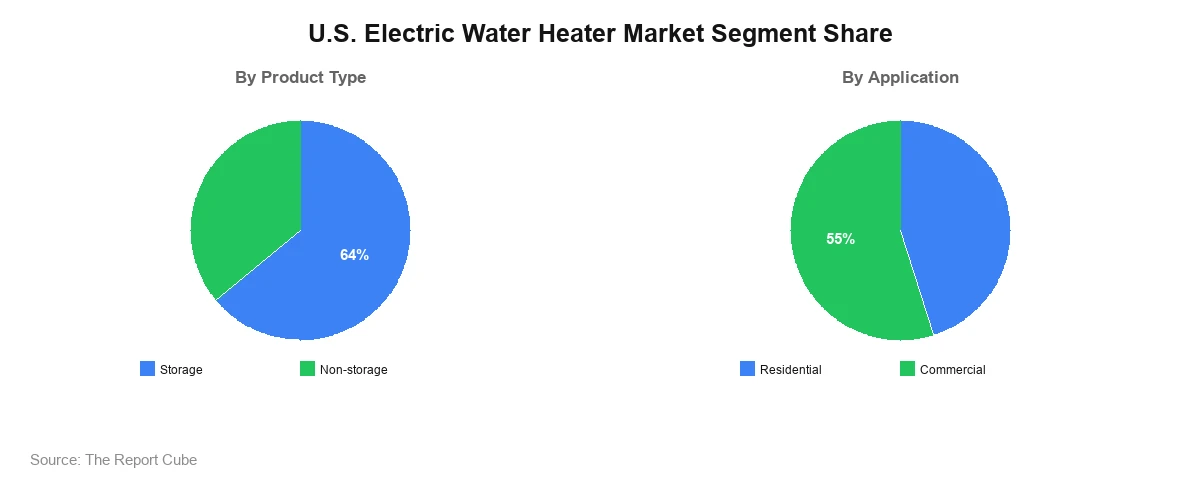
Storage water heaters lead the product category, holding approximately 64% of revenue in the base period. They retain heated water in insulated tanks, suit conventional household and commercial layouts, and are the main replacement product handled by plumbing contractors. Non-storage systems are the second-leading segment, offering on-demand heating, compact installation and point-of-use convenience for smaller homes, apartments and specialized commercial uses. Demand for non-storage equipment depends on electrical capacity, space limits and installer preference.'
By Application
- Residential
- Commercial
Commercial applications lead the market, accounting for approximately 55% of revenue in the base period. Hotels, hospitals, restaurants, schools, offices and laundries need continuous, higher-capacity hot water, which supports larger equipment and service contracts. Residential applications are the second-leading segment, driven by replacement of failed units in houses, apartments and condominiums, and by interest in efficient heat pump models ahead of federal standards.
U.S. Electric Water Heater Market Regional Analysis
The U.S. Electric Water Heater Market varies by region according to climate, housing type, construction activity, electricity prices and state electrification policy. Regional revenue shares were not supplied and are not available from approved government sources, so none are assigned.
|
Region |
Key Growth Factors |
Industry Trends |
|---|---|---|
|
Northeast |
Multifamily housing and residential replacement |
Interest in efficient and heat pump equipment |
|
Midwest |
Residential storage replacement demand |
Replacement-led purchasing through contractors |
|
South |
Residential construction and commercial establishments |
Demand from hospitality and healthcare facilities |
|
West |
Electrification initiatives and efficiency policy |
Adoption of energy-efficient technologies |
Competitive Landscape
The U.S. Electric Water Heater Market includes established water heating manufacturers, diversified appliance and building-technology groups, and tankless specialists. Competition centers on product efficiency, heat pump capability, distribution reach, brand strength with contractors and after-sales support. The table summarizes companies by general capability and does not represent market share or ranking.
|
Company |
Competitive Strength |
Primary Segment Served |
|---|---|---|
|
A. O. Smith Corporation |
Broad portfolio and wholesale distribution network |
Residential and commercial |
|
Rheem Manufacturing Company |
Storage and hybrid heat pump portfolio |
Residential and commercial |
|
Bradford White Corporation |
Professional plumbing distribution |
Residential and commercial |
|
GE Appliances |
Consumer brand and retail access |
Residential |
|
Bosch Thermotechnology |
Heating technology and home comfort portfolio |
Residential and commercial |
|
Stiebel Eltron |
Electric tankless specialization |
Residential and commercial |
|
Rinnai America Corporation |
Tankless water heating expertise |
Residential and commercial |
|
Hubbell Electric Heater Company |
High-capacity commercial electric heating |
Commercial and industrial |
- O. Smith Corporation: A. O. Smith is a Milwaukee, Wisconsin-based water technology company supplying residential and commercial water heaters under the A. O. Smith, State and Lochinvar brands. Its portfolio spans electric storage, tankless and heat pump products. Its competitive position rests on an extensive wholesale plumbing distributor network and strong exposure to replacement demand in North America.
- Rheem Manufacturing Company: Rheem is a long-established U.S. manufacturer of water heating and HVAC equipment with residential and commercial product lines. Its portfolio includes electric storage water heaters and hybrid electric heat pump models. Its competitive position relies on broad contractor and retail availability and a product range that aligns with the shift toward higher-efficiency electric water heating.
Recent Developments and Updates
- May 2025: The U.S. Department of Energy withdrew its December 2024 final rule on gas-fired instantaneous water heater standards. The withdrawal leaves the May 2024 consumer water heater standards, which favor electric heat pump storage models, as the principal efficiency driver for the electric segment.
U.S. Electric Water Heater Market Future Outlook
The U.S. Electric Water Heater Market Forecast indicates growth from USD 6.20 billion in 2026 to USD 11.06 billion by 2034 at a CAGR of 7.50%. Replacement demand, commercial hot-water needs and the approach of federal efficiency compliance are expected to sustain volumes, while heat pump models, connected controls and higher-capacity commercial products add value per unit and widen the addressable customer base.
Competitive activity is expected to center on heat pump capacity, installation-friendly designs, contractor training and distribution depth. Risks include higher installed costs, fuel price differences, housing and construction cycles, and regulatory changes. Companies with compliant portfolios, efficient manufacturing and established wholesale relationships should hold advantage as the market moves toward the 2029 standards and the 2034 forecast horizon.
U.S. Electric Water Heater Market Report Coverage
This U.S. Electric Water Heater Market Report summarizes the market valuation, forecast, segmentation, regional framework and competitive environment for 2026-2034.
|
Parameter |
Details |
|---|---|
|
Market Name |
U.S. Electric Water Heater Market |
|
Market Size (Base Year) |
USD 6.20 billion (2026) |
|
Market Size (Forecast Year) |
USD 11.06 billion (2034) |
|
CAGR |
7.50% |
|
Base Year |
2026 |
|
Historical Period |
2021-2025 |
|
Forecast Period |
2026-2034 |
|
Geographic Scope |
United States |
|
Segmentation |
By Product Type, By Technology, By Capacity, By Application, By Distribution Channel, By End User |
|
Regions Covered |
Northeast, Midwest, South, West |
|
Key Companies |
A. O. Smith Corporation, Rheem Manufacturing Company, Bradford White Corporation, GE Appliances, Bosch Thermotechnology, Stiebel Eltron, Rinnai America Corporation, Hubbell Electric Heater Company |
|
Customization |
Available as per requirement |
Why Choose This U.S. Electric Water Heater Market Report?
- Presents the 2026 market size, 2034 forecast and 7.50% CAGR for the U.S. Electric Water Heater Market.
- Segments the market by product type, technology, capacity, application, distribution channel and end user.
- Reviews drivers, opportunities, challenges and trends, including heat pump adoption and replacement demand.
- Provides regional context across the Northeast, Midwest, South and West, with unavailable shares identified.
- Profiles leading manufacturers by capability and primary segment served.
- Highlights opportunities in heat pump portfolios, commercial hot-water systems and connected controls.
- Supports manufacturers, distributors and investors in product, channel and compliance planning.
Table of Contents
- Introduction
- Objective of the Study
- Product Definition
- Market Segmentation
- Study Variables
- Research Methodology
- Secondary Data Points
- Companies Interviewed
- Primary Data Points
- Breakdown of Primary Interviews
- Secondary Data Points
- Executive Summary
- Market Dynamics
- Drivers
- Challenges
- Opportunity Assessment
- Recent Trends and Developments
- Policy and Regulatory Landscape
- U.S. Electric Water Heater Market Overview and Forecast Analysis (2021-2034)
- Market Size, By Value, By Growth Rate (CAGR/USD Billions)
- Demand – Supply Trends
- Market Share, By Product Type
- Storage
- Non-Storage
- Market Share, By Technology
- Electric Resistance Storage
- Heat Pump Storage
- Instantaneous / Tankless Electric
- Market Share, By Capacity
- Below 30 Gallons
- 30–50 Gallons
- 51–80 Gallons
- Above 80 Gallons
- Market Share, By Application
- Residential
- Commercial
- Market Share, By Distribution Channel
- Wholesale
- Retail
- Online
- Direct Sales
- Market Share, By End User
- Households
- Hotels
- Hospitals
- Restaurants
- Educational Institutions
- Offices
- Industrial & Other Commercial
- Market Share, By Region
- Northeast
- Midwest
- South
- West
- Market Share, By Competitors
- Competition Characteristics
- Revenue Shares
- Storage U.S. Electric Water Heater Market Overview, 2021-2034F
- By Value (USD Million)
- By Technology – Market Size & Forecast 2021-2034, USD Million
- Electric Resistance Storage
- Heat Pump Storage
- Instantaneous / Tankless Electric
- Non-Storage U.S. Electric Water Heater Market Overview, 2021-2034F
- By Value (USD Million)
- By Technology – Market Size & Forecast 2021-2034, USD Million
- Electric Resistance Storage
- Heat Pump Storage
- Instantaneous / Tankless Electric
- Competitive Outlook (Company Profile – Partial List)
- A.O. Smith Corporation
- Company Overview
- Business Segments
- Strategic Alliances/Partnerships
- Recent Developments
- Rheem Manufacturing Company
- Company Overview
- Business Segments
- Strategic Alliances/Partnerships
- Recent Developments
- Bradford White Corporation
- Company Overview
- Business Segments
- Strategic Alliances/Partnerships
- Recent Developments
- GE Appliances
- Company Overview
- Business Segments
- Strategic Alliances/Partnerships
- Recent Developments
- Bosch Thermotechnology
- Company Overview
- Business Segments
- Strategic Alliances/Partnerships
- Recent Developments
- Stiebel Eltron
- Company Overview
- Business Segments
- Strategic Alliances/Partnerships
- Recent Developments
- Rinnai America Corporation
- Company Overview
- Business Segments
- Strategic Alliances/Partnerships
- Recent Developments
- Hubbell Electric Heater Company
- Company Overview
- Business Segments
- Strategic Alliances/Partnerships
- Recent Developments
- Midea Group
- Company Overview
- Business Segments
- Strategic Alliances/Partnerships
- Recent Developments
- Others
- A.O. Smith Corporation
- Contact Us & Disclaimer
Top Key Players & Market Share Outlook
- A.O. Smith Corporation
- Rheem Manufacturing Company
- Bradford White Corporation
- GE Appliances
- Bosch Thermotechnology
- Stiebel Eltron
- Rinnai America Corporation
- Hubbell Electric Heater Company
- Midea Group
- Others
Frequently Asked Questions