


Build Your Custom Market Intelligence Report
Customize Your ReportKey Takeaways
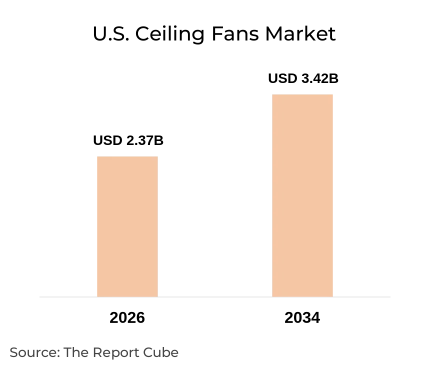
- U.S. Ceiling Fans Market is valued at USD 2.37 billion in 2026.
- The market is projected to reach USD 3.42 billion by 2034 at a CAGR of 4.70%.
- Standard ceiling fans lead the type segment with an estimated 45% share in 2026.
- Residential applications lead the end-use segment with an estimated 68% share in 2026.
- West leads regionally with an estimated 28% share; the fastest-growing end-use segment requires validation.
- Hunter Fan Company, Minka Aire, Emerson Electric Co., Westinghouse Lighting Corporation and Fanimation are key players.
- Efficiency-certified models are the leading technology theme across product development.
Market Overview
A ceiling fan is a mounted electric fan that circulates indoor air through rotating blades, improving perceived comfort and supporting ventilation. Products are installed in homes, offices, retail spaces, hospitality venues and industrial facilities, and differ by blade material, motor design, mounting method, lighting integration and control features.
The U.S. Ceiling Fans Market Analysis shows demand linked to construction, replacement projects and efficient cooling. According to the U.S. Census Bureau, private residential construction spending reached USD 882.3 billion in August 2026, while private nonresidential spending reached USD 773.0 billion, indicating potential installation activity.
Households and commercial operators purchase ceiling fans for air circulation, reduced cooling reliance and integrated lighting. Efficiency certification, quieter motors and smart controls shape product selection. The U.S. Ceiling Fans Market is valued at USD 2.37 billion in 2026 and is projected to grow at a CAGR of 4.70% during 2026–2034.
U.S. Ceiling Fans Market Dynamics
The U.S. ceiling fans market is influenced by residential and nonresidential construction, demand for energy-efficient cooling, product performance and installation requirements. Government sources describe efficiency, fan use and construction activity, but they do not independently establish the supplied market size or CAGR. Magnitude ratings below are qualitative.
|
Factor |
Type |
Specific Impact on Market |
Magnitude |
|---|---|---|---|
|
Residential and nonresidential construction activity |
Driver |
Creates installation and replacement points for ceiling fans |
Medium–High |
|
Energy-efficient cooling solutions |
Driver |
ENERGY STAR certified fans can be up to 44% more efficient than conventional fans |
Medium–High |
|
Efficient and certified fan models |
Opportunity |
Supports product differentiation through motor and blade design |
Medium |
|
New construction and renovation channels |
Opportunity |
Partnerships with builders, contractors and electricians reach installation points |
Medium |
|
Installation and building constraints |
Challenge |
Ceiling height, blade clearance and room layout limit product suitability |
Medium |
|
Difficulty comparing energy performance |
Challenge |
Inconsistent performance information complicates efficiency evaluation |
Medium |
|
Emphasis on measured fan efficiency |
Trend |
Airflow-per-watt criteria give a technical basis for comparing products |
Medium |
U.S. Ceiling Fans Market Growth Drivers
Construction and building improvement activity creates installation points for ceiling fans. According to the U.S. Census Bureau, private residential construction spending reached USD 882.3 billion and private nonresidential spending reached USD 773.0 billion at seasonally adjusted annual rates in August 2026. These figures are not fan-specific, so they indicate potential demand rather than measured sales.
Efficiency criteria also influence replacement decisions, and the U.S. Ceiling Fans Market Growth outlook reflects this link. ENERGY STAR states that certified ceiling fans can be up to 44% more efficient than conventional fans, giving households and commercial operators a documented basis for upgrading older units, although the effect on sales remains unquantified.
U.S. Ceiling Fans Market Opportunities
Efficient fan design offers manufacturers a route to product differentiation. ENERGY STAR certification relies on defined airflow and efficiency criteria, so efficient motors and optimized blade designs can support clearer positioning, provided performance claims rest on product-specific test results. Supplied evidence does not quantify the resulting demand.
New construction and renovation projects present a channel opportunity. Builders, contractors, electricians and renovation specialists influence product selection at installation and replacement points, allowing manufacturers and distributors to evaluate partnerships. Census construction spending signals potential channel activity, but it is not a direct estimate of ceiling fan demand.
U.S. Ceiling Fans Industry Challenges
Installation conditions restrict where particular products can be used. ENERGY STAR criteria distinguish standard and hugger ceiling fans by clearance and efficiency requirements, so ceiling height, blade clearance and room layout affect product suitability. These factors add installation considerations for retailers, electricians and households selecting between fan types.
Comparing energy performance can also be difficult. DOE and ENERGY STAR assess ceiling fans using airflow and efficiency criteria, including airflow per watt, yet households comparing products without consistent performance information may struggle to evaluate operating efficiency and long-term energy use, which complicates positioning for manufacturers of non-certified models.
Need Specific Data, Let’s Customize the Report for You
Request CustomizationU.S. Ceiling Fans Market Trends
Attention to measured fan efficiency is increasing. ENERGY STAR certification applies defined efficiency and airflow criteria, creating a clear technical basis for comparing products and drawing attention to motor performance, blade design and airflow efficiency. The supplied evidence does not establish the current sales share of certified products.
Among the U.S. Ceiling Fans Market Trends is the framing of fans as part of home cooling strategies. The U.S. Department of Energy explains that ceiling fans improve perceived comfort by moving air and do not lower room temperature, making fan operation, thermostat settings and switching fans off in unoccupied rooms relevant to energy-conscious use.
U.S. Ceiling Fans Market Segment Analysis
U.S. Ceiling Fans Market Share is distributed across product types, end uses, materials and mounting configurations, each shaped by installation conditions and usage patterns. Shares below are supplied 2026 estimates for the leading segments only.
By Type
- Standard Ceiling Fans
- Smart Ceiling Fans
- Energy-Efficient Ceiling Fans
- Industrial Ceiling Fans
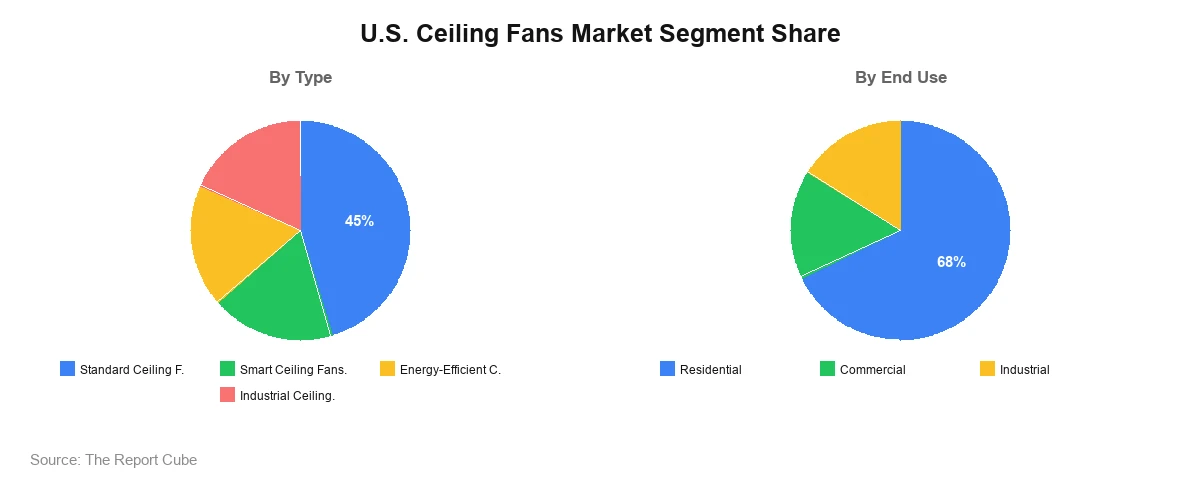
Standard ceiling fans lead the type segment with an estimated 45% share in 2026, supported by broad use in homes and commercial rooms and by wide brand availability from Hunter Fan Company, Minka Aire, Fanimation, Harbor Breeze and Westinghouse. Smart ceiling fans add connected controls, while energy-efficient models respond to certification criteria. Industrial ceiling fans serve large facilities with different airflow requirements.
By End Use
- Residential
- Commercial
- Industrial
Residential applications lead the end-use segment with an estimated 68% share in 2026, driven by housing construction, renovation and replacement of older fans in living areas and bedrooms. Commercial use follows, supported by nonresidential construction and the need for air circulation in offices, retail and hospitality spaces. Industrial use is more specialized, tied to facility size and airflow needs.
Regional Analysis
The U.S. market is assessed across West, Southwest, North and Midwest. Only the West share was supplied; other regional shares require validation. Growth factors and trends below are qualitative.
|
Region |
Estimated Market Share |
Key Growth Factors |
Industry Trends |
|---|---|---|---|
|
West |
28% |
Large housing and construction base, renovation activity |
Interest in efficient and design-led fans |
|
Southwest |
- |
Warm-climate cooling needs, residential construction |
Emphasis on airflow and cooling support |
|
North |
- |
Seasonal use, replacement and renovation |
Attention to reversible and efficient operation |
|
Midwest |
- |
Housing replacement, commercial and industrial facilities |
Practical, value-focused replacement |
West leads with an estimated 28% share in 2026, supported by a large residential base, renovation activity and commercial construction. Efficiency considerations and installation conditions influence model selection, and distribution through retailers and electrical contractors affects availability across metropolitan and suburban areas.
Southwest, North and Midwest hold the remaining share, with regional shares requiring validation. Warm-climate cooling needs support demand in the Southwest, seasonal use and replacement cycles shape the North, and housing replacement and facility use influence the Midwest. Climate, building stock and construction activity drive regional differences.
Market Share & Competitive Landscape
The U.S. ceiling fans market includes established decorative fan brands, lighting companies and retailer-linked brands. The table summarizes the supplied companies by general capability. It does not represent numerical market share, and company-level U.S. sales require validation.
|
Company |
Competitive Strength |
Primary Segment Served |
|---|---|---|
|
Hunter Fan Company |
Established ceiling fan brand with active design portfolio |
Residential ceiling fans |
|
Minka Aire |
Decorative fan designs across indoor and outdoor ranges |
Residential decorative fans |
|
Emerson Electric Co. |
Long-standing fan brand with energy-conscious models |
Residential and commercial fans |
|
Westinghouse Lighting Corporation |
Lighting and fan product range |
Residential ceiling fans |
|
Fanimation |
Design-oriented fans, including wet-location models |
Residential and outdoor-rated fans |
|
Monte Carlo Fans |
Decorative ceiling fan collections |
Residential decorative fans |
|
Casablanca Fan Company |
Decorative ceiling fans |
Residential fans |
|
Harbor Breeze |
Retailer-linked ceiling fan brand |
Home improvement retail |
|
Others |
Regional brands, importers and distributors |
Local supply and replacement |
Key Companies in the U.S. Ceiling Fans Market
Hunter Fan Company: Hunter Fan Company is headquartered in Memphis, Tennessee, and is one of the longest-established U.S. ceiling fan brands. Its published design patents indicate an active product portfolio. Verified 2024–2025 market-specific announcements could not be confirmed, so its strength rests on brand recognition and broad residential model range.
Fanimation: Fanimation designs decorative and outdoor-rated ceiling fans, including wet-location models, and a retail brand profile cites a 1984 founding. Headquarters details and 2024–2025 U.S. activity could not be verified and require confirmation. Its competitive strength lies in design variety across residential indoor and outdoor applications.
U.S. Ceiling Fans Market Future Outlook
The U.S. Ceiling Fans Market Forecast indicates steady expansion from USD 2.37 billion in 2026 to USD 3.42 billion by 2034 at a CAGR of 4.70%, based on supplied estimates. Growth is expected to depend on housing and nonresidential construction, replacement of older units, and adoption of efficiency-certified and smart models.
Technology investment is likely to concentrate on efficient motors, blade design and connected controls, while distributors and manufacturers may pursue builder and renovation channels. Risks include installation constraints, difficulty comparing product performance and construction cycles. The projections are supplied assumptions, and actual outcomes depend on regulation, supplier execution and customer spending.
U.S. Ceiling Fans Market Report Coverage
This U.S. Ceiling Fans Market Report summarizes the supplied valuation, forecast, segmentation, regional framework and competitive ecosystem.
|
Parameter |
Details |
|---|---|
|
Market Name |
U.S. Ceiling Fans Market |
|
Market Size 2026 |
USD 2.37 billion |
|
Market Size 2034 |
USD 3.42 billion |
|
Forecast Period |
2026–2034 |
|
CAGR |
4.70% |
|
Base Year |
2026 |
|
Historical Years |
2021-2034 |
|
Forecast Years |
2026–2034 |
|
Segments Covered |
By Type; By End Use; By Material; By Mounting Type |
|
Regions Covered |
West, Southwest, North, Midwest |
|
Key Companies |
Hunter Fan Company, Minka Aire, Emerson Electric Co., Westinghouse Lighting Corporation, Fanimation, Monte Carlo Fans, Casablanca Fan Company, Harbor Breeze |
|
Customization |
Available as per client requirements |
Why Choose This U.S. Ceiling Fans Market Report?
- Market coverage of ceiling fans across residential, commercial and industrial applications in the U.S.
- Clear presentation of the supplied 2026 valuation, 2034 forecast and 4.70% CAGR.
- Segmentation across four type categories, three end uses, four materials and three mounting types.
- Regional framework covering West, Southwest, North and Midwest.
- Competitive profiling of eight established ceiling fan brands and manufacturers.
- Trend insights on efficiency criteria, installation conditions and construction activity.
- Context on ENERGY STAR and DOE guidance relevant to product planning.
Table of Contents
- Introduction
- Objective of the Study
- Product Definition
- Market Segmentation
- Study Variables
- Research Methodology
- Secondary Data Points
- Companies Interviewed
- Primary Data Points
- Breakdown of Primary Interviews
- Secondary Data Points
- Executive Summary
- Market Dynamics
- Drivers
- Challenges
- Opportunity Assessment
- Recent Trends and Developments
- Policy and Regulatory Landscape
- U.S. Ceiling Fans Market Overview and Forecast Analysis (2021-2034)
- Market Size, By Value, By Growth Rate (CAGR/USD Billions)
- Demand – Supply Trends
- Market Share, By Type
- Standard Ceiling Fans
- Smart Ceiling Fans
- Energy-Efficient Ceiling Fans
- Industrial Ceiling Fans
- Market Share, By End Use
- Residential
- Commercial
- Industrial
- Market Share, By Material
- Wood
- Metal
- Plastic
- Glass
- Market Share, By Mounting Type
- Flush Mount
- Hanging Mount
- Sloped Ceiling Mount
- Market Share, By Region
- West
- Southwest
- North
- Midwest
- Market Share, By Competitors
- Competition Characteristics
- Revenue Shares
- Standard Ceiling Fans U.S. Ceiling Fans Market Overview, 2021-2034F
- By Value (USD Million)
- By End Use – Market Size & Forecast 2021-2034, USD Million
- Residential
- Commercial
- Industrial
- Smart Ceiling Fans U.S. Ceiling Fans Market Overview, 2021-2034F
- By Value (USD Million)
- By End Use – Market Size & Forecast 2021-2034, USD Million
- Residential
- Commercial
- Industrial
- Energy-Efficient Ceiling Fans U.S. Ceiling Fans Market Overview, 2021-2034F
- By Value (USD Million)
- By End Use – Market Size & Forecast 2021-2034, USD Million
- Residential
- Commercial
- Industrial
- Industrial Ceiling Fans U.S. Ceiling Fans Market Overview, 2021-2034F
- By Value (USD Million)
- By End Use – Market Size & Forecast 2021-2034, USD Million
- Residential
- Commercial
- Industrial
- Competitive Outlook (Company Profile – Partial List)
- Hunter Fan Company
- Company Overview
- Business Segments
- Strategic Alliances/Partnerships
- Recent Developments
- Minka Aire
- Company Overview
- Business Segments
- Strategic Alliances/Partnerships
- Recent Developments
- Emerson Electric Co.
- Company Overview
- Business Segments
- Strategic Alliances/Partnerships
- Recent Developments
- Westinghouse Lighting Corporation
- Company Overview
- Business Segments
- Strategic Alliances/Partnerships
- Recent Developments
- Fanimation
- Company Overview
- Business Segments
- Strategic Alliances/Partnerships
- Recent Developments
- Monte Carlo Fans
- Company Overview
- Business Segments
- Strategic Alliances/Partnerships
- Recent Developments
- Casablanca Fan Company
- Company Overview
- Business Segments
- Strategic Alliances/Partnerships
- Recent Developments
- Harbor Breeze
- Company Overview
- Business Segments
- Strategic Alliances/Partnerships
- Recent Developments
- Hunter Fan Company
- Contact Us & Disclaimer
Top Key Players & Market Share Outlook
- Hunter Fan Company
- Minka Aire
- Emerson Electric Co.
- Westinghouse Lighting Corporation
- Fanimation
- Monte Carlo Fans
- Casablanca Fan Company
- Harbor Breeze
Frequently Asked Questions