



Build Your Custom Market Intelligence Report
Customize Your ReportAustralia Home Exercise Bike Market Key Takeaways
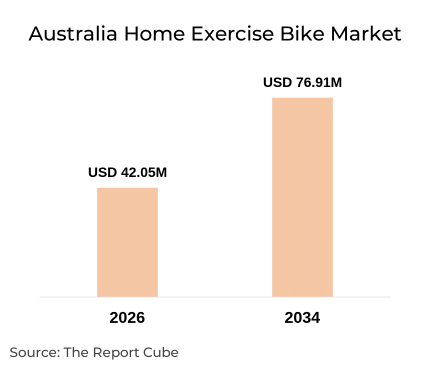
- Market valued at USD 42.05 million in 2026, reflecting consistent home fitness investment growth.
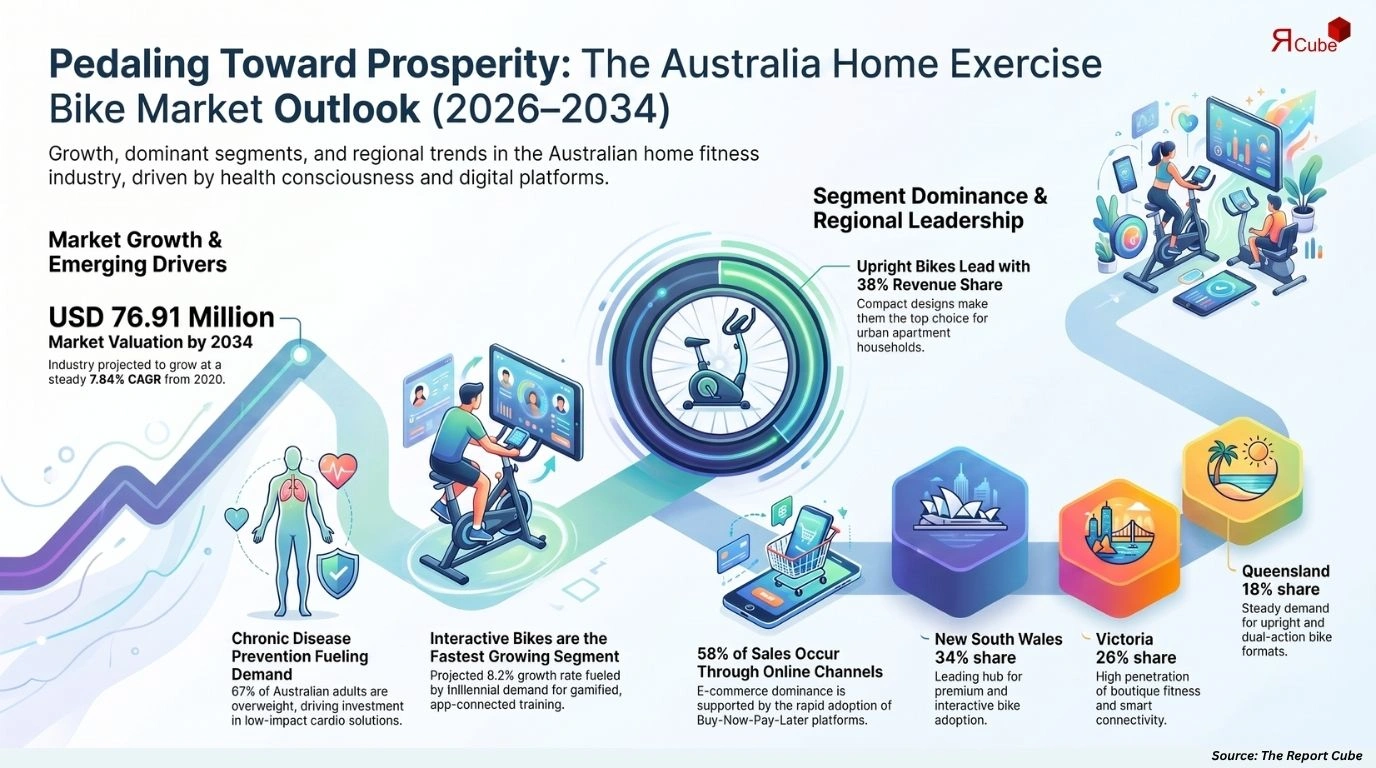
- Industry projected to reach USD 76.91 million by 2034, expanding at a 7.84% CAGR.
- Upright bikes dominate product demand across urban Australian households seeking accessible cardio.
- Interactive bikes represent the fastest-growing product type, driven by connected fitness adoption.
- Online channels are the leading distribution mode, accounting for the majority of unit sales.
- New South Wales leads regional revenue generation owing to population density and fitness culture.
- Western Australia is the fastest-growing state market, expanding at an 8.1% CAGR.
- Rising chronic disease rates and hybrid workout habits continue accelerating equipment purchases.
Australia Home Exercise Bike Market Insights & Analysis
The Australia Home Exercise Bike Market is anticipated to register a 7.84% CAGR during 2026–2034. The market size was valued at USD 42.05 million in 2026 and is projected to reach USD 76.91 million by 2034. Growth is underpinned by increasing health consciousness among Australians, the sustained behavioral shift toward home-based cardio training, and rapid product innovation integrating Bluetooth connectivity, app compatibility, and gamified training platforms. Australians collectively spend an estimated AUD 8.5 billion annually on fitness services and equipment, with the Australia Home Fitness Equipment Market reflecting consumer prioritization of accessible, year-round indoor workout solutions.
Government public health programs promoting preventive care and physical activity - including state-level initiatives across New South Wales and Queensland - continue reinforcing household fitness spending. The rise of subscription-based digital fitness services, including on-demand cycling classes that pair directly with smart exercise bikes, is significantly elevating average transaction values and post-purchase engagement. Corporate wellness incentives and employer-sponsored equipment rebates are further driving bulk procurement among hybrid-working professionals, particularly in the ACT and Victoria regions, creating a structural demand channel beyond conventional retail.
Australia Home Exercise Bike Market Dynamics
Demand for home exercise bikes in Australia continues to expand as shifting lifestyle habits, urban space constraints, and preventive health priorities drive consumers toward compact, multi-functional cardio equipment. The market is benefiting from a convergence of digital health integration, an ageing population seeking low-impact rehabilitation tools, and millennial-led adoption of gamified fitness technologies. Ongoing product innovation by domestic and global brands continues reshaping segment economics and broadening the addressable consumer base.
|
Factor |
Type |
Specific Impact on Market |
Magnitude |
|---|---|---|---|
|
Rising chronic lifestyle diseases |
Driver |
Accelerates low-impact cardio equipment demand in home settings |
Very High |
|
Expansion of app-connected fitness platforms |
Opportunity |
Elevates demand for Bluetooth-enabled interactive bike models |
High |
|
Ageing population seeking rehabilitation tools |
Driver |
Strengthens recumbent and ergonomic upright bike segment growth |
High |
|
Online retail channel maturation |
Trend |
Increases price transparency and purchase conversion rates |
High |
|
Premium product price sensitivity |
Challenge |
Limits interactive bike penetration in mid-tier consumer segments |
Moderate |
Key Market Driver: Chronic Disease Prevention Driving Cardio Investment
Australia's rising rates of obesity, type 2 diabetes, and cardiovascular conditions are compelling a growing segment of consumers to invest in home cardio solutions that deliver physician-recommended low-impact exercise. According to the Australian Institute of Health and Welfare, over 67% of Australian adults are overweight or obese. Home exercise bikes address this directly - offering a joint-friendly, clinician-endorsed cardiovascular workout format accessible regardless of location or mobility status. This health imperative is also supporting the Australian recumbent fitness equipment segment, especially among adults aged 55 and above managing joint or mobility limitations.
Major Industry Challenge: Premium Price Barriers in Interactive Segment
Interactive bikes with immersive digital consoles, live-streaming cycling classes, and advanced biometric tracking typically retail above AUD 1,500 - a price threshold that limits adoption among cost-conscious households and first-time buyers. While buy-now-pay-later platforms like Afterpay have reduced friction for mid-range purchases, the ongoing subscription fees associated with connected fitness platforms add recurring cost, dampening conversion in regional and lower-income demographics. Brands must balance hardware affordability with the software ecosystem that sustains user retention over the forecast period.
Emerging Trend Shaping Outlook: Gamified and Virtual Training Integration
Exercise bike manufacturers operating in Australia are increasingly embedding compatibility with platforms such as Zwift, Kinomap, and proprietary app ecosystems that transform indoor cycling into competitive, social experiences. This gamification of cardio training - featuring virtual terrain, leaderboards, and performance benchmarking - is materially extending average weekly usage durations and reducing equipment abandonment rates. The smart home gym equipment market reflects this shift, as consumers now evaluate exercise bikes not only on hardware specifications but on the depth and breadth of their connected software experience.
Need Specific Data, Let’s Customize the Report for You
Request CustomizationAustralia Home Exercise Bike Market Segment-wise Analysis
Australia's home exercise bike market is segmented across product type and distribution channel, with each dimension revealing distinct adoption patterns, consumer preferences, and revenue concentration dynamics that inform strategic positioning across the forecast period.
Australia Home Exercise Bike Market Segment-wise Analysis
By Type
- Recumbent Bike
- Upright Bike
- Dual Action Bike
- Interactive Bike
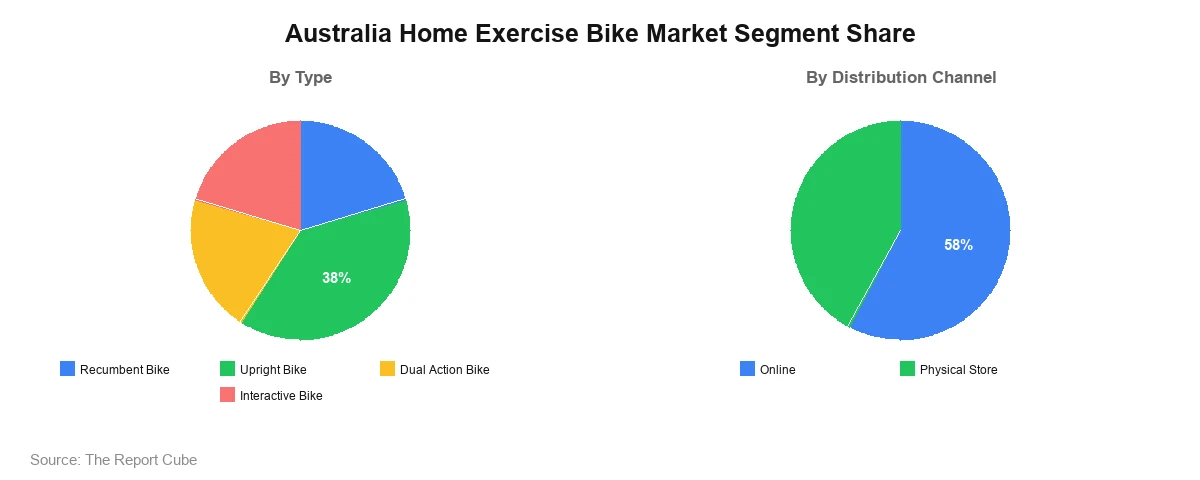
Upright bikes hold the dominant position in the Australia Home Exercise Bike Market with an estimated 38% revenue share in 2026. Their compact footprint, alignment with conventional cycling ergonomics, and broad compatibility with digital accessories make them the preferred choice across urban apartment households in Sydney, Melbourne, and Brisbane. Price accessibility across the AUD 400–1,200 range further positions upright bikes as the entry point for first-time home gym builders. Established Australian brands including Lifespan Fitness and Orbit Fitness have centered significant portfolio emphasis on upright variants, reinforcing segment leadership through broad retail distribution and competitive warranty offerings.
Recumbent bikes account for approximately 28% market share and are the preferred format for Australians aged 55 and above, NDIS beneficiaries, and users undergoing post-surgical rehabilitation. Their reclined seating, lumbar support structures, and lower joint stress profile distinguish them meaningfully from upright alternatives. Interactive bikes represent the fastest-growing sub-segment, projected to expand at an 8.2% CAGR through 2034, driven by millennial and Gen Z consumers seeking app-connected, gamified cycling experiences. Dual action bikes, which engage both upper and lower body musculature, maintain a loyal niche among users seeking full-body cardio alternatives. The interactive connected fitness bike segment is expected to generate disproportionate revenue per unit as average selling prices remain elevated.
By Distribution Channel
-
Online
- Physical Store
Online channels account for the leading distribution share in the Australia Home Exercise Bike Market, with an estimated 58% of sales by revenue occurring through e-commerce platforms, brand websites, and marketplace retailers such as Amazon Australia and MyDeal. The structural shift toward online purchasing accelerated substantially post-pandemic and has been sustained by Australian consumers' comfort with high-value fitness equipment purchases made remotely. Buy-now-pay-later adoption, transparent product reviews, and manufacturer-direct warranty policies have addressed traditional hesitancy around purchasing bulky equipment digitally. Lifespan Fitness and Orbit Fitness both operate robust direct-to-consumer online storefronts, reinforcing channel dominance with same-day dispatch from domestic warehouses.
Physical stores, including specialty fitness retailers, Harvey Norman, and Big W, retain approximately 42% of distribution share and serve consumers who prioritize tactile product assessment, in-store demonstrations, and immediate fulfilment without freight wait times. Physical retail remains particularly strong in Queensland and South Australia, where boutique fitness equipment retailers maintain high foot traffic. The online category is the fastest-growing channel, projected to record an 8.3% CAGR through 2034, supported by improved last-mile logistics infrastructure across metropolitan and regional Australia. Brands are increasingly investing in digital showroom experiences and augmented reality product trials to bridge the experiential gap between online and in-store retail touchpoints. The broader Australia online sporting goods market trend confirms sustained digital channel growth across adjacent fitness categories.
Regional Projection of Australia Home Exercise Bike Market
The Australia Home Exercise Bike Market exhibits meaningful regional variation driven by population density, fitness infrastructure maturity, income levels, and proximity to digital retail logistics hubs across the country's major states and territories.
|
Region |
Estimated Market Share |
Key Growth Factors |
Consumer Trends |
|---|---|---|---|
|
New South Wales |
34% |
Urban density, high disposable income, fitness culture |
Premium and interactive bike adoption |
|
Victoria |
26% |
Boutique fitness expansion, strong e-commerce penetration |
Smart connectivity and app-paired bikes |
|
Queensland |
18% |
Health-focused lifestyle, warm climate fitness culture |
Upright and dual action bike demand |
|
Australian Capital Territory |
9% |
High-income professionals, government wellness programs |
Mid-to-premium segment purchases |
|
Western Australia |
8% |
Mining sector income, remote fitness need |
Fastest-growing at 8.1% CAGR |
|
Others |
5% |
South Australia, Tasmania, Northern Territory |
Entry-level and recumbent bike demand |
- New South Wales: New South Wales leads the Australia Home Exercise Bike Market with approximately 34% revenue share, supported by Sydney's high-income urban population and a mature home fitness culture that prioritizes premium, technology-integrated equipment.
- Victoria: Victoria holds the second-largest regional share at approximately 26%, driven by Melbourne's boutique fitness ecosystem and strong e-commerce penetration among professional households.
- Queensland: Queensland accounts for approximately 18% of the market, with sunshine state consumers demonstrating consistent demand for upright and dual action bikes that complement outdoor-indoor hybrid fitness routines.
- Australian Capital Territory: The ACT, with its concentration of government professionals and above-average household incomes, contributes approximately 9% of market revenue and shows strong propensity for mid-to-premium product purchases.
- Western Australia: Western Australia is the fastest-growing state market, projected to expand at 8.1% CAGR through 2034, fueled by mining sector income levels and demand for home fitness solutions in geographically dispersed communities.
- Others: South Australia, Tasmania, and the Northern Territory collectively account for approximately 5% of market revenue, with demand concentrated in entry-level upright and recumbent formats across regional retail networks.
Australia Home Exercise Bike Market: Recent Development (2025)
- Orbit Fitness launched the Zenith recumbent bike range targeting NDIS users and home rehabilitation in Australia.
- Lifespan Fitness expanded its SM-120 magnetic spin bike line with 32 resistance levels via major Australian retail channels.
- York Fitness Equipment introduced an upgraded speed bike model for Australian specialty fitness retailers in mid-2025.
- Body Bike Australia strengthened its Bluetooth-enabled smart bike portfolio through expanded online distribution partnerships nationally.
Australia Home Exercise Bike Market Future Outlook (2034)
The Australia Home Exercise Bike Market is projected to expand at a 7.84% CAGR, reaching approximately USD 76.91 million by 2034. The market's growth trajectory will be shaped by deepening integration of AI-powered coaching platforms that adapt resistance, cadence, and training intensity to individual biometric profiles in real time. As smart connectivity becomes standard even in mid-range bike models, the distinction between consumer and semi-commercial equipment will continue narrowing, elevating category average selling prices and expanding total addressable revenue. The global interactive home fitness equipment market trajectory strongly supports Australia's upward momentum in connected cycling adoption.
Future expansion will be further reinforced by Australia's ageing demographic profile, with adults aged 65 and over projected to comprise 18% of the national population by 2034, generating sustained demand for low-impact, rehabilitation-compatible recumbent and ergonomic upright bikes. Subscription-based digital training ecosystems, corporate wellness procurement programs, and expanded NDIS equipment access pathways will collectively broaden the market's consumer base beyond traditional fitness enthusiasts. Brands that invest in local customer service infrastructure, domestic warranty fulfilment, and integrated app ecosystems are best positioned to capture long-term growth across both metropolitan and regional Australian markets.
Australia Home Exercise Bike Market Report Coverage
|
Report Attribute |
Details |
|---|---|
|
Market Name |
Australia Home Exercise Bike Market |
|
Market Size (2026) |
USD 42.05 Million |
|
Market Size (2034) |
USD 76.91 Million |
|
Forecast Period |
2026–2034 |
|
CAGR |
7.84% |
|
Base Year |
2026 |
|
Historical Years |
2021–2025 |
|
Forecast Years |
2026–2034 |
|
Segments Covered |
By Type (Recumbent Bike, Upright Bike, Dual Action Bike, Interactive Bike); By Distribution Channel (Online, Physical Store) |
|
Regions Covered |
New South Wales, Victoria, Queensland, Australian Capital Territory, Western Australia, Others |
|
Key Companies |
Orbit Fitness, Lifespan Fitness, York Fitness Equipment, Southern Cross Fitness, Body Bike Australia, Others |
|
Report Format |
PDF, Excel, PPT |
|
Customization |
Available as per client requirements |
Why Choose This Report?
- Comprehensive analysis covering all product types and distribution channels in Australia.
- Accurate market sizing with reliable USD-denominated forecast through 2034.
- Detailed state-level regional breakdown capturing growth variation across Australia.
- Competitive profiling of key Australian home exercise bike brands and strategies.
- Interactive and recumbent segment insights supported by real adoption data.
- Analysis of online channel growth and direct-to-consumer brand dynamics.
- Consumer behavioral trends including BNPL adoption and smart bike preference shifts.
- Strategic insights supporting investment, product development, and market entry decisions.
Table of Contents
- Introduction
- Objective of the Study
- Product Definition
- Market Segmentation
- Study Variables
- Research Methodology
- Secondary Data Points
- Companies Interviewed
- Primary Data Points
- Breakdown of Primary Interviews
- Secondary Data Points
- Executive Summary
- Market Dynamics
- Drivers
- Challenges
- Opportunity Assessment
- Recent Trends and Developments
- Policy and Regulatory Landscape
- Australia Home Exercise Bike Market Overview and Forecast Analysis (2021-2034)
- Market Size, By Value, By Growth Rate (CAGR/USD Millions)
- Demand – Supply Trends
- Market Share, By Type
- Recumbent Bike
- Upright Bike
- Dual Action Bike
- Interactive Bike
- Market Share, By Distribution Channel
- Online
- Physical Store
- Oil & Gas
- Industrial
- Market Share, By Region
- New South Wales
- Victoria
- Queensland
- Australian Capital Territory
- Western Australia
- Others
- Market Share, By Competitors
- Competition Characteristics
- Revenue Shares
- Recumbent Bike Australia Home Exercise Bike Market Overview, 2021-2034F
- By Value (USD Million)
- By Distribution Channel – Market Size & Forecast 2021-2034, USD Million
- Online
- Physical Store
- Oil & Gas
- Industrial
- Upright Bike Australia Home Exercise Bike Market Overview, 2021-2034F
- By Value (USD Million)
- By Distribution Channel – Market Size & Forecast 2021-2034, USD Million
- Online
- Physical Store
- Oil & Gas
- Industrial
- Dual Action Bike Australia Home Exercise Bike Market Overview, 2021-2034F
- By Value (USD Million)
- By Distribution Channel – Market Size & Forecast 2021-2034, USD Million
- Online
- Physical Store
- Oil & Gas
- Industrial
- Interactive Bike Australia Home Exercise Bike Market Overview, 2021-2034F
- By Value (USD Million)
- By Distribution Channel – Market Size & Forecast 2021-2034, USD Million
- Online
- Physical Store
- Oil & Gas
- Industrial
- Competitive Outlook (Company Profile – Partial List)
- Orbit Fitness
- Company Overview
- Business Segments
- Strategic Alliances/Partnerships
- Recent Developments
- Lifespan Fitness
- Company Overview
- Business Segments
- Strategic Alliances/Partnerships
- Recent Developments
- York Fitness Equipment
- Company Overview
- Business Segments
- Strategic Alliances/Partnerships
- Recent Developments
- Southern Cross Fitness
- Company Overview
- Business Segments
- Strategic Alliances/Partnerships
- Recent Developments
- Body Bike Australia
- Company Overview
- Business Segments
- Strategic Alliances/Partnerships
- Recent Developments
- Others
- Orbit Fitness
- Contact Us & Disclaimer
Top Key Players & Market Share Outlook
- Orbit Fitness
- Lifespan Fitness
- York Fitness Equipment
- Southern Cross Fitness
- Body Bike Australia
- Others
Frequently Asked Questions






