



Build Your Custom Market Intelligence Report
Customize Your ReportLatin America Digital Health Market Statistics and Insights
Market Insight
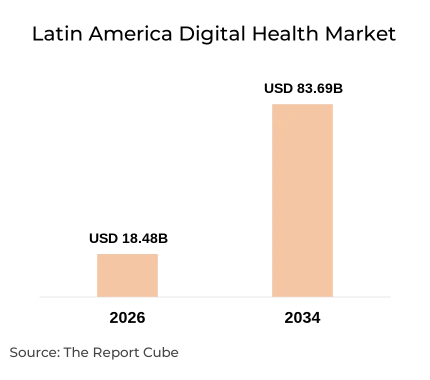
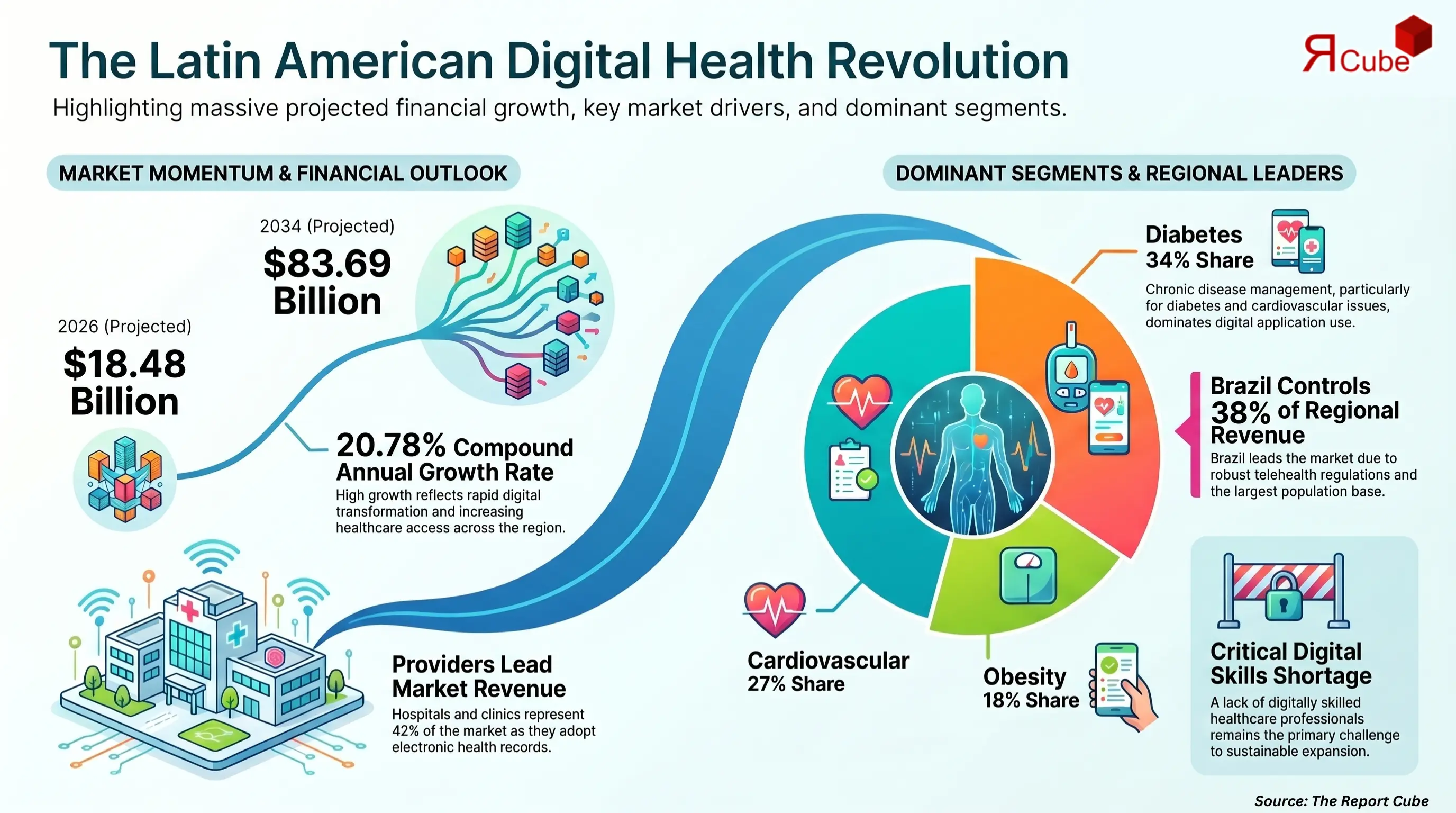
- Latin America Digital Health Market valued at USD 18.48 billion in 2026.
- Market projected to reach USD 83.69 billion by the year 2034.
- Market anticipated to register a CAGR of 20.78% during 2026–2034.
By Application
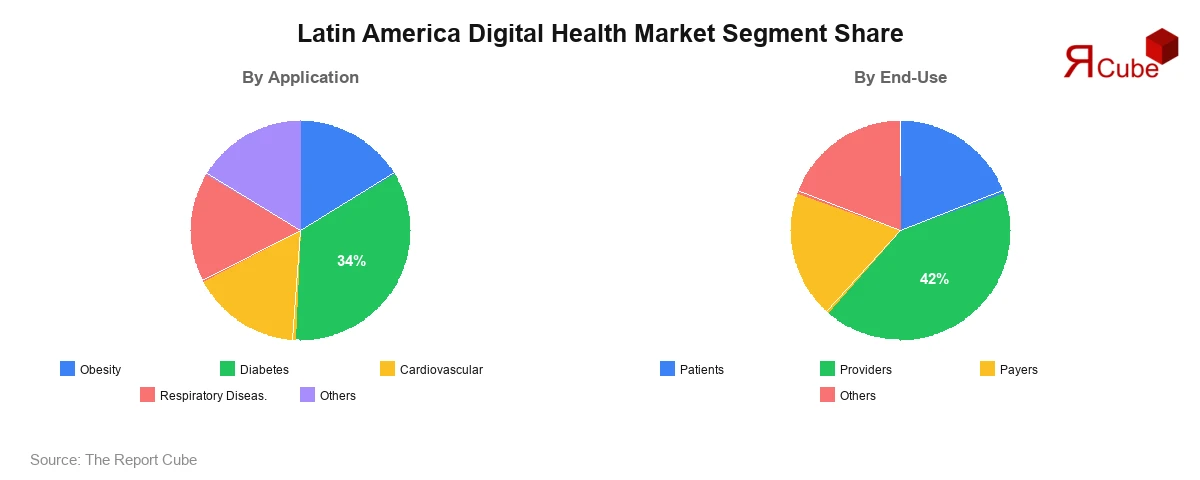
- Diabetes segment dominates, holding approximately 34% market share.
Competitive Landscape
- More than 10 companies are actively engaged in producing Latin America Digital Health Market solutions.
- Top 5 companies acquired around 38% of the market share.
- Apple Inc., Google Inc., Cerner Corporation, McKesson Corporation, Athenahealth Inc., and others.
By End-Use
- Providers segment leads with an estimated 42% market revenue share.
Latin America Digital Health Market Insights & Analysis
The Latin America Digital Health Market is anticipated to register a 20.78% CAGR during 2026–2034. The market size was valued at USD 18.48 billion in 2026 and is projected to reach USD 83.69 billion by 2034.
The region's rapid digital transformation across healthcare systems is a fundamental catalyst propelling this expansion. Brazil alone accounted for a significant portion of regional revenue in 2025, supported by the government's permanent telehealth regulation under Law No. 14,510/2022 and the Prontuário Eletrônico do Cidadão initiative aimed at unifying patient health data across municipalities. In January 2025, SK Biopharmaceuticals partnered with Brazilian pharmaceutical giant Eurofarma to develop an AI-driven platform targeting epilepsy management and seizure prediction - a milestone reflecting the private sector's deepening commitment to digital therapeutics. Furthermore, Colombia's 1DOC3 secured USD 10 million in Series B funding in early 2025 to scale behavioral health digital services across Argentina and Chile. Mexico's National Digital Strategy and National Universal Health Coverage Policy have further structured a regulatory environment favorable to sustained digital health adoption, reinforcing investor confidence across the region.
Latin America Digital Health Market Dynamics
Key Market Driver Rising Chronic Disease Burden Accelerates Adoption
Latin America faces a disproportionate burden of non-communicable diseases, with the World Health Organization reporting that 25.6% of children and 31% of adults across the region are classified as overweight or obese - a figure that has tripled since 2000. Diabetes affects an estimated 48 million individuals in the region, with cardiovascular disease remaining the leading cause of mortality across Brazil, Mexico, and Colombia. This epidemiological profile is directly accelerating institutional adoption of digital health platforms capable of enabling remote patient monitoring, chronic disease management, and AI-powered early diagnostics. Insurance providers such as Mapfre Salud in Mexico now formally cover digital obesity management programs, validating the clinical and financial case for digital intervention in chronic care pathways across the region.
Major Industry Challenge Healthcare Workforce Shortfall in Digital Competencies
Despite surging platform investment, a structural shortfall in digitally skilled healthcare professionals remains a significant constraint on sustainable market expansion. Countries such as Peru report a critically low number of universities offering accredited programs in health informatics, limiting the pool of professionals capable of implementing, maintaining, and optimizing complex electronic health record systems and clinical decision-support tools in public institutions. This gap is particularly acute in remote and rural settings where digital health deployment is most urgently needed. Without coordinated investment in workforce education, reskilling programs, and collaborative agreements between academic institutions and health ministries, the effective utilization of deployed technologies remains constrained - creating a risk of underperforming returns on digital infrastructure investments across lower-income member states.
Emerging Trend Shaping Outlook AI-Integrated Telehealth Platforms Reshaping Care Delivery
The convergence of artificial intelligence and telehealth infrastructure is fundamentally reshaping how primary and specialist care is delivered across Latin America. Platforms such as Zenklub in Brazil have deployed AI-powered therapy-matching tools that reduce patient dropout rates in mental health care, while Argentina's Ministry of Health has partnered with Microsoft to implement Azure-based virtual care platforms across provincial health centers. By 2026, an estimated 185.4 million Brazilians are projected to access mobile internet, creating a vast and scalable base for AI-driven health applications. The integration of natural language processing, predictive analytics, and remote biosignal monitoring is progressively enabling providers to shift from reactive to anticipatory care models - a transformation that is expected to define the region's digital health landscape through 2034 and beyond.
Need Specific Data, Let’s Customize the Report for You
Request CustomizationLatin America Digital Health Market Segment-wise Analysis
The Latin America Digital Health Market demonstrates strong segmentation across application verticals and end-use categories, reflecting the diverse healthcare priorities and deployment models operating within the region. Both primary segments exhibit distinct growth trajectories driven by epidemiological pressures, technological readiness, and healthcare system structure.
By Application
- Obesity
- Diabetes
- Cardiovascular
- Respiratory Diseases
- Others
The diabetes segment commands the dominant position within the application landscape, accounting for approximately 34% of total application-based market revenue in 2026. Latin America is home to nearly 48 million people living with diabetes, with Brazil, Mexico, and Colombia collectively accounting for the majority of the regional disease burden. Digital platforms offering continuous glucose monitoring integration, AI-driven dietary guidance, and remote endocrinologist consultations are driving strong adoption among both insured and uninsured populations. The cardiovascular segment holds the second-largest share at around 27%, as the rising incidence of hypertension and coronary artery disease fuels demand for connected cardiac monitoring devices and remote consultation platforms. The obesity segment, while currently contributing approximately 18% of application revenue, is rapidly expanding driven by the proliferation of personalized coaching applications, wearable integration, and the formal inclusion of digital obesity programs in insurance reimbursement frameworks across Mexico and Brazil. The respiratory diseases segment captures a meaningful portion of demand, particularly following heightened awareness of chronic respiratory conditions post-pandemic, while the others category encompasses mental health, oncology, and rare disease management platforms that are gaining significant traction.
By End-Use
- Patients
- Providers
- Payers
- Others
The providers segment dominates the end-use landscape, contributing approximately 42% of total market revenue in 2026. Healthcare providers - encompassing hospitals, clinics, and integrated health networks - represent the primary institutional adopters of electronic health record systems, clinical decision-support tools, telehealth consultation platforms, and remote patient monitoring infrastructure. Brazil's Sistema Único de Saúde (SUS) has deployed virtual consultation tools across Amazonian primary care teams, while Chile's public hospital network has achieved high EHR penetration, underscoring provider-led demand at the institutional level. The patients segment is the fastest-growing end-use category, capturing roughly 31% of revenue as smartphone and mobile broadband adoption accelerates self-managed healthcare behaviors. Patients are increasingly utilizing consumer-facing digital health applications for chronic disease self-monitoring, mental health support, and preventive wellness. The payers segment - comprising private health insurers, government health schemes, and managed care organizations - accounts for approximately 19% of market revenue, with insurers like SulAmérica and Amil integrating teleconsultation portals and digital care pathways to manage claims costs. The others category includes pharmaceutical companies, health technology vendors, and research institutions deploying digital health tools for clinical trial management and population health surveillance.
Regional Projection of Latin America Digital Health Market
The Latin America Digital Health Market is distributed across several key countries, each contributing distinct dynamics to the overall growth trajectory:
- Brazil
- Mexico
- Colombia
- Argentina
- Rest of Latin America
Brazil dominates the regional landscape, capturing an estimated 38% of total market revenue in 2026. The country benefits from the largest population base in the region, widespread mobile broadband access reaching over 92.5% of households by 2023, and a mature regulatory environment anchored by Law No. 14,510/2022 that formally legitimized permanent telehealth services.
Government-backed platforms, robust venture capital activity, and a deep ecosystem of health startups including Conexa Saúde and Zenklub reinforce Brazil's market leadership. Mexico ranks second, driven by its National Digital Strategy and rapid urbanization, while Colombia, Argentina, and Chile are emerging as high-growth markets underpinned by expanding digital health policy frameworks and growing private sector investment.
Latin America Digital Health Market: Recent Development (2025)
- In January 2025, SK Biopharmaceuticals and Eurofarma formed a digital health joint venture generating projected revenues exceeding USD 50 million annually.
- Colombia's 1DOC3 secured USD 10 million in Series B funding to expand behavioral health digital services regionally.
- Apple Inc. expanded its HealthKit integration with three major Brazilian hospital networks, broadening its regional footprint.
- Cerner Corporation reported a 17% year-on-year revenue increase from Latin American contracts, driven by Brazil EHR deployments.
Latin Ameica Digital Health Market Future Outlook (2034)
The Latin America Digital Health Market is positioned for transformative expansion through 2034, underpinned by a projected CAGR of 20.78% and a target market valuation of USD 83.69 billion. The proliferation of 5G infrastructure across Brazil, Mexico, and Colombia will dramatically expand the addressable population for real-time remote monitoring and AI-powered diagnostic applications. Wearable health device adoption is expected to grow in parallel with falling hardware costs, enabling continuous biometric data collection across both urban and rural populations. Regulatory convergence across member states - modeled on Brazil's telehealth legislation - is anticipated to reduce cross-border compliance barriers for multinational digital heath platforms. AI-driven personalized medicine, predictive population health analytics, and interoperable digital health ecosystems are expected to define the competitive frontier, creating substantial opportunities for both established players and regionally-rooted health technology innovators through the forecast horizon.
Why Choose This Report?
- Provides a comprehensive overview of the overall market analysis, encompassing key trends, consumer behavior analysis, and risk assessment to support strategic decision-making.
- Provides accurate, up-to-date insights into market size, segmentation, and emerging opportunities, helping to minimize risk & capitalizing on growth.
- Gives deep understanding of target audience preferences, investment habits, and communication channels for enhanced product development & marketing effectiveness.
- Delivers competitive analysis & benchmarking, uncovering the strengths & weaknesses of market competitors to guide strategies.
- Consolidate comprehensive market intelligence, reducing reasoning & streamlining research efforts.
- Facilitates customized market segmentation & risk mitigation strategies, fine-tuned to the business objectives.
- Aids in identifying both market challenges & untapped opportunities within the industry to drive long-term business growth.
- Provides valuable information based on actual customer data & search trends.
Table of Contents
- Introduction
- Objective of the study
- Product Definition
- Market Segmentation
- Study Variables
- Research Methodology
- Secondary Data Points
- Companies Interviewed
- Primary Data Points
- Breakdown of Primary Interviews
- Secondary Data Points
- Executive Summary
- Market Dynamics
- Drivers
- Challenges
- Opportunity Assessment
- Recent Trends and Developments
- Policy and Regulatory Landscape
- Latin America Digital Health Market Overview and Forecast Analysis (2021-2034)
- Market Size, By Value, By growth rate (CAGR/USD Billions)
- Demand - Supply Trends
- Market Share, By Technology
- Tele-healthcare
- mHealth
- Digital Health Systems
- Healthcare Analytics
- Market Share, By Application
- Obesity
- Diabetes
- Cardiovascular
- Respiratory Diseases
- Others
- Market Share, By End-Use
- Patients
- Providers
- Payers
- Others
- Market Share, By Region
- Brazil
- Mexico
- Colombia
- Argentina
- Rest of Latin America
- Market Share, By Competitors
- Competition Characteristics
- Revenue Shares
- Latin America Tele-healthcare Digital Health Market Overview, 2021-2034F
- By Value (USD Million)
- By Component- Market Size & Forecast 2021-2034, USD Million
- By Application- Market Size & Forecast 2021-2034, USD Million
- By End-Use- Market Size & Forecast 2021-2034, USD Million
- Latin America mHealth Digital Health Market Overview, 2021-2034F
- By Value (USD Million)
- By Component- Market Size & Forecast 2021-2034, USD Million
- By Application- Market Size & Forecast 2021-2034, USD Million
- By End-Use- Market Size & Forecast 2021-2034, USD Million
- Latin America Digital Health Systems Digital Health Market Overview, 2021-2034F
- By Value (USD Million)
- By Component- Market Size & Forecast 2021-2034, USD Million
- By Application- Market Size & Forecast 2021-2034, USD Million
- By End-Use- Market Size & Forecast 2021-2034, USD Million
- Latin America Healthcare Analytics Digital Health Market Overview, 2021-2034F
- By Value (USD Million)
- By Component- Market Size & Forecast 2021-2034, USD Million
- By Application- Market Size & Forecast 2021-2034, USD Million
- By End-Use- Market Size & Forecast 2021-2034, USD Million
- Competitive Outlook (Company Profile - Partial List)
- Apple Inc.
- Company Overview
- Business Segments
- Strategic Alliances/Partnerships
- Recent Developments
- AirStrip Technologies
- Company Overview
- Business Segments
- Strategic Alliances/Partnerships
- Recent Developments
- Google Inc.
- Company Overview
- Business Segments
- Strategic Alliances/Partnerships
- Recent Developments
- Orange
- Company Overview
- Business Segments
- Strategic Alliances/Partnerships
- Recent Developments
- Mckesson Corporation
- Company Overview
- Business Segments
- Strategic Alliances/Partnerships
- Recent Developments
- Athenahealth Inc.
- Company Overview
- Business Segments
- Strategic Alliances/Partnerships
- Recent Developments
- At&T Inc.
- Company Overview
- Business Segments
- Strategic Alliances/Partnerships
- Recent Developments
- Biotelemetry, Inc.
- Company Overview
- Business Segments
- Strategic Alliances/Partnerships
- Recent Developments
- Cerner Corporation
- Company Overview
- Business Segments
- Strategic Alliances/Partnerships
- Recent Developments
- Others
- Apple Inc.
- Contact Us & Disclaimer
Top Key Players & Market Share Outlook
- Apple Inc.
- AirStrip Technologies
- Google Inc.
- Orange
- Mckesson Corporation
- Athenahealth Inc.
- At&T Inc.
- Biotelemetry, Inc.
- Cerner Corporation
- Others
Frequently Asked Questions






