



Build Your Custom Market Intelligence Report
Customize Your ReportGCC Elevator and Escalator Market Key Highlights
By Product Type:
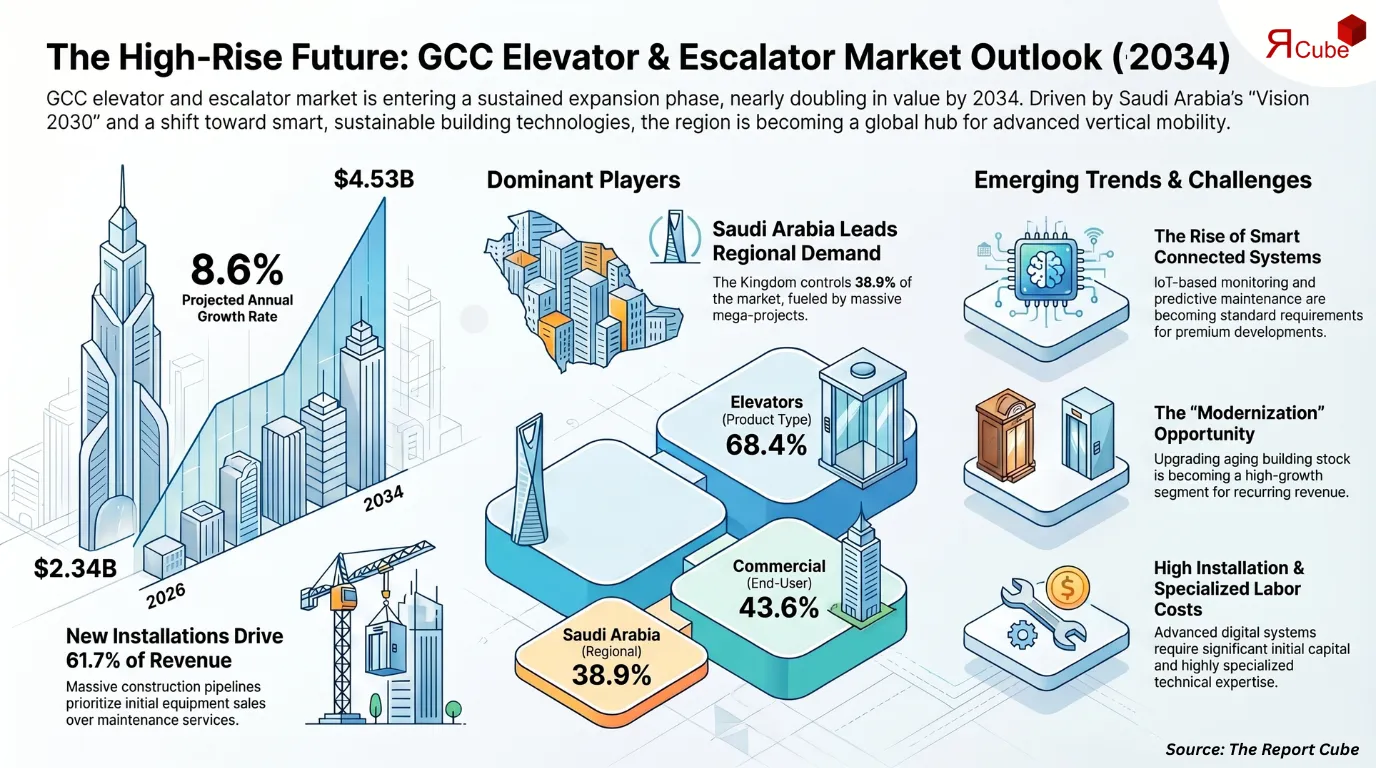
Elevators segment leads the market with nearly 68.4% share.
By Service Type:
New Installation segment dominates the market with approximately 61.7% of revenue.
Regional Outlook:
Saudi Arabia dominates the GCC Elevator and Escalator market with around 38.9% share.
GCC Elevator and Escalator Market Insights & Analysis
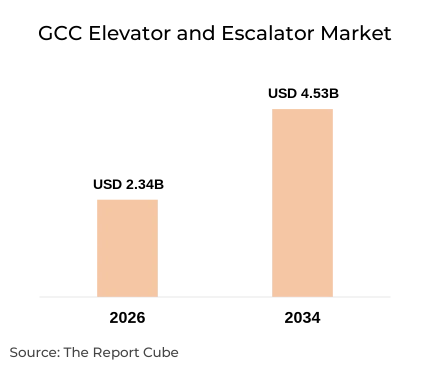
The GCC Elevator and Escalator Market is anticipated to register a CAGR of around 8.6% during the forecast period 2026-2034. The market size is valued at USD 2.34 billion in 2026 and is projected to reach USD 4.53 billion by 2034. The market is entering a period of sustained expansion, supported by one of the world's most active construction pipelines. Governments across the Gulf region are channeling substantial investments into urban transformation projects, transportation infrastructure, tourism destinations, and mixed-use developments. Saudi Arabia's Vision 2030 initiatives, alongside ongoing development programs in the UAE, Qatar, and Oman, are creating long-term demand for advanced vertical transportation systems. The growing concentration of high-rise residential towers, luxury hotels, commercial districts, and public infrastructure facilities is increasing the need for reliable and energy-efficient elevator and escalator solutions capable of handling higher passenger volumes and stricter performance requirements.
Industry participants are increasingly focusing on technology-driven offerings that enhance operational efficiency and lifecycle value. Smart elevators equipped with destination dispatch systems, predictive maintenance platforms, remote monitoring capabilities, and regenerative drives are becoming standard features in premium developments. Property owners and facility managers are prioritizing equipment that lowers maintenance costs, improves energy performance, and supports sustainability objectives. As GCC countries continue diversifying their economies through investments in real estate, healthcare, aviation, education, and hospitality sectors, the elevator and escalator industry is expected to benefit from a broad range of installation, modernization, and maintenance opportunities throughout the forecast period.
GCC Elevator & Escalator Market Impact Analysis
| Factor | Type | Specific Impact on Market | Magnitude | Business Implication |
|---|---|---|---|---|
| Large Scale Urban Projects | Market | Megacities and new townships raise demand for vertical transit | High | Strong pipeline for new elevator and escalator installations |
| Infrastructure and Transport Hubs | Market | Expansion of metros, airports and rail boosts public mobility needs | High | Drives orders for heavy duty escalators and transit elevators |
| Oil Price Linked Spending Cycles | Environmental | Government capex fluctuates with hydrocarbon revenue patterns | Medium | Requires flexible capacity and project backlog diversification |
| Shift Toward Smart Connected Systems | Technological | IoT based monitoring and control features become tender norms | High | Rewards vendors with digital service platforms and analytics |
| Strong Focus on Safety Compliance | Regulatory | Updated codes demand high safety, redundancy and certification | Medium | Favors organized players with compliant designs and audits |
| Modernization of Ageing Installations | Consumer | Existing buildings upgrade to energy efficient advanced equipment | Medium | Supports recurring revenue from retrofit and maintenance work |
| Presence of Global OEM Competitors | Competitive | Global brands intensify price and service level competition | High | Need for differentiation via lifecycle cost and reliability |
GCC Elevator and Escalator Market Dynamics
Key Driver: Rapid Infrastructure Development and Urban Expansion Across GCC Countries
The scale of ongoing and planned construction activity across GCC countries remains the strongest catalyst for market growth. Large urban developments require sophisticated vertical transportation systems capable of serving thousands of occupants daily while meeting international safety and efficiency standards. Landmark projects across Saudi Arabia, including smart cities, tourism destinations, business districts, and residential communities, are creating unprecedented demand for elevators and escalators. Similar investment momentum in the UAE's commercial and hospitality sectors continues to strengthen regional equipment demand.
Vertical transportation has become a critical component of modern building design rather than a supporting utility. Developers increasingly seek systems that combine operational reliability, space optimization, passenger comfort, and energy efficiency. As building heights increase and urban density rises, demand for high-capacity traction elevators, machine room-less technologies, and intelligent control systems is expected to grow steadily. This construction-led expansion provides a strong foundation for long-term market development across both equipment installation and aftersales service segments.
Industry Trends: Adoption of Smart and Energy-Efficient Vertical Mobility Solutions
Digital transformation is becoming a defining trend within the GCC elevator and escalator industry. Building owners are investing in intelligent mobility solutions that integrate seamlessly with broader building management systems. Advanced elevators now utilize cloud-based monitoring, predictive diagnostics, and real-time performance analytics to identify potential issues before operational disruptions occur. These technologies help reduce downtime, improve maintenance efficiency, and enhance passenger satisfaction in high-traffic environments.
Sustainability considerations are also influencing procurement decisions throughout the region. Developers increasingly favor elevator systems featuring regenerative braking technology, energy-efficient motors, and lightweight materials that contribute to lower building energy consumption. Demand for touchless controls and enhanced sanitation features has also gained traction in healthcare facilities, hospitality properties, and commercial complexes. As smart city initiatives continue expanding across the Gulf, technology-enabled vertical mobility solutions are expected to represent a growing share of new project specifications.
Book your FREE 30-minute expert consultation today
Contact UsMajor Challenge: High Installation Costs and Complex Maintenance Requirements
Although demand fundamentals remain strong, the industry faces ongoing challenges related to project economics and operational complexity. Modern elevator systems equipped with advanced digital capabilities require higher initial investments compared to conventional solutions. Developers working within tight budget constraints often face difficult decisions regarding technology selection, customization requirements, and long-term maintenance commitments. Fluctuations in construction schedules can further affect equipment procurement timelines and installation planning.
The growing sophistication of elevator and escalator technologies has also increased the need for specialized technical expertise. Maintaining advanced systems requires trained personnel capable of handling software-based diagnostics, connected devices, and integrated control platforms. In certain markets, workforce limitations and rising labor costs may create service bottlenecks. Furthermore, maintaining compliance with evolving safety regulations while ensuring uninterrupted operation remains a key responsibility for building owners and service providers throughout the GCC region.
Opportunity: Growing Modernization and Retrofit Demand Across Existing Building Stock
A significant portion of elevators currently operating across commercial buildings, residential towers, hospitals, and government facilities will require upgrades over the coming decade. Rather than replacing entire systems, many property owners are choosing modernization programs that improve safety, efficiency, and performance while minimizing disruption and capital expenditure. This trend is creating a substantial opportunity for manufacturers and service providers specializing in retrofit solutions.
>Modernization projects increasingly include digital control upgrades, energy-efficient drive systems, destination dispatch technologies, and predictive maintenance capabilities. Building operators recognize that modernized equipment can enhance tenant satisfaction, reduce operating costs, and support sustainability targets. As GCC cities continue maturing and existing building stock ages, modernization services are expected to become one of the fastest-growing segments within the regional elevator and escalator market, generating recurring revenue opportunities beyond new installations.
GCC Elevator and Escalator Market Segment-wise Analysis
By Product Type:
- Escalators
- Escalator Speed
- 1 m/s to 2.5 m/s
- 3 m/s to 3.5 m/s
- 4 m/s & Above
- Escalator Type
- Moving Stairs
- Moving Walkways/Travelators
- Escalator Speed
- Elevators
- Building Installation
- High Rise
- Low Rise
- Elevator Type
- Hydraulic Elevators
- Machine Room-Less (MRL) Elevators
- Traction Elevators
- Building Installation
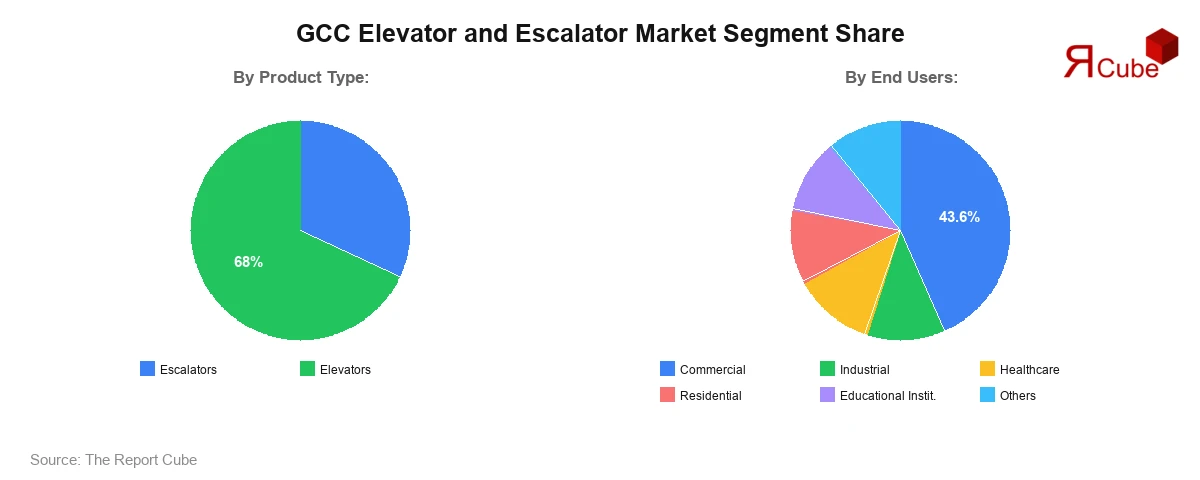
Elevators account for the largest share of the GCC elevator and escalator market, supported by the region's strong focus on vertical urban development. High-rise residential towers, luxury hospitality projects, premium office buildings, and mixed-use developments require advanced elevator systems capable of delivering reliable performance under intensive daily usage conditions. The segment is estimated to contribute approximately 68% of overall market revenue, reflecting its essential role in modern infrastructure projects.
Among elevator categories, machine room-less elevators continue gaining market acceptance due to their compact design, lower energy consumption, and installation flexibility. Traction elevators remain the preferred solution for high-rise developments because of their speed, efficiency, and ability to handle heavy passenger traffic. Developers increasingly prioritize systems that offer lower lifecycle costs, enhanced safety features, and compatibility with smart building ecosystems. These advantages are expected to sustain the segment's leadership position throughout the forecast period.
By End Users:
- Commercial
- Hospitality
- Retail & Shopping Centers
- Government & Transportation
- Airports
- Metro
- Government Buildings
- Others
- Offices
- Others
- Industrial
- Healthcare
- Residential
- Educational Institutions
- Others
The commercial segment dominates the market with an estimated revenue contribution of 43.6%, driven by extensive investment in hospitality properties, retail destinations, airports, office complexes, and public transportation infrastructure. Across the GCC, governments and private developers continue expanding commercial assets to support economic diversification, tourism growth, and urban development objectives. These facilities require high-capacity vertical transportation systems capable of ensuring smooth passenger movement while maintaining operational reliability.
Airports, metro stations, and large shopping centers represent particularly important demand centers due to their continuous traffic volumes and stringent performance requirements. Hotel operators and premium office developers increasingly view elevator quality as a key factor influencing user experience and building competitiveness. As commercial construction activity remains robust across major Gulf cities, this segment is expected to maintain its dominant contribution to overall market revenue.
Regional Projection of GCC Elevator and Escalator Industry
- Saudi Arabia
- United Arab Emirates
- Kuwait
- Oman
- Qatar
- Bahrain
Saudi Arabia represents the largest market for elevators and escalators within the GCC, accounting for approximately 38.9% of total regional revenue, supported by an unmatched pipeline of infrastructure and real estate projects. The Kingdom's Vision 2030 transformation agenda has accelerated investments across tourism, transportation, healthcare, education, and residential sectors, creating substantial demand for vertical mobility solutions. Large-scale developments such as NEOM, The Line, Red Sea Global projects, and multiple urban expansion initiatives are driving new installation opportunities across the country
The country's growing urban population and increasing emphasis on modern infrastructure continue to strengthen long-term market prospects. Demand extends beyond new construction, with modernization requirements also increasing across existing commercial and residential properties. International manufacturers are expanding their regional presence through service networks, partnerships, and localized support capabilities to capture opportunities arising from Saudi Arabia's evolving construction landscape. These factors are expected to reinforce the country's leadership position within the GCC elevator and escalator market throughout the forecast horizon.
Need insights for a specific region within this market?
Request Regional DataGCC Elevator & Escalator Market - Countries Analysis
| Country | Demand Level | Key Areas | System Dominance | Core Demand Logic | Growth Nature |
|---|---|---|---|---|---|
| Saudi Arabia | Very High | Riyadh, Jeddah, NEOM zone | High‑rise elevators | Vision 2030 mega projects | Project‑driven surge |
| United Arab Emirates | Very High | Dubai, Abu Dhabi, Sharjah | Mixed‑use E&E systems | Premium towers and malls | Upgrade‑led growth |
| Kuwait | Medium | Kuwait City, Al Ahmadi | Residential elevators | Mid‑rise housing stock | Steady infill growth |
| Oman | Low to Medium | Muscat, Sohar, Duqm | Basic traction units | New ports and tourism | Gradual catch‑up |
| Qatar | High | Doha, Lusail, industrial | Commercial E&E systems | Post‑World Cup assets | Asset‑upgrade cycle |
| Bahrain | Low | Manama, Seef, Muharraq | Residential and retail | Compact high‑rise cores | Replacement focused |
Government Initiatives & Policies
- Saudi Vision 2030 Infrastructure Development Program: Saudi Arabia continues investing heavily in smart cities, transportation networks, tourism projects, and urban development initiatives that directly support elevator and escalator installation demand across commercial and residential sectors.
- UAE Energy Efficiency and Green Building Regulations: The UAE promotes energy-efficient building standards through sustainability frameworks and green building programs, encouraging adoption of advanced elevator technologies with reduced energy consumption.
GCC Elevator and Escalator Industry Recent Developments
- 2025: Al Arabia Elevators & Moving Systems inaugurated the first Sigma Elevator showroom in the Middle East in Dubai, UAE. The facility showcases advanced elevator technologies, cabin designs, control systems, and mobility solutions, enabling developers, consultants, and contractors to evaluate products directly while strengthening Sigma Elevator's market presence across GCC countries.
Why Choose This Report?
- Provides a comprehensive overview of the overall market analysis, encompassing key trends, consumer behavior analysis, and risk assessment to support strategic decision-making.
- Provides accurate, up-to-date insights into market size, segmentation, and emerging opportunities, helping to minimize risk & capitalizing on growth.
- Gives deep understanding of target audience preferences, investment habits, and communication channels for enhanced product development & marketing effectiveness.
- Delivers competitive analysis & benchmarking, uncovering the strengths & weaknesses of market competitors to guide strategies.
- Consolidate comprehensive market intelligence, reducing reasoning & streamlining research efforts.
- Facilitates customized market segmentation & risk mitigation strategies, fine-tuned to the business objectives.
- Aids in identifying both market challenges & untapped opportunities within the industry to drive long-term business growth.
- Provides valuable information based on actual customer data & search trends.
Table of Contents
- Introduction
- Objective of the Study
- Product and Category Definition
- Market Segmentation
- Study Variables
- Research Methodology
- Secondary Data Points
- Breakdown of Secondary Sources
- Primary Data Points
- Breakdown of Primary Interviews
- Secondary Data Points
- Executive Summary
- Market Dynamics
- Emerging Opportunities
- Adoption Trends
- Demand Drivers
- Disruption Analysis (Challenges)
- Industry Analysis & Strategic Insights
- Supply/Value Chain Analysis
- Pricing Analysis
- Go-To-Market (GTM) Strategy
- BCG Matrix
- Recent Trends and Developments
- Import and Export Analysis
- Regulatory and Policy Landscape
- Country-wise Policies
- Government Initiatives
- GCC Elevator and Escalator Market Overview and Forecast Analysis (2021-2034)
- Market Size, By Value, By Growth Rate (CAGR/USD Billion)
- Market Share, By Product Type
- Escalators
- Market Share, By Escalator Speed
- 1 m/s to 2.5 m/s
- 3 m/s to 3.5 m/s
- 4 m/s & Above
- Market Share, By Escalator Type
- Moving Stairs
- Moving Walkways/Travelators
- Market Share, By Escalator Speed
- Elevators
- Market Share, By Building Installation
- High Rise
- Low Rise
- Market Share, By Elevator Type
- Hydraulic Elevators
- Machine Room-Less (MRL) Elevators
- Traction Elevators
- Market Share, By Building Installation
- Escalators
- Market Share, By Service Type
- Aftersales
- Modernization
- Maintenance & Repair
- New Installation
- Aftersales
- Market Share, By End Users
- Commercial
- Hospitality
- Retail & Shopping Centers
- Government & Transportation
- Airports
- Metro
- Government Buildings
- Others
- Offices
- Others
- Industrial
- Healthcare
- Residential
- Educational Institutions
- Others
- Commercial
- Market Share, By Country
- Saudi Arabia
- United Arab Emirates
- Kuwait
- Oman
- Qatar
- Bahrain
- Market Share, By Company
- Revenue Shares & Analysis
- Competitive Landscape
- Saudi Arabia Elevator and Escalator Market Overview and Forecast Analysis (2021-2034)
- Market Size, By Value, By Growth Rate (CAGR/USD Billion/Million)
- Market Share, By Product Type
- Market Share, By Service Type
- Market Share, By End Users
- United Arab Emirates Elevator and Escalator Market Overview and Forecast Analysis (2021-2034)
- Market Size, By Value, By Growth Rate (CAGR/USD Billion/Million)
- Market Share, By Product Type
- Market Share, By Service Type
- Market Share, By End Users
- Kuwait Elevator and Escalator Market Overview and Forecast Analysis (2021-2034)
- Market Size, By Value, By Growth Rate (CAGR/USD Billion/Million)
- Market Share, By Product Type
- Market Share, By Service Type
- Market Share, By End Users
- Oman Elevator and Escalator Market Overview and Forecast Analysis (2021-2034)
- Market Size, By Value, By Growth Rate (CAGR/USD Billion/Million)
- Market Share, By Product Type
- Market Share, By Service Type
- Market Share, By End Users
- Qatar Elevator and Escalator Market Overview and Forecast Analysis (2021-2034)
- Market Size, By Value, By Growth Rate (CAGR/USD Billion/Million)
- Market Share, By Product Type
- Market Share, By Service Type
- Market Share, By End Users
- Bahrain Elevator and Escalator Market Overview and Forecast Analysis (2021-2034)
- Market Size, By Value, By Growth Rate (CAGR/USD Billion/Million)
- Market Share, By Product Type
- Market Share, By Service Type
- Market Share, By End Users
- Competitive Analysis, 2026
- Market Share of Key Players
- Competitive Mapping for Each Segment and Companies Operating Regionally
- GCC Elevator and Escalator Companies Share & Competitive Analysis, 2026
- Saudi Arabia Elevator and Escalator Companies Share & Competitive Analysis, 2026
- United Arab Emirates Elevator and Escalator Companies Share & Competitive Analysis, 2026
- Kuwait Elevator and Escalator Companies Share & Competitive Analysis, 2026
- Oman Elevator and Escalator Companies Share & Competitive Analysis, 2026
- Qatar Elevator and Escalator Companies Share & Competitive Analysis, 2026
- Bahrain Elevator and Escalator Companies Share & Competitive Analysis, 2026
- Company Profile (Partial List)
- Fujitec Co., Ltd.
- Company Overview
- Product Portfolio
- Strategic Alliances/Partnerships
- Recent Developments
- Orona, S. Coop.
- Company Overview
- Product Portfolio
- Strategic Alliances/Partnerships
- Recent Developments
- KONE Corporation
- Company Overview
- Product Portfolio
- Strategic Alliances/Partnerships
- Recent Developments
- Hitachi, Ltd.
- Company Overview
- Product Portfolio
- Strategic Alliances/Partnerships
- Recent Developments
- Toshiba Elevator and Building Systems Corporation
- Company Overview
- Product Portfolio
- Strategic Alliances/Partnerships
- Recent Developments
- TK Elevator GmbH
- Company Overview
- Product Portfolio
- Strategic Alliances/Partnerships
- Recent Developments
- Otis Worldwide Corporation
- Company Overview
- Product Portfolio
- Strategic Alliances/Partnerships
- Recent Developments
- Hyundai Elevator Co., Ltd.
- Company Overview
- Product Portfolio
- Strategic Alliances/Partnerships
- Recent Developments
- Mitsubishi Electric Corporation
- Company Overview
- Product Portfolio
- Strategic Alliances/Partnerships
- Recent Developments
- Sigma Elevator Company
- Company Overview
- Product Portfolio
- Strategic Alliances/Partnerships
- Recent Developments
- Schindler Holding Ltd.
- Company Overview
- Product Portfolio
- Strategic Alliances/Partnerships
- Recent Developments
- Gulf Elevator and Escalator Company Ltd.
- Company Overview
- Product Portfolio
- Strategic Alliances/Partnerships
- Recent Developments
- Others (Partial List)
- Fujitec Co., Ltd.
- Contact Us and Disclaimer
Top Key Players & Market Share Outlook
- Fujitec Co., Ltd.
- Orona, S. Coop.
- KONE Corporation
- Hitachi, Ltd.
- Toshiba Elevator and Building Systems Corporation
- TK Elevator GmbH
- Otis Worldwide Corporation
- Hyundai Elevator Co., Ltd.
- Mitsubishi Electric Corporation
- Sigma Elevator Company
- Schindler Holding Ltd.
- Gulf Elevator and Escalator Company Ltd.
- Others
Frequently Asked Questions






