


Build Your Custom Market Intelligence Report
Customize Your ReportKey Takeaways
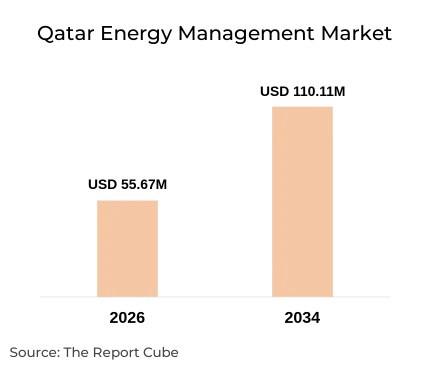
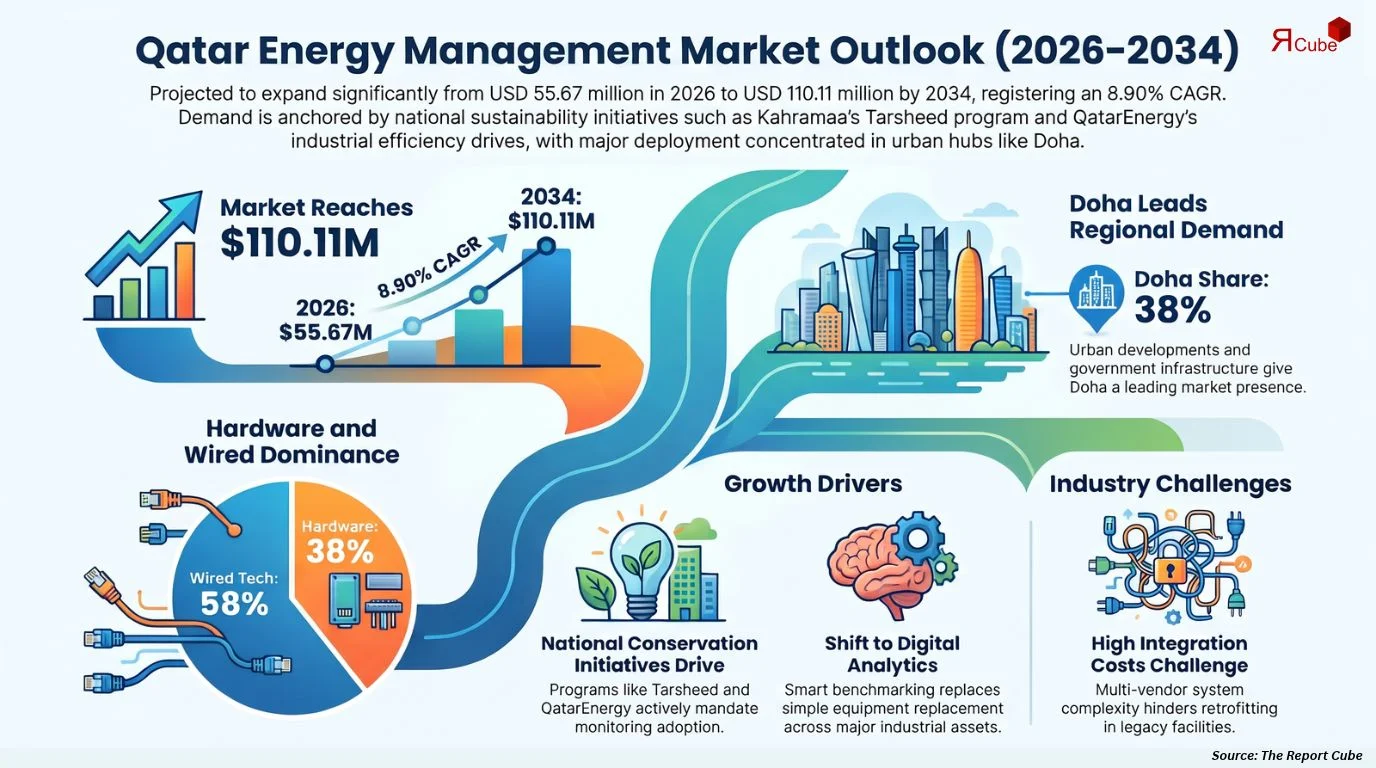
- Qatar Energy Management Market is valued at USD 55.67 million in 2026.
- The market is projected to reach USD 110.11 million by 2034 at an 8.90% CAGR.
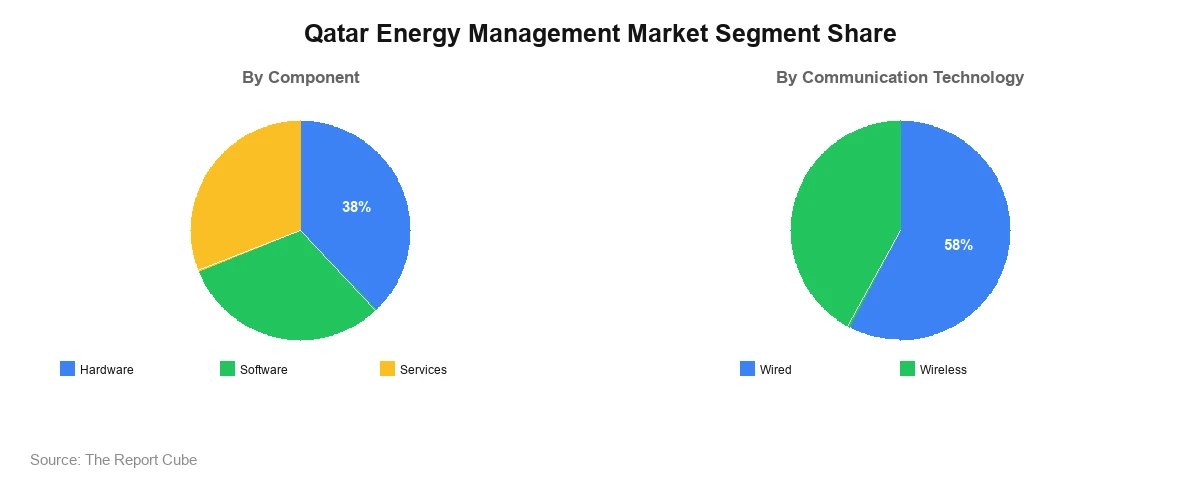
- Hardware leads the component segment with an estimated 38% share in 2026.
- Wired communication leads the technology segment with an estimated 58% share in 2026.
- Doha is the leading region with an estimated 38% share in 2026.
- End-user share data was not supplied, so leading and fastest-growing end users are not ranked.
- Siemens, Schneider Electric, Honeywell, Johnson Controls, ABB and Emerson are among the key players.
- Smart energy monitoring and industrial energy benchmarking are important technology themes.
Market Overview
Energy management refers to the monitoring, control, and optimization of energy use across buildings, industrial facilities, utilities, and homes. Systems combine sensors, meters, controllers, gateways, software platforms, and services to measure consumption, identify inefficiencies, and support operational decisions. Applications include building energy management, industrial energy management, demand management, energy auditing, and measurement and verification.
This Qatar Energy Management Market Analysis shows demand shaped by national conservation programmes and industrial efficiency initiatives. Kahramaa’s Tarsheed programme, launched in 2012, promotes electricity and water conservation, while QatarEnergy’s efficiency programme covers upstream, LNG, refining, gas-to-liquids, and petrochemical assets. Qatar National Vision 2030 further supports environmentally responsible development alongside economic growth.
Commercial establishments, industrial operators, and utilities adopt energy management solutions to reduce waste, improve operational visibility, and support sustainability targets. Smart monitoring, analytics, and benchmarking are gaining relevance across facilities. The market is valued at USD 55.67 million in 2026 and is projected to grow at a CAGR of 8.90% during 2026–2034.
Qatar Energy Management Market Dynamics
Qatar Energy Management Market Growth depends on national conservation programmes, industrial efficiency initiatives, building operations, and digital monitoring adoption. Implementation costs, system integration complexity, and legacy infrastructure influence deployment timelines, while competition among global automation, electrical, and building technology suppliers shapes pricing, service models, and technology selection.
|
Factor |
Type |
Specific Impact on Market |
Magnitude |
|---|---|---|---|
|
Government-led conservation programmes |
Driver |
Tarsheed promotes efficient electricity and water use and supports awareness of monitoring technologies |
High |
|
Energy optimization in oil and gas operations |
Driver |
QatarEnergy’s programme uses consumption monitoring and benchmarking across upstream, LNG, refining, GTL and petrochemical assets |
High |
|
Building energy management expansion |
Opportunity |
Integrated monitoring of cooling, lighting and ventilation in commercial, hospitality, healthcare and public buildings |
Medium–High |
|
Industrial analytics and managed services |
Opportunity |
Audits, predictive analytics, benchmarking and measurement and verification services for energy-intensive facilities |
Medium–High |
|
High implementation and integration costs |
Challenge |
Sensors, meters, networks, software and training raise project costs for smaller organizations and legacy sites |
Medium–High |
|
Multi-vendor system integration |
Challenge |
Different protocols and data formats increase deployment complexity and technical support needs |
Medium |
|
Smart energy monitoring |
Trend |
Digital, user-level consumption monitoring is gaining relevance, as seen in Kahramaa’s smart platform |
High |
|
Industrial energy benchmarking |
Trend |
Data-driven performance tracking is replacing reliance on equipment replacement alone |
Medium–High |
Qatar Energy Management Market Growth Drivers
Government conservation programmes support demand for monitoring and efficiency technologies. According to Kahramaa, the Tarsheed programme promotes efficient electricity and water use and has introduced an energy-efficiency smart platform that helps residential users understand and manage consumption. Awareness activities directed at building energy technicians reinforce structured energy management practices across Qatar.
Industrial operators also drive demand through systematic efficiency programmes. QatarEnergy’s programme covers upstream, LNG, refining, gas-to-liquids, and petrochemical assets, using consumption monitoring and benchmarking against design conditions to reduce fuel and feed-gas consumption. These practices increase the relevance of metering, analytics, and performance monitoring in energy-intensive facilities and across large industrial asset bases.
Qatar Energy Management Market Opportunities
Commercial buildings, hospitality facilities, healthcare institutions, and public infrastructure offer scope for integrated monitoring of cooling, lighting, ventilation, and other building systems. Qatar National Vision 2030 supports environmental protection and the use of environmentally sound technologies, which creates a policy context for expanding building energy management systems in both new and existing facilities.
Energy-intensive facilities can use energy audits, real-time monitoring, predictive analytics, benchmarking, and measurement and verification services to identify inefficiencies. QatarEnergy’s efficiency programme demonstrates the relevance of these activities across major industrial operations, indicating room for analytics platforms and managed energy services that convert consumption data into operational improvements and measurable efficiency gains.
Qatar Energy Management Industry Challenges
Energy management deployments may require sensors, smart meters, controllers, communication networks, software platforms, system integration, and staff training. The cost and complexity of combining these components can be a barrier for smaller organizations and facilities with legacy infrastructure, particularly where capital budgets may prioritize core operations over efficiency upgrades or system modernization.
Facilities may operate equipment from multiple vendors and use different control protocols, data formats, and legacy systems. Integrating these systems into a unified monitoring and optimization platform can increase deployment complexity and require specialized technical support, which may extend implementation timelines and raise project costs for building and industrial operators.
Need Specific Data, Let’s Customize the Report for You
Request CustomizationQatar Energy Management Market Trends
Qatar Energy Management Market Trends point toward wider use of smart energy monitoring. Kahramaa’s Tarsheed programme introduced an energy-efficiency smart platform that helps residential consumers understand consumption patterns and develop efficient usage plans, illustrating the growing relevance of digital, user-level energy management in residential settings alongside conventional public awareness campaigns.
Industrial energy management is also moving toward data-driven practice. QatarEnergy monitors energy consumption, benchmarks performance against design conditions, and applies performance indicators to identify efficiency gaps across its assets. This reflects a shift toward continuous measurement and analysis rather than reliance only on equipment replacement, and it may increase demand for analytics software and services.
Qatar Energy Management Market Segment Analysis
Qatar Energy Management Market Share is distributed across components, communication technologies, offerings, and end users, each reflecting different facility requirements and deployment models. Percentages are shown only where supplied for 2026. Share data for the remaining segments was not provided.
By Component
- Hardware
- Sensors & Meters
- Controllers
- Gateways & Communication Devices
- Servers & Computing Devices
- Display & User Interface Devices
- Others
- Software
- Energy Management & Monitoring Software
- Building Energy Management Software
- Industrial Energy Management Software
- Energy Analytics & Optimization Software
- Demand & Load Management Software
- Others
- Services
- Consulting & Energy Auditing
- System Integration & Implementation
- Maintenance & Support
- Managed Energy Services
- Measurement & Verification
Hardware leads the component segment with an estimated 38% share in 2026, supported by the physical infrastructure required for energy monitoring and control, including sensors and meters, controllers, gateways and communication devices, servers and computing devices, and display and user interface devices. Demand is linked to metering, building automation, and industrial monitoring deployments, and global electrical and automation suppliers such as Siemens, Schneider Electric, and ABB offer portfolios relevant to these requirements. Software follows, covering energy management and monitoring, building energy management, industrial energy management, analytics and optimization, and demand and load management platforms that convert measured data into operational decisions. Services complete the segment, spanning consulting and energy auditing, system integration and implementation, maintenance and support, managed energy services, and measurement and verification. Their role is driven by the need to configure, integrate, and validate systems across facilities with mixed equipment and legacy infrastructure.
By Communication Technology
- Wired
- Wireless
Wired communication leads the segment with an estimated 58% share in 2026, reflecting its use in facilities that require stable data transmission, deterministic control, and dependable connectivity for building management and industrial monitoring. Existing control infrastructure in commercial buildings and industrial plants also supports continued reliance on wired networks. Wireless communication follows, serving applications where retrofitting cables is difficult or costly, including sensor expansion, remote metering, and monitoring across distributed assets. Wireless systems can reduce installation complexity in existing facilities and support scalable data collection, although cybersecurity, interference, and coverage requirements influence design choices. Together, the two technologies can coexist, with selection depending on facility type, legacy equipment, reliability requirements, and integration needs.
Regional Analysis
|
Region |
Estimated Market Share |
Key Growth Factors |
Industry Trends |
|---|---|---|---|
|
Doha |
38% |
Government institutions, commercial buildings, hospitality facilities and smart-city districts such as Msheireb Downtown Doha |
Building automation, predictive maintenance and energy optimization in dense urban environments |
|
Al Khor |
- |
Regional demand detail requires validation |
Requires validation |
|
Al Raiyyan |
- |
Regional demand detail requires validation |
Requires validation |
|
Al Dawwah |
- |
Regional demand detail requires validation |
Requires validation |
|
Al Wakrah |
- |
Regional demand detail requires validation |
Requires validation |
Doha is the leading region with an estimated 38% share in 2026, supported by its concentration of government institutions, commercial buildings, hospitality facilities, and urban districts such as Msheireb Downtown Doha. Smart-city initiatives involving Siemens and Schneider Electric in the district indicate demand for building automation, predictive maintenance, and energy optimization solutions in dense urban environments.
Al Khor, Al Raiyyan, Al Dawwah, and Al Wakrah account for the remaining share, although individual regional allocations were not supplied. Demand in these areas is expected to depend on the local mix of industrial activity, public facilities, commercial buildings, and residential developments, and regional shares require validation before publication.
Market Share & Competitive Landscape
The Qatar Energy Management Market includes global automation, electrical, building technology, and energy solutions providers. The table summarizes supplied companies by general capability and relevant segment. It does not represent numerical market share, and Qatar-specific sales and project data should be validated.
|
Company |
Competitive Strength |
Primary Segment Served |
|---|---|---|
|
Siemens AG |
Building technology, automation, electrification and smart infrastructure portfolios |
Hardware, software and services for buildings and utilities |
|
Schneider Electric SE |
Energy management and automation, digital energy platforms |
Building and industrial energy management systems |
|
Honeywell International Inc. |
Building technologies and industrial automation |
Building and industrial energy management systems |
|
Johnson Controls International plc |
Building management, HVAC controls and efficiency solutions |
Building energy management systems |
|
ABB Ltd. |
Electrification and automation portfolios |
Industrial and power-related energy management |
|
Emerson Electric Co. |
Automation technologies and industrial software |
Industrial energy management |
|
Trane Technologies plc |
HVAC and building efficiency solutions |
Building energy management systems |
|
Enova |
Energy services and facilities-related solutions (company details require verification) |
Services for buildings and facilities |
|
Delta Electronics Inc. |
Power and energy-efficient electronics |
Hardware and monitoring components |
|
Mitsubishi Electric Corporation |
Automation and building systems |
Industrial and building energy management |
Key Companies in the Qatar Energy Management Market
Schneider Electric SE: Schneider Electric is headquartered in Rueil-Malmaison, France, and operates globally in energy management and automation. In May 2025, it signed a partnership with Invest Qatar covering smart infrastructure and AI solutions, and it has opened an office with a Services Training Centre in Msheireb Downtown Doha, strengthening local capabilities.
Siemens AG: Siemens AG is headquartered in Munich, Germany, and was founded in 1847, with portfolios spanning smart infrastructure, automation, and electrification. In September 2025, Estithmar Holding and Al Bidda Industries & Services signed an MoU with Siemens on smart, sustainable solutions, while Siemens’ work with Kahramaa included smart metering infrastructure.
Recent Developments
|
Year / Month |
Company |
Development |
|---|---|---|
|
May 2025 |
Invest Qatar and Schneider Electric |
Signed a partnership at the Qatar Economic Forum to support smart infrastructure and AI solutions. |
|
September 2025 |
Estithmar Holding, Al Bidda Industries & Services and Siemens |
Signed an MoU to advance smart and sustainable solutions. |
|
January 2026 |
Hamad International Airport and Kahramaa |
Launched an EV charging station initiative under the Tarsheed programme. |
Qatar Energy Management Market Future Outlook
Qatar Energy Management Market Forecast indicates expansion from USD 55.67 million in 2026 to USD 110.11 million by 2034 at an 8.90% CAGR, based on supplied estimates. Growth is expected to depend on national conservation programmes, industrial efficiency initiatives, building system upgrades, and wider adoption of monitoring, analytics, and managed energy services across commercial, industrial, and public-sector facilities during the forecast period.
Technology investment is likely to focus on smart metering, sensors, controllers, analytics software, and integration services, while competition among global suppliers may shape pricing and service models. Risks include high implementation costs, integration complexity across multi-vendor systems, and legacy infrastructure. The projected values remain supplied assumptions, and actual outcomes depend on policy implementation, technology adoption, supplier execution, and customer capital spending.
Qatar Energy Management Market Report Coverage
This Qatar Energy Management Market Report summarizes the supplied valuation, forecast assumptions, segmentation, regional framework, and competitive ecosystem.
|
Parameter |
Details |
|---|---|
|
Market Name |
Qatar Energy Management Market |
|
Market Size 2026 |
USD 55.67 million |
|
Market Size 2034 |
USD 110.11 million |
|
Forecast Period |
2026–2034 |
|
CAGR |
8.90% |
|
Base Year |
2026 |
|
Historical Years |
201-2025 |
|
Forecast Years |
2026–2034 |
|
Segments Covered |
By Component; By Communication Technology; By Offering; By End User |
|
Regions Covered |
Doha, Al Khor, Al Raiyyan, Al Dawwah, Al Wakrah |
|
Key Companies |
Siemens AG, Schneider Electric SE, Honeywell International Inc., Johnson Controls International plc, ABB Ltd., Emerson Electric Co., Trane Technologies plc, Enova, Delta Electronics Inc., Mitsubishi Electric Corporation |
|
Customization |
Available as per client requirements |
Why Choose This Qatar Energy Management Market Report?
- Market coverage spans energy management hardware, software and services across industrial, building and residential applications.
- Clear presentation of the supplied 2026 valuation, 2034 forecast and 8.90% CAGR.
- Segmentation covers component, communication technology, offering and end-user categories.
- Regional framework covers Doha, Al Khor, Al Raiyyan, Al Dawwah and Al Wakrah.
- Competitive profiling covers ten global automation, electrical and building technology companies.
- Trend insights draw on Tarsheed and QatarEnergy efficiency programmes to support planning and procurement strategy.
- Context on Qatar National Vision 2030 supports evaluation of energy efficiency investment priorities.
Table of Contents
- Introduction
- Objective of the Study
- Product Definition
- Market Segmentation
- Study Variables
- Research Methodology
- Secondary Data Points
- Companies Interviewed
- Primary Data Points
- Breakdown of Primary Interviews
- Secondary Data Points
- Executive Summary
- Market Dynamics
- Drivers
- Challenges
- Opportunity Assessment
- Recent Trends and Developments
- Policy and Regulatory Landscape
- Qatar Energy Management Market Overview and Forecast Analysis (2021-2034)
- Market Size, By Value, By Growth Rate (CAGR/USD Millions)
- Demand – Supply Trends
- Market Share, By Component
- Hardware
- Sensors & Meters
- Controllers
- Gateways & Communication Devices
- Servers & Computing Devices
- Display & User Interface Devices
- Others
- Software
- Energy Management & Monitoring Software
- Building Energy Management Software
- Industrial Energy
- Management Software
- Energy Analytics & Optimization Software
- Demand & Load Management Software
- Others
- Services
- Consulting & Energy Auditing
- System Integration & Implementation
- Maintenance & Support
- Managed
- Energy Services
- Measurement & Verification
- Hardware
- Market Share, By Communication Technology
- Wired
- Wireless
- Market Share, By Offering
- Industrial Energy Management Systems
- Building Energy Management Systems
- Home Energy Management Systems
- Others
- Market Share, By End User
- Oil & Gas
- Manufacturing & Industrial
- Power & Utilities
- Government & Public Sector
- Hospitality
- Healthcare
- Residential
- Data Centers & IT/Telecom
- Others
- Market Share, By Geography
- Doha
- Al Khor
- Al Raiyyan
- Al Dawwah
- Al Wakrah
- Market Share, By Competitors
- Competition Characteristics
- Revenue Shares
- Hardware Qatar Energy Management Market Overview, 2021-2034F
- By Value (USD Million)
- By Communication Technology – Market Size & Forecast 2021-2034, USD Million
- Wired
- Wireless
- Software Qatar Energy Management Market Overview, 2021-2034F
- By Value (USD Million)
- By Communication Technology – Market Size & Forecast 2021-2034, USD Million
- Wired
- Wireless
- Services Qatar Energy Management Market Overview, 2021-2034F
- By Value (USD Million)
- By Communication Technology – Market Size & Forecast 2021-2034, USD Million
- Wired
- Wireless
- Competitive Outlook (Company Profile – Partial List)
- Siemens AG
- Company Overview
- Business Segments
- Strategic Alliances/Partnerships
- Recent Developments
- Schneider Electric SE
- Company Overview
- Business Segments
- Strategic Alliances/Partnerships
- Recent Developments
- Honeywell International Inc.
- Company Overview
- Business Segments
- Strategic Alliances/Partnerships
- Recent Developments
- Johnson Controls International plc
- Company Overview
- Business Segments
- Strategic Alliances/Partnerships
- Recent Developments
- ABB Ltd.
- Company Overview
- Business Segments
- Strategic Alliances/Partnerships
- Recent Developments
- Emerson Electric Co.
- Company Overview
- Business Segments
- Strategic Alliances/Partnerships
- Recent Developments
- Trane Technologies plc
- Company Overview
- Business Segments
- Strategic Alliances/Partnerships
- Recent Developments
- Enova
- Company Overview
- Business Segments
- Strategic Alliances/Partnerships
- Recent Developments
- Delta Electronics Inc.
- Company Overview
- Business Segments
- Strategic Alliances/Partnerships
- Recent Developments
- Mitsubishi Electric Corporation
- Company Overview
- Business Segments
- Strategic Alliances/Partnerships
- Recent Developments
- Siemens AG
- Contact Us & Disclaimer
Top Key Players & Market Share Outlook
- Siemens AG
- Schneider Electric SE
- Honeywell International Inc.
- Johnson Controls International plc
- ABB Ltd.
- Emerson Electric Co.
- Trane Technologies plc
- Enova
- Delta Electronics Inc.
- Mitsubishi Electric Corporation
Frequently Asked Questions