



Build Your Custom Market Intelligence Report
Customize Your ReportQatar Greenhouse Market Insights & Analysis
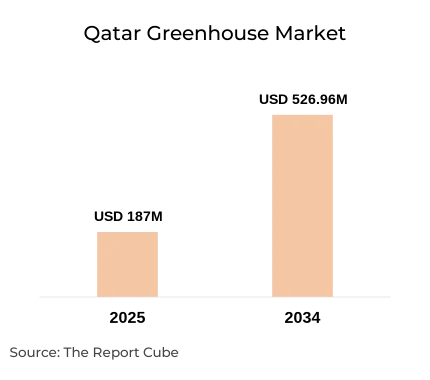
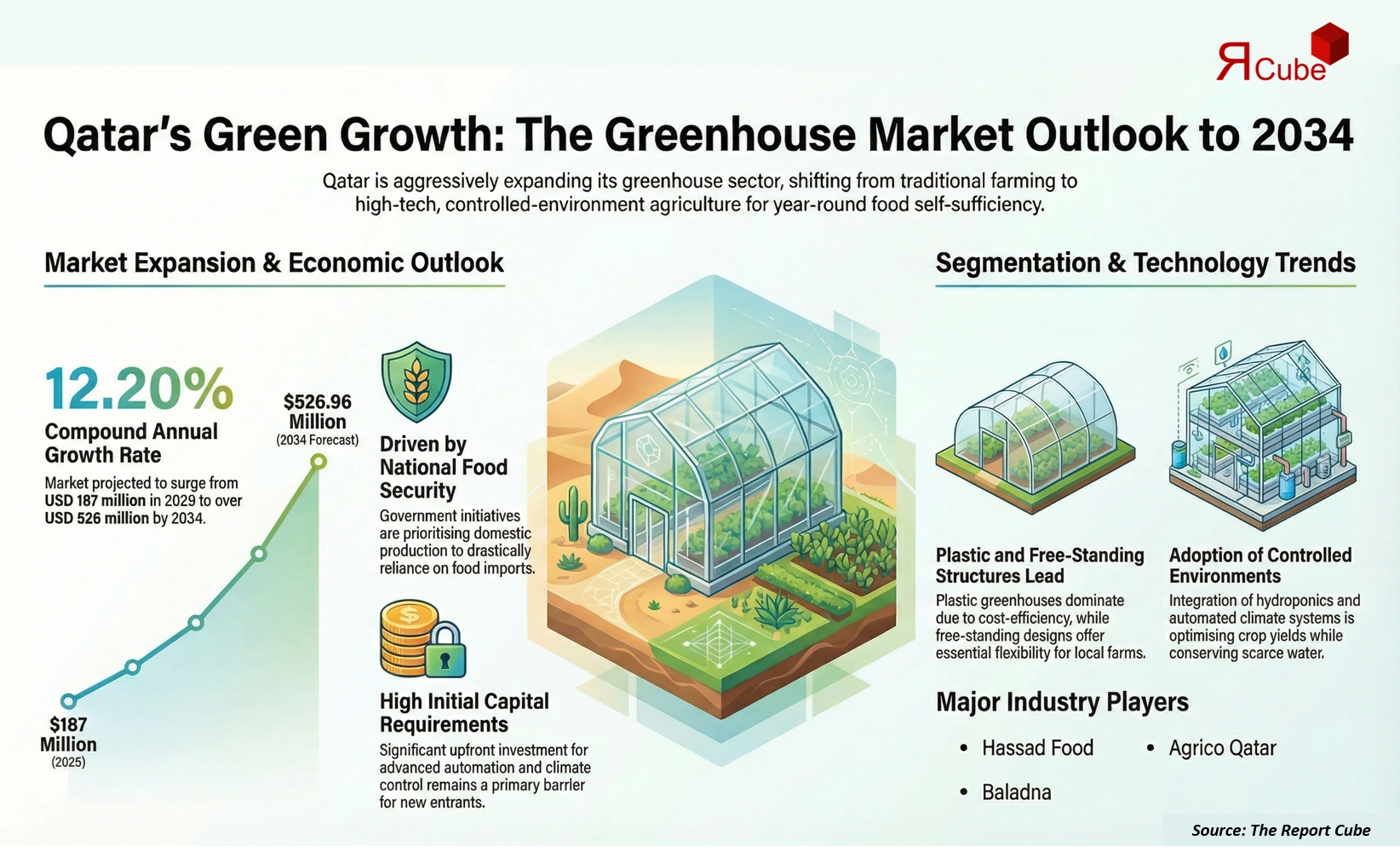
The Qatar greenhouse market is witnessing rapid growth as the country intensifies efforts to strengthen food security, reduce import dependency, and promote sustainable agricultural practices. In 2025, the market was valued at USD 187 million and is projected to reach USD 526.96 million by 2034, expanding at a CAGR of 12.20% during the 2026–2034 forecast period. Market growth is strongly supported by government-led agricultural modernization programs, rising demand for locally grown fresh produce, and increasing adoption of controlled environment agriculture technologies.
Qatar’s harsh climatic conditions, limited arable land, and water scarcity have accelerated the shift toward greenhouse farming systems. Greenhouses enable year-round cultivation by controlling temperature, humidity, light, and irrigation, significantly improving crop yield and quality. These systems are increasingly used to grow vegetables, fruits, herbs, and specialty crops that were previously dependent on imports.
The market has evolved from small-scale traditional structures to advanced greenhouse solutions integrating drip irrigation, hydroponics, climate control systems, and smart monitoring technologies. Local agribusinesses and government-backed entities are investing in modern greenhouse infrastructure to ensure consistent food supply and price stability. As consumer preference for fresh, locally produced food increases and sustainability goals gain priority, the Qatar greenhouse market is expected to experience strong and sustained long-term growth.
Qatar Greenhouse Market Key Highlight
- Strong government support for food security initiatives
- Greenhouse farming reduces dependence on food imports
- Plastic greenhouses dominate due to cost efficiency
- Free-standing structures widely adopted by local farms
- Advanced irrigation improves water-use efficiency
- Commercial agriculture drives large-scale installations
- Technology integration enhances crop productivity
- Rising demand for locally grown fresh produce
Key Market Driver – Food Security and Agricultural Self-Sufficiency
The primary driver of the Qatar greenhouse market is the national focus on food security and agricultural self-sufficiency. Government initiatives encourage domestic production of vegetables and fruits to reduce reliance on imports. Greenhouses enable high-yield farming under controlled conditions, making them essential for achieving these strategic objectives.
Additionally, population growth and increasing consumption of fresh produce further support greenhouse expansion. Subsidies, technical assistance, and public-private partnerships play a vital role in accelerating adoption among commercial farms and agribusinesses.
Key Market Trends – Adoption of Advanced Controlled Environment Systems
A key trend shaping the market is the adoption of advanced controlled environment agriculture technologies. Modern greenhouses incorporate automated climate control, drip irrigation, fertigation, and data-driven monitoring systems to optimize crop growth and reduce resource wastage.
Another emerging trend is the shift toward hydroponic and soilless cultivation systems, which improve productivity while minimizing water consumption. These innovations align with Qatar’s sustainability and water conservation goals.
Major Market Challenge – High Initial Capital Investment
Despite strong growth prospects, high initial capital investment remains a major challenge. Advanced greenhouse structures, climate control systems, and automation technologies require significant upfront expenditure. This can limit adoption among small-scale farmers and new entrants.
Operational challenges such as skilled labor requirements and energy costs also impact profitability, particularly for technologically advanced installations.
Key Market Opportunity – Expansion of Commercial and Export-Oriented Farming
The expansion of commercial greenhouse farming presents a significant opportunity. Large-scale projects aimed at supplying domestic retail chains, hospitality sectors, and institutional buyers are increasing. Additionally, niche export opportunities for high-quality produce may emerge as production capacity and quality standards improve.
Need Specific Data, Let’s Customize the Report for You
Contact UsQatar Greenhouse Market Segment-wise Analysis
This section evaluates market segmentation by greenhouse type and material used, highlighting adoption patterns and performance characteristics.
By Type:
- Free-standing Greenhouses
- Gutter-connected Greenhouses
Free-standing greenhouses hold the largest share of the Qatar greenhouse market due to flexibility, lower construction complexity, and suitability for small and medium-scale farms. Gutter-connected greenhouses are gaining traction in large commercial projects where scalability and efficient land use are priorities.
By Material Used:
- Plastic Greenhouse
- Glass Greenhouse
Plastic greenhouses dominate the market owing to lower cost, ease of installation, and good thermal insulation. Glass greenhouses are adopted in high-end commercial projects where superior light transmission and durability are required, though higher costs limit widespread use.
Qatar Greenhouse Market Recent Development 2025
- Hassad Food expanded controlled environment agriculture projects to boost local production
- Baladna invested in greenhouse farming for fresh fodder and produce
- Elite Agro Qatar strengthened greenhouse vegetable cultivation capacity
- Netafim Middle East supplied advanced drip irrigation systems for greenhouse farms
Qatar Greenhouse Market Future Outlook (2034)
By 2034, the Qatar greenhouse market is expected to reach USD 526.96 million, driven by continued government support, technological advancements, and rising demand for locally grown produce. Adoption of smart greenhouse technologies, hydroponics, and energy-efficient systems will further enhance productivity and sustainability. Commercial greenhouse projects will remain the primary growth engine, while innovation and operational efficiency improvements will support long-term market expansion. Overall, the outlook remains highly positive, aligned with Qatar’s food security and sustainability objectives.
Major Queries Answered in the Report
- What is the current and forecast size of the Qatar greenhouse market?
- Which greenhouse types are most widely adopted?
- How do food security initiatives influence market growth?
- Which materials dominate greenhouse construction?
- What challenges affect greenhouse adoption in Qatar?
- Which regions lead greenhouse farming activities?
- Who are the key players operating in the Qatar greenhouse market?
Table of Contents
- Introduction
- Objective of the study
- Product Definition
- Market Segmentation
- Study Variables
- Research Methodology
- Secondary Data Points
- Companies Interviewed
- Primary Data Points
- BreakDown of Primary Interviews
- Secondary Data Points
- Executive Summary
- Market Dynamics
- Drivers
- Challenges
- Opportunity Assessment
- Recent Trends and Developments
- Policy and Regulatory Landscape
- Oman Greenhouse Market Overview (2020-2034)
- Market Size, By Value (in USD Millions)
- Market Share, By Type
- Free-standing Greenhouses
- Gutter-connected Greenhouses
- Market Share, By Material Used
- Plastic Greenhouse
- Glass Greenhouse
- Market Share, By Technology
- Heating System
- Cooling System
- Others
- Market Share, By Crop Type
- Fruits and Vegetables
- Flowers and Ornamentals
- Others
- Market Share, By Region
- North
- East
- West
- South
- Central
- Market Share, By Competitors
- Competition Characteristics
- Revenue Shares
- Oman Free-standing Greenhouses Greenhouse Market Overview, 2020-2034F
- By Value (USD Million)
- By Material Used- Market Size & Forecast 2020-2034, USD Million
- By Technology- Market Size & Forecast 2020-2034, USD Million
- By Crop Type- Market Size & Forecast 2020-2034, USD Million
- Oman Gutter-connected Greenhouses Greenhouse Market Overview, 2020-2034F
- By Value (USD Million)
- By Material Used- Market Size & Forecast 2020-2034, USD Million
- By Technology- Market Size & Forecast 2020-2034, USD Million
- By Crop Type- Market Size & Forecast 2020-2034, USD Million
- Competitive Outlook (Company Profile - Partial List)
- Hassad Food
- Company Overview
- Business Segments
- Strategic Alliances/Partnerships
- Recent Developments
- Agrico Qatar
- Company Overview
- Business Segments
- Strategic Alliances/Partnerships
- Recent Developments
- Widam Food Company
- Company Overview
- Business Segments
- Strategic Alliances/Partnerships
- Recent Developments
- Baladna
- Company Overview
- Business Segments
- Strategic Alliances/Partnerships
- Recent Developments
- Qatar Greenhouses Company
- Company Overview
- Business Segments
- Strategic Alliances/Partnerships
- Recent Developments
- Elite Agro Qatar
- Company Overview
- Business Segments
- Strategic Alliances/Partnerships
- Recent Developments
- Agrimatco Qatar
- Company Overview
- Business Segments
- Strategic Alliances/Partnerships
- Recent Developments
- Netafim Middle East
- Company Overview
- Business Segments
- Strategic Alliances/Partnerships
- Recent Developments
- Rijk Zwaan Middle East
- Company Overview
- Business Segments
- Strategic Alliances/Partnerships
- Recent Developments
- Others
- Hassad Food
- Contact Us & Disclaimer
Top Key Players & Market Share Outlook
- Hassad Food
- Agrico Qatar
- Widam Food Company
- Baladna
- Qatar Greenhouses Company
- Elite Agro Qatar
- Agrimatco Qatar
- Netafim Middle East
- Rijk Zwaan Middle East
- Others
Frequently Asked Questions






