



Build Your Custom Market Intelligence Report
Customize Your ReportEurope ESG Compliance in FMCG Market Key Highlights
By Offering:
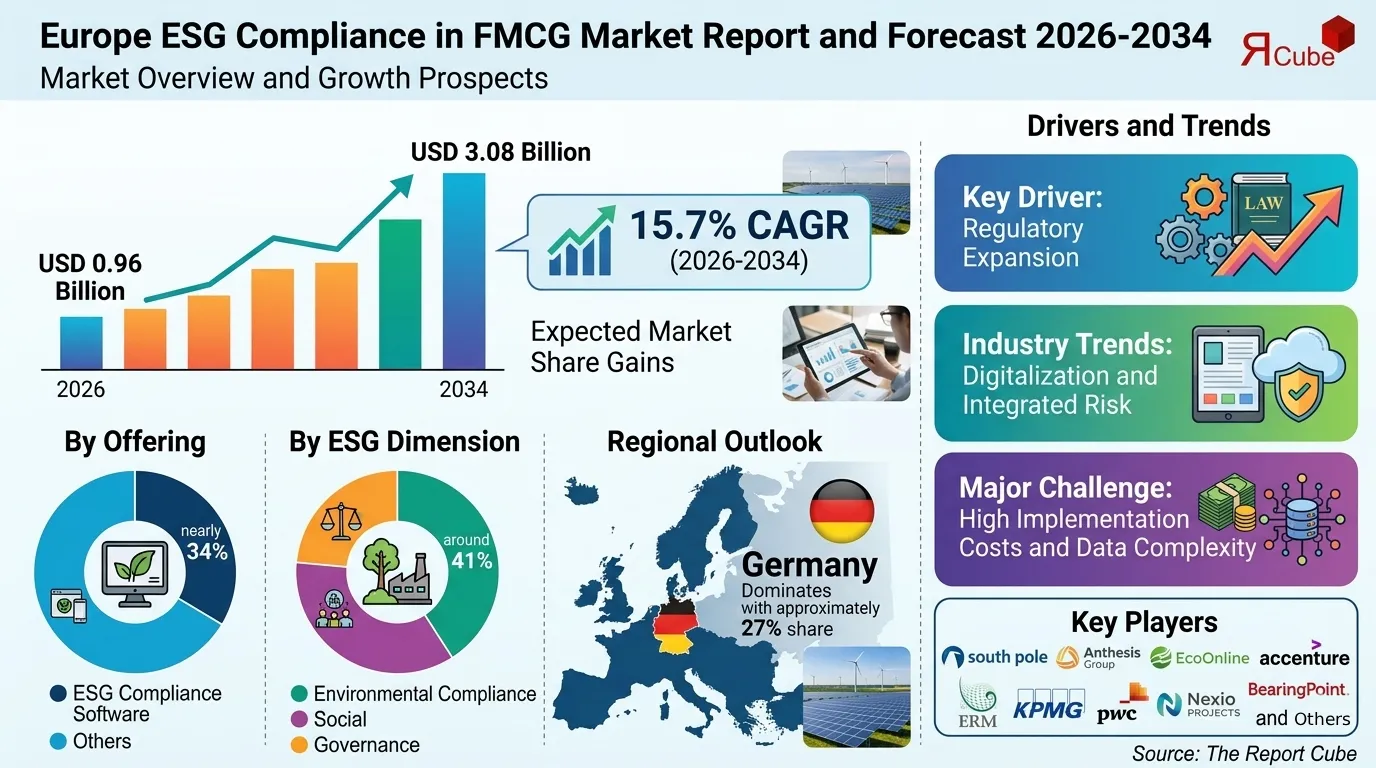
ESG Compliance Software segment leads the market with nearly 34% market share.
By ESG Dimension:
Environmental Compliance segment dominates the market with around 41% of revenue.
Regional Outlook:
Germany dominates the Europe ESG Compliance in FMCG market with approximately 27% share.
Europe ESG Compliance in FMCG Market Insights & Analysis
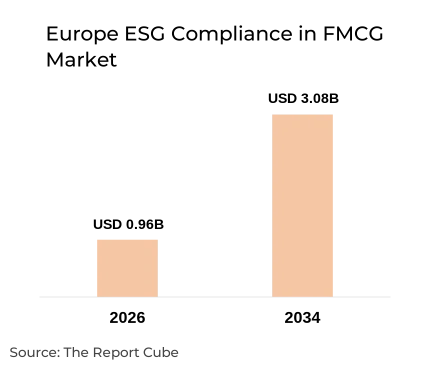
The Europe ESG Compliance in FMCG Market is anticipated to register a CAGR of around 15.7% during the forecast period 2026-2034. The market size is valued at USD 0.96 billion in 2026 and is projected to reach USD 3.08 billion by 2034. This strong Europe ESG Compliance in FMCG Market growth reflects the region’s accelerated transition toward sustainability-driven operations, supported by strict regulatory frameworks such as CSRD and EU Taxonomy. Increasing regulatory pressure on FMCG companies to disclose environmental and social impacts has significantly expanded demand for ESG advisory, reporting, and compliance software solutions.
Investment trends indicate that over 65% of large FMCG companies in Europe are expected to allocate dedicated ESG compliance budgets by 2027. The market is also witnessing rapid innovation in digital ESG platforms, enabling automated reporting and real-time monitoring of sustainability metrics. Companies are integrating supply chain traceability tools and climate-risk analytics to meet stringent compliance requirements. In addition, collaborations between consulting firms and software providers are accelerating adoption across mid-sized enterprises, further strengthening Europe ESG Compliance in FMCG Market value and revenue potential.
Europe ESG Compliance in FMCG Market Dynamics
Key Driver: Regulatory Expansion and Mandatory ESG Reporting Frameworks
The primary driver of the Europe ESG Compliance in FMCG Market is the rapid expansion of mandatory ESG reporting frameworks across the European Union. Regulations such as CSRD and CSDDD have significantly widened the scope of companies required to disclose sustainability data. By 2026, more than 50,000 companies are expected to fall under CSRD compliance, creating a massive demand for ESG reporting services and software solutions. FMCG companies, with complex supply chains, are particularly impacted due to the need for transparent sourcing and emissions tracking.
Moreover, the concept of double materiality has reshaped corporate reporting strategies. Businesses must now assess both financial risks and environmental or social impacts. This shift has pushed FMCG players to invest heavily in ESG compliance tools, driving Europe ESG Compliance in FMCG Market size expansion. The increased accountability toward stakeholders and investors further reinforces the importance of structured ESG compliance systems.
Book your FREE 30-minute expert consultation today
Contact UsIndustry Trends: Digitalization of ESG Platforms and Integrated Risk Management
A key trend shaping the Europe ESG Compliance in FMCG Market is the rapid digitalization of ESG management systems. Companies are adopting cloud-based platforms to centralize ESG data collection, reporting, and analytics. These platforms enable real-time monitoring of emissions, packaging waste, and supply chain risks. By 2025, nearly 48% of European FMCG companies had integrated ESG dashboards into their operational systems, enhancing decision-making capabilities.
Another emerging trend is the integration of ESG compliance with enterprise risk management. Businesses are shifting from standalone compliance tools to unified risk platforms that cover environmental, health, safety, and governance risks. This integrated approach improves efficiency and ensures faster regulatory alignment. As a result, ESG compliance is becoming a strategic function rather than a regulatory obligation, boosting Europe ESG Compliance in FMCG Market trends.
Major Challenge: High Implementation Costs and Data Complexity
One of the major challenges in the Europe ESG Compliance in FMCG Market is the high cost associated with implementing ESG solutions. Advanced compliance software, consulting services, and continuous monitoring systems require substantial financial investment. Small and mid-sized FMCG enterprises often struggle to adopt these systems due to budget constraints, limiting market penetration.
Additionally, data complexity poses a significant barrier. FMCG companies operate across multiple geographies with diverse suppliers, making ESG data collection and validation difficult. Inconsistent data standards and lack of interoperability between systems further complicate reporting processes. These challenges can delay compliance and increase operational risks, restraining Europe ESG Compliance in FMCG Market growth.
Opportunity: Expansion of ESG Compliance Across Supply Chains
The growing focus on supply chain transparency presents a major opportunity for the Europe ESG Compliance in FMCG Market. Companies are increasingly required to monitor supplier practices related to labor conditions, emissions, and resource usage. This has created strong demand for ESG supply chain platforms and analytics tools that provide end-to-end visibility.
Furthermore, the rise of sustainable consumer behavior is encouraging FMCG brands to strengthen ESG compliance beyond regulatory requirements. Companies that demonstrate strong ESG performance are gaining competitive advantages in terms of brand loyalty and investor confidence. This shift is expected to unlock new revenue streams and accelerate Europe ESG Compliance in FMCG Market value over the forecast period.
Europe ESG Compliance in FMCG Market Segment-wise Analysis
By Offering:
- ESG Advisory Services
- ESG Reporting Services
- ESG Compliance Software
- ESG Training and Assurance
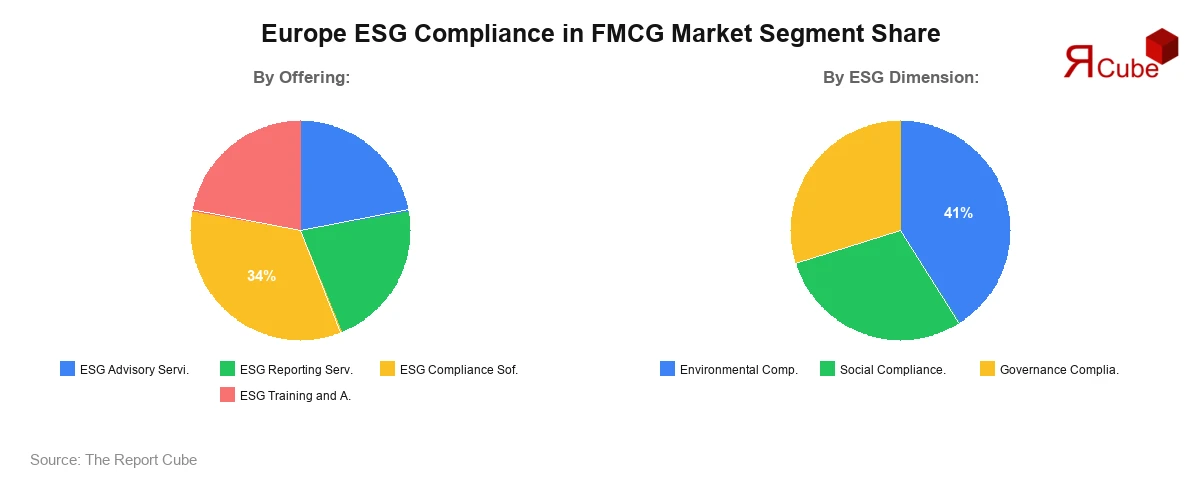
The ESG compliance software segment leads the Europe ESG Compliance in FMCG Market share with approximately 34% contribution in 2026. This dominance is driven by increasing demand for automated reporting and real-time data management solutions. Companies are prioritizing digital tools that streamline compliance with EU regulations such as CSRD and EU Taxonomy. Platforms offering features like carbon tracking, regulatory reporting, and supply chain monitoring are witnessing strong adoption.
Furthermore, cloud-based ESG software solutions are gaining traction due to their scalability and cost efficiency. Around 55% of large FMCG enterprises in Europe have already implemented centralized ESG data platforms. These tools not only enhance compliance but also improve operational transparency and risk management, strengthening overall Europe ESG Compliance in FMCG Market growth.
By ESG Dimension:
- Environmental Compliance
- Social Compliance
- Governance Compliance
Environmental compliance dominates the Europe ESG Compliance in FMCG Market with nearly 41% revenue share. The focus on reducing carbon emissions, sustainable packaging, and resource efficiency has significantly increased investments in environmental compliance solutions. FMCG companies are under pressure to meet net-zero targets and circular economy goals, driving demand for environmental analytics and reporting tools.
In addition, stricter regulations related to deforestation, water usage, and waste management are pushing companies to adopt comprehensive environmental monitoring systems. This segment continues to lead due to its direct impact on regulatory compliance and brand reputation, reinforcing Europe ESG Compliance in FMCG Market trends.
Regional Projection of Europe ESG Compliance in FMCG Industry
- The UK
- Germany
- The Netherlands
- France
- Spain
- Italy
- Rest of Europe
Germany leads the Europe ESG Compliance in FMCG Market with an estimated 27% share, driven by strong regulatory enforcement and industrial base. The country has been at the forefront of sustainability initiatives, with strict environmental laws and active adoption of ESG frameworks across industries. German FMCG companies are early adopters of ESG compliance software and advisory services, ensuring adherence to EU regulations.
Additionally, Germany’s focus on circular economy practices and carbon neutrality goals has accelerated investments in ESG technologies. The presence of leading consulting firms and technology providers further supports market growth. This leadership position is expected to continue as regulatory requirements become more stringent across Europe.
Need insights for a specific region within this market?
Request Regional DataGovernment Initiatives & Policies
- EU Corporate Sustainability Reporting Directive (CSRD): Expands ESG reporting requirements to over 50,000 companies, mandating standardized disclosures.
- EU Corporate Sustainability Due Diligence Directive (CSDDD): Requires companies to identify and mitigate ESG risks across supply chains, strengthening accountability.
Europe ESG Compliance in FMCG Industry Recent Developments
- 2025: EcoOnline expanded its ESG capabilities by acquiring D4H, integrating crisis management with ESG and EHS solutions, enabling FMCG firms to manage risks and regulatory compliance more effectively across Europe.
- 2026: EcoOnline launched its Mega Trends report highlighting the transition toward connected ESG risk platforms, supporting FMCG companies in integrating compliance across operations and supply chains.
- 2026: KPMG introduced updated guidance on EU ESG regulations, helping FMCG companies align reporting and compliance strategies with evolving CSRD and CSDDD frameworks.
Why Choose This Report? Europe ESG Compliance in FMCG Market
- Provides a comprehensive overview of the overall market analysis, encompassing key trends, consumer behavior analysis, and risk assessment to support strategic decision-making.
- Provides accurate, up-to-date insights into market size, segmentation, and emerging opportunities, helping to minimize risk & capitalizing on growth.
- Gives deep understanding of target audience preferences, investment habits, and communication channels for enhanced product development & marketing effectiveness.
- Delivers competitive analysis & benchmarking, uncovering the strengths & weaknesses of market competitors to guide strategies.
- Consolidate comprehensive market intelligence, reducing reasoning & streamlining research efforts.
- Facilitates customized market segmentation & risk mitigation strategies, fine-tuned to the business objectives.
- Aids in identifying both market challenges & untapped opportunities within the industry to drive long-term business growth.
- Provides valuable information based on actual customer data & search trends.
Table of Contents
- Introduction
- Objective of the Study
- Product and Category Definition
- Market Segmentation
- Study Variables
- Research Methodology
- Secondary Data Points
- Breakdown of Secondary Sources
- Primary Data Points
- Breakdown of Primary Interviews
- Secondary Data Points
- Executive Summary
- Market Dynamics
- Drivers
- Challenges
- Opportunity Assessment
- Recent Trends and Developments
- Regulatory and Policy Landscape
- Europe ESG Compliance in FMCG Market Overview (2021-2034)
- Market Size, By Value (USD Billion)
- Market Share, By Offering
- ESG Advisory Services
- Strategy Development
- Materiality Assessment
- ESG Program Design
- Change Management
- ESG Reporting Services
- CSRD and ESRS Reporting
- EU Taxonomy Alignment
- SFDR and PAI Disclosures
- GRI and ISSB Reporting
- ESG Compliance Software
- Data Management Platforms
- Regulatory Reporting Tools
- Supply Chain ESG Platforms
- Risk and Performance Analytics
- ESG Training and Assurance
- ESG Capacity Building
- ESG Audits and Assurance
- Certification Support
- ESG Advisory Services
- Market Share, By ESG Dimension
- Environmental Compliance
- Climate and Emissions
- Resource and Water Use
- Packaging and Circularity
- Deforestation and Sourcing
- Social Compliance
- Labor and Human Rights
- Health and Safety
- Community and Consumers
- Diversity and Inclusion
- Governance Compliance
- Ethics and Anti-corruption
- Board Oversight and Policies
- ESG Risk Management
- Environmental Compliance
- Market Share, By FMCG Segment
- Food and Beverage
- Personal Care and Beauty
- Household and Home Care
- Retail and E-commerce
- Others
- Market Share, By Deployment
- On-premise Solutions
- Cloud-based Solutions
- Hybrid Solutions
- Market Share, By Organization Size
- Large Enterprises
- Small and Mid-sized Enterprises
- Market Share, By Country
- The UK
- Germany
- The Netherlands
- France
- Spain
- Italy
- Rest of Europe
- Market Share, By Company
- Revenue Shares and Analysis
- Competitive Landscape
- The UK Europe ESG Compliance in FMCG Market
- Market Size, By Value (USD Billion/Million)
- Market Share, By Offering
- Market Share, By ESG Dimension
- Market Share, By FMCG Segment
- Market Share, By Deployment
- Market Share, By Organization Size
- Germany Europe ESG Compliance in FMCG Market
- Market Size, By Value (USD Billion/Million)
- Market Share, By Offering
- Market Share, By ESG Dimension
- Market Share, By FMCG Segment
- Market Share, By Deployment
- Market Share, By Organization Size
- The Netherlands Europe ESG Compliance in FMCG Market
- Market Size, By Value (USD Billion/Million)
- Market Share, By Offering
- Market Share, By ESG Dimension
- Market Share, By FMCG Segment
- Market Share, By Deployment
- Market Share, By Organization Size
- France Europe ESG Compliance in FMCG Market
- Market Size, By Value (USD Billion/Million)
- Market Share, By Offering
- Market Share, By ESG Dimension
- Market Share, By FMCG Segment
- Market Share, By Deployment
- Market Share, By Organization Size
- Spain Europe ESG Compliance in FMCG Market
- Market Size, By Value (USD Billion/Million)
- Market Share, By Offering
- Market Share, By ESG Dimension
- Market Share, By FMCG Segment
- Market Share, By Deployment
- Market Share, By Organization Size
- Italy Europe ESG Compliance in FMCG Market
- Market Size, By Value (USD Billion/Million)
- Market Share, By Offering
- Market Share, By ESG Dimension
- Market Share, By FMCG Segment
- Market Share, By Deployment
- Market Share, By Organization Size
- Competitive Outlook and Company Profiles
- South Pole
- Company Overview
- Product Portfolio
- Strategic Alliances/Partnerships
- Recent Developments
- Anthesis Group
- Company Overview
- Product Portfolio
- Strategic Alliances/Partnerships
- Recent Developments
- EcoOnline
- Company Overview
- Product Portfolio
- Strategic Alliances/Partnerships
- Recent Developments
- Accenture (Sustainability Services)
- Company Overview
- Product Portfolio
- Strategic Alliances/Partnerships
- Recent Developments
- ERM
- Company Overview
- Product Portfolio
- Strategic Alliances/Partnerships
- Recent Developments
- KPMG (ESG Advisory)
- Company Overview
- Product Portfolio
- Strategic Alliances/Partnerships
- Recent Developments
- PwC (Sustainability Services)
- Company Overview
- Product Portfolio
- Strategic Alliances/Partnerships
- Recent Developments
- Nexio Projects
- Company Overview
- Product Portfolio
- Strategic Alliances/Partnerships
- Recent Developments
- BearingPoint
- Company Overview
- Product Portfolio
- Strategic Alliances/Partnerships
- Recent Developments
- EcoVadis
- Company Overview
- Product Portfolio
- Strategic Alliances/Partnerships
- Recent Developments
- Sphera
- Company Overview
- Product Portfolio
- Strategic Alliances/Partnerships
- Recent Developments
- Envea
- Company Overview
- Product Portfolio
- Strategic Alliances/Partnerships
- Recent Developments
- Deloitte (ESG and Sustainability)
- Company Overview
- Product Portfolio
- Strategic Alliances/Partnerships
- Recent Developments
- dss+ (DuPont Sustainable Solutions)
- Company Overview
- Product Portfolio
- Strategic Alliances/Partnerships
- Recent Developments
- Others
- South Pole
- Contact Us and Disclaimer
Top Key Players & Market Share Outlook
- South Pole
- Anthesis Group
- EcoOnline
- Accenture (Sustainability Services)
- ERM
- KPMG (ESG Advisory)
- PwC (Sustainability Services)
- Nexio Projects
- BearingPoint
- EcoVadis
- Sphera
- Envea
- Deloitte (ESG & Sustainability)
- dss+ (DuPont Sustainable Solutions)
- Others
Frequently Asked Questions






