



Build Your Custom Market Intelligence Report
Customize Your ReportGlobal Ethane Market Key Highlights
By Source:
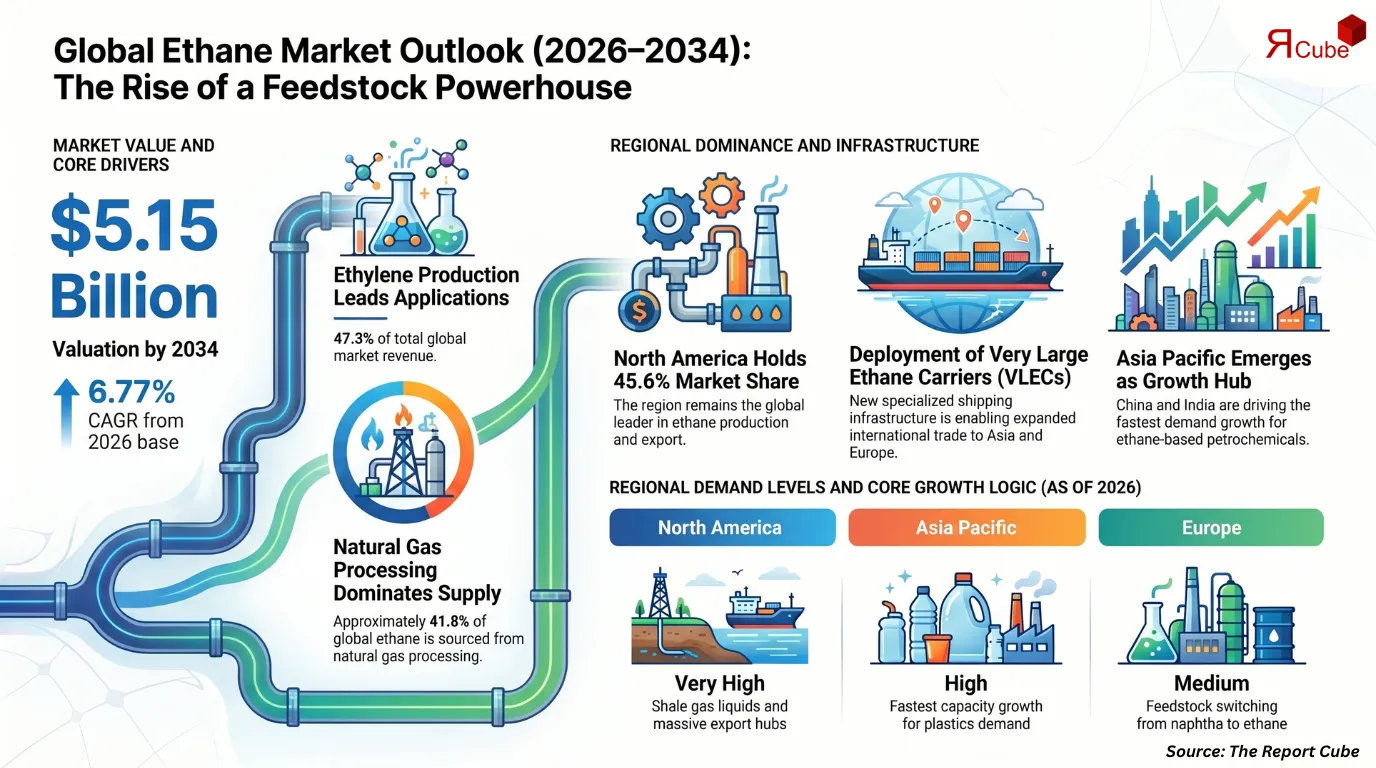
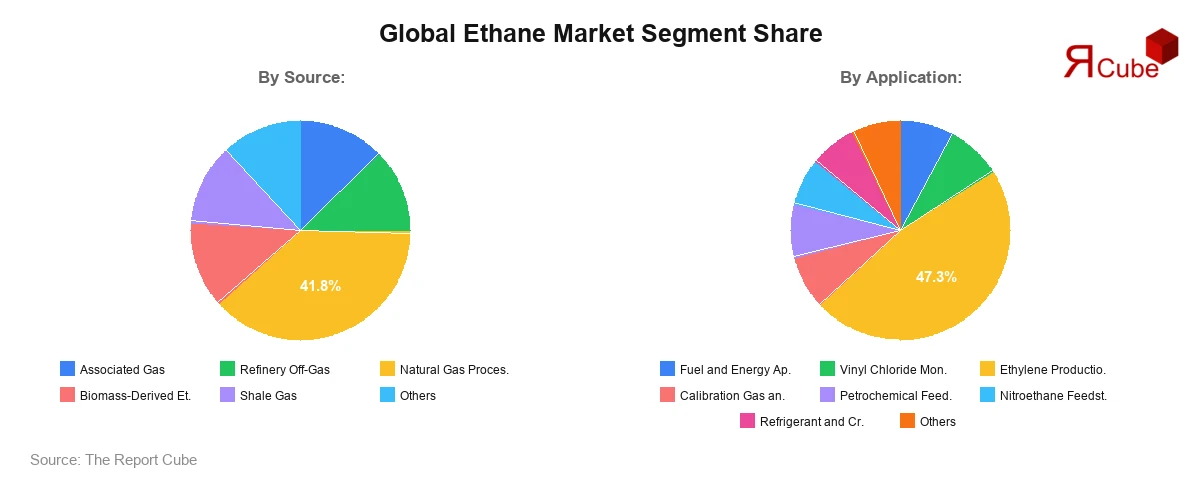
Natural Gas Processing segment leads the market with approximately 41.8% share.
By Application:
Ethylene Production segment dominates the market with nearly 47.3% of total revenue.
Regional Outlook:
North America dominates the Global Ethane Market with around 45.6% share.
Global Ethane Market Insights & Analysis
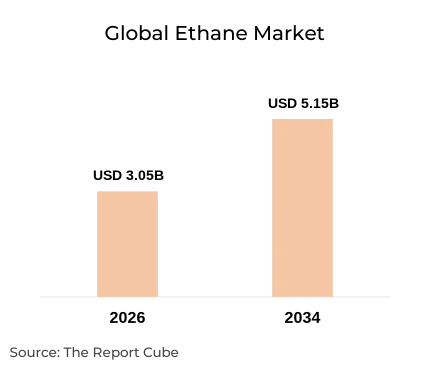
The Global Ethane Market is anticipated to register a CAGR of around 6.77% during the forecast period 2026-2034. The market size is valued at USD 3.05 billion in 2026 and is projected to reach USD 5.15 billion by 2034. The ethane market continues to gain momentum as expanding ethylene production capacities, rising petrochemical investments, and the need for economical hydrocarbon feedstocks drive industry growth. As one of the most cost-effective feedstocks used in steam cracking, ethane remains highly attractive, particularly in regions with abundant natural gas resources. Ongoing investments in export terminals, pipeline networks, and specialized ethane transportation infrastructure are strengthening supply chains and enabling smoother international trade flows. In addition, many petrochemical manufacturers are increasingly transitioning from naphtha-based feedstocks to ethane to enhance profitability, improve operational efficiency, and lower production expenses.
Throughout 2025 and 2026, the global ethane industry is witnessing significant expansion across its entire value chain. Large-scale projects across the United States Gulf Coast, Europe, India, and other Asian markets are supporting increased export capacity and encouraging long-term supply partnerships. The development of new ethane export facilities, capacity additions in petrochemical crackers, and the deployment of very large ethane carriers (VLECs) are opening new avenues for market growth. Favorable feedstock economics continue to encourage petrochemical producers to adopt ethane-based production processes over alternative raw materials. Furthermore, advancements in natural gas processing technologies and enhanced ethane recovery systems are improving production efficiency, reinforcing long-term market expansion, rising demand, and the growth of global ethane trade.
Global Ethane Market Impact Analysis
| Factor | Type | Specific Impact on Market | Magnitude | Business Implication |
|---|---|---|---|---|
| Petrochemical and Ethylene Demand Growth | Market | Higher ethylene production needs lift global ethane consumption volumes | High | Supports long term contracts with crackers and integrated chemical majors |
| Expansion of Natural Gas and NGL Output | Environmental | Rising shale and gas liquids output increases ethane availability worldwide | High | Enables capacity additions and export oriented supply strategies in key hubs |
| Regional Shift Toward U.S. and APAC Supply | Competitive | North America and Asia Pacific strengthen roles as major ethane trade centers | High | Drives investment focus toward U.S. export terminals and Asian cracker projects |
| Price Volatility Linked to Gas and Oil Cycles | Market | Fluctuating gas liquids prices impact ethane economics versus alternative feedstocks | Medium | Requires hedging tools and flexible feedstock strategies in ethylene plants |
| Environmental and Emissions Regulations | Regulatory | Climate policies raise scrutiny on ethane based petrochemicals and emissions | Medium | Promotes investment in efficiency, carbon management and lower emission technologies |
| Infrastructure and Shipping Capacity Expansion | Technological | New pipelines and very large gas carriers improve long distance ethane trade | Medium | Opens arbitrage opportunities and supports diversified market access for producers |
| Downstream Plastics and Consumer Goods Demand | Consumer | Growth in packaging, automotive and construction materials sustains ethane use | High | Encourages alignment with high growth end use clusters and value chain partnerships |
Global Ethane Market Dynamics
Key Driver: Growing Ethylene Production Capacity Across Global Petrochemical Hubs
The accelerating expansion of ethylene production capacity across major petrochemical regions continues to be the most significant growth catalyst for the global ethane market. Ethylene remains a foundational petrochemical building block used in the production of polyethylene, ethylene oxide, styrene, and a wide range of industrial and consumer chemicals. Because ethane delivers a higher ethylene conversion yield than several alternative feedstocks, it has become the preferred choice for many petrochemical manufacturers seeking greater operational efficiency and cost competitiveness.
Rising global demand for packaging solutions, automotive materials, construction products, and industrial plastics is creating sustained consumption of ethylene-based derivatives. In response, producers are investing heavily in new steam crackers and upgrading existing facilities to maximize ethane utilization. Across North America, Europe, and Asia Pacific, petrochemical companies are also entering long-term ethane procurement agreements to strengthen feedstock security and reduce exposure to fluctuations in naphtha pricing. These strategic developments are expected to reinforce ethane demand, support revenue growth, and drive market expansion throughout the forecast period.
Industry Trends: Expansion of Global Ethane Trade and Export Infrastructure
The global ethane trade landscape is undergoing a significant transformation as both exporting and importing nations expand specialized logistics and handling infrastructure. The United States continues to dominate international ethane supply, supported by abundant shale gas resources, increasing production volumes, and ongoing investments in export terminal capacity.
A key industry trend is the growing deployment of very large ethane carriers (VLECs) and dedicated import facilities designed specifically for ethane transportation and storage. Countries such as India, China, and Belgium are strengthening their import capabilities to secure reliable feedstock supplies and diversify sourcing strategies. At the same time, petrochemical producers are incorporating greater volumes of ethane into cracker operations to improve production economics, particularly during periods of weaker petrochemical margins. As infrastructure networks become more sophisticated and globally connected, international ethane trade is expected to expand steadily, supporting market growth and increasing global market penetration through 2034.
Book your FREE 30-minute expert consultation today
Contact UsMajor Challenge: Trade Policy Uncertainty and Supply Chain Risks
Althrough favorable growth prospects, the ethane industry remains vulnerable to geopolitical tensions, evolving trade policies, and supply chain disruptions. Recent developments involving export controls and regulatory changes have underscored the dependence of many petrochemical markets on uninterrupted ethane supplies. Countries with significant import reliance may face operational and financial pressures if trade restrictions, shipping disruptions, or policy changes constrain feedstock availability.
Infrastructure-related challenges also continue to affect market development. Establishing import terminals, storage facilities, and transportation systems requires substantial capital expenditure, extensive planning, and regulatory approvals that can delay project execution. In addition, volatility in natural gas markets can influence ethane production economics, affecting both supply availability and pricing dynamics. These uncertainties may temporarily slow investment decisions and impact demand growth in certain regions, creating challenges for stakeholders across the ethane value chain.
Opportunity: Rising Ethane Adoption in Asia Pacific Petrochemical Production
Asia Pacific is emerging as one of the most growth regions for future ethane market development, driven by rapid industrialization, expanding chemical manufacturing activity, and increasing demand for petrochemical products. Producers across China, India, South Korea, and Southeast Asia are actively evaluating and expanding ethane integration strategies to improve cracker efficiency and strengthen profitability.
The competitive pricing of imported U.S. ethane relative to traditional naphtha feedstocks is encouraging wider adoption among regional petrochemical operators. Simultaneously, investments in import terminals, storage infrastructure, and long-term shipping arrangements are improving regional access to ethane supplies. Several industry participants have announced initiatives aimed at increasing ethane utilization rates to enhance operational performance and optimize production costs.
Global Ethane Market Segment-wise Analysis
By Source:
- Associated Gas
- Refinery Off-Gas
- Natural Gas Processing
- Biomass-Derived Ethane
- Shale Gas
- Others
Natural Gas Processing continues to be the primary source of ethane production, contributing nearly 41.8% of the global ethane market. Its strong market position is largely driven by the widespread availability of natural gas resources and ongoing investments in modern gas processing infrastructure. Since natural gas streams naturally contain substantial volumes of natural gas liquids (NGLs), they offer a cost-effective and reliable pathway for commercial ethane extraction.
Technological advancements, particularly in cryogenic gas processing, have significantly improved recovery rates while helping operators optimize production costs. In addition, the rapid expansion of shale gas development across North America has strengthened feedstock availability, ensuring a stable supply of ethane for downstream industries. Investments in gas gathering networks, fractionation plants, storage facilities, and export terminals are further enhancing the efficiency and reach of the natural gas processing value chain.
By Application:
- Fuel and Energy Applications
- Vinyl Chloride Monomer Feedstock
- Ethylene Production
- Calibration Gas and Laboratory Use
- Petrochemical Feedstock
- Nitroethane Feedstock
- Refrigerant and Cryogenic Applications
- Others
Ethylene production remains the leading application for ethane, accounting for nearly 47.3% of total global market revenue. This dominance is largely attributed to ethane’s role as a highly efficient and cost-effective feedstock in steam cracking processes, where it delivers superior ethylene yields compared to many alternative raw materials. As a cornerstone of the petrochemical value chain, ethylene is essential for manufacturing polyethylene, specialty plastics, packaging materials, synthetic fibers, and a wide range of industrial chemicals.
The continued expansion of industries such as consumer goods, construction, automotive, and packaging is fueling robust demand for ethylene-based products worldwide. Rising consumption of lightweight plastic materials, flexible packaging solutions, and durable infrastructure components has further strengthened the need for reliable ethylene supplies. Industry participants are increasingly prioritizing ethane as a feedstock because it supports improved operational efficiency while helping reduce production costs.
Regional Projection of Global Ethane Industry
- North America
- Europe
- Asia Pacific
- Middle East and Africa
- South America
North America accounts for approximately 45.6% of the global ethane market, maintaining its position as the leading regional contributor. This dominance is largely attributed to the region’s vast shale gas resources, well-established natural gas processing capabilities, and a mature petrochemical industry that relies heavily on ethane as a key feedstock. The United States plays a central role in this leadership, serving as the world's largest producer and exporter of ethane through an extensive network of pipelines, fractionation plants, and strategically located export terminals along the Gulf Coast.
The region continues to strengthen its market position through ongoing investments in petrochemical expansion projects, ethylene production facilities, and export infrastructure. These developments are enhancing supply reliability while improving the ability of North American producers to meet growing international demand. Increasing ethane shipments to European and Asian markets are creating new revenue opportunities and reinforcing the region’s importance in the global energy and chemicals value chain.
Need insights for a specific region within this market?
Request Regional DataGlobal Ethane Market Regional Analysis
The global ethane market in 2026 shows distinct regional patterns led by petrochemical investments, shale gas output, and export-focused infrastructure.
| Region | Demand Level | Key Areas | System Dominance | Core Demand Logic | Growth Nature |
|---|---|---|---|---|---|
| North America | Very High | US Gulf Coast, Western Canada | Steam crackers & NGL exports | Shale gas liquids and export hubs | Capacity-led, export-driven growth |
| Europe | Medium | Northwest Europe, North Sea | Imported ethane for crackers | Feedstock switch from naphtha | Gradual, efficiency-led growth |
| Asia Pacific | High | China coastal, India west coast | Ethane-based ethylene units | Petrochemicals for plastics demand | Fastest demand and capacity growth |
| Middle East & Africa | Medium to High | Saudi Arabia, UAE, Qatar | Integrated gas-to-chemicals | Gas-rich, export-oriented crackers | Strategic, project-driven growth |
| South America | Low to Medium | Brazil, Argentina, Mexico | Associated gas and imports | Selective petrochemical expansion | Moderate, infrastructure-limited growth |
Government Initiatives & Policies
- U.S. Department of Energy Industrial Decarbonization Roadmap (2025 Update): Supports cleaner petrochemical production, energy efficiency upgrades, and advanced feedstock utilization across the chemical sector.
- India National Green Hydrogen Mission and Petrochemical Feedstock Infrastructure Support (2025-2026): Encourages industrial feedstock diversification, port infrastructure development, and chemical manufacturing investments that support imported ethane utilization.
Global Ethane Industry Recent Developments
- 2026: Enterprise Products Partners L.P. reported stronger export terminal performance as gross operating margin from Morgan's Point and Neches River facilities increased due to higher ethane export volumes, reinforcing the strategic importance of U.S. Gulf Coast export infrastructure.
- 2026: INEOS Group advanced Project One in Antwerp, with approximately 80,000 barrels per day of ethane consumption capacity expected to create a significant new demand outlet for U.S. ethane exports into Europe.
- 2026: U.S. Energy Information Administration Outlook projected ethane recovery near 3.15 million barrels per day, supporting continued feedstock availability for domestic steam crackers and international export markets.
- 2025: ONGC and Mitsui O.S.K. Lines signed an agreement to develop two Very Large Ethane Carriers to supply imported ethane to OPaL's cracker complex, strengthening India's long-term feedstock security strategy.
- 2025: Enterprise Products Partners L.P. progressed commissioning activities at the Neches River terminal, adding 120,000 barrels per day of Phase 1 export capacity and enhancing supply flexibility for Asia and Europe.
- 2025: Asian Petrochemical Producers accelerated ethane feedstock adoption strategies, with several companies evaluating increased ethane utilization to improve cracker profitability amid weaker naphtha economics.
Why Choose This Report?
- Provides a comprehensive overview of the overall market analysis, encompassing key trends, consumer behavior analysis, and risk assessment to support strategic decision-making.
- Provides accurate, up-to-date insights into market size, segmentation, and emerging opportunities, helping to minimize risk & capitalizing on growth.
- Gives deep understanding of target audience preferences, investment habits, and communication channels for enhanced product development & marketing effectiveness.
- Delivers competitive analysis & benchmarking, uncovering the strengths & weaknesses of market competitors to guide strategies.
- Consolidate comprehensive market intelligence, reducing reasoning & streamlining research efforts.
- Facilitates customized market segmentation & risk mitigation strategies, fine-tuned to the business objectives.
- Aids in identifying both market challenges & untapped opportunities within the industry to drive long-term business growth.
- Provides valuable information based on actual customer data & search trends.
Table of Contents
- Introduction
- Objective of the Study
- Product and Category Definition
- Market Segmentation
- Study Variables
- Research Methodology
- Secondary Data Points
- Breakdown of Secondary Sources
- Primary Data Points
- Breakdown of Primary Interviews
- Secondary Data Points
- Executive Summary
- Market Dynamics
- Emerging Opportunities
- Adoption Trends
- Demand Drivers
- Disruption Analysis (Challenges)
- Industry Analysis & Strategic Insights
- Supply/Value Chain Analysis
- Pricing Analysis
- Go-To-Market (GTM) Strategy
- BCG Matrix
- Recent Trends and Developments
- Import and Export Analysis
- Regulatory and Policy Landscape
- Region-wise Policies
- Government Initiatives
- Global Ethane Market Overview and Forecast Analysis (2021-2034)
- Market Size, By Value, By Growth Rate (CAGR/USD Billion)
- Market Share, By Source
- Associated Gas
- Refinery Off-Gas
- Natural Gas Processing
- Biomass-Derived Ethane
- Shale Gas
- Others
- Market Share, By Type
- Bio-Ethane
- Conventional Ethane
- Market Share, By Purity Grade
- Fuel Grade Ethane
- Industrial Grade Ethane
- Polymer Grade Ethane
- Lab Grade Ethane
- Petrochemical Feedstock Grade Ethane
- Others
- Market Share, By Form
- Liquefied Ethane
- Compressed Ethane
- Gaseous Ethane
- Market Share, By Application
- Fuel and Energy Applications
- Vinyl Chloride Monomer Feedstock
- Ethylene Production
- Calibration Gas and Laboratory Use
- Petrochemical Feedstock
- Nitroethane Feedstock
- Refrigerant and Cryogenic Applications
- Others
- Market Share, By End-Use Industry
- Chemicals
- Packaging
- Healthcare and Laboratory
- Plastics and Polymers
- Construction
- Automotive
- Oil and Gas
- Consumer Goods
- Textiles
- Others
- Market Share, By Supply Mode
- Truck Transportation
- On-Site Captive
- Pipeline
- Rail Transportation
- Tanker and Marine Transportation
- Market Share, By Supply Position
- Merchant Market
- Domestic Consumption
- Captive Integrated Consumption
- Export-Oriented
- Import-Dependent
- Market Share, By Pricing Model
- Long-Term Contract Pricing
- Spot Pricing
- Captive Transfer Pricing
- Market Share, By Region
- North America
- Europe
- Asia Pacific
- Middle East and Africa
- South America
- Market Share, By Company
- Revenue Shares and Analysis
- Competitive Landscape
- North America Ethane Market Overview and Forecast Analysis (2021-2034)
- Market Size, By Value, By Growth Rate (CAGR/USD Billion/Million)
- Market Share, By Source
- Market Share, By Type
- Market Share, By Purity Grade
- Market Share, By Form
- Market Share, By Application
- Market Share, By End-Use Industry
- Market Share, By Supply Mode
- Market Share, By Supply Position
- Market Share, By Pricing Model
- Market Share, By Country
- The United States
- Canada
- Mexico
- Rest of North America
- Europe Ethane Market Overview and Forecast Analysis (2021-2034)
- Market Size, By Value, By Growth Rate (CAGR/USD Billion/Million)
- Market Share, By Source
- Market Share, By Type
- Market Share, By Purity Grade
- Market Share, By Form
- Market Share, By Application
- Market Share, By End-Use Industry
- Market Share, By Supply Mode
- Market Share, By Supply Position
- Market Share, By Pricing Model
- Market Share, By Country
- Germany
- The United Kingdom
- France
- Italy
- Spain
- Netherlands
- Russia
- Poland
- Belgium
- Sweden
- Rest of Europe
- Asia Pacific Ethane Market Overview and Forecast Analysis (2021-2034)
- Market Size, By Value, By Growth Rate (CAGR/USD Billion/Million)
- Market Share, By Source
- Market Share, By Type
- Market Share, By Purity Grade
- Market Share, By Form
- Market Share, By Application
- Market Share, By End-Use Industry
- Market Share, By Supply Mode
- Market Share, By Supply Position
- Market Share, By Pricing Model
- Market Share, By Country
- China
- India
- Japan
- South Korea
- Australia
- Indonesia
- Thailand
- Malaysia
- Vietnam
- Philippines
- Singapore
- New Zealand
- Rest of Asia Pacific
- Middle East and Africa Ethane Market Overview and Forecast Analysis (2021-2034)
- Market Size, By Value, By Growth Rate (CAGR/USD Billion/Million)
- Market Share, By Source
- Market Share, By Type
- Market Share, By Purity Grade
- Market Share, By Form
- Market Share, By Application
- Market Share, By End-Use Industry
- Market Share, By Supply Mode
- Market Share, By Supply Position
- Market Share, By Pricing Model
- Market Share, By Country
- Saudi Arabia
- The United Arab Emirates
- South Africa
- Egypt
- Nigeria
- Morocco
- Turkey
- Rest of the Middle East and Africa
- South America Ethane Market Overview and Forecast Analysis (2021-2034)
- Market Size, By Value, By Growth Rate (CAGR/USD Billion/Million)
- Market Share, By Source
- Market Share, By Type
- Market Share, By Purity Grade
- Market Share, By Form
- Market Share, By Application
- Market Share, By End-Use Industry
- Market Share, By Supply Mode
- Market Share, By Supply Position
- Market Share, By Pricing Model
- Market Share, By Country
- Brazil
- Argentina
- Chile
- Colombia
- Peru
- Rest of South America
- Competitive Analysis, 2026
- Market Share of Key Players
- Competitive Mapping for Each Segment and Companies Operating Regionally
- North America Ethane Companies Share and Competitive Analysis, 2026
- Europe Ethane Companies Share and Competitive Analysis, 2026
- Asia Pacific Ethane Companies Share and Competitive Analysis, 2026
- Middle East and Africa Ethane Companies Share and Competitive Analysis, 2026
- South America Ethane Companies Share and Competitive Analysis, 2026
- Company Profile (Partial List)
- Satellite Chemical Co., Ltd.
- Company Overview
- Product Portfolio
- Strategic Alliances/Partnerships
- Recent Developments
- Dow Inc.
- Company Overview
- Product Portfolio
- Strategic Alliances/Partnerships
- Recent Developments
- Reliance Industries Limited
- Company Overview
- Product Portfolio
- Strategic Alliances/Partnerships
- Recent Developments
- QatarEnergy
- Company Overview
- Product Portfolio
- Strategic Alliances/Partnerships
- Recent Developments
- Chevron Phillips Chemical Company LLC
- Company Overview
- Product Portfolio
- Strategic Alliances/Partnerships
- Recent Developments
- Enterprise Products Partners L.P.
- Company Overview
- Product Portfolio
- Strategic Alliances/Partnerships
- Recent Developments
- Saudi Aramco
- Company Overview
- Product Portfolio
- Strategic Alliances/Partnerships
- Recent Developments
- Targa Resources Corp.
- Company Overview
- Product Portfolio
- Strategic Alliances/Partnerships
- Recent Developments
- ADNOC
- Company Overview
- Product Portfolio
- Strategic Alliances/Partnerships
- Recent Developments
- ExxonMobil Corporation
- Company Overview
- Product Portfolio
- Strategic Alliances/Partnerships
- Recent Developments
- SABIC
- Company Overview
- Product Portfolio
- Strategic Alliances/Partnerships
- Recent Developments
- Shell plc
- Company Overview
- Product Portfolio
- Strategic Alliances/Partnerships
- Recent Developments
- Energy Transfer LP
- Company Overview
- Product Portfolio
- Strategic Alliances/Partnerships
- Recent Developments
- LyondellBasell Industries N.V.
- Company Overview
- Product Portfolio
- Strategic Alliances/Partnerships
- Recent Developments
- INEOS Group
- Company Overview
- Product Portfolio
- Strategic Alliances/Partnerships
- Recent Developments
- Others (Partial List)
- Satellite Chemical Co., Ltd.
- Contact Us and Disclaimer
Top Key Players & Market Share Outlook
- Satellite Chemical Co., Ltd.
- Dow Inc.
- Reliance Industries Limited
- QatarEnergy
- Chevron Phillips Chemical Company LLC
- Enterprise Products Partners L.P.
- Saudi Aramco
- Targa Resources Corp.
- ADNOC
- ExxonMobil Corporation
- SABIC
- Shell plc
- Energy Transfer LP
- LyondellBasell Industries N.V.
- INEOS Group
Frequently Asked Questions






