




Build Your Custom Market Intelligence Report
Customize Your ReportGCC Flexible Packaging Market Size, Share & Forecast 2026-2034
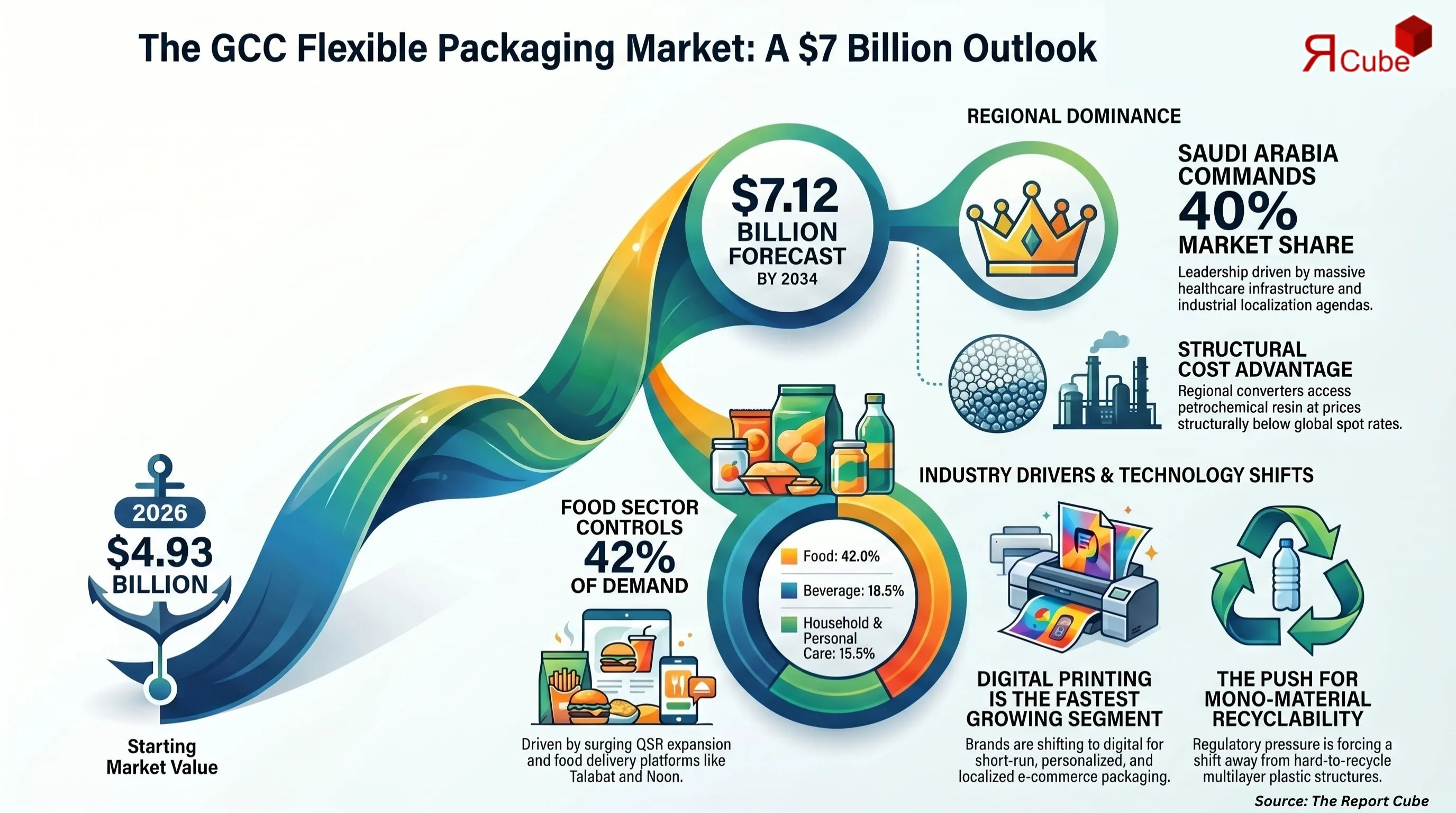
The GCC flexible packaging market is valued at USD 4.93 billion in 2026 and is projected to reach USD 7.12 billion by 2034, expanding at a CAGR of 4.70% over the forecast period. Flexible packaging - encompassing pouches, films, wraps, bags, and laminates - has become the format of choice across the Gulf Cooperation Council as brands, retailers, and logistics operators prioritize lightweight, barrier-rich, and cost-efficient solutions. The region's rapid urbanization, surging food delivery and e-commerce adoption, and governments' economic diversification agendas under programs such as Saudi Vision 2030 and the UAE's "Make it in the Emirates" initiative are collectively accelerating investment in packaging infrastructure. These structural tailwinds, combined with a world-class petrochemical feedstock base that grants regional converters a durable cost advantage, position the GCC as one of the most dynamic flexible packaging markets globally through 2034.
Key Takeaways: GCC Flexible Packaging Market
- The GCC flexible packaging market is forecast to reach USD 7.12 billion by 2034, rising from USD 4.93 billion in 2026 at a 4.70% CAGR.
- Saudi Arabia holds the leading country share, supported by a large population, expanding manufacturing base, and USD 65 billion planned healthcare infrastructure investment.
- The food end-user segment commands the largest revenue share, accounting for more than two-fifths of total GCC flexible packaging demand.
- Flexography leads the printing technology segment by volume, while digital printing is the fastest-growing sub-segment due to surging short-run, personalized packaging demand.
- Rotogravure maintains a strong position in premium high-volume segments such as pharmaceuticals and confectionery.
- Napco National's August 2025 acquisition of Arabian Flexible Packaging signals accelerating consolidation activity across the regional landscape.
- Huhtamaki's Omnilock Ultra PAPER innovation won the Gold Award in Sustainable Flexible Packaging at Prime Awards Packaging MEA 2025, highlighting the region's shift toward recyclable mono-material formats.
- UAE's e-commerce sales, estimated at USD 8.8 billion in 2024 and projected to exceed USD 13.6 billion by 2029, are driving outsized demand for lightweight, tamper-evident flexible packaging.
GCC Flexible Packaging Market: An Overview
Flexible packaging refers to containers or wraps manufactured from pliable materials - plastic films, aluminum foil, paper, or multi-layer laminates - that conform to the shape of their contents while providing superior barrier protection against moisture, oxygen, and light. In the GCC context, the category encompasses stand-up pouches, flat bags, films and wraps, sachet packs, and specialty laminates deployed across food, beverage, pharmaceutical, personal care, and industrial applications.
The regional market benefits from a unique combination of forces. Integrated petrochemical complexes - including Borouge 4's 1.4 million-tonne polyethylene increment commissioned in 2024 and Saudi Arabia's additional 800,000-tonne polypropylene capacity - provide converter facilities with resin at costs structurally below global spot prices. This feedstock advantage allows GCC-based manufacturers to serve not just domestic demand but also export to Africa, Europe, and Asia. At the consumer level, a young, digitally active population with rising disposable incomes is reshaping purchasing habits toward convenience formats, premium presentations, and on-the-go products - all of which depend heavily on flexible packaging. International tourism surges - the Saudi Ministry of Tourism reported a 56% increase in international visitors between 2019 and 2023 - are also expanding the consumption of packaged food and beverages at hotels, QSRs, and retail outlets, further reinforcing demand for the GCC flexible packaging market.
GCC Flexible Packaging Market Dynamics
Key Market Driver: Booming Packaged Food and Beverage Demand Across GCC
The expansion of packaged food consumption is the single most powerful force shaping the GCC flexible packaging market. With food applications accounting for more than two-fifths of regional packaging demand, the sector's growth directly amplifies converter revenues. Rapid urbanization across Saudi Arabia, the UAE, Qatar, and Kuwait has fueled the expansion of modern retail formats - hypermarkets, convenience chains, and dark stores - all of which depend on high-quality, visually appealing flexible packs for shelf differentiation. The GCC's Quick Service Restaurant (QSR) sector has also expanded aggressively, with international and regional chains increasing takeaway and delivery volumes that require pouch, wrap, and bag formats. Rising food delivery platform activity - driven by platforms such as Talabat, Noon Food, and Careem Now - translates directly into growing demand for resealable pouches and lightweight films. Saudi Arabia's population growth and urbanization rate further amplify this driver, as packaged dairy, snack, and frozen food consumption trends upward across major cities.
Major Industry Challenge: Complex Multilayer Structures Limiting Recyclability
Despite strong growth, the GCC flexible packaging market faces a structural challenge around multilayer packaging recyclability. Flexible packs - particularly those using three or more dissimilar material layers - are difficult to disassemble for recycling, leaving much of the packaging stream destined for landfill. The UAE's "Dubai Waste Management Strategy 2041" and broader Extended Producer Responsibility (EPR) frameworks being piloted across the region are increasing pressure on converters and brand owners to shift toward mono-material, recyclable structures. Achieving equivalent barrier performance in mono-material films without an aluminum or dissimilar-polymer layer requires significant R&D investment, raising near-term costs for converters. Smaller regional packaging firms, which lack the R&D infrastructure of global players, face a particularly acute cost-compliance gap that may compress margins through the forecast period.
Need Specific Data, Let’s Customize the Report for You
Request CustomizationEmerging Trend Shaping Outlook: Smart and Digital Packaging Adoption Accelerates
The integration of smart packaging technologies - including QR codes, NFC tags, RFID sensors, and temperature indicators - represents the most distinctive growth trend differentiating the GCC flexible packaging market from more mature packaging markets. GCC governments and regional regulators are increasingly mandating traceability and anti-counterfeiting compliance, especially in pharmaceuticals and food exports, which is aligning regulatory intent with commercial demand for digitally integrated packs. Digital printing technology, in particular, is enabling brand owners to deploy variable data printing, short-run seasonal graphics, and consumer engagement campaigns that are impractical with traditional rotogravure or flexography. The UAE's ambition to position itself as a global innovation hub - evidenced by EUR 266 million in machinery imports in 2024, a 24.5% year-on-year increase - is embedding advanced printing and packaging technology at the heart of its industrial strategy.
GCC Flexible Packaging Market Segmentation Analysis
By End-User Industry
|
Sub-Segment |
Market Share (%) |
Key Driver |
Competitive Intensity |
|---|---|---|---|
|
Food |
42.0% |
Surging QSR expansion and packaged dairy demand across UAE and Saudi Arabia |
High |
|
Beverage |
18.5% |
Rising bottled water, juice, and energy drink consumption in a predominantly hot climate |
High |
|
Pharmaceutical and Medical |
14.0% |
Saudi government's USD 65 billion healthcare infrastructure investment driving blister and pouch demand |
Medium |
|
Household and Personal Care |
15.5% |
Premium cosmetics and homecare brand expansion via modern retail and e-commerce channels |
Medium |
|
Industrial and Chemicals |
10.0% |
Petrochemical export packaging and agrochemical sector growth in Oman and Bahrain |
Low |
Food retains commanding leadership because flexible packaging's barrier properties directly address the GCC's acute food safety and shelf-life demands in a high-temperature, high-humidity distribution environment. The food segment's structural advantage is reinforced by the region's cold-chain limitations, which make oxygen-barrier and moisture-barrier films essential rather than optional for perishable products. The pharmaceutical and medical segment, while only the third-largest by revenue today, represents the fastest-growing end-user category, with a CAGR trajectory meaningfully above the overall market average.
Saudi Arabia's healthcare expenditure alone dominates GCC healthcare spending at roughly 60% of the total, and the government's commitment to investing USD 65 billion in healthcare infrastructure by 2030 is already translating into procurement mandates for compliant, tamper-evident, and sterile flexible pharmaceutical packs. A notable cross-segment dynamic is the competitive interplay between food and personal care packaging: as premium FMCG brands invest in premium printing and barrier laminates for personal care products, these technology investments are being adapted and applied to food packaging, accelerating the overall sophistication of the market.
By Printing Technology
|
Sub-Segment |
Market Share (%) |
Key Driver |
Competitive Intensity |
|---|---|---|---|
|
Flexography |
38.0% |
Cost-effective, high-speed printing on diverse substrates aligns with large-volume food and FMCG requirements |
High |
|
Rotogravure |
32.0% |
Superior image fidelity and consistent ink density for premium pharmaceutical and confectionery packaging |
High |
|
Digital |
18.0% |
Short-run personalized campaigns and brand localization driven by e-commerce and Vision 2030 branding mandates |
Medium |
|
Offset |
12.0% |
Secondary packaging and label applications for industrial and household chemical products |
Low |
Flexography holds the largest share in the GCC flexible packaging printing technology segment because its substrate versatility - covering plastic films, paper, foil, and biodegradable materials - combined with fast press speeds of up to 400 meters per minute, makes it ideally suited for high-volume, cost-sensitive food and beverage applications. Wide-web flexo lines operating near Jeddah Islamic Port and King Abdulaziz Port in Dammam are purpose-built for large-format runs - cereal liners, frozen food bags, and shrink films - that serve both the domestic market and GCC export corridors.
Digital printing is the fastest-growing technology sub-segment, propelled by an entirely different demand dynamic: brands seeking short-run, regionally customized, and seasonal packaging that would be prohibitively expensive using rotogravure cylinder setups costing USD 5,000–8,000 per color. The shift to digital flexible packaging printing is also accelerating because e-commerce platforms require packaging that performs as a marketing tool at the point of delivery, not merely a protective container. Digital's growth reinforces the broader market shift: as premium and personalized packaging gains traction, the overall value intensity of the GCC flexible packaging market rises even where volume growth remains moderate.
Regional Projection of GCC Flexible Packaging Market
- Saudi Arabia: Largest country contributor, accounting for approximately 38–40% of regional flexible packaging demand, underpinned by the country's large population, expanding petrochemical manufacturing base, and the government's active industrial localization agenda under Vision 2030. The country's growing pharmaceutical manufacturing sector, supported by USD 65 billion in planned healthcare infrastructure, is an additional growth engine often absent from regional competitor analysis.
- UAE: The second-largest and most innovation-intensive market, with e-commerce revenues of USD 8.8 billion in 2024 projected to exceed USD 13.6 billion by 2029. Dubai's role as a regional trade and re-export hub amplifies packaging throughput beyond domestic consumption alone.
- Qatar: A niche premium market benefiting from post-World Cup retail infrastructure expansion, driving demand for premium-presentation flexible packs and high-fidelity printed pouches in retail settings.
- Kuwait: Elevated per-capita consumption of bottled water and packaged beverages - reflected in a daily per-capita water consumption of 447 liters - drives disproportionate demand for beverage flexible packaging.
- Oman and Bahrain: Smaller markets but notable growth contributors, with Oman projected to record some of the highest country-level CAGRs in the broader GCC packaging space, supported by industrial diversification and port-linked re-export logistics.
GCC Flexible Packaging Market: Recent Development (2025)
- In August 2025, Napco Investment LLC - a Dubai-based subsidiary of Napco National - completed the acquisition of Arabian Flexible Packaging from the Ghurair Group, effective August 1, 2025. The deal expands Napco's rotogravure printing capacity and substrate expertise across polypropylene, polyester, nylon, and foil, strengthening its position under the UAE's In-Country Value (ICV) localization framework. Napco National reported net revenues of SAR 1.97 billion in FY2024, with its packaging division contributing a growing share of earnings through regional expansion.
- In May 2025, Hotpack Packaging Industries LLC, a UAE-headquartered packaging conglomerate, invested USD 100 million to open its first North American manufacturing plant in New Jersey, signaling the company's transition from a GCC-focused manufacturer to a global flexible packaging platform with export-oriented scale.
GCC Flexible Packaging Market Future Outlook (2034)
The GCC flexible packaging market is well-positioned to reach USD 7.12 billion by 2034, growing at a CAGR of 4.70% through the forecast period. Key long-term growth opportunities include the expansion of pharmaceutical packaging as GCC governments build out domestic healthcare manufacturing, the proliferation of smart packaging technologies embedded with digital connectivity for food safety and supply chain traceability, and the accelerating transition toward mono-material recyclable formats driven by UAE EPR regulation and multinational brand owner sustainability pledges. Artificial intelligence is beginning to reshape converter operations in the region - optimizing print scheduling, material yield, and defect detection - while also enabling mass-personalization at scale that was previously economically unviable. Converters investing in AI-driven production and recyclable barrier films will command premium pricing and preferred-supplier status among global FMCG brands expanding GCC distribution through 2034.
GCC Flexible Packaging Market Report Coverage
|
Report Features |
Details |
|---|---|
|
Base Year |
2026 |
|
Forecast Period |
2026-2034 |
|
Market Value (2026) |
USD 4.93 Billion |
|
Market Value (2034) |
USD 7.12 Billion |
|
CAGR |
4.70% |
|
Historical Data |
2021–2025 |
|
Forecast Units |
USD Billion |
|
Report Format |
PDF / PPT / Excel |
|
Customization |
Available |
|
Delivery Format |
PPT, PDF & Excel |
|
Key Players Profiled |
Huhtamaki Oyj, Rotopacking Materials Industry Company LLC, ENPI Group LLC, Amber Packaging Industries LLC, Radiant Packaging Industry LLC, Emirates Printing Press LLC, Arabian Flexible Packaging LLC, Hotpack Packaging Industries LLC, Napco National Co., Others |
|
Regional Coverage |
Saudi Arabia, UAE, Qatar, Kuwait, Oman, Bahrain |
|
Customization |
Available |
|
Delivery |
PPT, PDF & Excel |
Why Choose This Report?
- Provides a comprehensive overview of the overall market analysis, encompassing key trends, consumer behavior analysis, and risk assessment to support strategic decision-making.
- Provides accurate, up-to-date insights into market size, segmentation, and emerging opportunities, helping to minimize risk & capitalizing on growth.
- Gives deep understanding of target audience preferences, investment habits, and communication channels for enhanced product development & marketing effectiveness.
- Delivers competitive analysis & benchmarking, uncovering the strengths & weaknesses of market competitors to guide strategies.
- Consolidate comprehensive market intelligence, reducing reasoning & streamlining research efforts.
- Facilitates customized market segmentation & risk mitigation strategies, fine-tuned to the business objectives.
- Aids in identifying both market challenges & untapped opportunities within the industry to drive long-term business growth.
- Provides valuable information based on actual customer data & search trends.
Table of Contents
- Introduction
- Objective of the study
- Product Definition
- Market Segmentation
- Study Variables
- Research Methodology
- Secondary Data Points
- Companies Interviewed
- Primary Data Points
- Breakdown of Primary Interviews
- Secondary Data Points
- Executive Summary
- Market Dynamics
- Drivers
- Challenges
- Opportunity Assessment
- Recent Trends and Developments
- Policy and Regulatory Landscape
- GCC Flexible Packaging Market Overview and Forecast Analysis (2021-2034)
- Market Size, By Value, By growth rate (CAGR/USD Billions)
- Demand - Supply Trends
- Market Share, By Material Type
- Plastic
- Paper
- Metal
- Market Share, By Product Type
- Bags and Pouches
- Films and Wraps
- Sachets and Stick Packs
- Other Product Types
- Market Share, By End-User Industry
- Food
- Beverage
- Pharmaceutical and Medical
- Household and Personal Care
- Industrial and Chemicals
- Market Share, By Printing Technology
- Flexography
- Rotogravure
- Digital
- Offset
- Market Share, By Country
- Saudi Arabia
- UAE
- Qatar
- Kuwait
- Oman
- Bahrain
- Market Share, By Company
- Revenue Shares
- Competition Characteristics
- Saudi Arabia Flexible Packaging Market Overview, 2021-2034F
- Market Size, By Value (in USD Billions)
- By Material Type
- By Product Type
- By End-User Industry
- By Printing Technology
- UAE Flexible Packaging Market Overview, 2021-2034F
- Market Size, By Value (in USD Billions)
- By Material Type
- By Product Type
- By End-User Industry
- By Printing Technology
- Qatar Flexible Packaging Market Overview, 2021-2034F
- Market Size, By Value (in USD Billions)
- By Material Type
- By Product Type
- By End-User Industry
- By Printing Technology
- Kuwait Flexible Packaging Market Overview, 2021-2034F
- Market Size, By Value (in USD Billions)
- By Material Type
- By Product Type
- By End-User Industry
- By Printing Technology
- Oman Flexible Packaging Market Overview, 2021-2034F
- Market Size, By Value (in USD Billions)
- By Material Type
- By Product Type
- By End-User Industry
- By Printing Technology
- Competitive Outlook (Company Profile - Partial List)
- Huhtamaki Oyj
- Company Overview
- Business Segments
- Strategic Alliances/Partnerships
- Recent Developments
- Rotopacking Materials Industry Company LLC
- Company Overview
- Business Segments
- Strategic Alliances/Partnerships
- Recent Developments
- ENPI Group LLC
- Company Overview
- Business Segments
- Strategic Alliances/Partnerships
- Recent Developments
- Amber Packaging Industries LLC
- Company Overview
- Business Segments
- Strategic Alliances/Partnerships
- Recent Developments
- Radiant Packaging Industry LLC
- Company Overview
- Business Segments
- Strategic Alliances/Partnerships
- Recent Developments
- Emirates Printing Press LLC
- Company Overview
- Business Segments
- Strategic Alliances/Partnerships
- Recent Developments
- Arabian Flexible Packaging LLC
- Company Overview
- Business Segments
- Strategic Alliances/Partnerships
- Recent Developments
- Hotpack Packaging Industries LLC
- Company Overview
- Business Segments
- Strategic Alliances/Partnerships
- Recent Developments
- Napco National Co.
- Company Overview
- Business Segments
- Strategic Alliances/Partnerships
- Recent Developments
- Others
- Huhtamaki Oyj
- Contact Us & Disclaimer
Top Key Players & Market Share Outlook
- Huhtamaki Oyj
- Rotopacking Materials Industry Company LLC
- ENPI Group LLC
- Amber Packaging Industries LLC
- Radiant Packaging Industry LLC
- Emirates Printing Press LLC
- Arabian Flexible Packaging LLC
- Hotpack Packaging Industries LLC
- Napco National Co.
- Others
Frequently Asked Questions






