



Build Your Custom Market Intelligence Report
Customize Your ReportGCC Food Waste Management Market Key Highlights
By Waste Type:
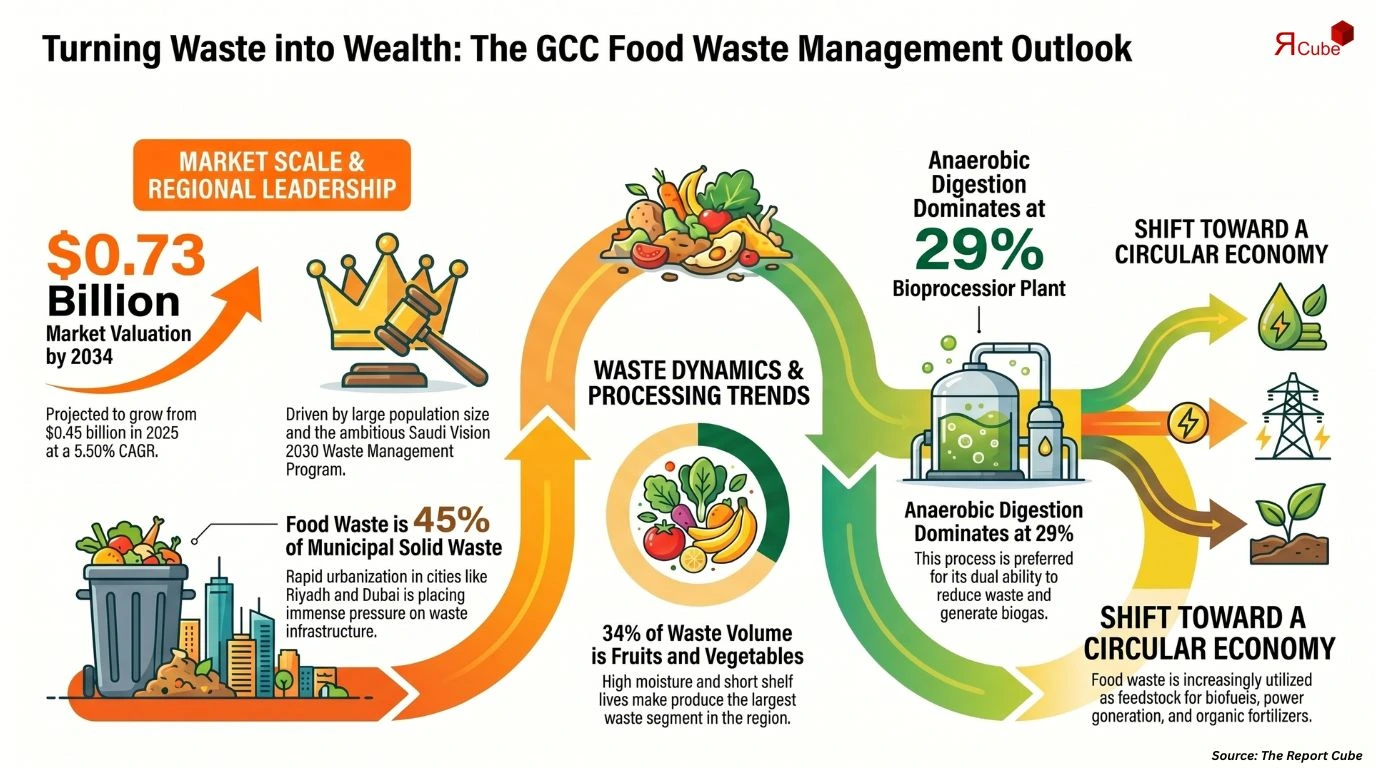
Fruits and vegetables segment leads the market, contributing nearly 34% of total waste volume.
By Process:
Anaerobic digestion dominates the market, accounting for around 29% share.
Regional Outlook:
Saudi Arabia leads the GCC market with approximately 38% share.
Government Initiatives & Policies
- Saudi Vision 2030 – Waste Management Program: Focuses on reducing landfill dependency and increasing recycling and recovery rates.
- UAE National Food Security Strategy 2051: Emphasizes food loss reduction and sustainable waste treatment practices.
GCC Food Waste Management Market Insights & Analysis
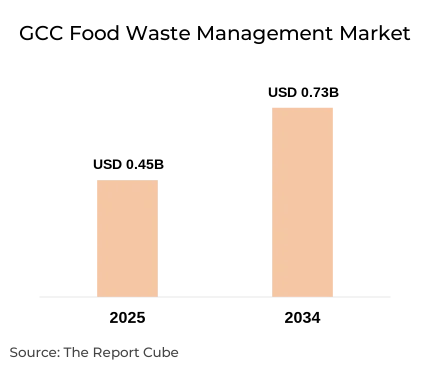
The GCC Food Waste Management Market is anticipated to register a CAGR of 5.50% during the forecast period. The market size was valued at USD 0.45 billion in 2025 and is projected to reach USD 0.73 billion by 2034. Food waste management has emerged as a critical sustainability priority across GCC countries as rapid urbanization, population growth, and rising food imports place increasing pressure on waste handling systems.
Across the region, food waste generation per capita remains among the highest globally, with estimates suggesting that nearly 30–35% of food prepared for consumption is discarded annually. This imbalance has encouraged governments and private players to invest in structured waste segregation, recovery, and treatment solutions. The market is transitioning from landfill-heavy disposal toward integrated waste management models that emphasize recycling, composting, and energy recovery. Strategic partnerships between municipalities and private operators are strengthening infrastructure while improving operational efficiency. These developments are steadily transforming food waste from an environmental liability into a recoverable resource.
GCC Food Waste Management Market Dynamics
Market Driver: Rising Urban Population and Municipal Waste Pressure
Rapid urban expansion across GCC cities is a primary force driving the food waste management market. Urban centers such as Riyadh, Dubai, and Doha have experienced population growth rates exceeding 2.5% annually, resulting in higher household and commercial food waste volumes. Municipal authorities face increasing pressure to manage organic waste efficiently while maintaining public health standards. Food waste alone accounts for nearly 45% of total municipal solid waste in several GCC cities. As landfill capacities approach saturation, governments are prioritizing structured waste diversion programs. Investments in anaerobic digestion plants, composting facilities, and waste-to-energy projects are accelerating as municipalities seek scalable solutions. This growing urban waste burden directly fuels sustained demand for professional food waste management services.
Book your FREE 30-minute expert consultation today
Contact UsIndustry Trends: Shift Toward Waste-to-Energy and Circular Economy Models
A notable trend shaping the GCC food waste management market is the adoption of circular economy principles. Food waste is increasingly treated as a feedstock for biofuel, power generation, and organic fertilizers. Anaerobic digestion facilities across the UAE and Saudi Arabia are converting organic waste into biogas, supporting national renewable energy targets. By 2024, waste-to-energy projects contributed nearly 3% of municipal power generation in select GCC cities. Private operators are also integrating digital tracking systems to optimize waste collection routes and improve recovery efficiency. This trend reflects a broader regional strategy to reduce environmental impact while extracting economic value from waste streams.
Market Challenge: Limited Source Segregation and Behavioral Barriers
One of the key challenges restraining market efficiency is the limited adoption of source-level waste segregation. In many GCC countries, food waste is still mixed with general waste, reducing recycling and recovery efficiency. Behavioral patterns, including excessive food consumption and limited public awareness, further complicate waste reduction efforts. Studies indicate that households contribute over 55% of food waste, yet participation in segregation programs remains below 30% in most cities. This increases processing costs and reduces the quality of recovered materials. Overcoming these challenges requires sustained public education, regulatory enforcement, and infrastructure upgrades, which can slow short-term market progress.
Market Opportunity: Growing Demand for Organic Fertilizers and Biofuels
The rising demand for organic fertilizers and renewable fuels presents a strong growth opportunity for the GCC food waste management market. Agriculture and landscaping sectors across the region are increasingly adopting compost-based soil enhancers to improve water retention and soil health. Compost derived from food waste is gaining traction as a cost-effective alternative to chemical fertilizers. Additionally, biofuel production from food waste aligns with regional energy diversification goals. Governments are offering incentives for waste-to-energy projects, encouraging private sector participation. This expanding demand base supports long-term revenue growth and market diversification.
GCC Food Waste Management Market Segment-wise Analysis
By Waste Type:
- Cereals
- Dairy Products
- Fruits and Vegetables
- Meat and Seafood
- Oilseeds and Pulses
- Processed Food
- Others
Fruits and vegetables represent the largest waste type segment, accounting for approximately 34% of total food waste volume. High moisture content and short shelf life contribute to elevated spoilage rates during transportation and storage. Retail and wholesale markets generate substantial quantities of unsold produce, strengthening demand for rapid collection and composting solutions. This segment plays a central role in shaping waste processing strategies across the GCC.
By Process:
- Aerobic Digestion
- Anaerobic Digestion
- Incineration or Combustion
- Recycling and Recovery
- Landfill Disposal
- Others
Anaerobic digestion leads the processing segment with nearly 29% share, supported by its dual benefit of waste reduction and energy generation. The process is increasingly preferred for large-scale municipal and commercial waste streams due to its efficiency and environmental benefits. Government-backed waste-to-energy projects continue to strengthen this segment’s dominance.
Regional Projection of GCC Food Waste Management Industry
- Saudi Arabia
- United Arab Emirates
- Oman
- Qatar
- Kuwait
- Bahrain
- Rest of GCC
Saudi Arabia leads the GCC food waste management market with an estimated 38% share, driven by large population size and ambitious national sustainability targets. The UAE follows closely, supported by advanced waste infrastructure and strong private sector participation. Qatar and Kuwait show steady growth, driven by municipal modernization programs. Smaller GCC nations are gradually expanding capacity through regional collaborations and public-private partnerships.
GCC Food Waste Management Market Recent Developments
- 2025: BEEAH Group expanded its organic waste processing facility in Sharjah, increasing composting capacity to support municipal waste diversion targets.
- 2025: Tadweer Group launched a food waste segregation awareness campaign across Abu Dhabi, targeting households and commercial food service operators.
- 2025: Veolia Middle East announced a new anaerobic digestion project in Saudi Arabia focused on converting food waste into renewable biogas.
Need insights for a specific region within this market?
Request Regional DataWhy Choose This Report?
- Provides a comprehensive overview of the overall market analysis, encompassing key trends, consumer behavior analysis, and risk assessment to support strategic decision-making.
- Provides accurate, up-to-date insights into market size, segmentation, and emerging opportunities, helping to minimize risk & capitalizing on growth.
- Gives deep understanding of target audience preferences, investment habits, and communication channels for enhanced product development & marketing effectiveness.
- Delivers competitive analysis & benchmarking, uncovering the strengths & weaknesses of market competitors to guide strategies.
- Consolidate comprehensive market intelligence, reducing reasoning & streamlining research efforts.
- Facilitates customized market segmentation & risk mitigation strategies, fine-tuned to the business objectives.
- Aids in identifying both market challenges & untapped opportunities within the industry to drive long-term business growth.
- Provides valuable information based on actual customer data & search trends.
Table of Contents
- Introduction
- Objective of the Study
- Product and Category Definition
- Market Segmentation
- Study Variables
- Research Methodology
- Secondary Data Points
- Breakdown of Secondary Sources
- Primary Data Points
- Breakdown of Primary Interviews
- Secondary Data Points
- Executive Summary
- Market Dynamics
- Drivers
- Challenges
- Opportunity Assessment
- Recent Trends and Developments
- Regulatory and Policy Landscape
- GCC Food Waste Management Market Overview (2021–2034)
- Market Size, By Value (USD Billion)
- Market Share, By Waste Type
- Cereals
- Dairy Products
- Fruits and Vegetables
- Meat and Seafood
- Oilseeds and Pulses
- Processed Food
- Others
- Market Share, By Process
- Aerobic Digestion
- Anaerobic Digestion
- Incineration or Combustion
- Recycling and Recovery
- Landfill Disposal
- Others
- Market Share, By Application
- Animal Feed
- Fertilizers
- Biofuel
- Power Generation
- Others
- Market Share, By End User
- Municipalities and Households
- Food Service Providers
- Food Distributors and Suppliers
- Food Manufacturers
- Other End Users
- Market Share, By Source
- Household
- Retail
- Manufacturing
- Foodservice
- Others
- Market Share, By Method
- Landfills
- Incineration
- Composting
- Anaerobic Digestion
- Others
- Market Share, By Country
- Saudi Arabia
- United Arab Emirates
- Oman
- Qatar
- Kuwait
- Bahrain
- Rest of GCC
- Market Share, By Company
- Revenue Shares and Analysis
- Competitive Landscape
- Saudi Arabia Food Waste Management Market
- Market Size, By Value (USD Billion)
- Market Share, By Waste Type
- Market Share, By Process
- Market Share, By Application
- Market Share, By End User
- Market Share, By Source
- Market Share, By Method
- UAE Food Waste Management Market
- Market Size, By Value (USD Billion)
- Market Share, By Waste Type
- Market Share, By Process
- Market Share, By Application
- Market Share, By End User
- Market Share, By Source
- Market Share, By Method
- Oman Food Waste Management Market
- Market Size, By Value (USD Billion)
- Market Share, By Waste Type
- Market Share, By Process
- Market Share, By Application
- Market Share, By End User
- Market Share, By Source
- Market Share, By Method
- Qatar Food Waste Management Market
- Market Size, By Value (USD Billion)
- Market Share, By Waste Type
- Market Share, By Process
- Market Share, By Application
- Market Share, By End User
- Market Share, By Source
- Market Share, By Method
- Kuwait Food Waste Management Market
- Market Size, By Value (USD Billion)
- Market Share, By Waste Type
- Market Share, By Process
- Market Share, By Application
- Market Share, By End User
- Market Share, By Source
- Market Share, By Method
- Bahrain Food Waste Management Market
- Market Size, By Value (USD Billion)
- Market Share, By Waste Type
- Market Share, By Process
- Market Share, By Application
- Market Share, By End User
- Market Share, By Source
- Market Share, By Method
- Competitive Outlook and Company Profiles
- BEEAH Group
- Company Overview
- Product Portfolio
- Strategic Alliances/Partnerships
- Recent Developments
- Tadweer Group
- Company Overview
- Product Portfolio
- Strategic Alliances/Partnerships
- Recent Developments
- Averda
- Company Overview
- Product Portfolio
- Strategic Alliances/Partnerships
- Recent Developments
- SUEZ Middle East
- Company Overview
- Product Portfolio
- Strategic Alliances/Partnerships
- Recent Developments
- Dulsco
- Company Overview
- Product Portfolio
- Strategic Alliances/Partnerships
- Recent Developments
- Imdaad
- Company Overview
- Product Portfolio
- Strategic Alliances/Partnerships
- Recent Developments
- Veolia Middle East
- Company Overview
- Product Portfolio
- Strategic Alliances/Partnerships
- Recent Developments
- Green Mountains
- Company Overview
- Product Portfolio
- Strategic Alliances/Partnerships
- Recent Developments
- Envirol
- Company Overview
- Product Portfolio
- Strategic Alliances/Partnerships
- Recent Developments
- Envac Middle East
- Company Overview
- Product Portfolio
- Strategic Alliances/Partnerships
- Recent Developments
- Clear Earth Recycling
- Company Overview
- Product Portfolio
- Strategic Alliances/Partnerships
- Recent Developments
- Blue LLC
- Company Overview
- Product Portfolio
- Strategic Alliances/Partnerships
- Recent Developments
- Geocycle
- Company Overview
- Product Portfolio
- Strategic Alliances/Partnerships
- Recent Developments
- M.A.H.Y. Khoory and Co.
- Company Overview
- Product Portfolio
- Strategic Alliances/Partnerships
- Recent Developments
- Others
- BEEAH Group
- Contact Us and Disclaimer
Top Key Players & Market Share Outlook
- BEEAH Group
- Tadweer Group
- Averda
- SUEZ Middle East
- Dulsco
- Imdaad
- Veolia Middle East
- Green Mountains
- Envirol
- Envac Middle East
- Clear Earth Recycling
- Blue LLC
- Geocycle
- M.A.H.Y. Khoory and Co.
- Others
Frequently Asked Questions






