



Build Your Custom Market Intelligence Report
Customize Your ReportIndia Food Waste Management Market Key Highlights
By Waste Type:
Fruits and vegetables segment leads the market, contributing nearly 42% of total waste volume.
By Process:
Composting and anaerobic digestion collectively dominate, accounting for around 48% market share.
Regional Outlook:
South India dominates the market with approximately 29% share.
Government Initiatives & Policies
- Swachh Bharat Mission (Urban & Gramin): Promotes source segregation and scientific food waste processing across municipalities.
- National Bio-Energy Mission: Encourages conversion of organic waste into biogas and bio-CNG for energy security.
India Food Waste Management Market Insights & Analysis
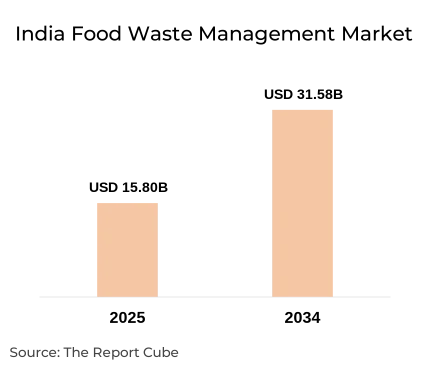
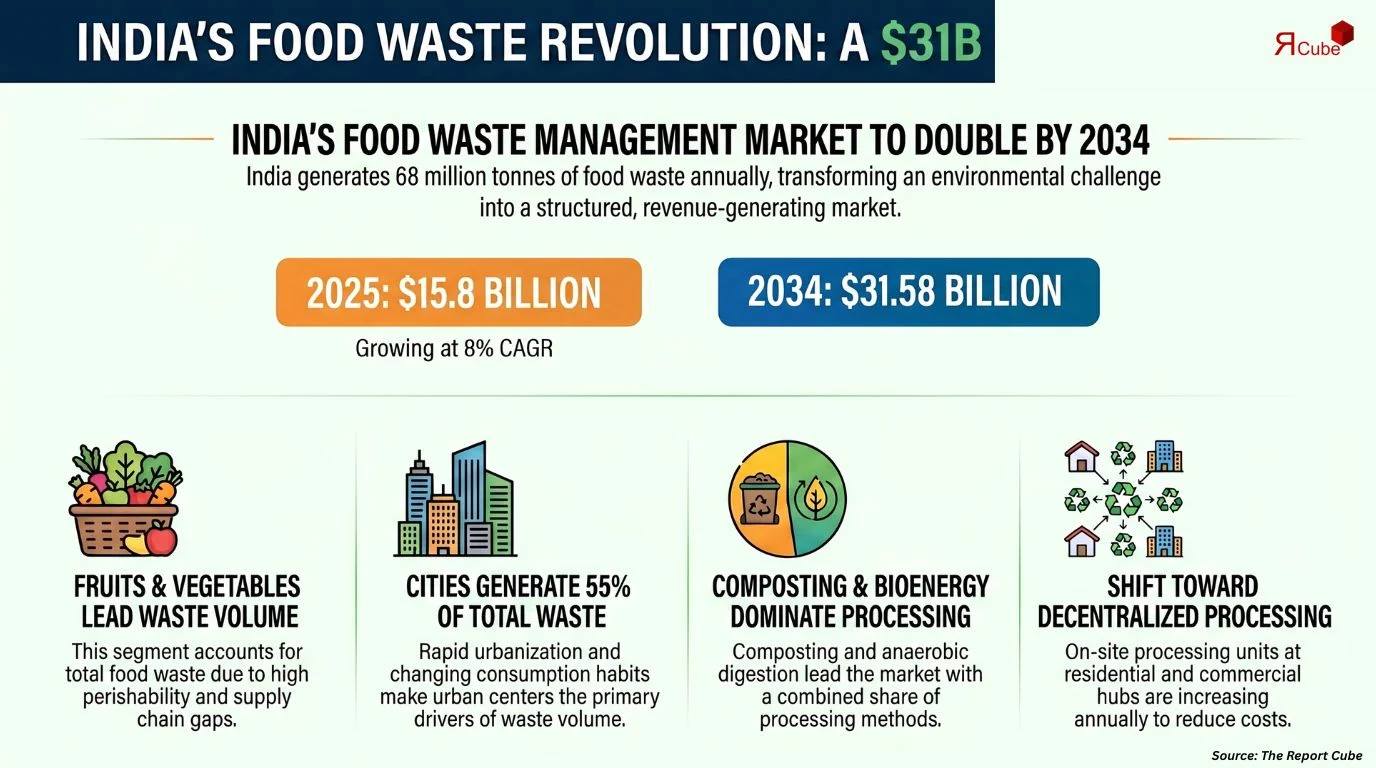
The India Food Waste Management Market is anticipated to register a CAGR of 8.00% during 2026–2034. The market size was valued at USD 15.8 billion in 2025 and is projected to reach USD 31.58 billion by 2034. India generates over 68 million tonnes of food waste annually, positioning waste management as both an environmental necessity and an economic opportunity.
Rapid urbanization, changing consumption patterns, and expansion of organized retail have intensified food waste volumes across the value chain. At the same time, policy emphasis on circular economy models has shifted waste handling from basic disposal toward recovery and value creation. Investments exceeding USD 3.2 billion have flowed into organic waste processing infrastructure since 2021, including composting units, biomethanation plants, and waste-to-energy facilities. Technology-enabled segregation, public–private partnerships, and decentralized processing models are reshaping market structure. As municipalities and private operators align with sustainability targets, food waste management is evolving into a structured, revenue-generating service ecosystem across India.
India Food Waste Management Market Dynamics
Key Driver: Rising Urban Food Waste Generation and Policy Mandates
Urban India generates nearly 55% of the country’s total food waste, primarily from households, food service providers, and organized retail. Population density, higher disposable incomes, and evolving dietary habits have significantly increased per capita food waste over the past decade. Municipal Solid Waste Rules mandate source segregation and scientific treatment of organic waste, compelling local bodies to invest in food waste management infrastructure. Cities implementing mandatory segregation report up to 35% reduction in landfill-bound organic waste within two years. Additionally, rising landfill saturation and environmental compliance pressures are accelerating adoption of composting and anaerobic digestion solutions. These regulatory and demographic forces collectively form the strongest growth driver for the India food waste management market.
Book your FREE 30-minute expert consultation today
Contact UsIndustry Trends: Decentralized Processing and Bioenergy Integration
A prominent trend shaping the market is the shift toward decentralized waste processing systems. Residential complexes, hotels, and institutional campuses are increasingly installing on-site composters and biomethanation units, reducing transportation costs and processing delays. Over 4,500 decentralized organic waste processing units were operational in India by 2024, reflecting a 21% annual increase. Integration of food waste management with bioenergy production is also gaining traction. Biogas plants utilizing food waste feedstock are supplying bio-CNG to city gas networks, aligning waste management with energy transition goals. Digital monitoring platforms for waste tracking and performance reporting are further improving operational transparency and efficiency across the sector.
Major Challenge: Segregation Gaps and Infrastructure Disparity
Inconsistent source segregation remains a critical challenge for effective food waste management. Nearly 38% of urban households still fail to segregate organic waste correctly, leading to contamination and reduced processing efficiency. Infrastructure disparity between Tier I cities and smaller municipalities further constrains market scalability. Many regions lack adequate composting or anaerobic digestion capacity, resulting in continued reliance on landfills. Operational challenges such as odor control, leachate management, and community acceptance also increase project risk. These structural gaps raise processing costs and slow the transition toward fully circular waste management systems across India.
Opportunity: Circular Economy and Agricultural Demand for Organic Inputs
India’s expanding organic farming sector presents a major opportunity for food waste-derived compost and biofertilizers. Demand for organic soil amendments is growing at over 11% annually, driven by soil health concerns and sustainable agriculture practices. Food waste compost offers a cost-effective alternative to chemical fertilizers, particularly for small and marginal farmers. Additionally, biofuel and power generation applications create new revenue streams from food waste processing. As carbon credit frameworks mature and extended producer responsibility gains traction, food waste management operators can monetize environmental benefits, strengthening long-term market viability.
India Food Waste Management Market Segment-wise Analysis
By Waste Type:
- Cereals
- Dairy Products
- Fruits and Vegetables
- Meat and Seafood
- Oilseeds and Pulses
- Processed Food
- Others
Fruits and vegetables account for approximately 42% of total food waste processed in India, making them the leading waste type segment. High moisture content and short shelf life contribute to elevated wastage across farms, wholesale markets, and households. Seasonal gluts and inefficient cold chain infrastructure further amplify losses. This segment drives strong demand for composting and anaerobic digestion solutions, as fruit and vegetable waste offers high biodegradability and biogas yield. Municipal processing facilities increasingly prioritize this waste stream to achieve diversion targets and generate organic manure.
By Process:
- Aerobic Digestion
- Anaerobic Digestion
- Incineration or Combustion
- Recycling and Recovery
- Landfill Disposal
- Others
Composting and anaerobic digestion dominate processing methods, jointly holding nearly 48% market share. Composting remains widely adopted due to low capital costs and suitability for decentralized applications. Anaerobic digestion is expanding rapidly, particularly in urban centers, due to its dual benefit of waste reduction and energy generation. Facilities processing over 150 tonnes per day are increasingly favoring anaerobic systems to maximize economic returns and meet renewable energy mandates.
Regional Projection of India Food Waste Management Industry
- North India
- South India
- East India
- West India
- Central India
- Northeast India
South India leads the India food waste management market with nearly 29% share, driven by proactive municipal policies and higher public awareness. Cities such as Bengaluru and Chennai have implemented strict segregation enforcement and decentralized processing models. West India follows closely, supported by strong private sector participation and industrial waste processing capacity. North India shows rising momentum as large metropolitan regions expand waste-to-energy projects. Regional growth patterns reflect policy execution efficiency and urban infrastructure maturity.
India Food Waste Management Market Recent Developments
- 2025: Pure Planet visited Excel Industries’ Mumbai facility to explore a strategic partnership for scalable organic waste solutions, focused on Excel’s patented Organic Waste Converter (OWC) system and Bioculum-based composting for decentralized food waste treatment across India.
- 2025: In its FY 2024–25 investor materials (Feb–May 2025), Excel Industries highlighted upgraded decentralized organic waste treatment systems, capable of processing up to 2 MT per day, converting segregated food waste into rich compost, and integrating products like Bioculum and Sanitreat into municipal and commercial waste projects.
- 2025: Excel Industries emphasized its integrated MSW solutions in the same investor presentation—manufacturing compost and refuse-derived fuel, alongside recovery and recycling of plastics and metals—positioning the company as a full-cycle municipal food and organic waste processor for Indian cities.
Need insights for a specific region within this market?
Request Regional DataWhy Choose This Report?
- Provides a comprehensive overview of the overall market analysis, encompassing key trends, consumer behavior analysis, and risk assessment to support strategic decision-making.
- Provides accurate, up-to-date insights into market size, segmentation, and emerging opportunities, helping to minimize risk & capitalizing on growth.
- Gives deep understanding of target audience preferences, investment habits, and communication channels for enhanced product development & marketing effectiveness.
- Delivers competitive analysis & benchmarking, uncovering the strengths & weaknesses of market competitors to guide strategies.
- Consolidate comprehensive market intelligence, reducing reasoning & streamlining research efforts.
- Facilitates customized market segmentation & risk mitigation strategies, fine-tuned to the business objectives.
- Aids in identifying both market challenges & untapped opportunities within the industry to drive long-term business growth.
- Provides valuable information based on actual customer data & search trends.
Table of Contents
- Introduction
- Objective of the Study
- Product and Category Definition
- Market Segmentation
- Study Variables
- Research Methodology
- Secondary Data Points
- Breakdown of Secondary Sources
- Primary Data Points
- Breakdown of Primary Interviews
- Secondary Data Points
- Executive Summary
- Market Dynamics
- Drivers
- Challenges
- Opportunity Assessment
- Recent Trends and Developments
- Regulatory and Policy Landscape
- India Food Waste Management Market Overview (2021–2034)
- Market Size, By Value (USD Billion)
- Market Share, By Waste Type
- Cereals
- Dairy Products
- Fruits and Vegetables
- Meat and Seafood
- Oilseeds and Pulses
- Processed Food
- Others
- Market Share, By Process
- Aerobic Digestion
- Anaerobic Digestion
- Incineration or Combustion
- Recycling and Recovery
- Landfill Disposal
- Others
- Market Share, By Application
- Animal Feed
- Fertilizers
- Biofuel
- Power Generation
- Others
- Market Share, By End User
- Municipalities and Households
- Food Service Providers
- Food Distributors and Suppliers
- Food Manufacturers
- Other End Users
- Market Share, By Source
- Household
- Retail
- Manufacturing
- Foodservice
- Others
- Market Share, By Method
- Landfills
- Incineration
- Composting
- Anaerobic Digestion
- Others
- Market Share, By Region
- North India
- South India
- East India
- West India
- Central India
- Northeast India
- Market Share, By Company
- Revenue Shares and Analysis
- Competitive Landscape
- North India Food Waste Management Market
- Market Size, By Value (USD Billion)
- Market Share, By Waste Type
- Market Share, By Process
- Market Share, By Application
- Market Share, By End User
- Market Share, By Source
- South India Food Waste Management Market
- Market Size, By Value (USD Billion)
- Market Share, By Waste Type
- Market Share, By Process
- Market Share, By Application
- Market Share, By End User
- Market Share, By Source
- East India Food Waste Management Market
- Market Size, By Value (USD Billion)
- Market Share, By Waste Type
- Market Share, By Process
- Market Share, By Application
- Market Share, By End User
- Market Share, By Source
- West India Food Waste Management Market
- Market Size, By Value (USD Billion)
- Market Share, By Waste Type
- Market Share, By Process
- Market Share, By Application
- Market Share, By End User
- Market Share, By Source
- Central India Food Waste Management Market
- Market Size, By Value (USD Billion)
- Market Share, By Waste Type
- Market Share, By Process
- Market Share, By Application
- Market Share, By End User
- Market Share, By Source
- Northeast India Food Waste Management Market
- Market Size, By Value (USD Billion)
- Market Share, By Waste Type
- Market Share, By Process
- Market Share, By Application
- Market Share, By End User
- Market Share, By Source
- Competitive Outlook and Company Profiles
- Excel Industries
- Company Overview
- Product Portfolio
- Strategic Alliances/Partnerships
- Recent Developments
- Solwearth Ecotech
- Company Overview
- Product Portfolio
- Strategic Alliances/Partnerships
- Recent Developments
- Vermigold Ecotech
- Company Overview
- Product Portfolio
- Strategic Alliances/Partnerships
- Recent Developments
- Green Planet Solutions
- Company Overview
- Product Portfolio
- Strategic Alliances/Partnerships
- Recent Developments
- Daily Dump
- Company Overview
- Product Portfolio
- Strategic Alliances/Partnerships
- Recent Developments
- Mailhem Engineers
- Company Overview
- Product Portfolio
- Strategic Alliances/Partnerships
- Recent Developments
- TrashCon
- Company Overview
- Product Portfolio
- Strategic Alliances/Partnerships
- Recent Developments
- Eco Wise Waste Management
- Company Overview
- Product Portfolio
- Strategic Alliances/Partnerships
- Recent Developments
- Biofics Pvt Ltd
- Company Overview
- Product Portfolio
- Strategic Alliances/Partnerships
- Recent Developments
- Sampurn(e)arth
- Company Overview
- Product Portfolio
- Strategic Alliances/Partnerships
- Recent Developments
- Others
- Excel Industries
- Contact Us and Disclaimer
Top Key Players & Market Share Outlook
- Excel Industries
- Solwearth Ecotech
- Vermigold Ecotech
- Green Planet Solutions
- Daily Dump
- Mailhem Engineers
- TrashCon
- Eco Wise Waste Management
- Biofics Pvt Ltd
- Sampurn(e)arth
- Others
Frequently Asked Questions






