



Build Your Custom Market Intelligence Report
Customize Your ReportIndia Sludge Dewatering System Market Key Highlights
By Technology and Equipment Type:
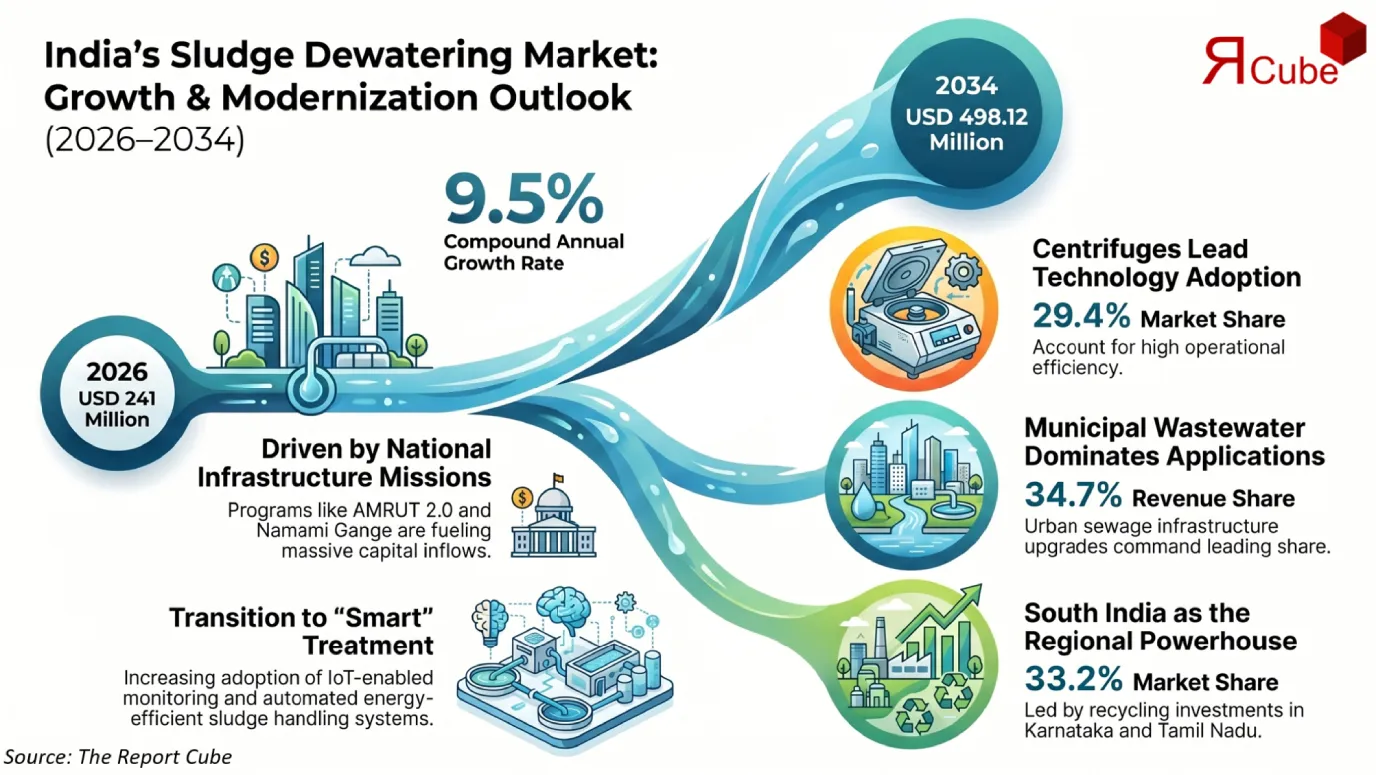
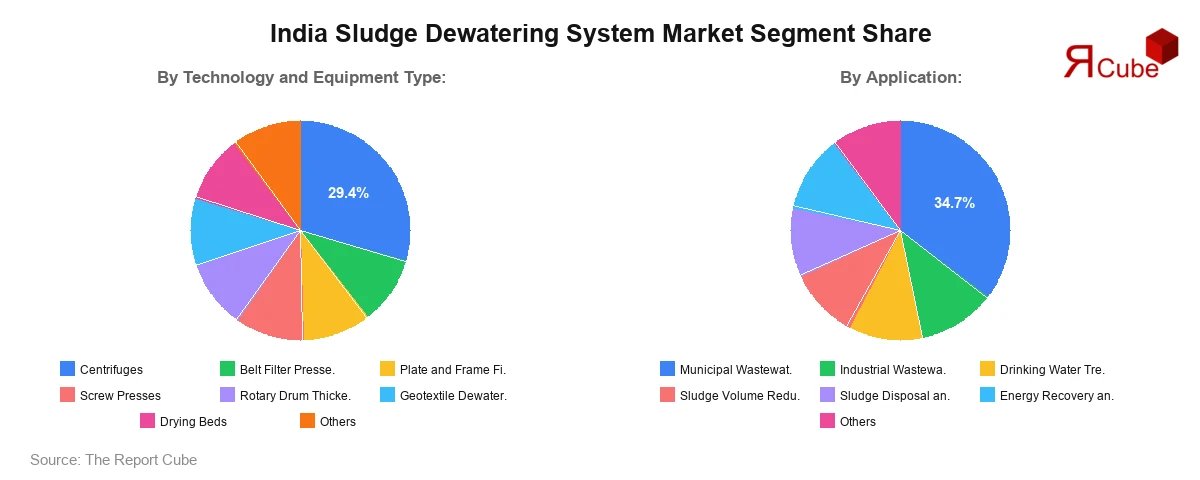
Centrifuges segment leads the market with nearly 29.4% share.
By Application:
Municipal Wastewater Treatment segment dominates the market with around 34.7% of revenue.
Regional Outlook:
South India region dominates the India Sludge Dewatering System Market with approximately 33.2% share.
India Sludge Dewatering System Market Insights & Analysis
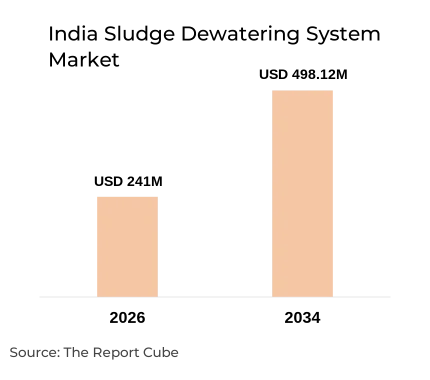
The India Sludge Dewatering System Market is anticipated to register a CAGR of around 9.5% during the forecast period 2026-2034. The market is valued at USD 241 million in 2026 and is projected to reach USD 498.12 million by 2034. Market expansion is strongly linked with India’s accelerating wastewater reuse targets, urban sewage infrastructure upgrades, and stricter industrial discharge compliance standards issued by the Central Pollution Control Board (CPCB). Based on recent wastewater infrastructure tenders and EPC activity across Bengaluru, Chennai, Mumbai, and Hyderabad, municipalities are increasingly prioritizing sludge volume reduction, treated water recovery, and energy-efficient sludge handling systems. Demand for centrifuges, screw presses, plate filter presses, and automated sludge treatment systems has increased notably within municipal wastewater treatment and industrial effluent management projects.
Industry activity between 2025 and 2026 confirms a visible shift toward reuse-driven wastewater infrastructure rather than disposal-focused treatment facilities. Projects awarded to VA Tech WABAG, Schneider Electric, Veolia Water Technologies, and other leading water technology providers show growing adoption of IoT-enabled monitoring systems, tertiary treatment integration, and biogas-linked sludge processing. Search behavior analysis also indicates rising commercial interest in wastewater sludge management systems, sludge drying technologies, sewage sludge treatment equipment, and industrial dewatering solutions. Increasing investments in bio-CBG plants, renewable energy-linked digestate treatment, and decentralized wastewater recycling facilities are expected to strengthen long-term demand for compact and energy-efficient sludge dewatering technologies across India.
India Sludge Dewatering System Market Insights & Analysis
| Factor | Type | Specific Impact on Market | Magnitude | Business Implication |
|---|---|---|---|---|
| National sanitation and wastewater programmes | Market | Boosts STP construction and sludge handling investments nationwide | High | Target municipal tenders with cost-effective dewatering systems |
| Rapid urbanisation and rising wastewater volumes | Market | Accelerates need for reliable sludge volume reduction solutions | High | Prioritise high-throughput systems for large urban treatment plants |
| Stricter environmental and discharge regulations | Regulatory | Enforces compliance on sludge disposal and moisture content limits | High | Position compliant technologies as risk-mitigation and audit ready |
| Shift toward automated and energy-efficient equipment | Technological | Drives replacement of manual or legacy sludge handling methods | High | Develop low-energy, automated presses and centrifuges for plants |
| High initial capital and operating cost barriers | Market | Slows adoption in smaller ULBs and budget constrained facilities | Medium | Offer leasing, PPP models, and modular systems to ease adoption |
| Industrial clusters’ effluent and sludge management needs | Market | Creates steady demand from ETPs across key manufacturing belts | High | Design industry-specific systems and build strong OEM partnerships |
| Technology evolution in presses and centrifuges | Technological | Improves cake dryness, reliability, and footprint of installations | Medium | Invest in R&D and showcase lifecycle savings in bid documents |
| Growing preference for sustainable sludge reuse options | Environmental | Encourages solutions enabling co-processing and resource recovery | Medium | Bundle dewatering with downstream reuse or disposal partnerships |
| Shortage of skilled operators in smaller municipalities | Consumer | Limits performance of complex, maintenance heavy systems | Medium | Offer operator training plus low-maintenance, plug-and-play units |
| Competition from global and domestic equipment suppliers | Competitive | Creates pricing pressure and higher technical performance benchmarks | Medium | Differentiate via service, local support, and lifecycle cost models |
India Sludge Dewatering System Market Dynamics
Key Driver: Rising Government Investments in Wastewater Recycling Infrastructure
India’s wastewater treatment sector is witnessing strong capital inflow through programs such as AMRUT 2.0, Namami Gange, Jal Jeevan Mission, and multiple state-led urban water reuse initiatives. According to urban development estimates, untreated sewage generation continues to rise across major Indian cities, creating pressure on municipal authorities to modernize treatment infrastructure and reduce sludge disposal volumes. This environment is accelerating procurement of sludge dewatering systems including centrifuges, belt filter presses, screw presses, and automated sludge drying technologies. Recent municipal projects in Chennai and Bengaluru further demonstrate the growing preference for integrated wastewater recycling systems supported by long-term operation and maintenance contracts.
Industry procurement trends also show increasing demand for wastewater sludge reduction systems, municipal sludge handling equipment, and industrial effluent treatment technologies. Water-intensive sectors such as textiles, pharmaceuticals, chemicals, and food processing are strengthening investments in sludge treatment infrastructure to meet evolving environmental regulations and water reuse requirements. These factors collectively continue supporting stable growth across the India sludge dewatering system market.
Book your FREE 30-minute expert consultation today
Contact UsIndustry Trends: Transition Toward Automated and Energy-Efficient Sludge Treatment Systems
Technology adoption patterns across India’s wastewater sector indicate a clear transition toward fully automated and energy-efficient sludge dewatering systems. Municipal corporations and industrial treatment operators are increasingly integrating IoT-enabled controls, predictive maintenance software, and automated sludge monitoring platforms to improve process reliability and reduce operational costs. Schneider Electric’s automation deployment at Mumbai’s Bhandup treatment facility reflects the broader industry movement toward digitally managed water infrastructure.
Another major trend shaping the India sludge dewatering system market is the integration of sludge processing with renewable energy recovery. Biogas-linked wastewater treatment plants are increasingly using sludge drying beds, digestate separation systems, and low-energy centrifuges to maximize resource efficiency. Search trend analysis also reflects growing visibility for terms such as smart wastewater treatment systems, automated sludge filtration technologies, and energy-efficient dewatering equipment. This trend is expected to strengthen as industries prioritize sustainability reporting, operational optimization, and lower lifecycle treatment costs.
Major Challenge: High Equipment Cost and Operational Complexity
Although demand for advanced sludge management infrastructure continues to increase, high capital investment remains a major challenge for several municipal authorities and medium-scale industrial operators. Fully automatic sludge dewatering systems, decanter centrifuges, and advanced filtration units involve significant upfront costs along with continuous maintenance requirements. Smaller urban local bodies often face budget limitations that delay technology upgrades and restrict procurement of high-capacity sludge treatment systems.
Operational expertise also remains an important concern across multiple wastewater treatment facilities in India. Efficient sludge handling requires trained personnel, stable power supply, periodic equipment servicing, and optimized process management. Industry feedback from wastewater operators further highlights concerns related to spare part availability, energy consumption, and downtime management. Search intent trends additionally indicate growing queries around sludge dewatering system pricing, wastewater treatment operating costs, and sludge equipment maintenance requirements. These operational barriers may continue affecting adoption rates in cost-sensitive regions.
Opportunity: Expansion of Bio-CBG and Waste-to-Energy Infrastructure
India’s expanding compressed biogas and waste-to-energy ecosystem is creating new commercial opportunities for sludge dewatering equipment manufacturers and technology providers. Strategic collaborations involving TRuAlt Bioenergy, GAIL India, and other renewable energy developers are increasing the number of bio-CBG plants processing agricultural waste, industrial effluents, and organic sludge. These facilities generate large volumes of digestate and semi-solid waste, increasing demand for efficient dewatering, drying, and sludge separation technologies.
Bioenergy-linked wastewater treatment systems are also encouraging adoption of compact and modular sludge management solutions suitable for decentralized facilities in rural and semi-urban regions. Industrial sectors including sugar processing, distilleries, dairy processing, and food manufacturing are increasingly integrating anaerobic digestion systems with sludge handling infrastructure to improve waste utilization efficiency. industry activity for india sludge dewatering system market such as digestate dewatering systems, sludge drying technologies, and biogas wastewater treatment equipment further confirms rising industry interest in this high-growth application segment.
India Sludge Dewatering System Market Segment-wise Analysis
By Technology and Equipment Type:
- Centrifuges
- Belt Filter Presses
- Plate and Frame Filter Presses
- Screw Presses
- Rotary Drum Thickeners
- Geotextile Dewatering Bags
- Drying Beds
- Others
Centrifuges continue to account for the leading share in the India sludge dewatering system market due to their strong operational efficiency, reduced footprint requirement, and suitability for continuous wastewater treatment operations. The segment captured nearly 29.4% market share in 2026, supported by rising deployment across municipal sewage treatment plants and industrial wastewater facilities. Municipal utilities increasingly prefer centrifuge-based sludge handling systems because they significantly reduce sludge moisture content while lowering transportation and disposal costs.
Industrial users across pharmaceuticals, chemicals, food processing, textiles, and petrochemicals are also adopting decanter centrifuges to improve compliance with wastewater discharge standards. Competitor analysis indicates that leading manufacturers including Alfa Laval, ANDRITZ AG, and Huber Technology are expanding their India-focused product portfolios with energy-efficient and automated centrifuge systems designed for variable sludge conditions. Growing preference for low-maintenance, high-throughput equipment is expected to further strengthen demand for centrifuge technologies during the forecast period.
By Application:
- Municipal Wastewater Treatment
- Industrial Wastewater Treatment
- Drinking Water Treatment Plants
- Sludge Volume Reduction
- Sludge Disposal and Landfill
- Energy Recovery and Biogas Plants
- Others
Municipal Wastewater Treatment remains the dominant application segment in the India sludge dewatering system market with nearly 34.7% revenue share. Rapid urban population growth and increasing sewage generation volumes are compelling municipal authorities to upgrade treatment infrastructure with advanced sludge handling technologies. State governments in Tamil Nadu, Maharashtra, Karnataka, and Gujarat are actively investing in wastewater recycling and tertiary treatment systems to reduce freshwater dependency and strengthen industrial water reuse capabilities.
Large-scale urban infrastructure projects in Chennai, Bengaluru, and Mumbai continue generating substantial demand for sludge filtration systems, drying beds, screw presses, and automated dewatering equipment. Procurement activity and search trend analysis further show rising interest in municipal sludge treatment systems, sewage sludge reduction technologies, and wastewater recycling infrastructure. Long-term PPP-based operation and maintenance contracts are also supporting stable equipment demand while encouraging modernization of aging treatment facilities across metropolitan and industrial regions.
Regional Projection of India Sludge Dewatering System Industry
- North India
- South India
- West India
- East India
- Central India
South India holds the leading position in the India sludge dewatering system market with nearly 33.2% share, supported by strong wastewater recycling investments and industrial water reuse initiatives. Tamil Nadu and Karnataka remain major contributors due to large-scale sewage treatment expansion projects in Chennai and Bengaluru. Recent contracts involving wastewater recycling facilities, tertiary treatment plants, and digitally automated water infrastructure continue strengthening regional demand for sludge dewatering systems, sludge drying technologies, and advanced filtration equipment.
The region also benefits from a strong concentration of water-intensive industries including textiles, pharmaceuticals, automotive manufacturing, electronics, and chemicals. These sectors are increasingly investing in industrial effluent treatment and sludge management infrastructure to meet environmental compliance standards and improve water reuse efficiency. EPC contractors, technology providers, and municipal authorities in South India are also adopting integrated wastewater treatment systems linked with biogas recovery and energy optimization, further supporting long-term market expansion across the region.
Need insights for a specific region within this market?
Request Regional DataIndia Sludge Dewatering System Industry Regional Analysis
The India sludge dewatering market varies by region, industry mix, and projects.
| Region | Key Municipal / Industrial Clusters | Demand Drivers | Dominant End Users | Preferred Dewatering Technologies | Price Sensitivity | Growth Potential | Key Challenges |
|---|---|---|---|---|---|---|---|
| North India | Delhi NCR, Punjab, Haryana belts | STP upgrades, river cleanup, urban load | Urban utilities, food, textile, pharma | Centrifuges, belt presses, filter presses | Medium, lifecycle and O&M focused | High, driven by policy and retrofits | Space limits, energy cost, skilled O&M |
| South India | Bengaluru, Chennai, Hyderabad, Kochi | IT cities, zero‑liquid‑discharge push | Municipal STPs, pharma, chemicals, food | Centrifuges, screw presses, belt presses | Medium‑low, tech and reliability led | High, strong industrial compliance push | High inflow variability, sludge quality |
| West India | Mumbai, Pune, Gujarat industrial zones | Industrial clusters, coastal urban growth | Refineries, petrochem, textiles, ports | Centrifuges, filter presses, decanters | Medium, ROI and uptime prioritized | High, capex rich, export oriented base | Corrosive loads, stringent discharge norms |
| East India | Kolkata, mining and steel corridors | River rejuvenation, mining, steel plants | Municipal bodies, steel, mining, power | Filter presses, belt presses, thickeners | High, funding dependent, phased buys | Medium, project based, lumpy ordering | Delayed tenders, O&M and power gaps |
| Central India | MP, Chhattisgarh, emerging town STPs | New STP rollouts, industrialization wave | Municipal STPs, paper, power, metals | Belt presses, screw presses, dry beds | High, prefers robust low OPEX designs | Medium‑high, from low installed base | Skill shortage, low automation comfort |
Government Initiatives & Policies
- AMRUT 2.0: The Government of India continues expanding sewage treatment and water recycling infrastructure under AMRUT 2.0, promoting wastewater reuse and advanced sludge management systems in urban local bodies.
- Namami Gange Programme: Ongoing river rejuvenation projects under Namami Gange are increasing investments in sewage treatment plants, sludge handling infrastructure, and industrial wastewater treatment systems across multiple Indian states.
India Sludge Dewatering System Industry Recent Developments
- 2026: VA Tech WABAG secured a PPP contract from Chennai Metropolitan Water Supply and Sewerage Board to refurbish and operate a 45 MLD wastewater recycling facility in Chennai. The project strengthens demand for advanced sludge treatment systems integrated with industrial water reuse infrastructure.
- 2025: TRuAlt Bioenergy and GAIL India formed a strategic joint venture to develop compressed biogas plants across India, increasing demand for digestate dewatering, sludge drying, and solid-liquid separation technologies linked with bioenergy infrastructure.
- 2025: Schneider Electric won a contract to automate Mumbai’s Bhandup 2000 MLD water treatment plant using EcoStruxure digital systems. The project accelerates adoption of automated sludge management and smart wastewater treatment technologies in India.
Why Choose This Report?
- Provides a comprehensive overview of the overall market analysis, encompassing key trends, consumer behavior analysis, and risk assessment to support strategic decision-making.
- Provides accurate, up-to-date insights into market size, segmentation, and emerging opportunities, helping to minimize risk & capitalizing on growth.
- Gives deep understanding of target audience preferences, investment habits, and communication channels for enhanced product development & marketing effectiveness.
- Delivers competitive analysis & benchmarking, uncovering the strengths & weaknesses of market competitors to guide strategies.
- Consolidate comprehensive market intelligence, reducing reasoning & streamlining research efforts.
- Facilitates customized market segmentation & risk mitigation strategies, fine-tuned to the business objectives.
- Aids in identifying both market challenges & untapped opportunities within the industry to drive long-term business growth.
- Provides valuable information based on actual customer data & search trends.
Table of Contents
- Introduction
- Objective of the Study
- Product and Category Definition
- Market Segmentation
- Study Variables
- Research Methodology
- Secondary Data Points
- Breakdown of Secondary Sources
- Primary Data Points
- Breakdown of Primary Interviews
- Secondary Data Points
- Executive Summary
- Market Dynamics
- Emerging Opportunities
- Adoption Trends
- Demand Drivers
- Disruption Analysis (Challenges)
- Industry Analysis and Strategic Insights
- Supply and Value Chain Analysis
- Pricing Analysis
- Go-to-Market Strategy
- BCG Matrix
- Recent Trends and Developments
- Import and Export Analysis
- Regulatory and Policy Landscape
- Region-wise Policies
- Government Initiatives
- India Sludge Dewatering System Market Overview and Forecast Analysis (2021-2034)
- Market Size, By Value, By Growth Rate (CAGR/USD Million)
- Market Share, By Technology and Equipment Type
- Centrifuges
- Belt Filter Presses
- Plate and Frame Filter Presses
- Screw Presses
- Rotary Drum Thickeners
- Geotextile Dewatering Bags
- Drying Beds
- Others
- Market Share, By Sludge Type
- Primary Sludge
- Secondary Sludge
- Mixed Sludge
- Industrial Sludge
- Oil and Grease Sludge
- Market Share, By Application
- Municipal Wastewater Treatment
- Industrial Wastewater Treatment
- Drinking Water Treatment Plants
- Sludge Volume Reduction
- Sludge Disposal and Landfill
- Energy Recovery and Biogas Plants
- Others
- Market Share, By End-Use Industry
- Municipal Utilities
- Food and Beverage Industry
- Pharmaceutical and Chemical Industry
- Power Generation Industry
- Oil and Gas Industry
- Pulp and Paper Industry
- Textile Industry
- Others
- Market Share, By Automation Level
- Manual Sludge Dewatering Systems
- Semi-Automatic Sludge Dewatering Systems
- Fully Automatic Sludge Dewatering Systems
- Market Share, By Region
- North India
- South India
- West India
- East India
- Central India
- Market Share, By Company
- Revenue Shares and Analysis
- Competitive Landscape
- North India Sludge Dewatering System Market Overview and Forecast Analysis (2021-2034)
- Market Size, By Value, By Growth Rate (CAGR/USD Million)
- Market Share, By Technology and Equipment Type
- Market Share, By Sludge Type
- Market Share, By Application
- Market Share, By End-Use Industry
- Market Share, By Automation Level
- South India Sludge Dewatering System Market Overview and Forecast Analysis (2021-2034)
- Market Size, By Value, By Growth Rate (CAGR/USD Million)
- Market Share, By Technology and Equipment Type
- Market Share, By Sludge Type
- Market Share, By Application
- Market Share, By End-Use Industry
- Market Share, By Automation Level
- West India Sludge Dewatering System Market Overview and Forecast Analysis (2021-2034)
- Market Size, By Value, By Growth Rate (CAGR/USD Million)
- Market Share, By Technology and Equipment Type
- Market Share, By Sludge Type
- Market Share, By Application
- Market Share, By End-Use Industry
- Market Share, By Automation Level
- East India Sludge Dewatering System Market Overview and Forecast Analysis (2021-2034)
- Market Size, By Value, By Growth Rate (CAGR/USD Million)
- Market Share, By Technology and Equipment Type
- Market Share, By Sludge Type
- Market Share, By Application
- Market Share, By End-Use Industry
- Market Share, By Automation Level
- Central India Sludge Dewatering System Market Overview and Forecast Analysis (2021-2034)
- Market Size, By Value, By Growth Rate (CAGR/USD Million)
- Market Share, By Technology and Equipment Type
- Market Share, By Sludge Type
- Market Share, By Application
- Market Share, By End-Use Industry
- Market Share, By Automation Level
- Competitive Analysis, 2026
- Market Share of Key Players
- Competitive Mapping for Each Segment and Companies/Brands Operating Regionally
- North India Sludge Dewatering System Companies/Brands Share and Competitive Analysis, 2026
- South India Sludge Dewatering System Companies/Brands Share and Competitive Analysis, 2026
- West India Sludge Dewatering System Companies/Brands Share and Competitive Analysis, 2026
- East India Sludge Dewatering System Companies/Brands Share and Competitive Analysis, 2026
- Central India Sludge Dewatering System Companies/Brands Share and Competitive Analysis, 2026
- Company Profiles (Partial List)
- Thermax Limited
- Company Overview
- Product Portfolio
- Strategic Alliances and Partnerships
- Recent Developments
- Alfa Laval
- Company Overview
- Product Portfolio
- Strategic Alliances and Partnerships
- Recent Developments
- Ion Exchange (India) Ltd.
- Company Overview
- Product Portfolio
- Strategic Alliances and Partnerships
- Recent Developments
- Aqseptence Group
- Company Overview
- Product Portfolio
- Strategic Alliances and Partnerships
- Recent Developments
- SUEZ Water Technologies and Solutions
- Company Overview
- Product Portfolio
- Strategic Alliances and Partnerships
- Recent Developments
- Triveni Engineering and Industries Ltd.
- Company Overview
- Product Portfolio
- Strategic Alliances and Partnerships
- Recent Developments
- ANDRITZ AG
- Company Overview
- Product Portfolio
- Strategic Alliances and Partnerships
- Recent Developments
- Huber Technology
- Company Overview
- Product Portfolio
- Strategic Alliances and Partnerships
- Recent Developments
- Veolia Water Technologies
- Company Overview
- Product Portfolio
- Strategic Alliances and Partnerships
- Recent Developments
- Others (Partial List)
- Thermax Limited
- Contact Us and Disclaimer
Top Key Players & Market Share Outlook
- Thermax Limited
- Alfa Laval
- Ion Exchange (India) Ltd.
- Aqseptence Group
- SUEZ Water Technologies & Solutions
- Triveni Engineering & Industries Ltd.
- ANDRITZ AG
- Huber Technology
- Veolia Water Technologies
- Others
Frequently Asked Questions






