



Build Your Custom Market Intelligence Report
Customize Your ReportBrazil Carbon Credit Market Insights & Analysis
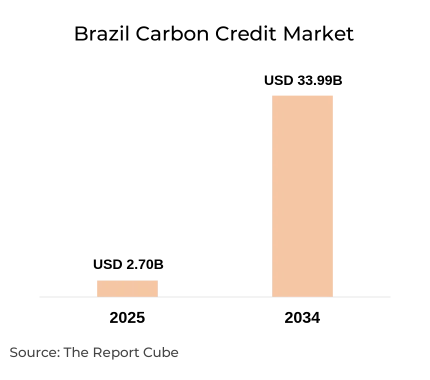
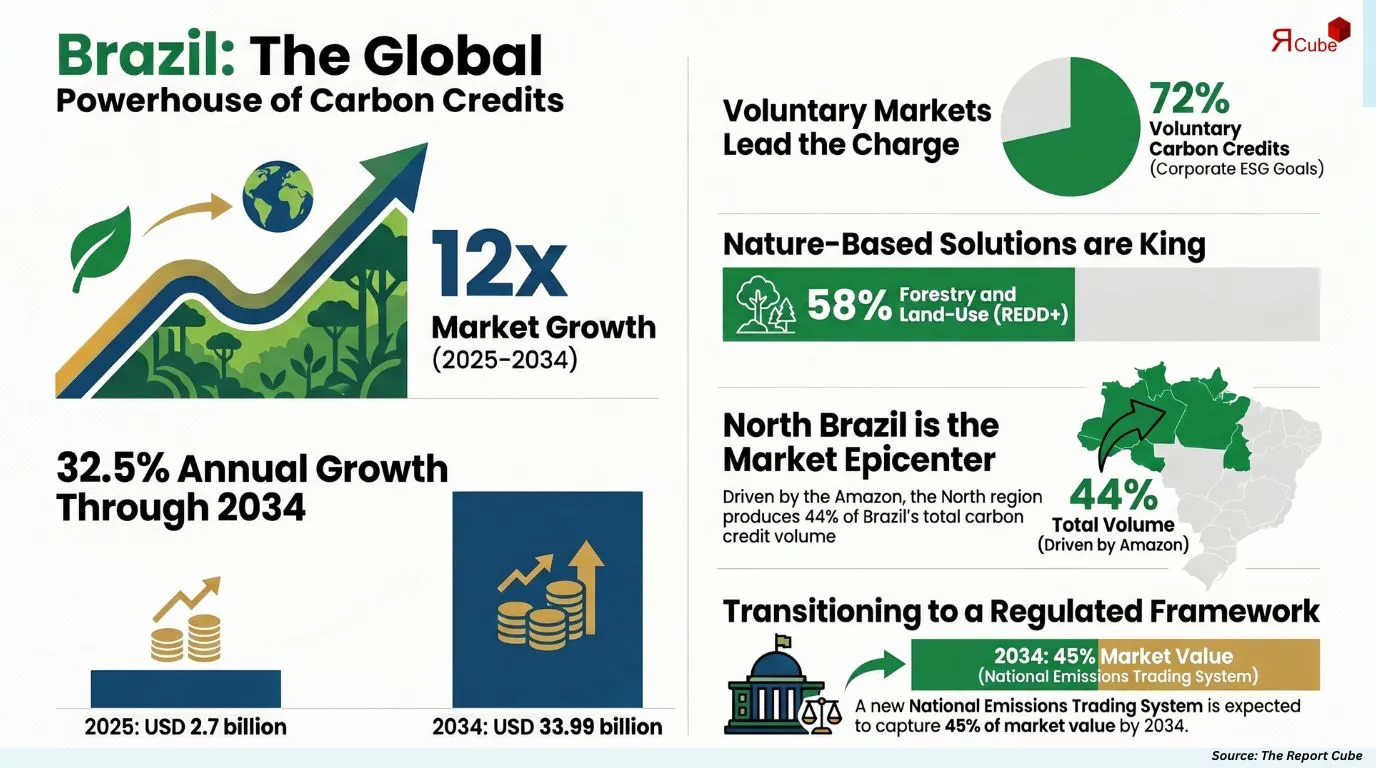
The Brazil Carbon Credit Market is anticipated to register a CAGR of 32.50% during 2026-2034. The market size was valued at USD 2.7 billion in 2025 and is projected to reach USD 33.99 billion by 2034. This exceptional growth trajectory positions Brazil as one of the fastest-growing carbon credit markets globally, driven by its vast natural resources, strong forestry potential, and increasing global demand for high-quality carbon offsets.
Brazil plays a strategic role in the carbon ecosystem due to its extensive forest cover, biodiversity, and leadership in nature-based solutions. The country accounts for a significant share of REDD+ and land-use-based carbon credit projects, making it a preferred destination for multinational corporations seeking credible offsets. In 2024, Brazil represented nearly 18% of all voluntary carbon credits issued globally, reflecting strong international confidence in its project pipeline.
Additionally, increasing corporate net-zero commitments, expansion of voluntary carbon markets, and progress toward a regulated national emissions trading framework are accelerating market maturity. As Brazil strengthens its regulatory clarity and monitoring mechanisms, investor participation and cross-border carbon trading activity are expected to scale rapidly through 2034.
Brazil Carbon Credit Market Recent Developments
- 2025: Ambipar Group expanded large-scale REDD+ projects across the Amazon region to increase certified credit issuance.
- 2025: Biofílica Ambipar partnered with international buyers to supply long-term voluntary carbon offsets.
Government Initiatives & Policies
- Brazil Emissions Trading System Framework: Federal initiative to establish a regulated carbon market and national cap-and-trade mechanism.
- National Climate Change Policy (PNMC): Program supporting emissions reduction, forest conservation, and carbon market development.
Brazil Carbon Credit Market Dynamics
Key Driver: Rising Global Demand for Nature-Based Carbon Offsets
The surge in global demand for high-integrity, nature-based carbon credits is the primary driver of the Brazil Carbon Credit Market. Corporations across energy, manufacturing, aviation, and finance sectors are increasingly relying on voluntary offsets to meet net-zero and ESG commitments. Brazil’s forestry and land-use projects generate credits with strong biodiversity and social co-benefits, making them highly attractive. Over 65% of Brazil’s issued credits in 2024 were linked to forest conservation and avoided deforestation projects. This strong alignment with global sustainability priorities continues to drive robust demand.
Book your FREE 30-minute expert consultation today
Contact UsIndustry Trends: Rapid Expansion of Voluntary Carbon Markets
The voluntary carbon market dominates Brazil’s carbon credit landscape, accounting for nearly 72% of total market value in 2025. Corporations prefer voluntary credits for flexibility and immediate climate action. Increasing use of long-term offtake agreements, price floors, and digital monitoring platforms is improving market transparency and revenue stability. Blockchain-based registries and satellite monitoring are also being adopted to enhance traceability and verification, strengthening buyer confidence and market credibility.
Major Challenge: Regulatory Uncertainty and Standardization Gaps
Despite strong growth, regulatory uncertainty remains a key challenge. The absence of a fully implemented national compliance market creates ambiguity around future credit eligibility and pricing structures. Additionally, varying certification standards and concerns around double counting can impact buyer trust. Smaller project developers often face high certification and verification costs, limiting market entry. Addressing these issues through standardized national frameworks and stronger governance mechanisms is critical for long-term stability.
Opportunity: Implementation of a Regulated National Carbon Market
The planned rollout of Brazil’s national emissions trading system represents a major growth opportunity. A regulated compliance market would significantly expand demand from domestic industries, including energy, cement, steel, and transportation. Analysts estimate that compliance credits could account for over 45% of total market value by 2034. Integration with international carbon markets under Article 6 of the Paris Agreement further enhances Brazil’s potential as a global carbon trading hub.
Brazil Carbon Credit Market Segment-wise Analysis
By Credit Type:
- Compliance Market Credits
- Voluntary Market Credits
Voluntary market credits dominate the segment, holding approximately 72% market share in 2025. Strong international corporate demand and flexible trading structures support this leadership. However, compliance credits are expected to grow at a faster pace once Brazil’s regulated market becomes operational.
By Project Type:
- Forestry & Land Use (REDD+)
- Renewable Energy
- Methane Capture
- Energy Efficiency
- Industrial Emission Reduction
Forestry and land-use projects account for nearly 58% of total issued credits, driven by Brazil’s vast forest resources and global emphasis on nature-based solutions. These projects also deliver social and biodiversity co-benefits, increasing premium pricing potential.
Need insights for a specific region within this market?
Request Regional DataRegional Projection of Brazil Carbon Credit Industry
- Southeast Brazil
- South Brazil
- North Brazil
- Northeast Brazil
- Central-West Brazil
North Brazil leads the market, contributing approximately 44% of total carbon credit volume. The region’s extensive Amazon rainforest coverage and concentration of REDD+ projects underpin its dominance. International investment and conservation funding continue to flow into this region, supporting long-term market leadership.
Why Choose This Report?
- Provides a comprehensive overview of the overall market analysis, encompassing key trends, consumer behavior analysis, and risk assessment to support strategic decision-making.
- Provides accurate, up-to-date insights into market size, segmentation, and emerging opportunities, helping to minimize risk & capitalizing on growth.
- Gives deep understanding of target audience preferences, investment habits, and communication channels for enhanced product development & marketing effectiveness.
- Delivers competitive analysis & benchmarking, uncovering the strengths & weaknesses of market competitors to guide strategies.
- Consolidate comprehensive market intelligence, reducing reasoning & streamlining research efforts.
- Facilitates customized market segmentation & risk mitigation strategies, fine-tuned to the business objectives.
- Aids in identifying both market challenges & untapped opportunities within the industry to drive long-term business growth.
- Provides valuable information based on actual customer data & search trends.
Table of Contents
- Introduction
- Objective of the Study
- Carbon Credit Definition
- Market Segmentation
- Study Variables
- Research Methodology
- Secondary Data Points
- Breakdown of Secondary Sources
- Primary Data Points
- Breakdown of Primary Interviews
- Secondary Data Points
- Executive Summary
- Market Dynamics
- Drivers
- Challenges
- Opportunity Assessment
- Recent Trends and Developments
- Regulatory and Policy Landscape
- Brazil Carbon Credit Market Overview (2020-2034)
- Market Size, By Volume & Value
- Market Share, By Credit Type
- Compliance Market Credits
- Voluntary Market Credits
- Market Share, By Project Type
- Forestry & Land Use (REDD+)
- Renewable Energy
- Methane Capture
- Energy Efficiency
- Industrial Emission Reduction
- Market Share, By End User
- Energy & Utilities
- Manufacturing
- Agriculture & Forestry
- Transportation
- Financial Institutions
- Market Share, By Trading Platform
- Over-the-Counter (OTC)
- Exchange-Based Trading
- Market Share, By Certification Standard
- Verified Carbon Standard (VCS)
- Gold Standard
- Clean Development Mechanism (CDM)
- Brazilian National Standards
- Market Share, By Company
- Competition Characteristics
- Revenue Shares & Analysis
- Market Share, By Region
- Southeast Brazil Carbon Credit Market
- Market Size, By Volume & Value
- Market Share, By Project Type
- Market Share, By End User
- South Brazil Carbon Credit Market
- Market Size, By Volume & Value
- Market Share, By Project Type
- Market Share, By End User
- North Brazil Carbon Credit Market
- Market Size, By Volume & Value
- Market Share, By Project Type
- Market Share, By End User
- Northeast Brazil Carbon Credit Market
- Market Size, By Volume & Value
- Market Share, By Project Type
- Market Share, By End User
- Central-West Brazil Carbon Credit Market
- Market Size, By Volume & Value
- Market Share, By Project Type
- Market Share, By End User
- Southeast Brazil Carbon Credit Market
- Competitive Outlook and Company Profiles
- Biofílica Ambipar
- Company Overview
- Carbon Credit Portfolio
- Strategic Alliances/Partnerships
- Recent Developments
- Ambipar Group
- Company Overview
- Carbon Credit Portfolio
- Strategic Alliances/Partnerships
- Recent Developments
- NaturAll Carbon
- Company Overview
- Carbon Credit Portfolio
- Strategic Alliances/Partnerships
- Recent Developments
- Carbonext
- Company Overview
- Carbon Credit Portfolio
- Strategic Alliances/Partnerships
- Recent Developments
- Mercuria Brasil
- Company Overview
- Carbon Trading Portfolio
- Strategic Alliances/Partnerships
- Recent Developments
- Others
- Company Overview
- Business Segments
- Strategic Alliances/Partnerships
- Recent Developments
- Biofílica Ambipar
- Contact Us / Disclaimer
Top Key Players & Market Share Outlook
- Biofílica Ambipar
- Ambipar Group
- NaturAll Carbon
- Carbonext
- Mercuria Brasil
- Others
Frequently Asked Questions






