



Build Your Custom Market Intelligence Report
Customize Your ReportIndia Waste-to-Energy Market Key Highlights
By Waste Type:
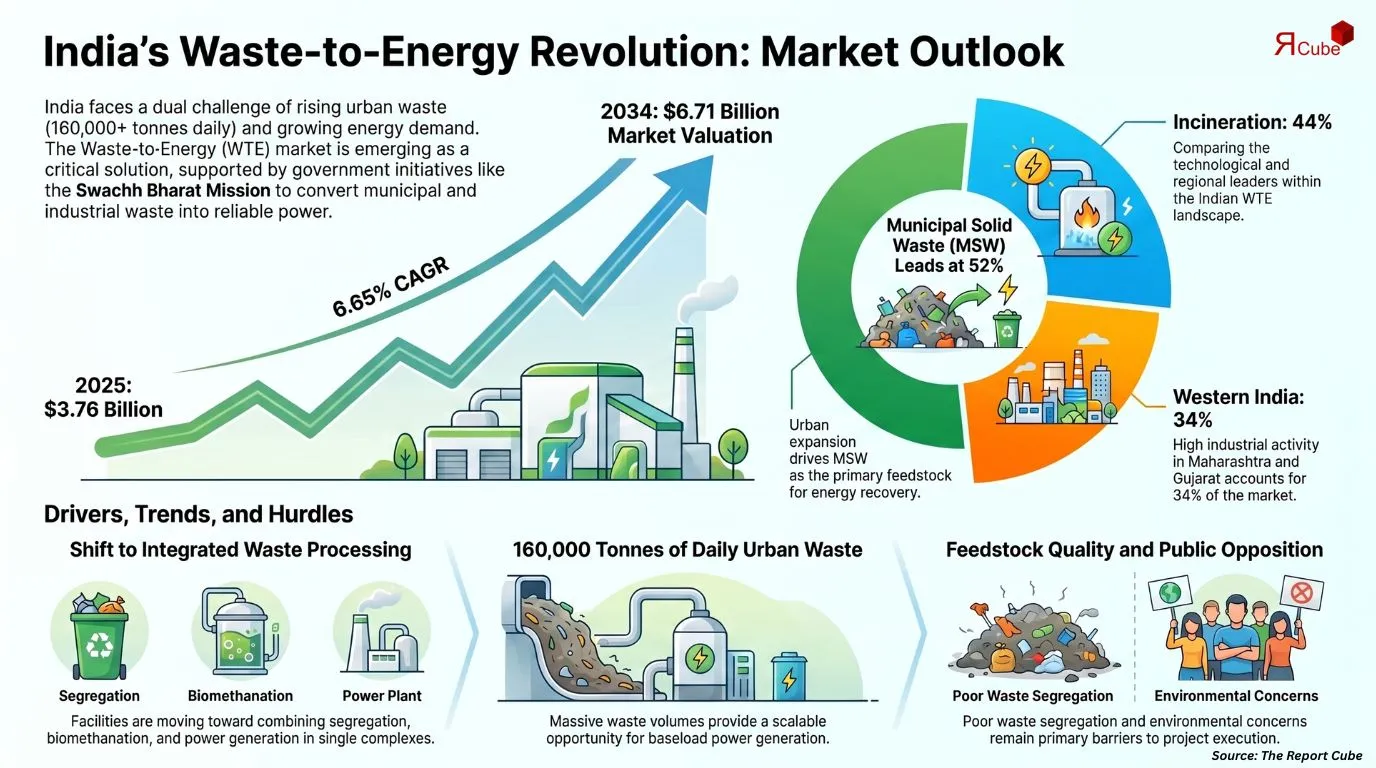
Municipal Solid Waste (MSW) segment leads the market, contributing nearly 52% of total feedstock utilization.
By Technology:
Incineration-based waste-to-energy systems dominate the market, accounting for around 44% of installed capacity across India.
Regional Outlook:
Western India leads the market with approximately 34% share.
Government Initiatives & Policies
- Swachh Bharat Mission (Urban): National program promoting scientific waste processing and energy recovery.
- National Bio-Energy Mission: Policy framework encouraging conversion of waste into renewable energy.
India Waste-to-Energy Market Insights & Analysis
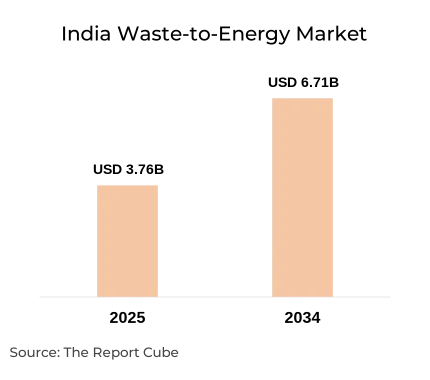
The India Waste-to-Energy Market is anticipated to register a CAGR of 6.65% during 2026-2034. The market size was valued at USD 3.76 billion in 2025 and is projected to reach USD 6.71 billion by 2034. Waste-to-energy has emerged as a strategic solution for India’s dual challenge of rising waste volumes and growing energy demand. With urban India generating over 160,000 tonnes of municipal solid waste daily, energy recovery from waste is gaining strong policy and commercial attention.
Market growth is supported by increasing investments in urban infrastructure and stricter landfill regulations. State governments are actively encouraging private sector participation through public-private partnership models, enabling faster project execution. Technological improvements in incineration efficiency, biomethanation, and refuse-derived fuel processing are improving plant economics. Additionally, waste-to-energy projects support India’s renewable energy targets while reducing dependence on fossil fuels. Financial incentives such as viability gap funding and feed-in tariffs have improved bankability, making the sector attractive for domestic and international investors.
India Waste-to-Energy Market Dynamics
Market Driver: Rapid Growth in Urban Waste Generation and Energy Demand
India’s accelerating urbanization is the primary driver of the waste-to-energy market. Urban population growth has increased municipal solid waste generation by nearly 5% annually over the last decade. Cities such as Delhi, Mumbai, and Bengaluru collectively generate more than 30,000 tonnes of waste per day, placing immense pressure on landfills. Waste-to-energy facilities offer a scalable solution by reducing landfill dependency while generating electricity and heat. Simultaneously, India’s electricity demand continues to rise at over 6% annually, driven by industrialization and electrification initiatives. Waste-to-energy bridges this gap by converting waste streams into reliable baseload power. Government mandates requiring municipalities to process waste scientifically further accelerate adoption. This convergence of waste management urgency and energy security needs firmly anchors market expansion.
Book your FREE 30-minute expert consultation today
Contact UsMarket Trends: Shift Toward Integrated Waste Processing and Advanced Conversion Technologies
The market is witnessing a shift from standalone incineration plants toward integrated waste processing ecosystems. Facilities now combine segregation, refuse-derived fuel production, biomethanation, and power generation within single complexes. Thermochemical technologies such as gasification and pyrolysis are gaining traction for handling high-calorific industrial and plastic waste. These systems improve energy efficiency and reduce emissions by up to 25% compared to conventional incineration. Digital monitoring and automation are also being adopted to enhance operational reliability. States are increasingly favoring decentralized waste-to-energy plants near waste generation points to reduce transportation costs. This integrated and technology-driven approach is improving long-term sustainability and operational viability.
Market Challenge: Feedstock Quality, Project Execution Delays, and Public Opposition
One of the biggest challenges for the India waste-to-energy market is inconsistent feedstock quality. Poor waste segregation at source leads to high moisture content and contamination, reducing plant efficiency. Many projects experience delays due to land acquisition issues, financing constraints, and regulatory approvals. Public resistance related to environmental concerns and emissions has also slowed project implementation in several urban areas. Operational challenges such as plant downtime and maintenance costs further impact profitability. Addressing these issues requires stronger municipal coordination, improved segregation infrastructure, and transparent environmental monitoring to build public trust.
Market Opportunity: Strong Policy Push and Expansion of Bioenergy and Circular Economy Models
India’s transition toward a circular economy presents a major opportunity for the waste-to-energy market. Policies promoting bioenergy, renewable gas, and alternative fuels are expanding the addressable market beyond electricity generation. Compressed biogas plants using agricultural and organic waste are gaining momentum, particularly in rural and semi-urban regions. Industrial waste-to-energy projects are also increasing as industries seek cost-effective waste disposal and captive power generation. Carbon credit mechanisms and green financing instruments further enhance project viability. As waste-to-energy aligns closely with sustainability goals, long-term growth opportunities remain strong.
India Waste-to-Energy Market Segment-wise Analysis
By Waste Type:
- Municipal Solid Waste (MSW)
- Industrial Waste
- Commercial Waste
- Agricultural Waste
- Others
Municipal solid waste dominates the India waste-to-energy market with approximately 52% share in 2025. Rapid urban expansion and rising consumption patterns continue to increase MSW volumes. Urban local bodies prefer waste-to-energy solutions to reduce landfill overflow and manage waste sustainably. MSW-based plants benefit from consistent waste availability and government support. Improvements in segregation practices are gradually enhancing feedstock quality, strengthening this segment’s long-term outlook.
By Technology:
- Incineration
- Thermochemical
- Biochemical
- Physical Processes
- Mechanical Processes
- Others
Incineration remains the leading technology, accounting for nearly 44% of operational capacity. Its ability to handle large volumes of mixed waste makes it suitable for densely populated cities. Modern incineration plants achieve higher energy recovery and lower emissions through advanced flue gas treatment systems. However, thermochemical and biochemical technologies are gaining ground, especially for segregated waste streams and renewable gas production.
Regional Projection of India Waste-to-Energy Industry
- West India
- South India
- North India
- East India
- Central India
- North-East
Western India leads the waste-to-energy market with around 34% share, driven by higher urbanization and industrial activity in states such as Maharashtra and Gujarat. Strong municipal initiatives and private sector participation support regional dominance. Southern India follows closely, supported by proactive state policies and early adoption of biomethanation projects. Northern India shows strong growth potential due to rising waste volumes in metropolitan regions. Eastern and North-Eastern regions are gradually adopting waste-to-energy solutions as infrastructure improves.
India Waste-to-Energy Market Recent Developments
- 2025: JITF advanced operations at its Jaipur municipal waste-to-power facility (about 12 MW, ~1,000 TPD), secured under a long-term, regulated power purchase agreement with Jaipur Vidyut Vitran Nigam, supporting its footprint in city-level waste-to-energy projects.
- 2025: Abellon CleanEnergy expanded its presence in India’s waste and bioenergy sector by participating in state and municipal tenders for solid waste treatment and RDF/biomass-based power generation, strengthening its role as a private infrastructure developer.
- 2025: A2Z Group continued active participation in India’s waste-to-energy and integrated waste management space, operating municipal processing and RDF-based power assets through public–private partnerships and targeting new opportunities linked to urban development and Swachh Bharat initiatives.
Need insights for a specific region within this market?
Request Regional DataWhy Choose This Report?
- Provides a comprehensive overview of the overall market analysis, encompassing key trends, consumer behavior analysis, and risk assessment to support strategic decision-making.
- Provides accurate, up-to-date insights into market size, segmentation, and emerging opportunities, helping to minimize risk & capitalizing on growth.
- Gives deep understanding of target audience preferences, investment habits, and communication channels for enhanced product development & marketing effectiveness.
- Delivers competitive analysis & benchmarking, uncovering the strengths & weaknesses of market competitors to guide strategies.
- Consolidate comprehensive market intelligence, reducing reasoning & streamlining research efforts.
- Facilitates customized market segmentation & risk mitigation strategies, fine-tuned to the business objectives.
- Aids in identifying both market challenges & untapped opportunities within the industry to drive long-term business growth.
- Provides valuable information based on actual customer data & search trends.
Table of Contents
- Introduction
- Objective of the Study
- Product and Category Definition
- Market Segmentation
- Study Variables
- Research Methodology
- Secondary Data Points
- Breakdown of Secondary Sources
- Primary Data Points
- Breakdown of Primary Interviews
- Secondary Data Points
- Executive Summary
- Market Dynamics
- Drivers
- Challenges
- Opportunity Assessment
- Recent Trends and Developments
- Regulatory and Policy Landscape
- India Waste-to-Energy Market Overview (2021-2034)
- Market Size, By Value (USD Billion)
- Market Share, By Waste Type
- Municipal Solid Waste
- Industrial Waste
- Agricultural Waste
- Biomedical Waste
- Others
- Market Share, By Technology
- Incineration
- Gasification
- Pyrolysis
- Anaerobic Digestion
- Refuse-Derived Fuel
- Others
- Market Share, By Plant Size
- Small Scale (<10 MW)
- Medium Scale (10-50 MW)
- Large Scale (>50 MW)
- Market Share, By Energy Output
- Electricity Generation
- Heat Generation
- Combined Heat and Power
- Biogas
- Refuse-Derived Fuel Output
- Market Share, By Ownership
- Public Sector
- Private Sector
- Public-Private Partnership
- Market Share, By End User
- Utility Companies
- Industrial Users
- Commercial Establishments
- Municipal Corporations
- Others
- Market Share, By Region
- North India
- West India
- South India
- East India
- Central India
- Northeast India
- Market Share, By Company
- Revenue Shares and Analysis
- Competitive Landscape
- North India Waste-to-Energy Market
- Market Size, By Value (USD Billion/Million)
- Market Share, By Waste Type
- Market Share, By Technology
- Market Share, By Plant Size
- Market Share, By Energy Output
- Market Share, By Ownership
- Market Share, By End User
- West India Waste-to-Energy Market
- Market Size, By Value (USD Billion/Million)
- Market Share, By Waste Type
- Market Share, By Technology
- Market Share, By Plant Size
- Market Share, By Energy Output
- Market Share, By Ownership
- Market Share, By End User
- South India Waste-to-Energy Market
- Market Size, By Value (USD Billion/Million)
- Market Share, By Waste Type
- Market Share, By Technology
- Market Share, By Plant Size
- Market Share, By Energy Output
- Market Share, By Ownership
- Market Share, By End User
- East India Waste-to-Energy Market
- Market Size, By Value (USD Billion/Million)
- Market Share, By Waste Type
- Market Share, By Technology
- Market Share, By Plant Size
- Market Share, By Energy Output
- Market Share, By Ownership
- Market Share, By End User
- Central India Waste-to-Energy Market
- Market Size, By Value (USD Billion/Million)
- Market Share, By Waste Type
- Market Share, By Technology
- Market Share, By Plant Size
- Market Share, By Energy Output
- Market Share, By Ownership
- Market Share, By End User
- Northeast India Waste-to-Energy Market
- Market Size, By Value (USD Billion/Million)
- Market Share, By Waste Type
- Market Share, By Technology
- Market Share, By Plant Size
- Market Share, By Energy Output
- Market Share, By Ownership
- Market Share, By End User
- Competitive Outlook and Company Profiles
- Re Sustainability Limited
- Company Overview
- Product Portfolio
- Strategic Alliances/Partnerships
- Recent Developments
- JITF Urban Infrastructure Limited
- Company Overview
- Product Portfolio
- Strategic Alliances/Partnerships
- Recent Developments
- Antony Waste Handling Cell Limited
- Company Overview
- Product Portfolio
- Strategic Alliances/Partnerships
- Recent Developments
- Abellon CleanEnergy Limited
- Company Overview
- Product Portfolio
- Strategic Alliances/Partnerships
- Recent Developments
- A2Z Infra Engineering Limited
- Company Overview
- Product Portfolio
- Strategic Alliances/Partnerships
- Recent Developments
- SAEL Industries
- Company Overview
- Product Portfolio
- Strategic Alliances/Partnerships
- Recent Developments
- Hitachi Zosen India Pvt. Ltd.
- Company Overview
- Product Portfolio
- Strategic Alliances/Partnerships
- Recent Developments
- SUEZ India Private Limited
- Company Overview
- Product Portfolio
- Strategic Alliances/Partnerships
- Recent Developments
- EverEnviro Resource Management
- Company Overview
- Product Portfolio
- Strategic Alliances/Partnerships
- Recent Developments
- Mailhem Environment Pvt. Ltd.
- Company Overview
- Product Portfolio
- Strategic Alliances/Partnerships
- Recent Developments
- Thermax Limited
- Company Overview
- Product Portfolio
- Strategic Alliances/Partnerships
- Recent Developments
- EMS Limited
- Company Overview
- Product Portfolio
- Strategic Alliances/Partnerships
- Recent Developments
- Organic Recycling Systems
- Company Overview
- Product Portfolio
- Strategic Alliances/Partnerships
- Recent Developments
- Veolia India Private Limited
- Company Overview
- Product Portfolio
- Strategic Alliances/Partnerships
- Recent Developments
- Attero Recycling
- Company Overview
- Product Portfolio
- Strategic Alliances/Partnerships
- Recent Developments
- SELCO International Limited
- Company Overview
- Product Portfolio
- Strategic Alliances/Partnerships
- Recent Developments
- Synergy Waste Management (P) Ltd
- Company Overview
- Product Portfolio
- Strategic Alliances/Partnerships
- Recent Developments
- Z-Tech (India) Limited
- Company Overview
- Product Portfolio
- Strategic Alliances/Partnerships
- Recent Developments
- Namo eWaste Management Limited
- Company Overview
- Product Portfolio
- Strategic Alliances/Partnerships
- Recent Developments
- VA Tech WABAG Limited
- Company Overview
- Product Portfolio
- Strategic Alliances/Partnerships
- Recent Developments
- NREDCAP
- Institutional Overview
- Role in Renewable Energy Promotion
- Key Programs & Partnerships
- Recent Initiatives
- Others
- Re Sustainability Limited
- Contact Us and Disclaimer
Top Key Players & Market Share Outlook
- Re Sustainability Limited
- JITF Urban Infrastructure Limited
- Antony Waste Handling Cell Limited
- Abellon CleanEnergy Limited
- A2Z Infra Engineering Limited
- SAEL Industries
- Hitachi Zosen India Pvt. Ltd.
- SUEZ India Private Limited
- EverEnviro Resource Management
- Mailhem Environment Pvt. Ltd.
- Thermax Limited
- EMS Limited
- Organic Recycling Systems
- Veolia India Private Limited
- Attero Recycling
- SELCO International Limited
- Synergy Waste Management (P) Ltd
- Z-Tech (India) Limited
- Namo eWaste Management Limited
- VA Tech WABAG Limited
- NREDCAP
- Others
Frequently Asked Questions






