



Build Your Custom Market Intelligence Report
Customize Your ReportGlobal Food Waste Management Market Statistics and Insights
Market Size Statistics
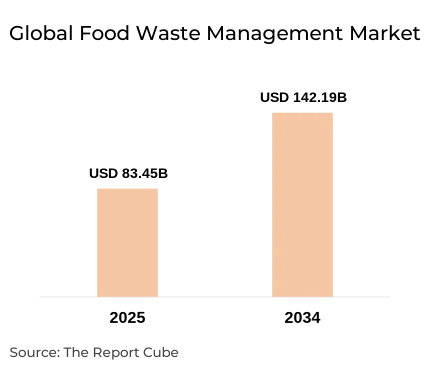
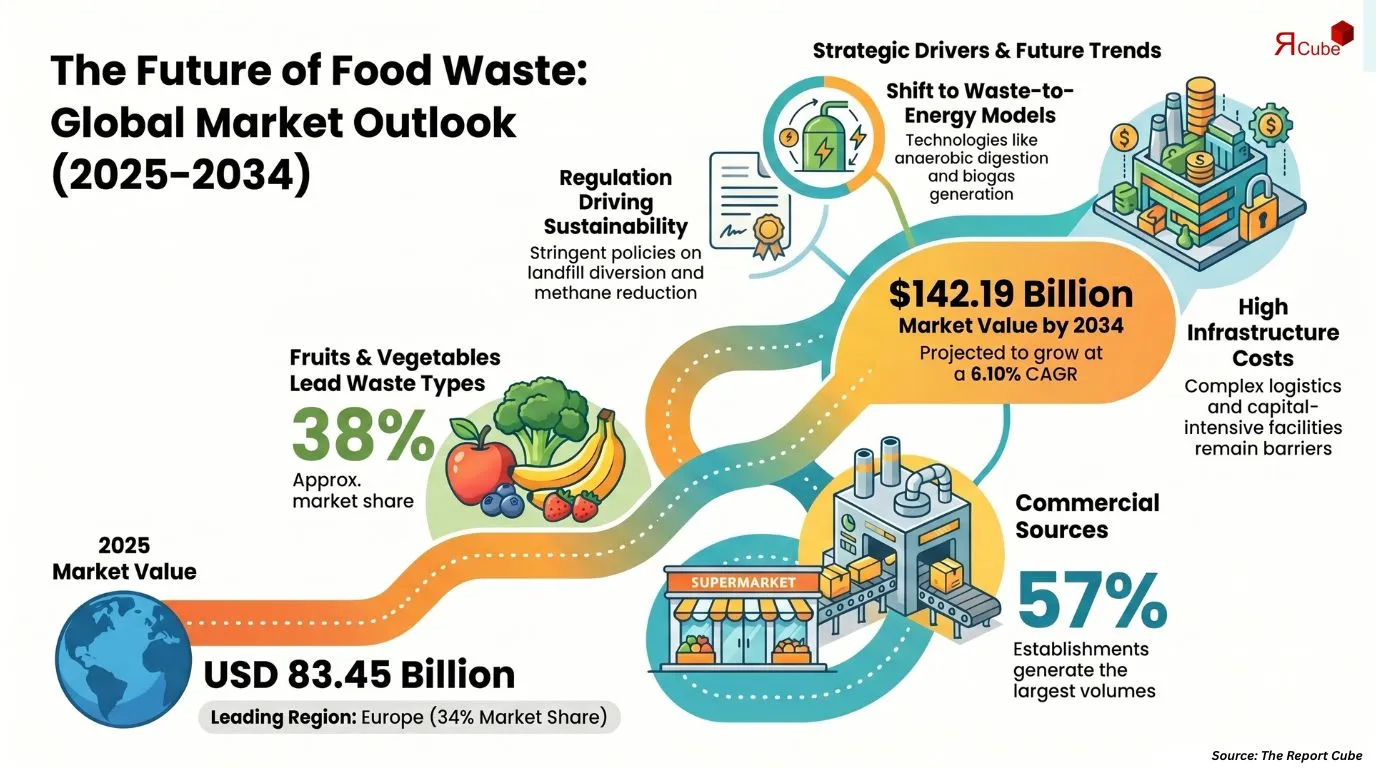
- Global market valued at USD 83.45 billion in 2025
- Global market estimated nearly USD 142.19 billion by 2034
- Market expected to expand registering CAGR of 6.10%
By Waste Type
- Fruits and vegetables waste dominates holding approximately 38% market share
Competition
- More than 10 companies are actively engaged in producing Global Food Waste Management Market
- Top 5 companies acquired around 59% of the market share.
- Veolia, Suez, Waste Management Inc., Republic Services Inc., Covanta Ltd., and others
By Source
- Commercial sources lead holding nearly 57% market share
Global Food Waste Management Market Insights and Analysis
The Global Food Waste Management Market is anticipated to register a 6.10% during 2026-2034. The market size was valued at USD 83.45 billion in 2025 and is projected to reach USD 142.19 billion by 2034. The market is witnessing sustained growth driven by increasing global food consumption, rapid urbanization, and rising awareness regarding environmental sustainability. Large volumes of food waste generated across households, food processing units, retail outlets, and hospitality sectors are accelerating the need for efficient waste management solutions.
According to global sustainability estimates, nearly one-third of all food produced is wasted annually, prompting governments and organizations to implement waste reduction and recycling initiatives. Expansion of composting facilities, anaerobic digestion plants, and waste-to-energy projects is strengthening market growth. Regulatory mandates aimed at reducing landfill waste, lowering greenhouse gas emissions, and promoting circular economy practices are further supporting adoption. Additionally, technological advancements in waste segregation, collection, and treatment are improving operational efficiency. Growing investments by municipalities and private players in sustainable waste infrastructure continue to reinforce Global Food Waste Management Market Growth across developed and emerging economies.
Global Food Waste Management Market Dynamics
Key Market Driver: Rising environmental regulations and sustainability initiatives
Governments worldwide are enforcing stringent regulations to reduce food waste disposal in landfills and lower methane emissions. Policies promoting organic waste segregation, composting, and renewable energy generation from food waste are accelerating adoption of structured waste management systems. Corporate sustainability commitments and zero-waste targets across food service and retail sectors are further strengthening demand. Increased public awareness regarding food waste reduction and environmental responsibility continues to drive investments in advanced food waste management solutions globally.
Major Industry Challenge: High operational costs and infrastructure requirements
Food waste management involves complex logistics, including collection, segregation, transportation, and treatment. Establishing composting plants, anaerobic digesters, and waste-to-energy facilities requires significant capital investment and skilled operational management. Inadequate waste segregation at source and contamination issues reduce processing efficiency. Developing economies face challenges related to limited infrastructure, funding constraints, and inconsistent regulatory enforcement, which can slow market penetration despite growing waste volumes.
Emerging Trend Shaping Outlook: Shift toward waste-to-energy and circular economy models
The market is increasingly shifting toward waste-to-energy technologies and circular economy frameworks. Anaerobic digestion and biogas generation from food waste are gaining traction due to their ability to produce renewable energy and nutrient-rich byproducts. Integration of digital waste tracking, smart collection systems, and data analytics is improving efficiency and compliance. These innovations are shaping Global Food Waste Management Market Trends and supporting long-term sustainability goals.
Need Specific Data, Let’s Customize the Report for You
Contact UsGlobal Food Waste Management Market Segment-wise Analysis
The market is segmented by waste type and source, reflecting diverse waste generation patterns and management requirements.
By Waste Type
- Cereals
- Dairy and Dairy Products
- Fruits and Vegetables
- Meat and Poultry
- Fish and Seafood
- Oilseeds and Pulses
- Roots and Tubers
- Others
Fruits and vegetables waste represents the leading segment, accounting for approximately 38% market share. High perishability, seasonal production, and extensive supply chain handling contribute to significant waste generation. This segment is widely processed through composting and anaerobic digestion due to its high organic content. Other waste types such as meat, dairy, and seafood require specialized handling due to contamination and hygiene considerations.
By Source
- Residential
- Commercial
Commercial sources dominate the market, contributing nearly 57% market share. Food service establishments, supermarkets, food processing plants, and hospitality businesses generate large volumes of food waste consistently. Regulatory requirements and corporate sustainability programs drive structured waste management adoption across commercial entities. Residential food waste management is also expanding steadily with the introduction of municipal collection programs and public awareness initiatives.
Regional Projection of Global Food Waste Management Market
- North America
- Europe
- Asia Pacific
- Latin America
- Middle East and Africa
Europe leads the global market with approximately 34% market share. Strong regulatory frameworks, landfill diversion targets, and advanced waste treatment infrastructure support regional dominance. Countries across the region have implemented mandatory organic waste separation and invested heavily in composting and biogas facilities. Asia Pacific is witnessing rapid growth driven by urbanization, rising food consumption, and expanding municipal waste management programs.
Global Food Waste Management Market: Recent Develpoment
- Veolia: Expanded anaerobic digestion facilities for food waste in Europe and Asia, achieving 20% higher biogas yields through 2025 tech upgrades.
- Suez: Post-merger with Veolia, integrated food waste streams into joint composting operations, focusing on municipal contracts.
- Waste Management, Inc.: Launched nationwide food waste-to-RNG (renewable natural gas) programs in the US, diverting 500K+ tons annually by late 2025.
- Republic Services, Inc.: Invested $150M in new AD plants for commercial food waste, boosting fertilizer production.
- Covanta Ltd.: Shifted toward hybrid waste-to-energy systems incorporating food organics, with pilot projects in North America.
- Stericycle, Inc.: Enhanced biohazard-compliant food waste services for processing plants, securing major hospitality deals.
- Remondis SE & Co., KG: Rolled out AI-optimized collection routes in Germany, reducing food waste transport emissions by 15%.
Global Food Waste Management Market Future Outlook (2034)
The market is expected to grow at a 6.10% CAGR, reaching USD 142.19 billion by 2034. Growth will be driven by stricter environmental regulations, expansion of waste-to-energy infrastructure, and increasing corporate sustainability commitments. Technological advancements in waste segregation, processing, and energy recovery will enhance operational efficiency. Rising urban populations and food service industry expansion in emerging economies will further increase waste volumes. Long-term market expansion will be reinforced by circular economy adoption, renewable energy integration, and continued public-private investments, ensuring a positive Global Food Waste Management Market Outlook.
Why Choose This Report?
- Provides a comprehensive overview of the overall market analysis, encompassing key trends, consumer behavior analysis, and risk assessment to support strategic decision-making.
- Provides accurate, up-to-date insights into market size, segmentation, and emerging opportunities, helping to minimize risk & capitalizing on growth.
- Gives deep understanding of target audience preferences, investment habits, and communication channels for enhanced product development & marketing effectiveness.
- Delivers competitive analysis & benchmarking, uncovering the strengths & weaknesses of market competitors to guide strategies.
- Consolidate comprehensive market intelligence, reducing reasoning & streamlining research efforts.
- Facilitates customized market segmentation & risk mitigation strategies, fine-tuned to the business objectives.
- Aids in identifying both market challenges & untapped opportunities within the industry to drive long-term business growth.
- Provides valuable information based on actual customer data & search trends.
Table of Contents
- Introduction
- Objective of the study
- Product Definition
- Market Segmentation
- Study Variables
- Research Methodology
- Secondary Data Points
- Companies Interviewed
- Primary Data Points
- Breakdown of Primary Interviews
- Secondary Data Points
- Executive Summary
- Market Dynamics
- Drivers
- Challenges
- Opportunity Assessment
- Recent Trends and Developments
- Policy and Regulatory Landscape
- Global Food Waste Management Market Overview (2021-2034)
- Market Size, By Value (in USD Billion)
- Market Share, By Waste Type
- Cereals
- Dairy & Dairy Products
- Fruits & Vegetables
- Meat & Poultry
- Fish & Seafood
- Oilseeds & Pulses
- Roots & Tubers
- Others
- Market Share, By Source
- Residential
- Commercial
- Market Share, By Service Type
- Collection
- Transportation
- Disposal/Recycling
- Others
- Market Share, By Processes
- Aerobic Digestion
- Anaerobic Digestion
- Combustion
- Others
- Market Share, By Region
- North America
- Europe
- Asia Pacific
- Latin America
- Middle East and Africa
- Market Share, By Company
- Revenue Shares
- Competition Characteristics
- North America Food Waste Management Market Overview (2021-2034)
- Market Size, By Value (in USD Million/Billion)
- Market Share, By Waste Type
- Market Share, By Source
- Market Share, By Service Type
- Market Share, By Processes
- By Country
- The US
- Canada
- Mexico
- The US Food Waste Management Market Overview (2021-2034)
- Market Share, By Waste Type
- Market Share, By Source
- Market Share, By Service Type
- Market Share, By Processes
- Canada Food Waste Management Market Overview (2021-2034)
- Market Share, By Waste Type
- Market Share, By Source
- Market Share, By Service Type
- Market Share, By Processes
- Mexico Food Waste Management Market Overview (2021-2034)
- Market Share, By Waste Type
- Market Share, By Source
- Market Share, By Service Type
- Market Share, By Processes
- South America Food Waste Management Market Overview (2021-2034)
- Market Size, By Value (in USD Million/Billion)
- Market Share, By Waste Type
- Market Share, By Source
- Market Share, By Service Type
- Market Share, By Processes
- By Country
- Brazil
- Argentina
- Rest of South America
- Brazil Food Waste Management Market Overview (2021-2034)
- Market Share, By Waste Type
- Market Share, By Source
- Market Share, By Service Type
- Market Share, By Processes
- Argentina Food Waste Management Market Overview (2021-2034)
- Market Share, By Waste Type
- Market Share, By Source
- Market Share, By Service Type
- Market Share, By Processes
- Europe Food Waste Management Market Overview (2021-2034)
- Market Size, By Value (in USD Million/Billion)
- By Waste Type
- By Source
- By Service Type
- By Processes
- By Country
- Germany
- The UK
- France
- Spain
- Italy
- Rest of Europe
- Germany Food Waste Management Market Overview (2021-2034)
- Market Share, By Waste Type
- Market Share, By Source
- Market Share, By Service Type
- Market Share, By Processes
- France Food Waste Management Market Overview (2021-2034)
- Market Share, By Waste Type
- Market Share, By Source
- Market Share, By Service Type
- Market Share, By Processes
- The UK Food Waste Management Market Overview (2021-2034)
- Market Share, By Waste Type
- Market Share, By Source
- Market Share, By Service Type
- Market Share, By Processes
- Spain Food Waste Management Market Overview (2021-2034)
- Market Share, By Waste Type
- Market Share, By Source
- Market Share, By Service Type
- Market Share, By Processes
- Italy Food Waste Management Market Overview (2021-2034)
- Market Share, By Waste Type
- Market Share, By Source
- Market Share, By Service Type
- Market Share, By Processes
- The Middle East & Africa Food Waste Management Market Overview (2021-2034)
- Market Size, By Value (in USD Million/Billion)
- By Waste Type
- By Source
- By Service Type
- By Processes
- By Country
- The UAE
- Saudi Arabia
- South Africa
- Rest of the Middle East & Africa
- The UAE Food Waste Management Market Overview (2021-2034)
- Market Share, By Waste Type
- Market Share, By Source
- Market Share, By Service Type
- Market Share, By Processes
- Saudi Arabia Food Waste Management Market Overview (2021-2034)
- Market Share, By Waste Type
- Market Share, By Source
- Market Share, By Service Type
- Market Share, By Processes
- South Africa Food Waste Management Market Overview (2021-2034)
- Market Share, By Waste Type
- Market Share, By Source
- Market Share, By Service Type
- Market Share, By Processes
- Asia-Pacific Food Waste Management Market Overview (2021-2034)
- Market Size, By Value (in USD Million/Billion)
- By Waste Type
- By Source
- By Service Type
- By Processes
- By Country
- China
- India
- Japan
- South Korea
- Australia
- Rest of Asia-Pacific
- China Food Waste Management Market Overview (2021-2034)
- Market Share, By Waste Type
- Market Share, By Source
- Market Share, By Service Type
- Market Share, By Processes
- India Food Waste Management Market Overview (2021-2034)
- Market Share, By Waste Type
- Market Share, By Source
- Market Share, By Service Type
- Market Share, By Processes
- Japan Food Waste Management Market Overview (2021-2034)
- Market Share, By Waste Type
- Market Share, By Source
- Market Share, By Service Type
- Market Share, By Processes
- South Korea Food Waste Management Market Overview (2021-2034)
- Market Share, By Waste Type
- Market Share, By Source
- Market Share, By Service Type
- Market Share, By Processes
- Austraila Food Waste Management Market Overview (2021-2034)
- Market Share, By Waste Type
- Market Share, By Source
- Market Share, By Service Type
- Market Share, By Processes
- Competitive Outlook (Company Profile - Partial List)
- Veolia
- Company Overview
- Business Segments
- Strategic Alliances/Partnerships
- Recent Developments
- Suez
- Company Overview
- Business Segments
- Strategic Alliances/Partnerships
- Recent Developments
- Waste Management, Inc.
- Company Overview
- Business Segments
- Strategic Alliances/Partnerships
- Recent Developments
- Republic Services, Inc.
- Company Overview
- Business Segments
- Strategic Alliances/Partnerships
- Recent Developments
- Covanta Ltd.
- Company Overview
- Business Segments
- Strategic Alliances/Partnerships
- Recent Developments
- Stericycle, Inc.
- Company Overview
- Business Segments
- Strategic Alliances/Partnerships
- Recent Developments
- Remondis SE & Co., KG
- Company Overview
- Business Segments
- Strategic Alliances/Partnerships
- Recent Developments
- Clean Harbors, Inc.
- Company Overview
- Business Segments
- Strategic Alliances/Partnerships
- Recent Developments
- Biffa
- Company Overview
- Business Segments
- Strategic Alliances/Partnerships
- Recent Developments
- Rumpke
- Company Overview
- Business Segments
- Strategic Alliances/Partnerships
- Recent Developments
- Advanced Disposal Services, Inc.
- Company Overview
- Business Segments
- Strategic Alliances/Partnerships
- Recent Developments
- Cleanaway
- Company Overview
- Business Segments
- Strategic Alliances/Partnerships
- Recent Developments
- FCC Recycling (UK) Limited
- Company Overview
- Business Segments
- Strategic Alliances/Partnerships
- Recent Developments
- DS Smith
- Company Overview
- Business Segments
- Strategic Alliances/Partnerships
- Recent Developments
- Others
- Veolia
- Disclaimer
Top Key Players & Market Share Outlook
- Veolia
- Suez
- Waste Management, Inc.
- Republic Services, Inc.
- Covanta Ltd.
- Stericycle, Inc.
- Remondis SE & Co., KG
- Clean Harbors, Inc.
- Biffa
- Rumpke
- Advanced Disposal Services, Inc.
- Cleanaway
- FCC Recycling (UK) Limited
- DS Smith
- Others
Frequently Asked Questions






